
Specialist vehicle
master guide
Specialist vehicle body types and equipment
Choose from the pictures, or use the guide menu to go straight to a vehicle, handling method or booking question.
Choose a picture to jump to its guide
MOFFETT rigid
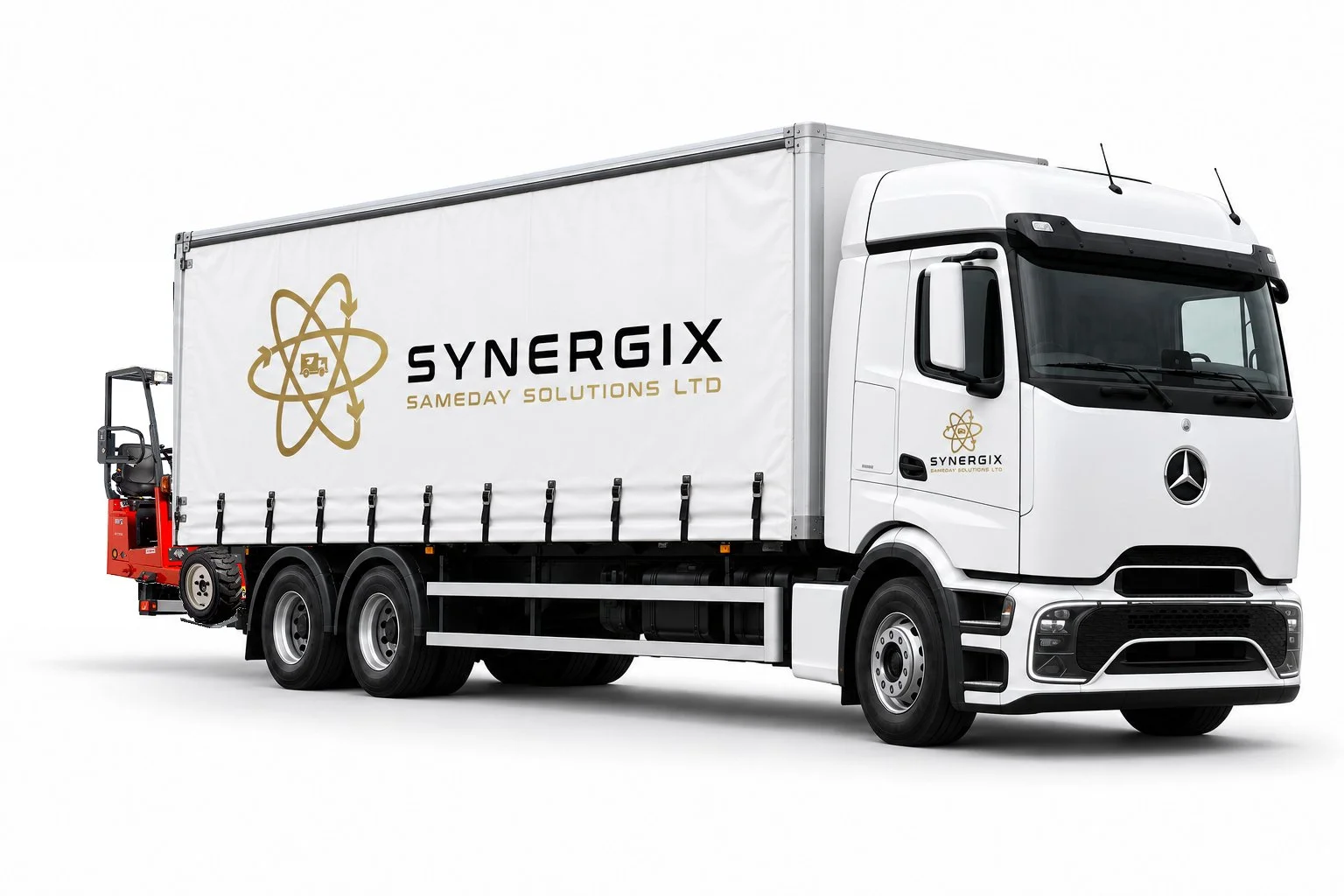
Truck-mounted forklift delivery. Check pallet weight, load centre and the route across the site.
HIAB crane lorry
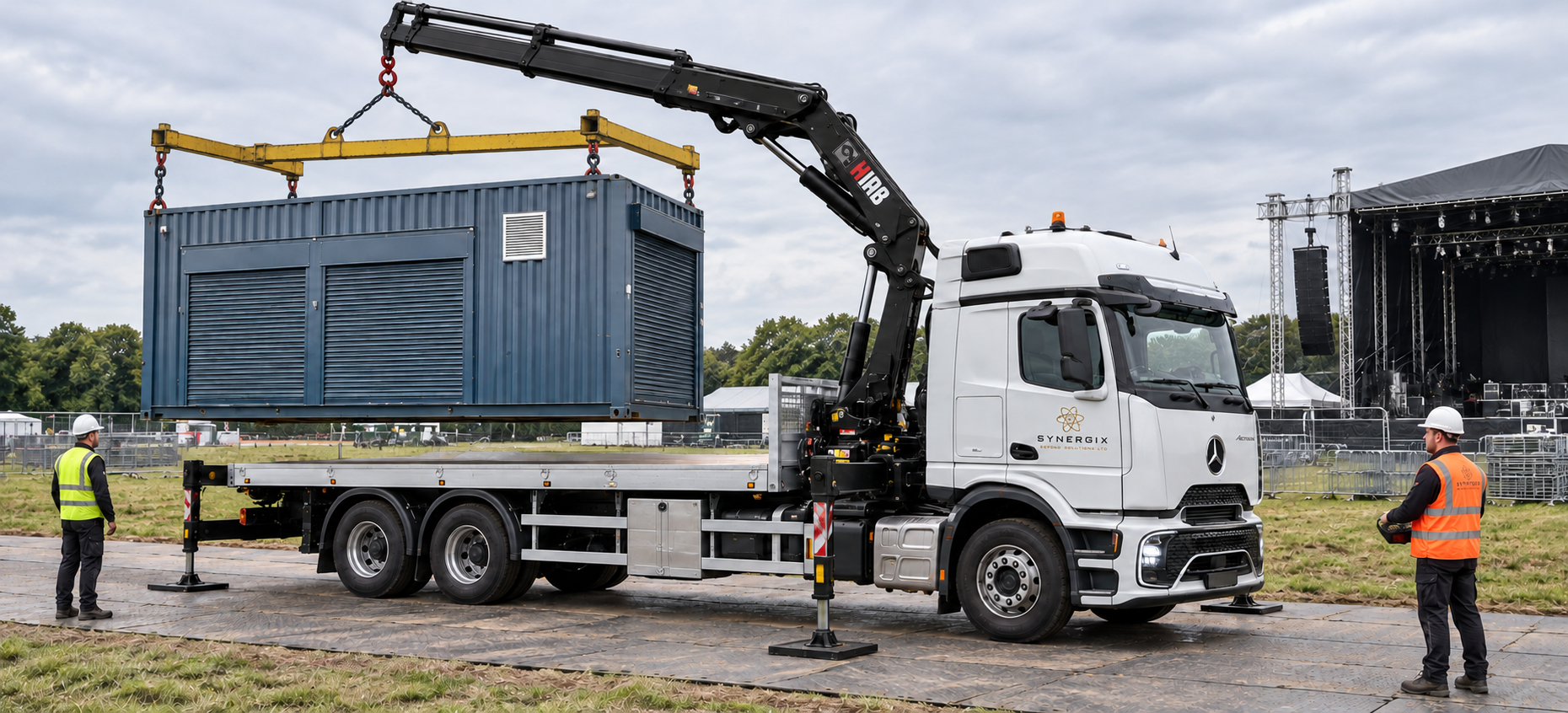
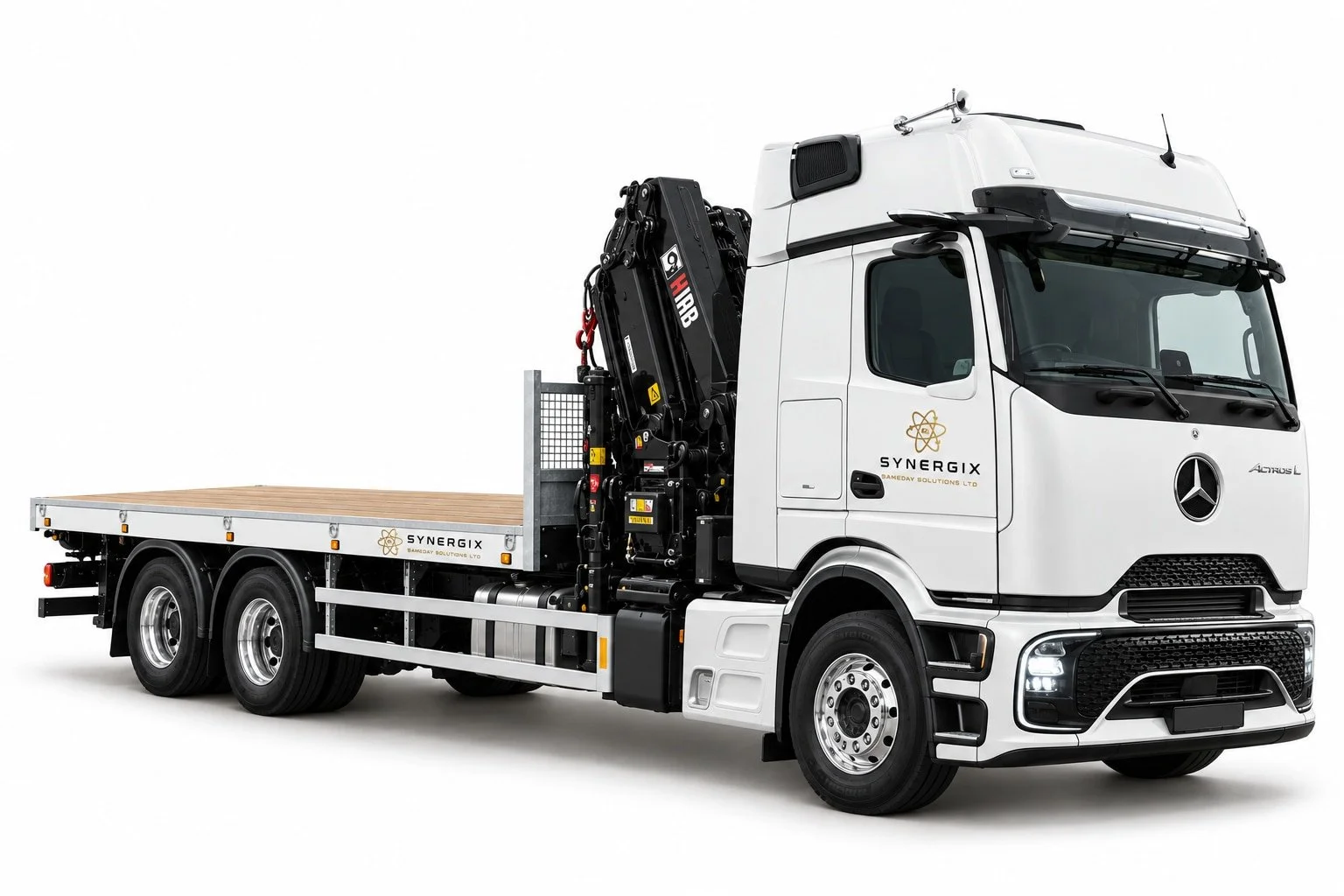
A loader crane for assessed lifts. Actual reach, lift chart, stabilisers and ground decide suitability.
Wagon and drag
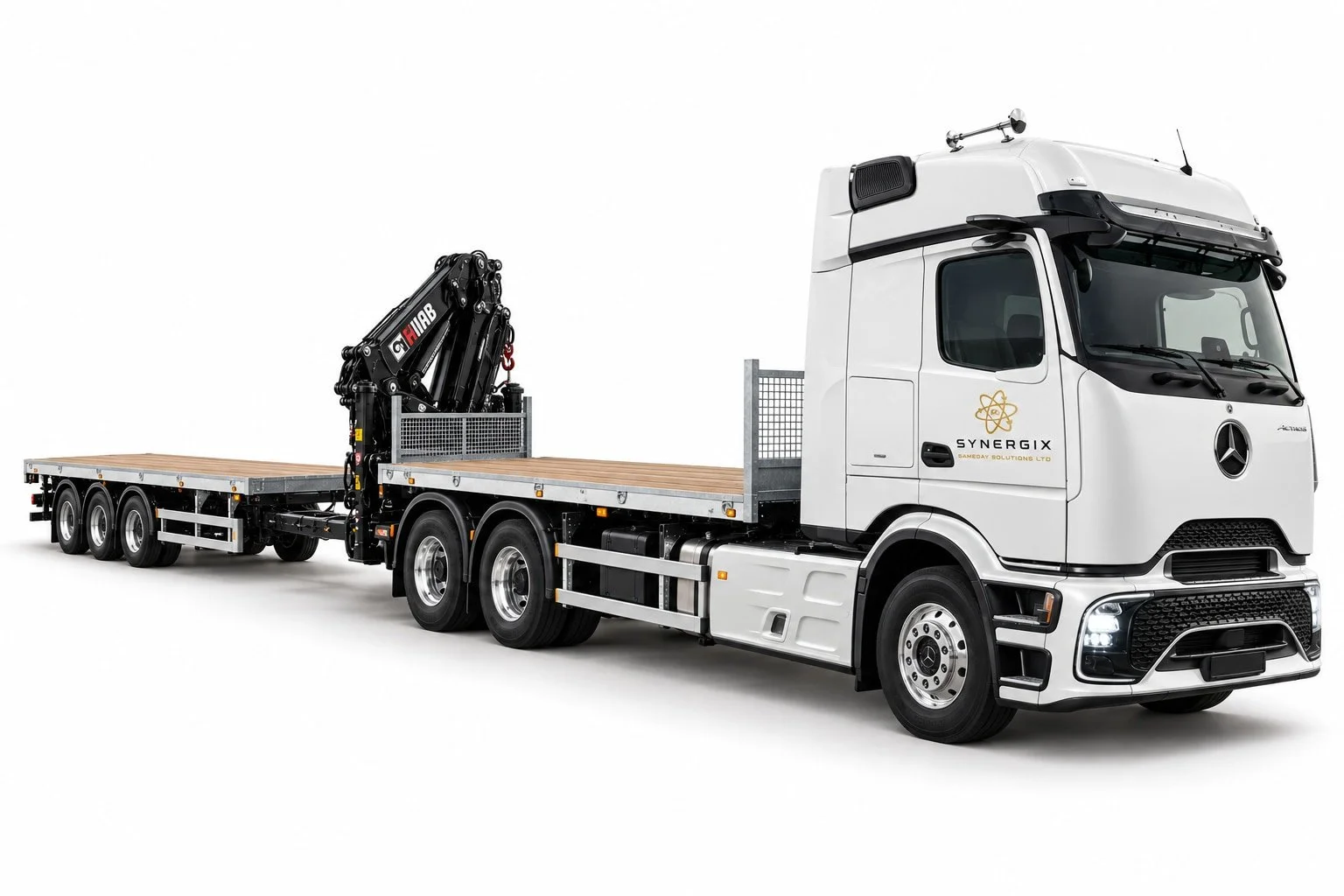
A rigid and drawbar trailer with separate decks. Check both platforms, access and unloading sequence.
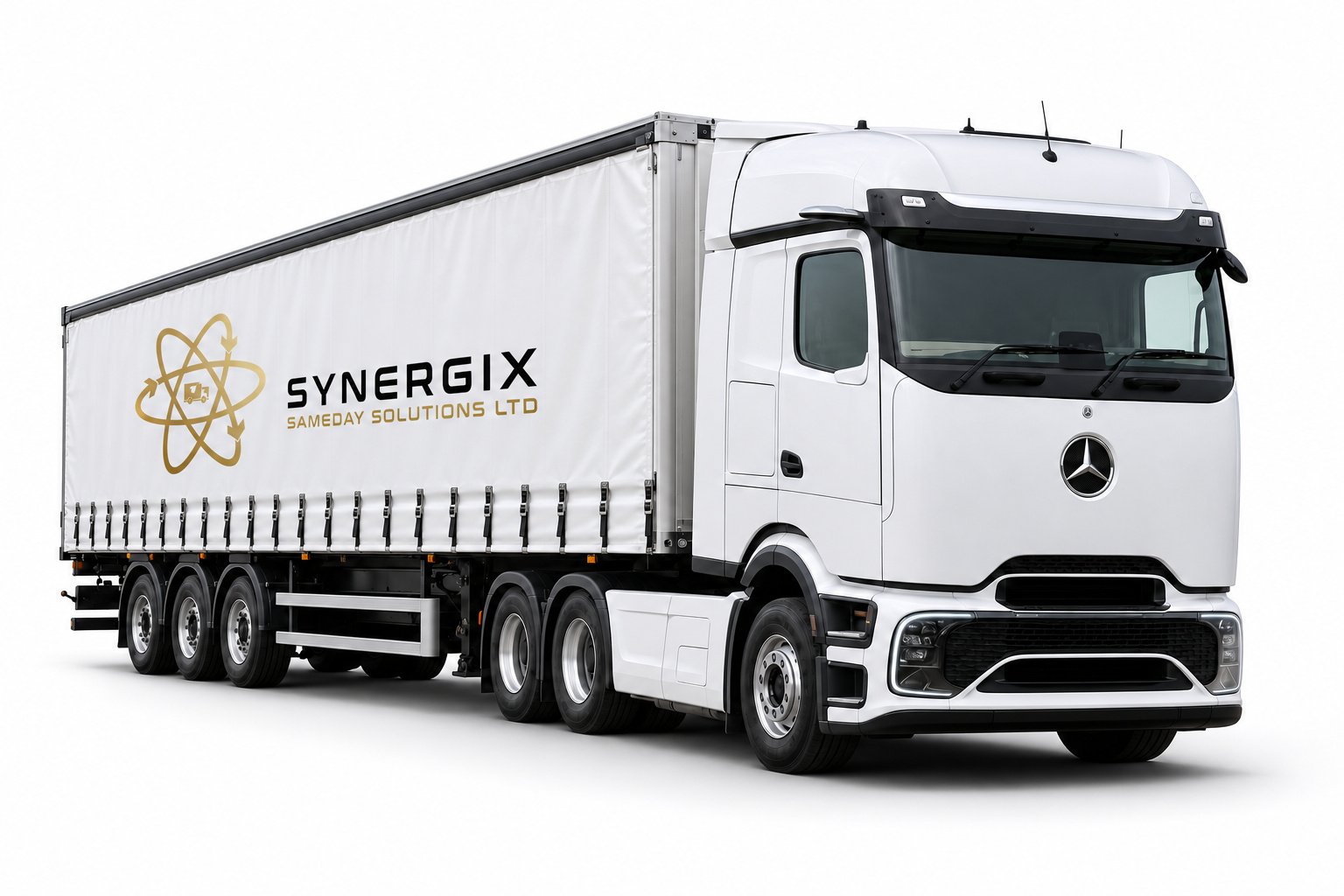
Curtainsider
Side loading for pallets, long goods and general haulage. Check clear apertures and effective restraint.
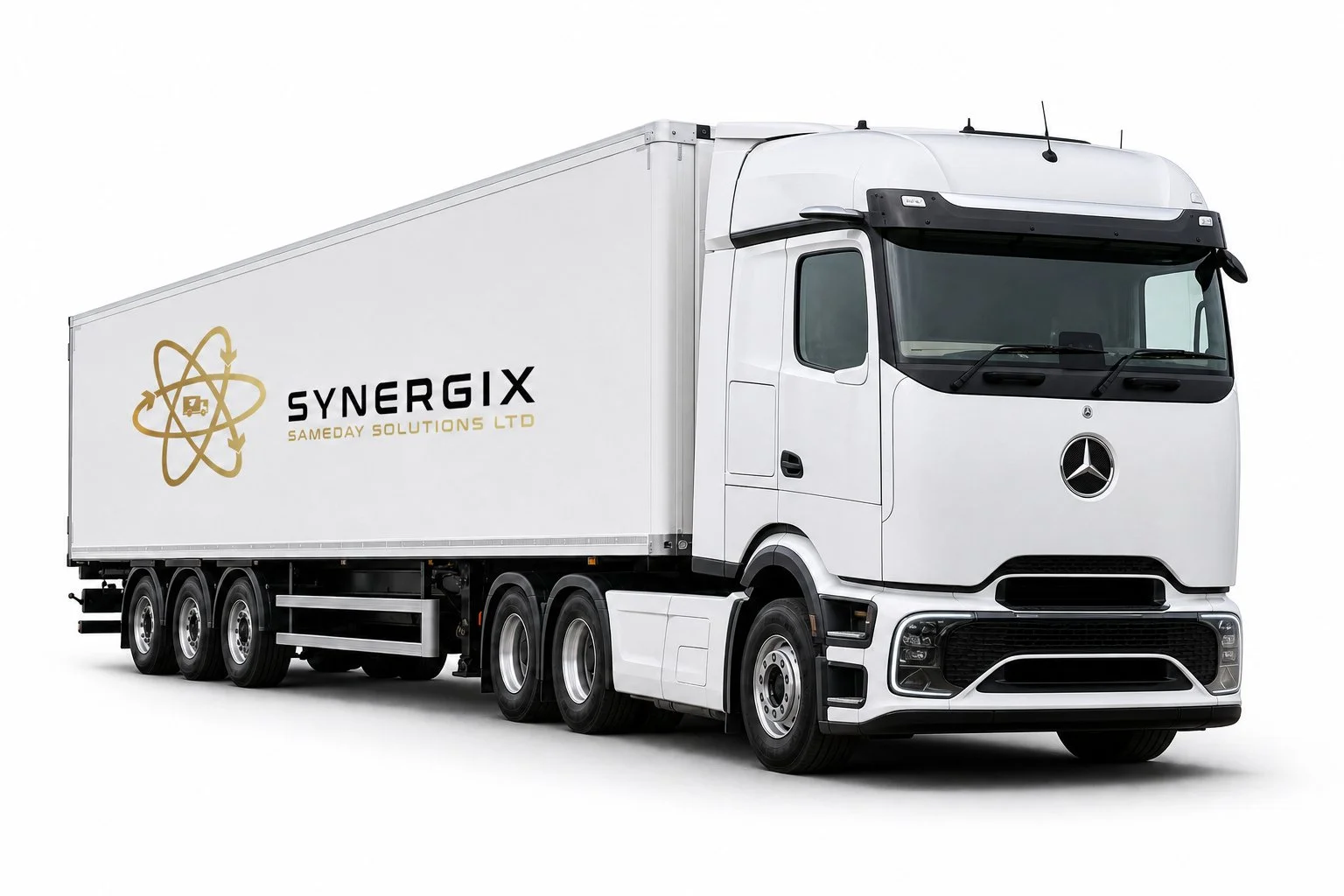
Box trailer
Enclosed general freight, retail stock and dock deliveries. Confirm rear access and any lift.
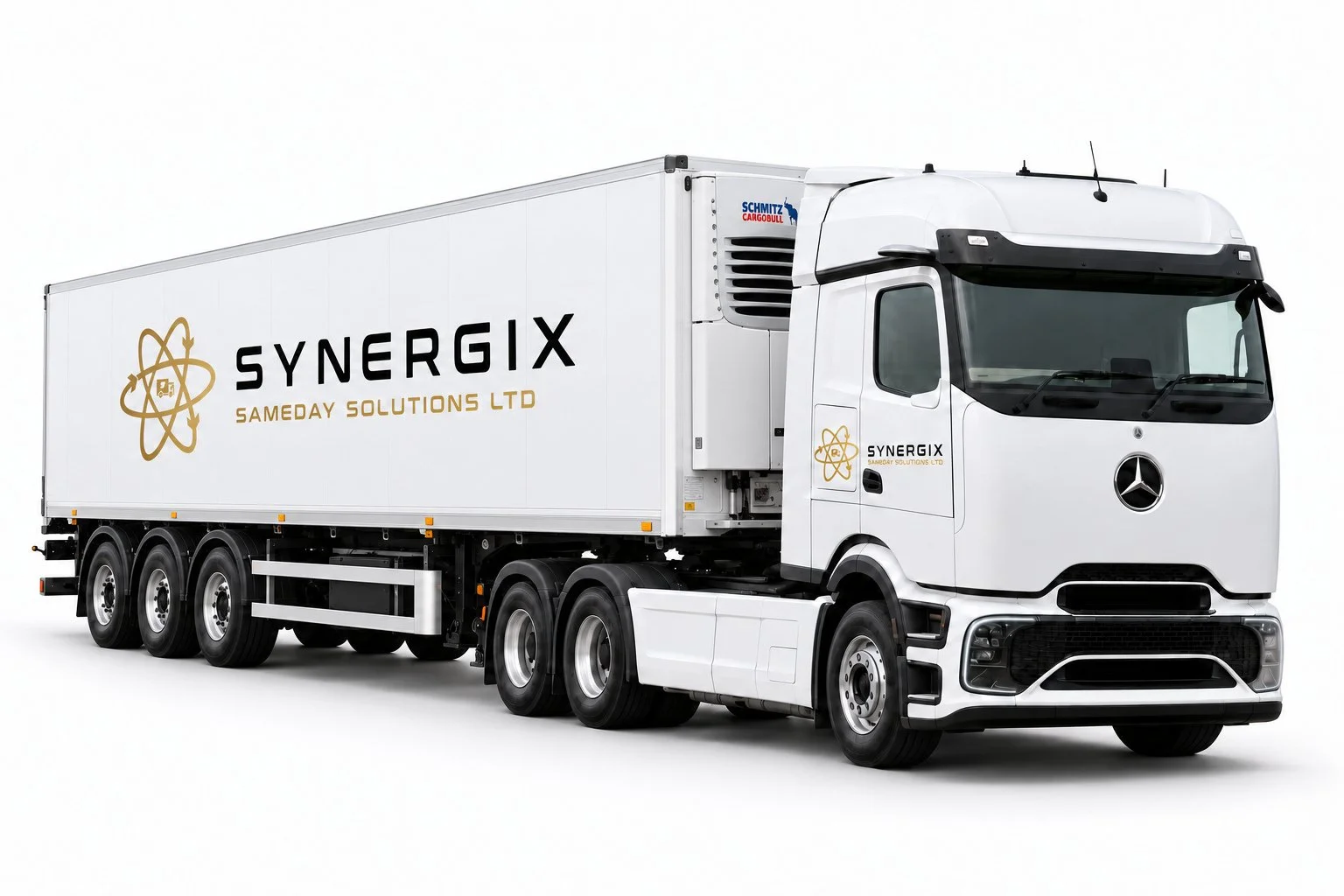
Refrigerated trailer
Agreed chilled, frozen or controlled-temperature transport. Check payload, airflow and the temperature duty.
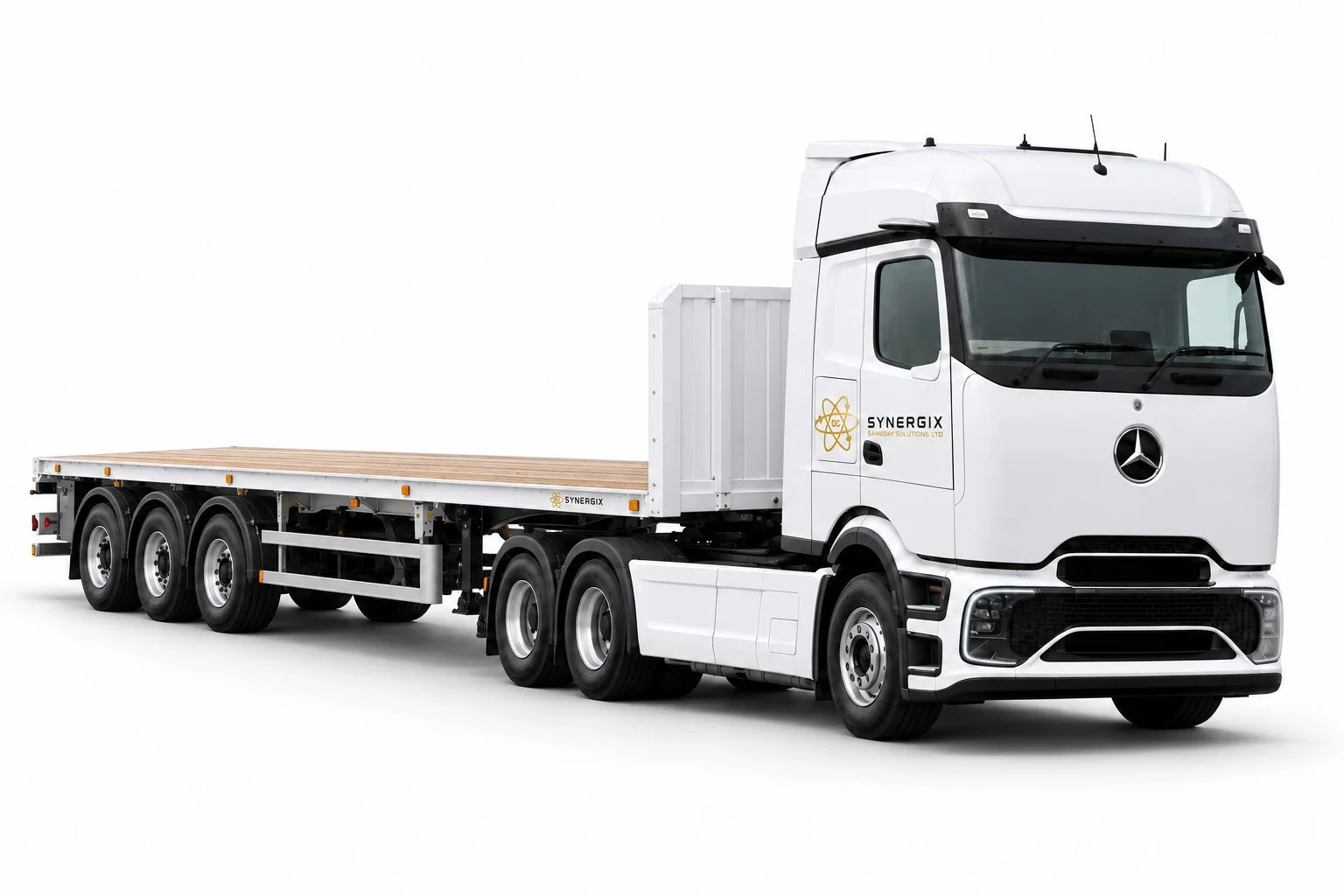
Flatbed
Open-deck freight needing side or overhead access. Agree supports, weather protection and unloading.
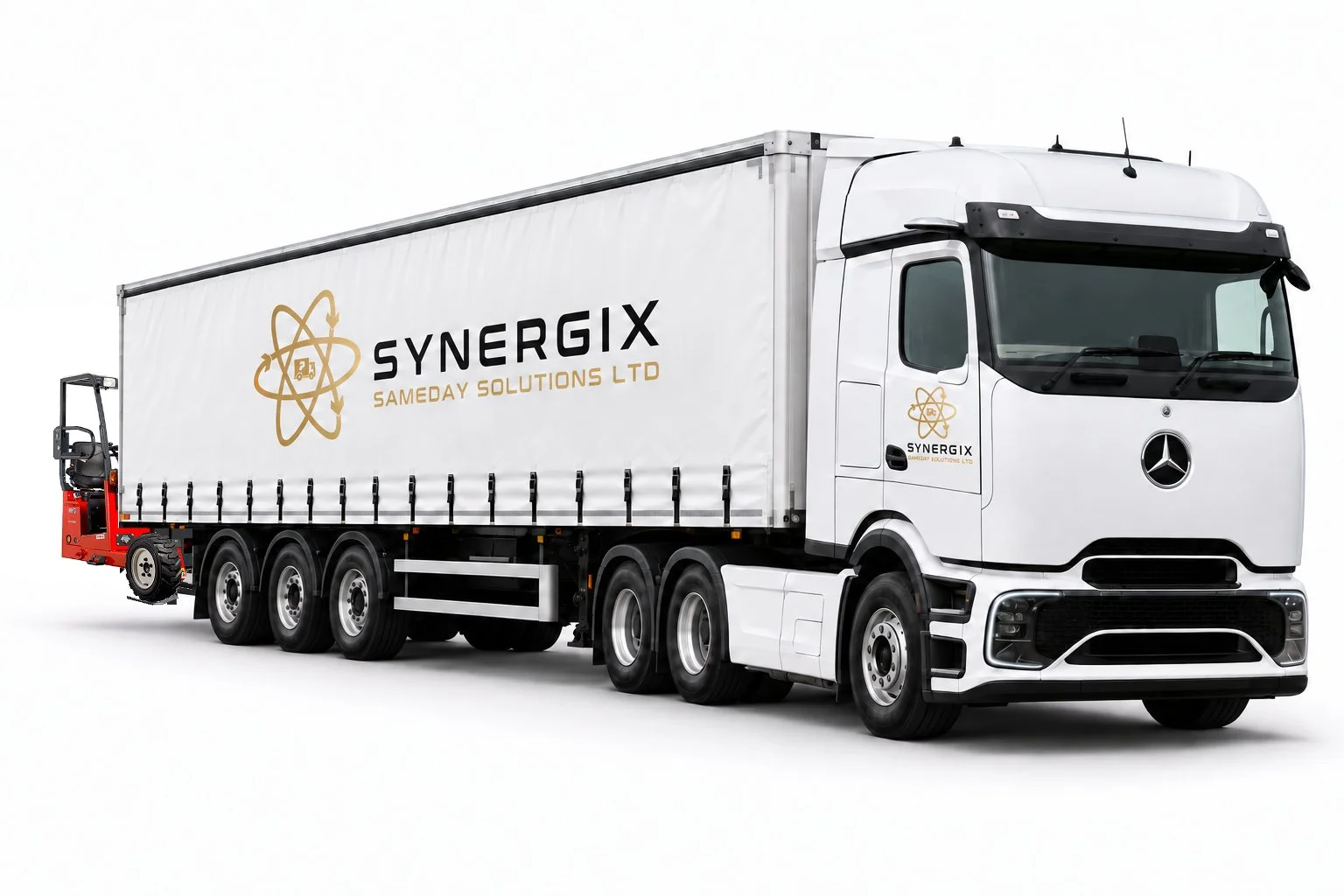
Curtainsider with Moffett
Weather-protected pallets with a carried forklift. Payload, rear mounting and ground route need checking.
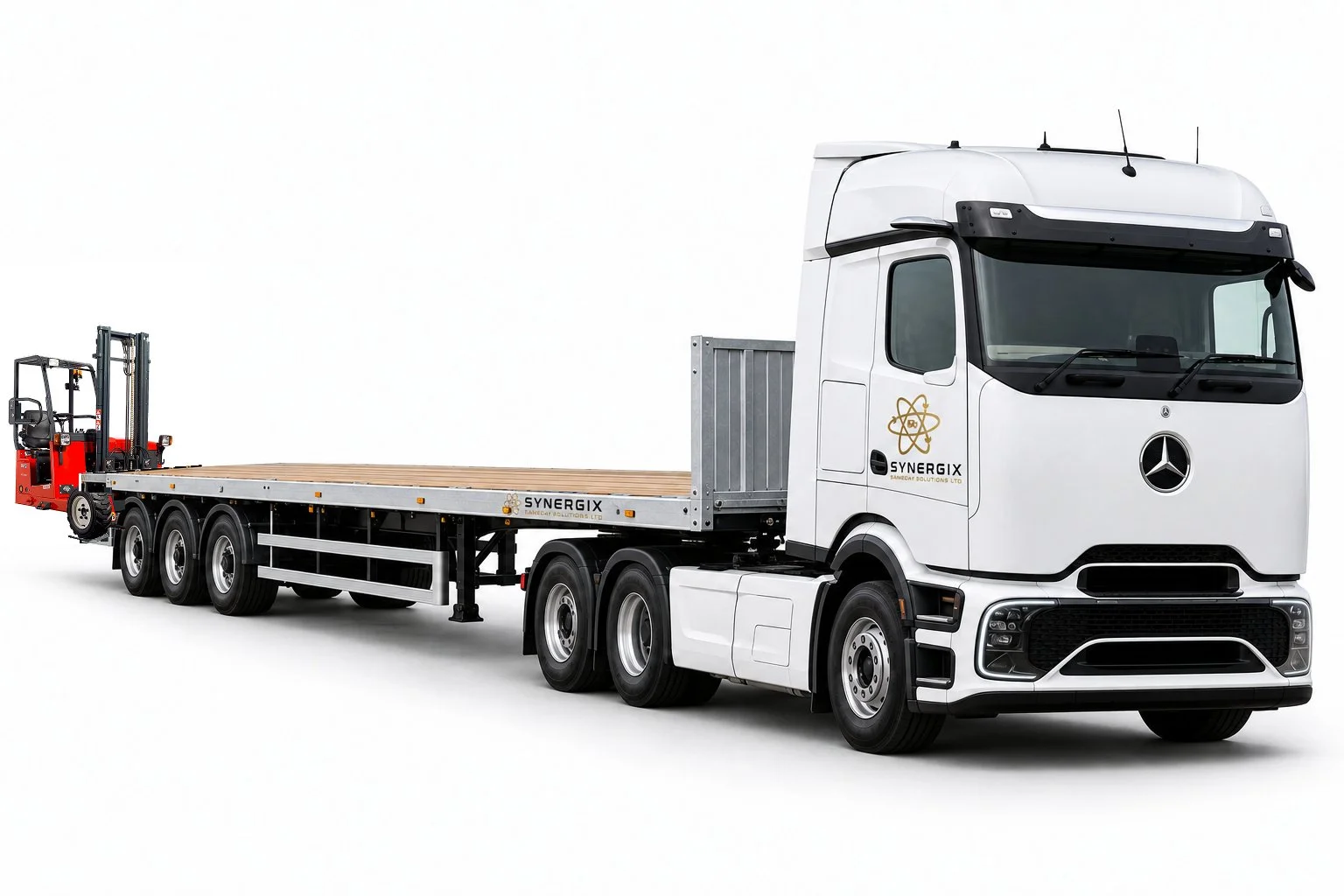
Flatbed with Moffett
Suitable open-deck pallet loads with forklift unloading. Confirm load centre, fork entry and delivery surface.
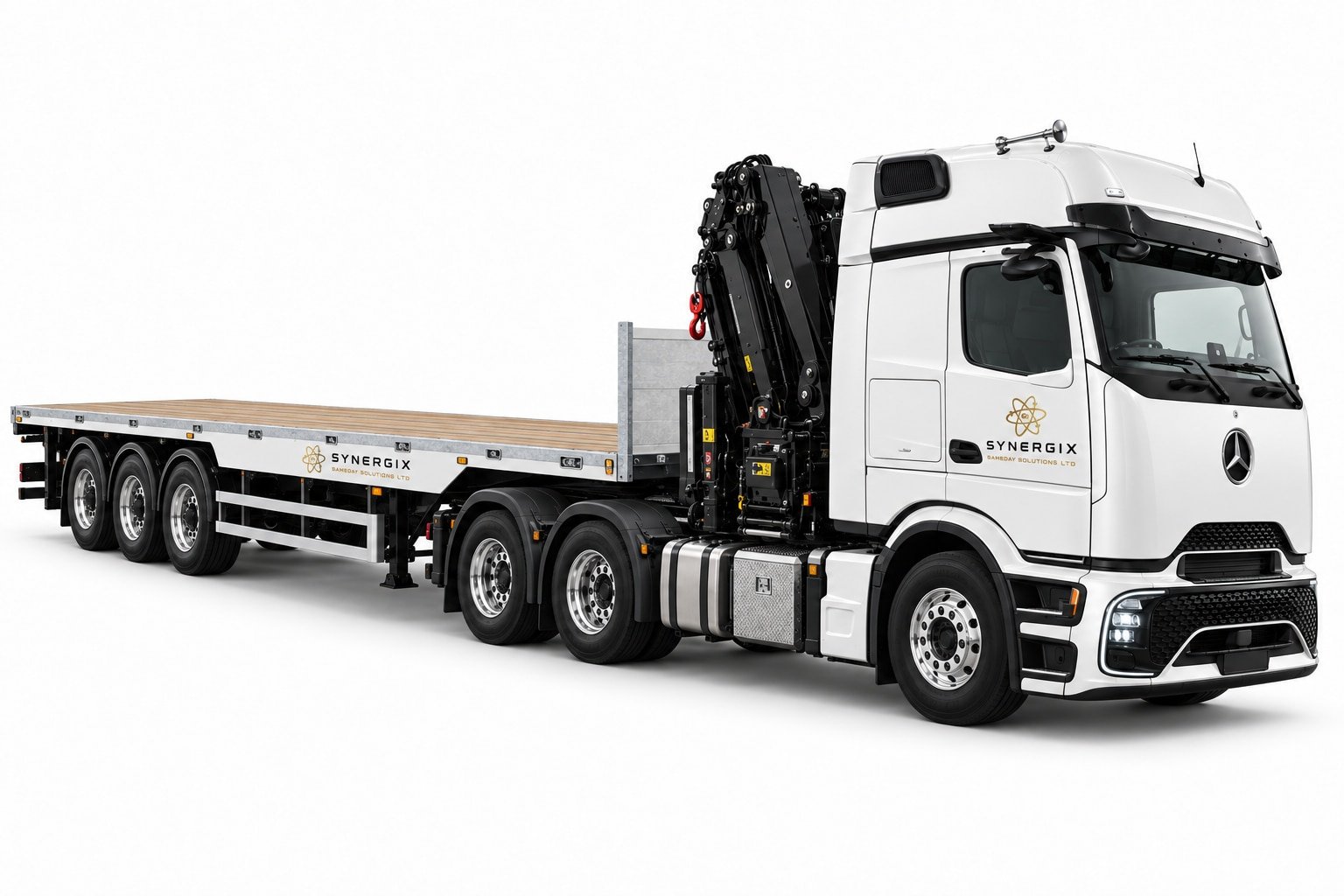
Artic with loader crane
A crane-equipped combination for assessed lifts. The load chart, stabiliser area and reduced payload control the job.
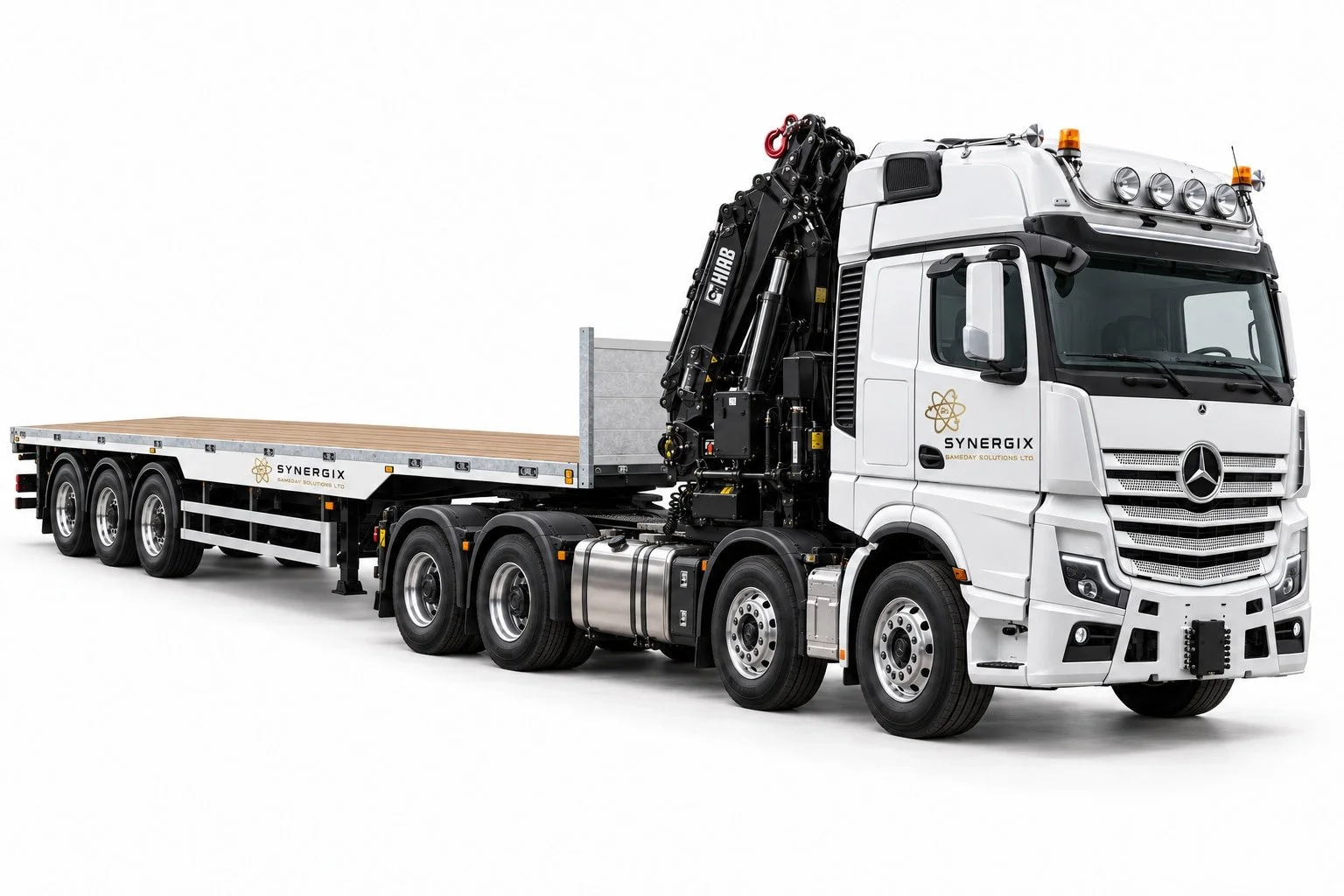
Heavy crane combination
Specialist tractor and trailer specification for demanding lifts. Ordinary 44-tonne or payload assumptions do not apply automatically.
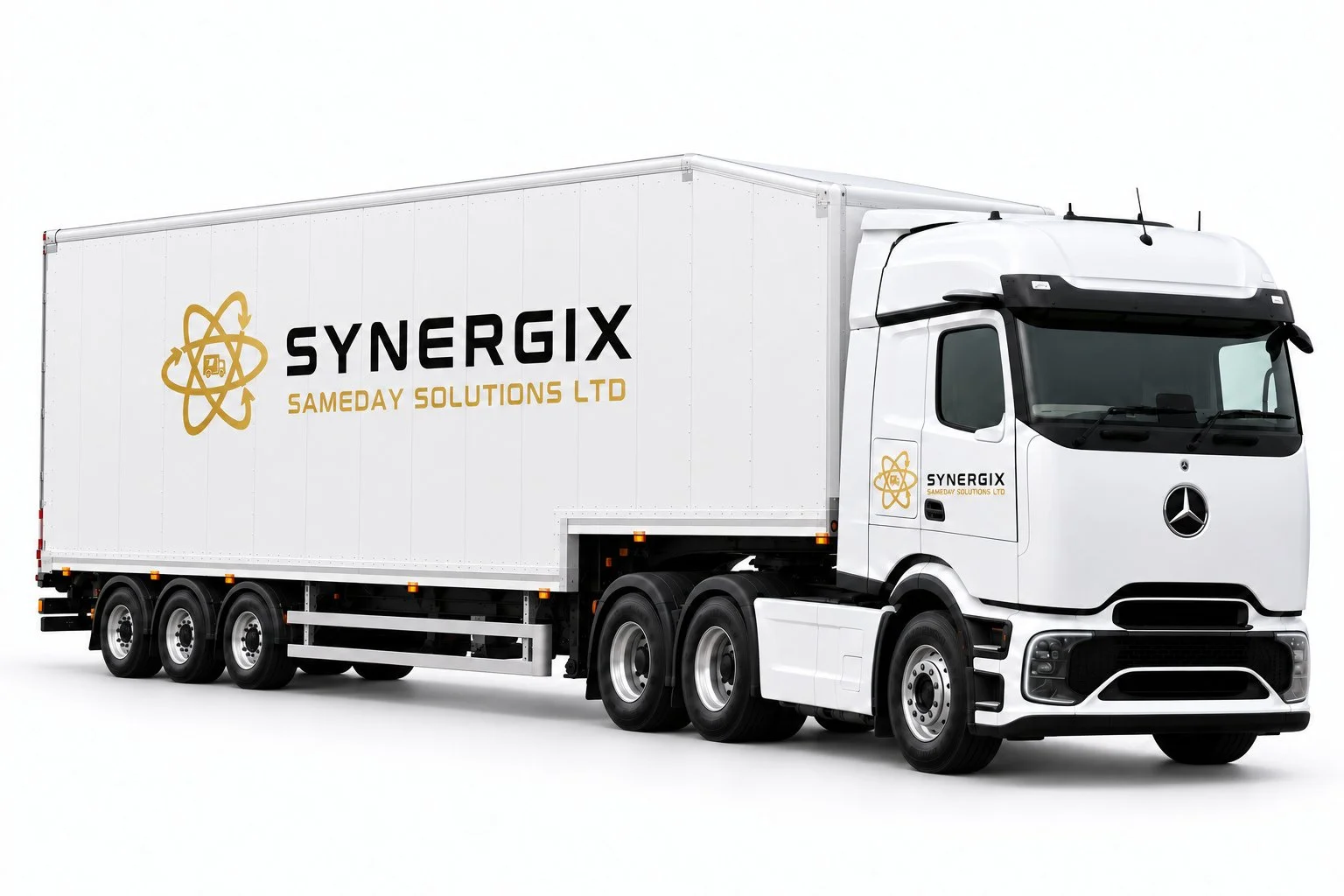
Double-deck box
Two loading levels for suitable high-volume freight. Check deck heights, deck ratings, docks and the route.
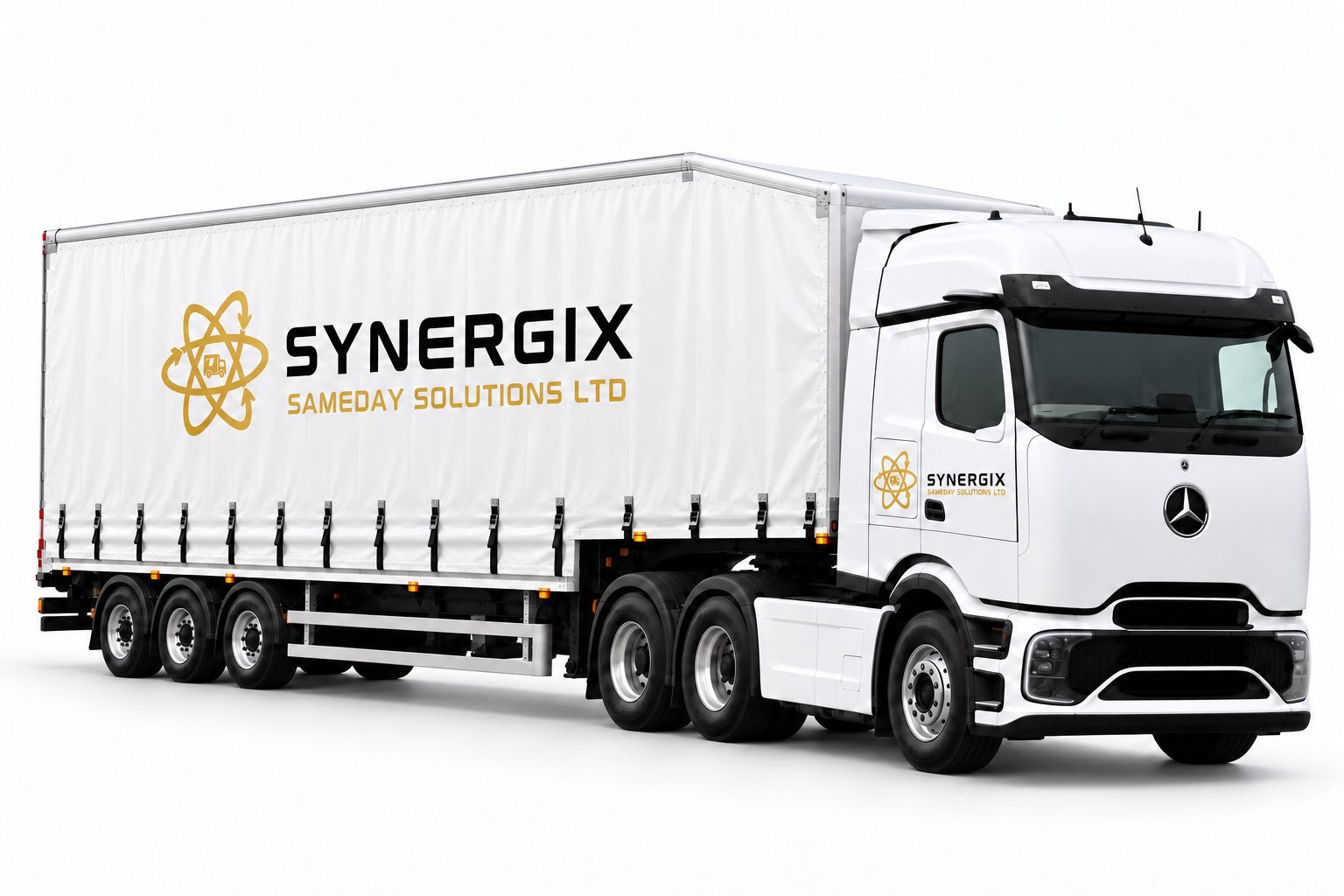
Double-deck curtainsider
Multiple loading levels with side-access options. Specify the actual loading sequence and equipment.
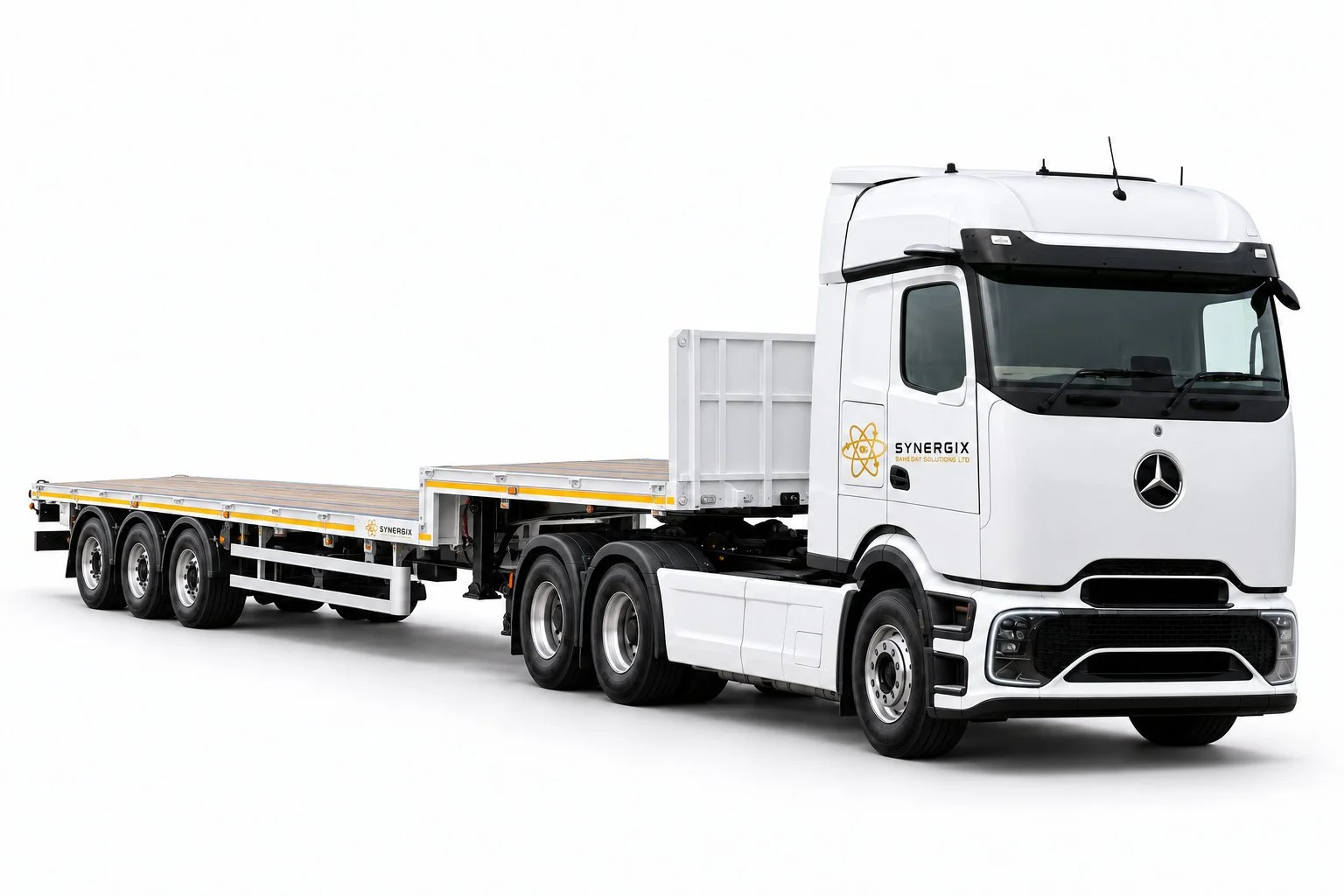
Step-frame
A raised front deck and lower main deck. Each deck has its own useful length and loading limits.
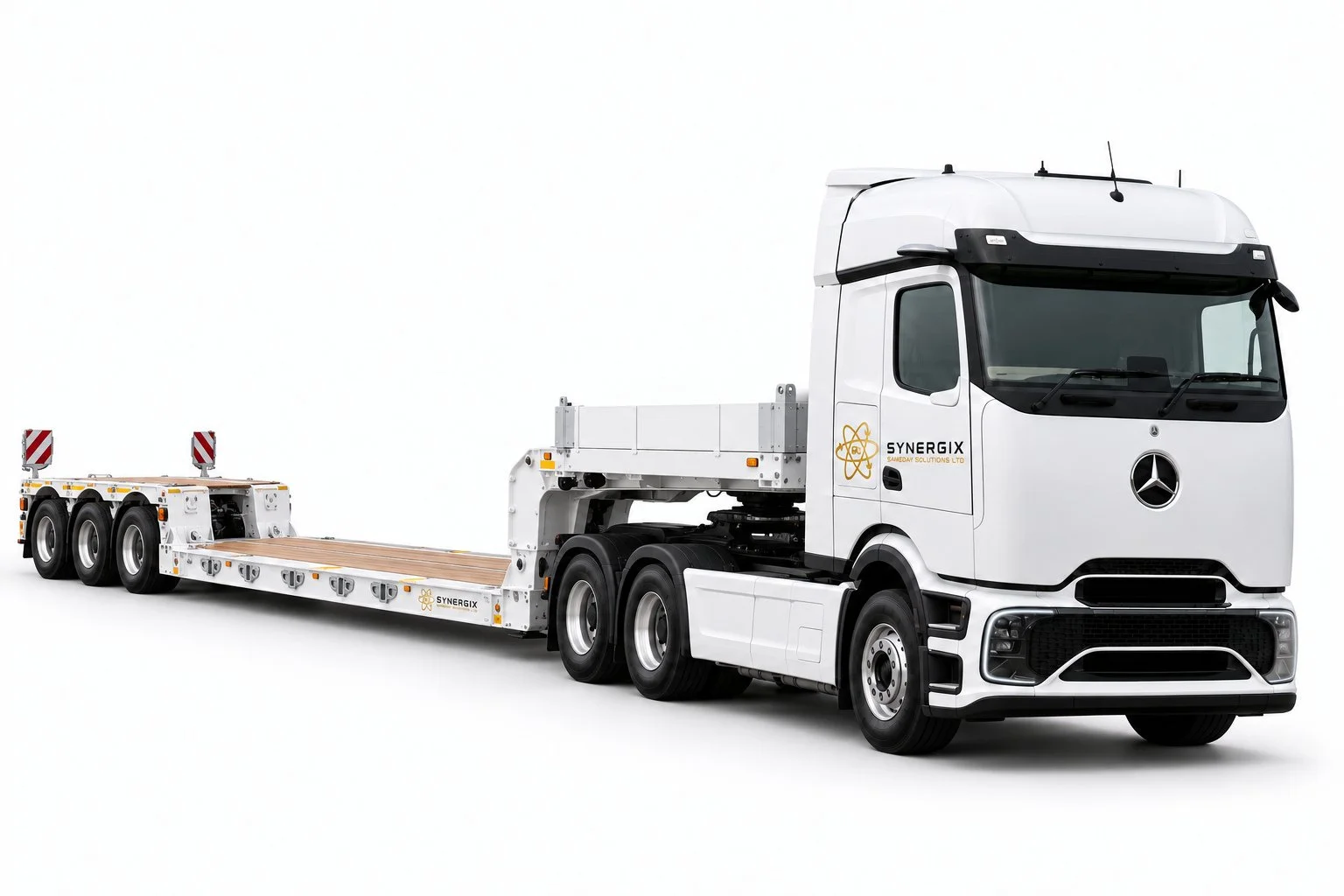
Low loader
Suitable plant and machinery with a lower well. Ground clearance, ramps, load dimensions and route approval matter.
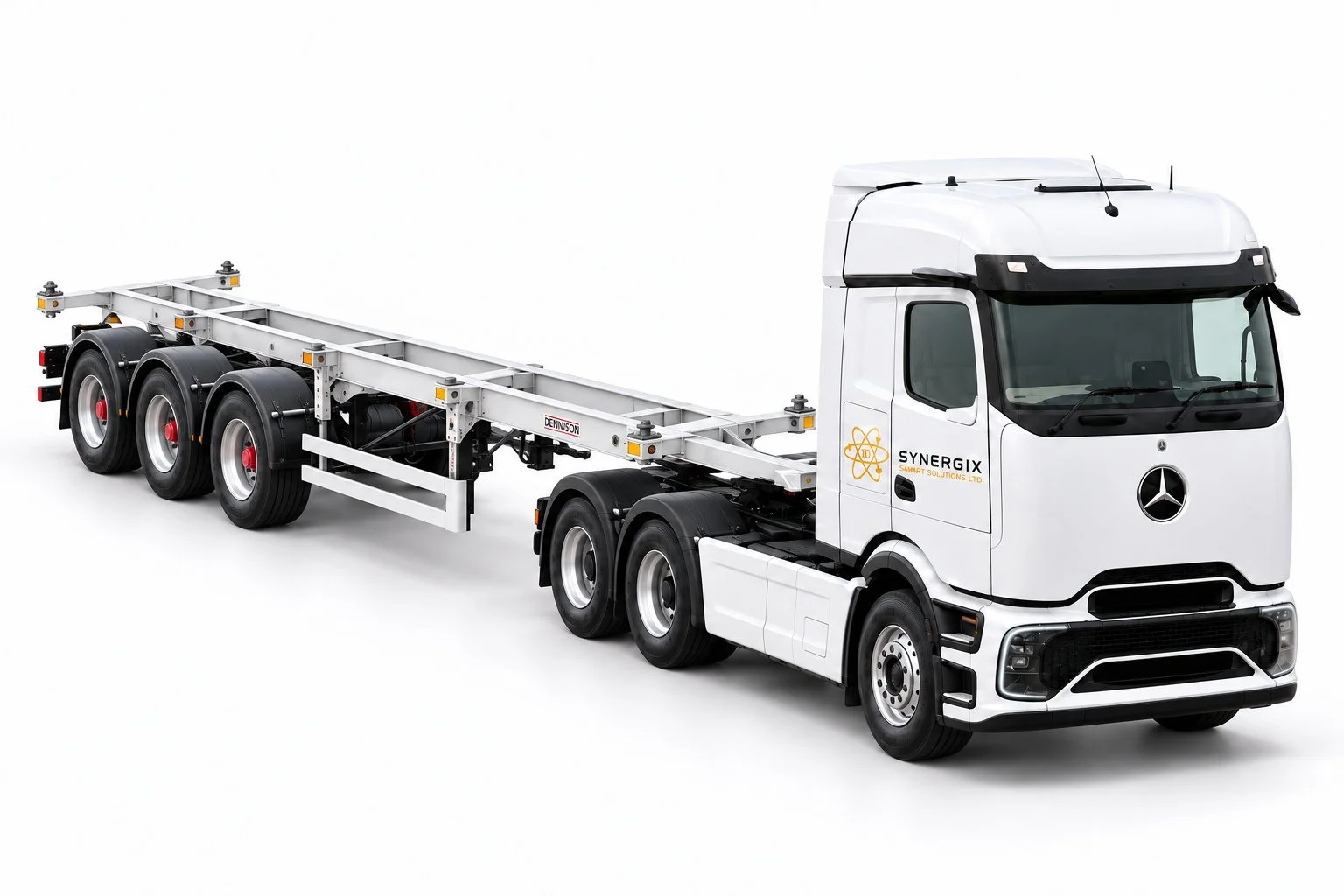
Skeletal container trailer
A chassis for compatible containers. Confirm container size, gross weight, locks and terminal handover.
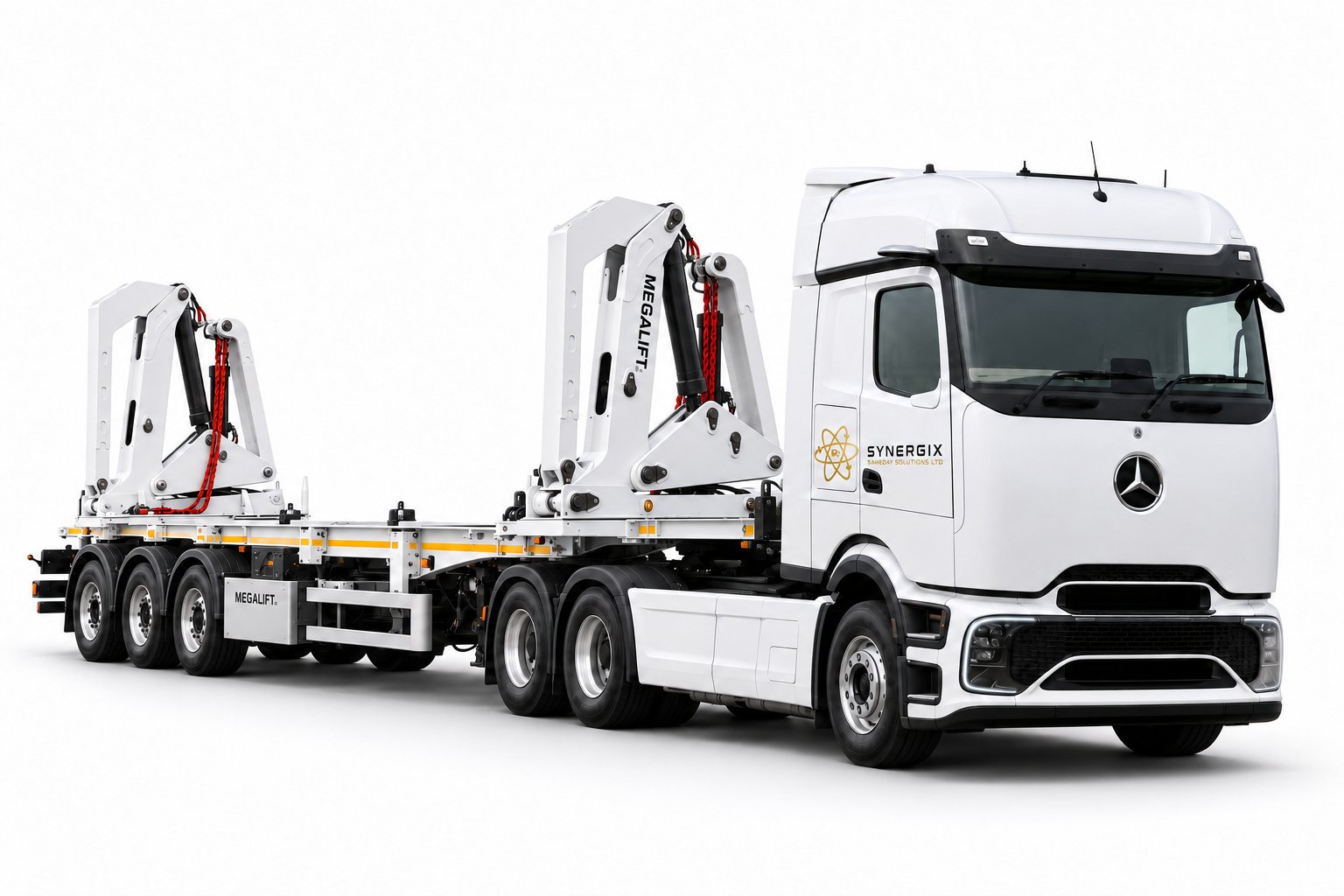
Megalift / container side-loader
Container lifting beside the trailer. Check the container rating, side clearance and stabiliser support.
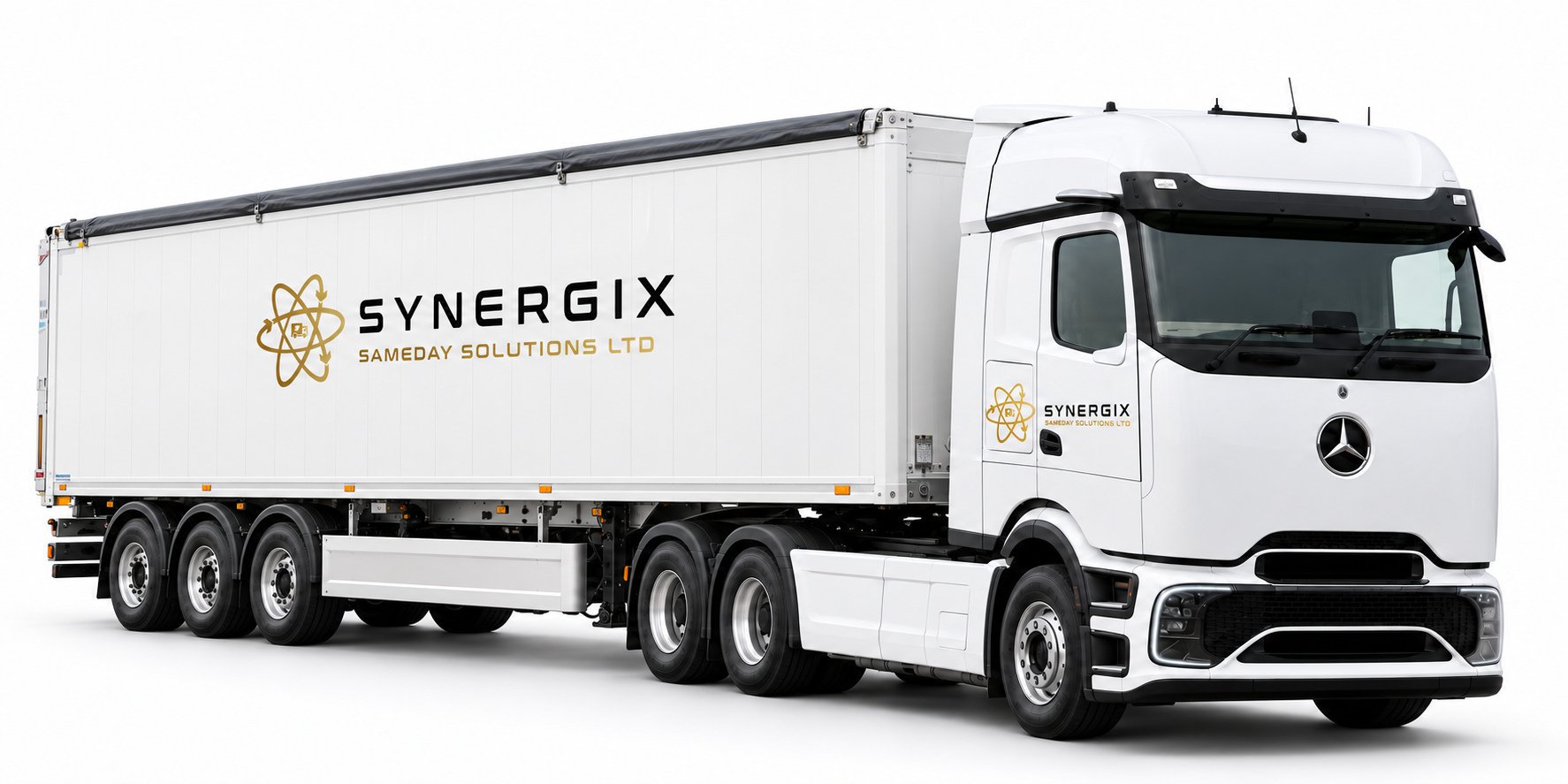
Walking floor
A moving floor for compatible bulk goods. Product, cleaning and a safe discharge area must be agreed.
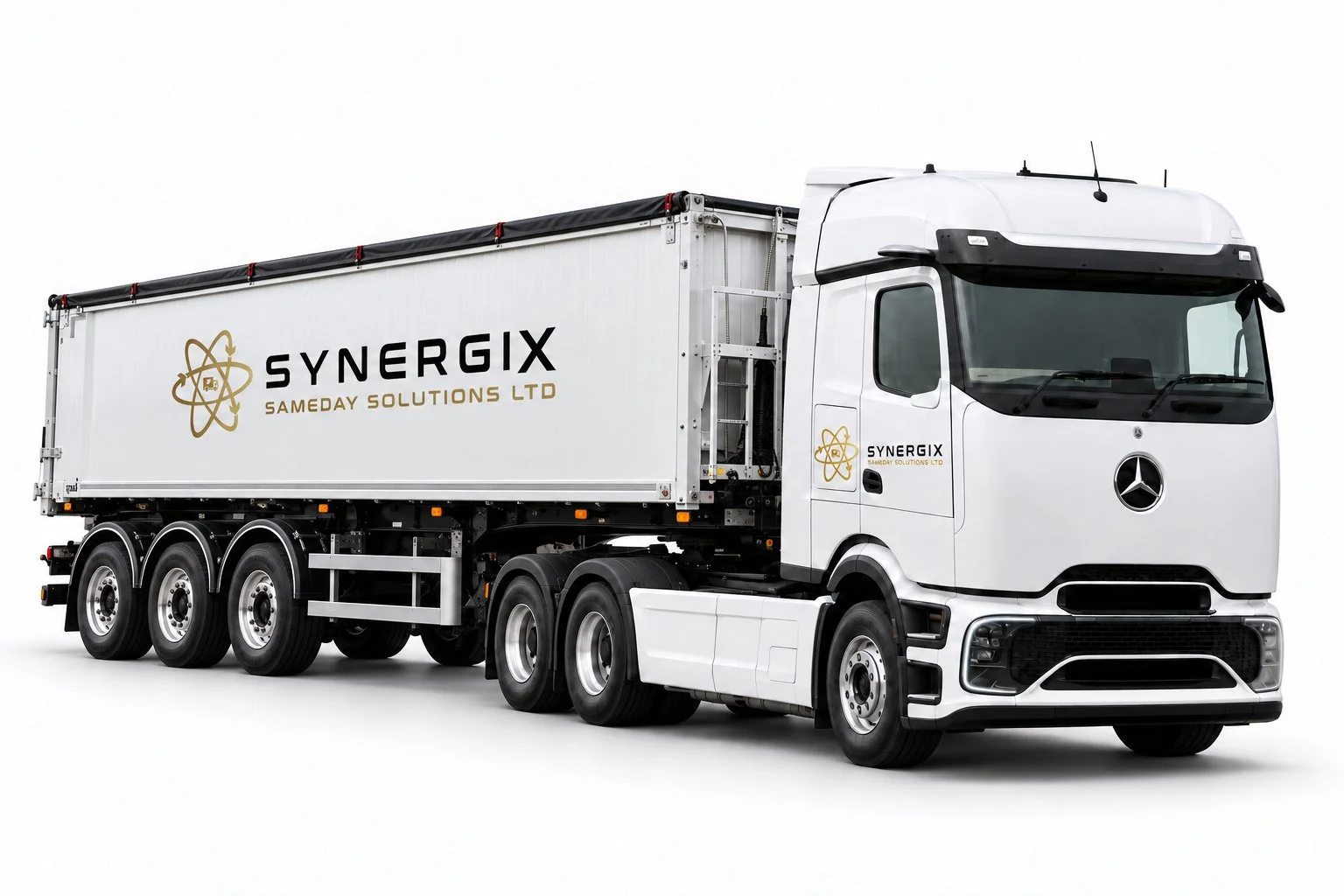
Bulk tipper
Loose bulk materials in an appropriate body. Tipping requires suitable ground and clear space above.
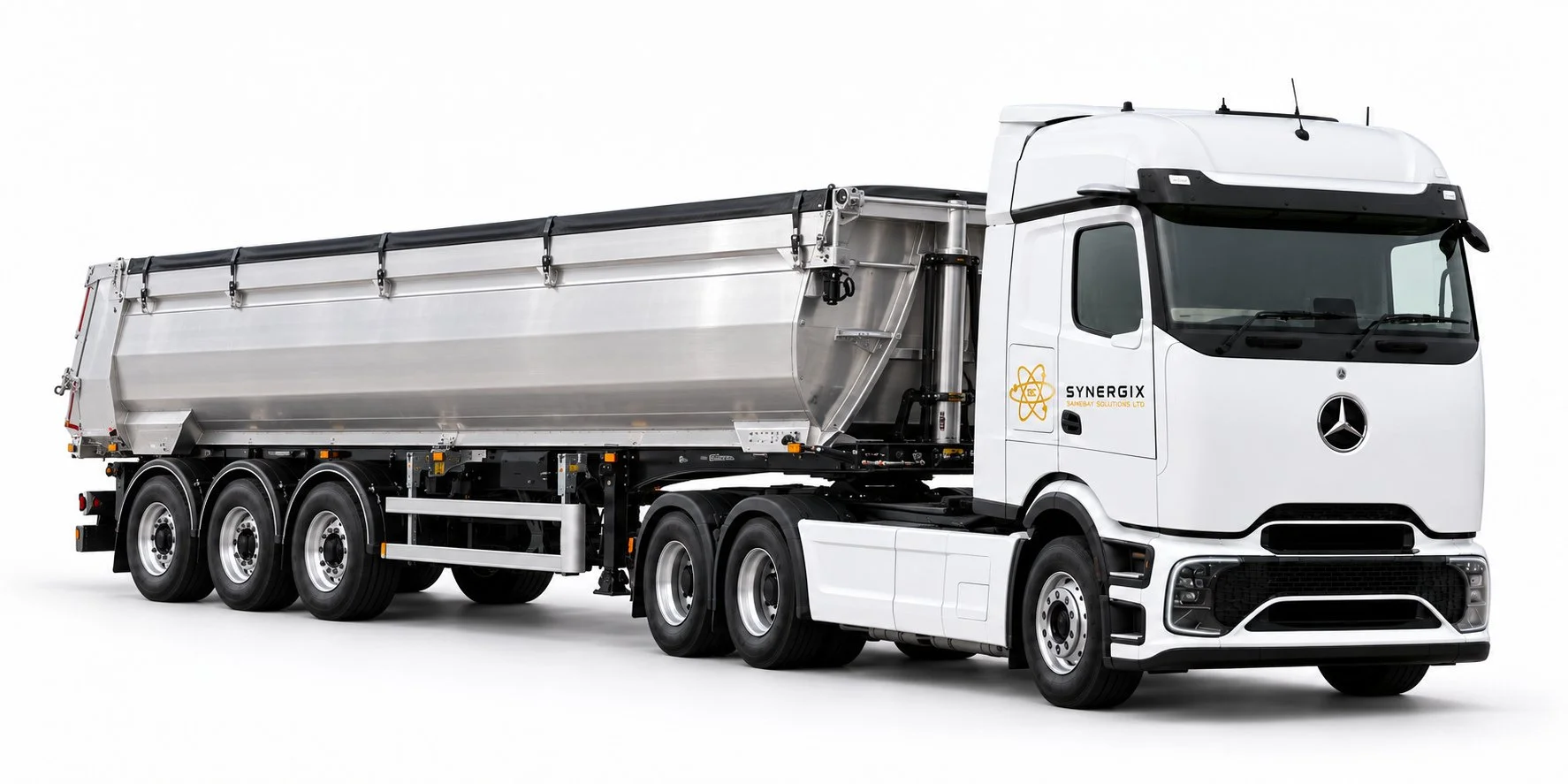
Alloy U-shaped tipper
A separate rounded-body tipping option. Match material, body condition and discharge arrangements.
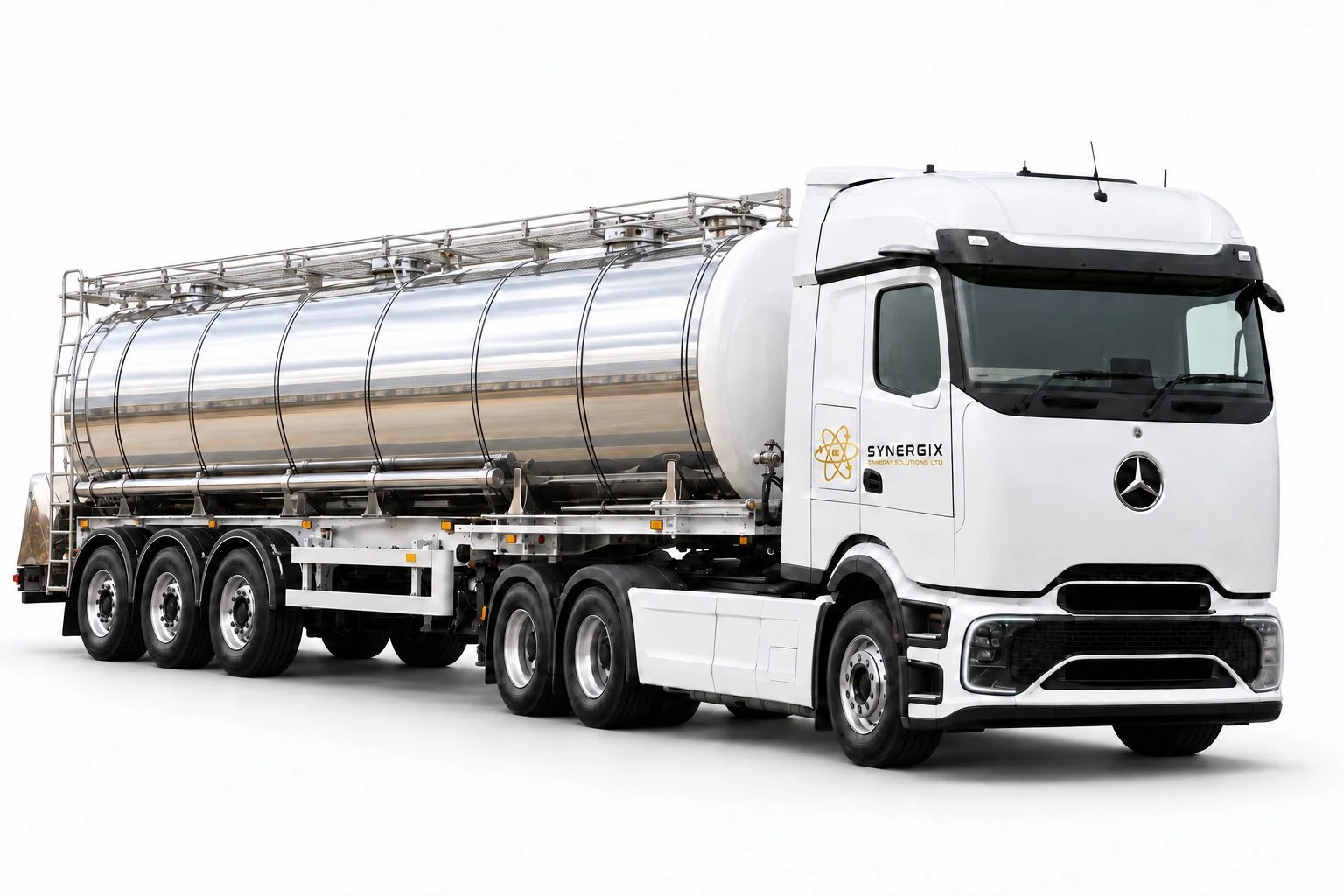
Tanker
Compatible liquids or bulk products in a specified tank. Agree cleaning history, fittings and any dangerous-goods requirements.
Illustrations identify body and equipment types. They do not establish exact lifting ratings, dimensions, fleet ownership or availability of the vehicle supplied. We confirm the actual specification against the load, route and sites.
Specialist vehicle dimensions and payload
Choose the body and handling method before applying standard van, rigid or artic figures.
| Measurement | What must be checked |
|---|---|
| Usable space | Clear length, width and height of each deck or temperature compartment, plus fixed obstructions |
| Loading aperture | Rear doors, side opening, roof opening, ramps and any space needed to manoeuvre the goods |
| Freight allowance | The ready-to-load vehicle or combination, with fuel, people, lifting equipment and accessories |
| Individual unit | Packaged footprint and total mass, centre of gravity, lifting points and point loads |
| Handling rating | Actual crane chart, forklift plate, tail-lift load centre, ramp/deck rating and approved attachments |
| Site envelope | The whole vehicle, deployed legs, moving boom, container lifting corridor and escape space |
| Loaded road dimensions | Overall height, width, length and projections, including cargo and carried equipment |
Gross weight is not payload
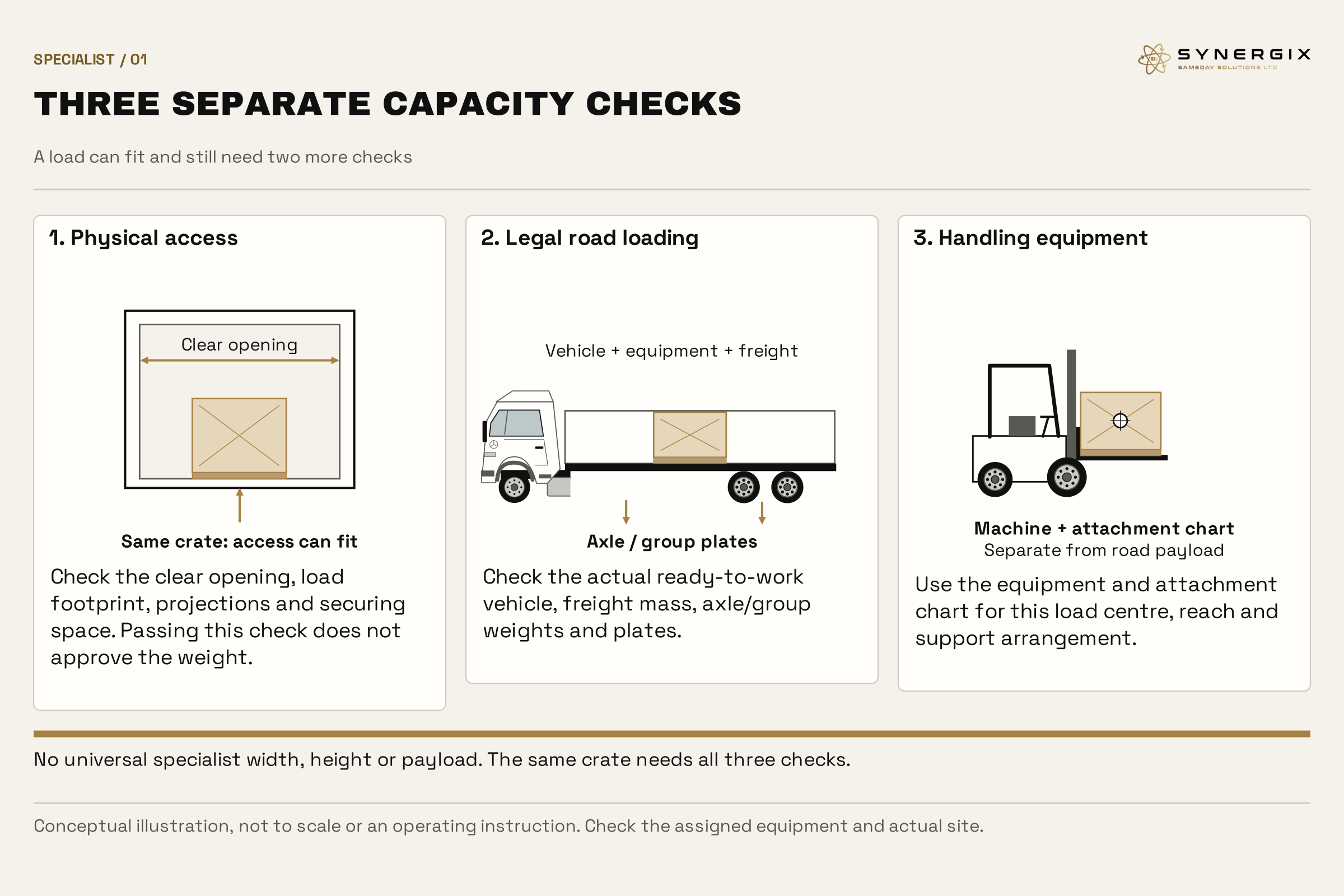
A 26-tonne rigid is a vehicle class, not permission to carry 26 tonnes of goods. A 44-tonne articulated limit covers the tractor, trailer, people, fuel, equipment and freight together. Start with the relevant permitted weight and subtract the actual ready-to-load mass, then check every axle, deck and route limit. A nominal subtraction that leaves room overall can still overload an axle.
Equipment takes away freight allowance
A loader crane, truck-mounted forklift, mounting kit, tail lift, battery, extra floor or refrigeration unit adds mass. The position matters too: a forklift carried behind the rear axle has a different effect from mass placed near the centre of the load bed. Neither a fixed percentage nor a standard 100 kg deduction suits every installation. Confirm the actual equipment and vehicle before pricing the load.
Standard guide figures stay with standard bodies
Our ordinary category guides use up to 15,000 kg for a 26-tonne rigid and up to 26,000 kg for an artic. Those are enquiry guides for the relevant general-haulage arrangements, not specialist guarantees. A heavy crane combination, lifting-deck trailer or container side-loader can have a substantially different freight allowance. Read the 26-tonne guide or the standard artic guide.
The lift limit is a separate limit
A vehicle may have enough payload for a 3,000 kg crate while its forklift, tail lift or crane cannot handle that crate in the required position. Compare the whole lifting mass, geometry and attachments with the actual equipment rating. Loading by a customer’s forklift does not prove that our unloading method can manage the same item.
Volume, density and floor pressure
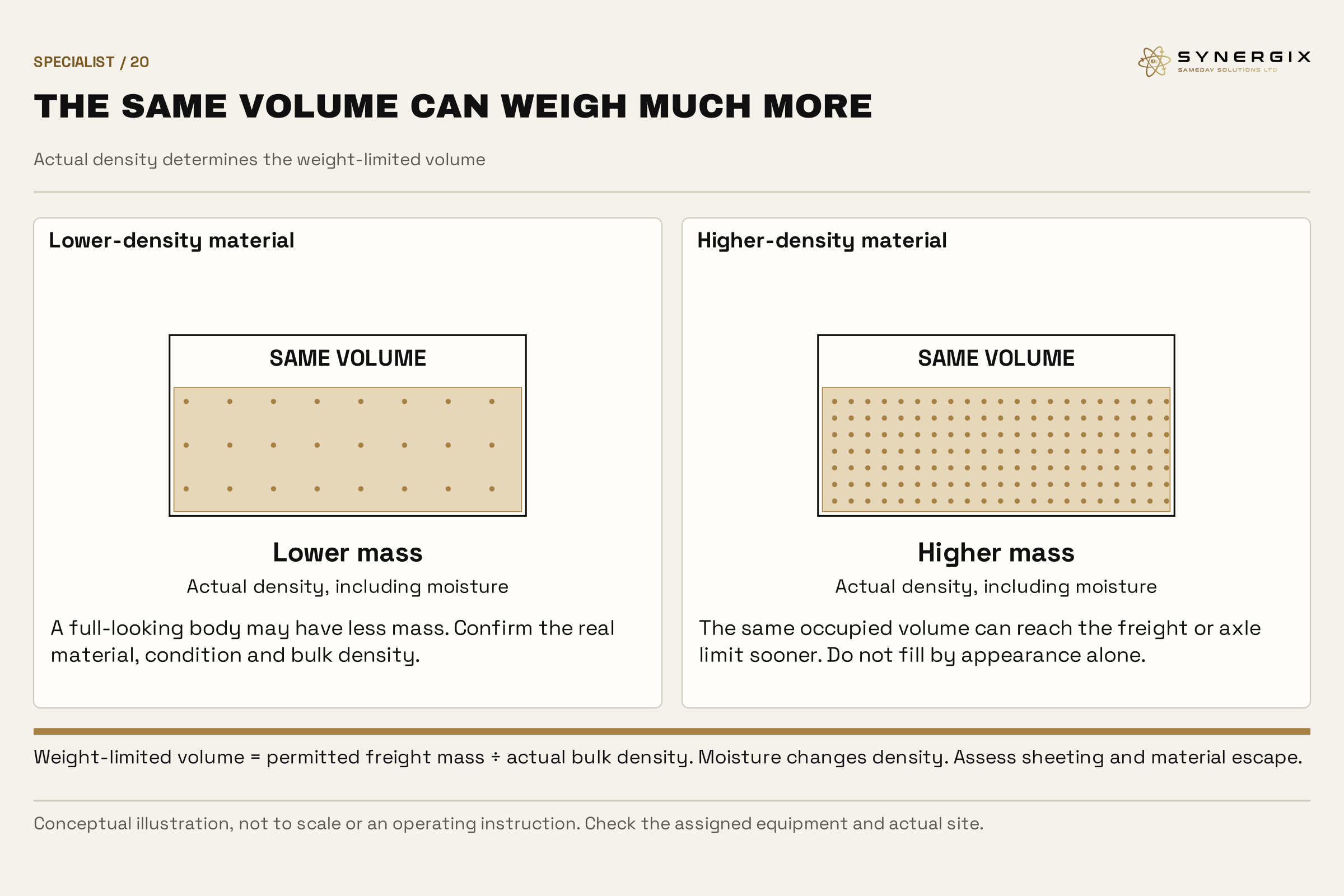
Bulk material can fill a body before reaching the weight allowance, or reach the weight allowance with the body mostly empty. Divide permitted freight kilograms by the material’s actual bulk density to estimate the weight-limited volume. Wetness, compaction and contamination can change density. Machinery feet, pallet runners and wheels concentrate weight on the deck; total vehicle payload does not establish an acceptable point load.
Pallet numbers need an actual plan
A suitable standard artic can take up to 26 UK pallets of 1,200 × 1,000 mm or 33 Euro pallets of 1,200 × 800 mm in one floor layer. Do not automatically apply these counts to a stepped floor, double deck, partitioned fridge or crane body. Include packaging overhang, restraint, temperature-airflow gaps and delivery order. Each deck and axle must stay within its own limit.
Refrigerated trailers and temperature-controlled vehicles
Specify the product temperature, the monitoring evidence, the power supply and the loading arrangement as one job.
What a refrigerated body does
A purpose-built insulated body and refrigeration system maintain suitable goods within an agreed operating range. Chilled food, frozen stock and certain temperature-sensitive goods have different requirements. A normal dry box is not equivalent. Transport refrigeration is normally intended to maintain appropriately conditioned product, not to freeze warm food or rapidly pull down a large unconditioned load.
Internal space and equipment weight
A purpose-built refrigerated truck or trailer can have broadly comparable internal dimensions to a standard body. Do not automatically subtract insulation from another vehicle’s internal measurement. Obtain the fridge body’s own specification. Evaporators, air ducts, partitions and protective fittings can create local restrictions. Refrigeration equipment and an agreed tail lift add mass and can reduce payload even when the usable body dimensions remain similar.
Choose the set point from the product requirement
Give the required product temperature, acceptable range, collection condition and loading duration. Chilled and frozen are broad labels, not complete instructions. A +2°C air set point does not prove that the centre of every carton is +2°C. Likewise, a frozen-food requirement may be stricter than an assumed freezer setting. Different foods, medicines, flowers and chemicals need their own product specification.
Air temperatures are not product temperatures
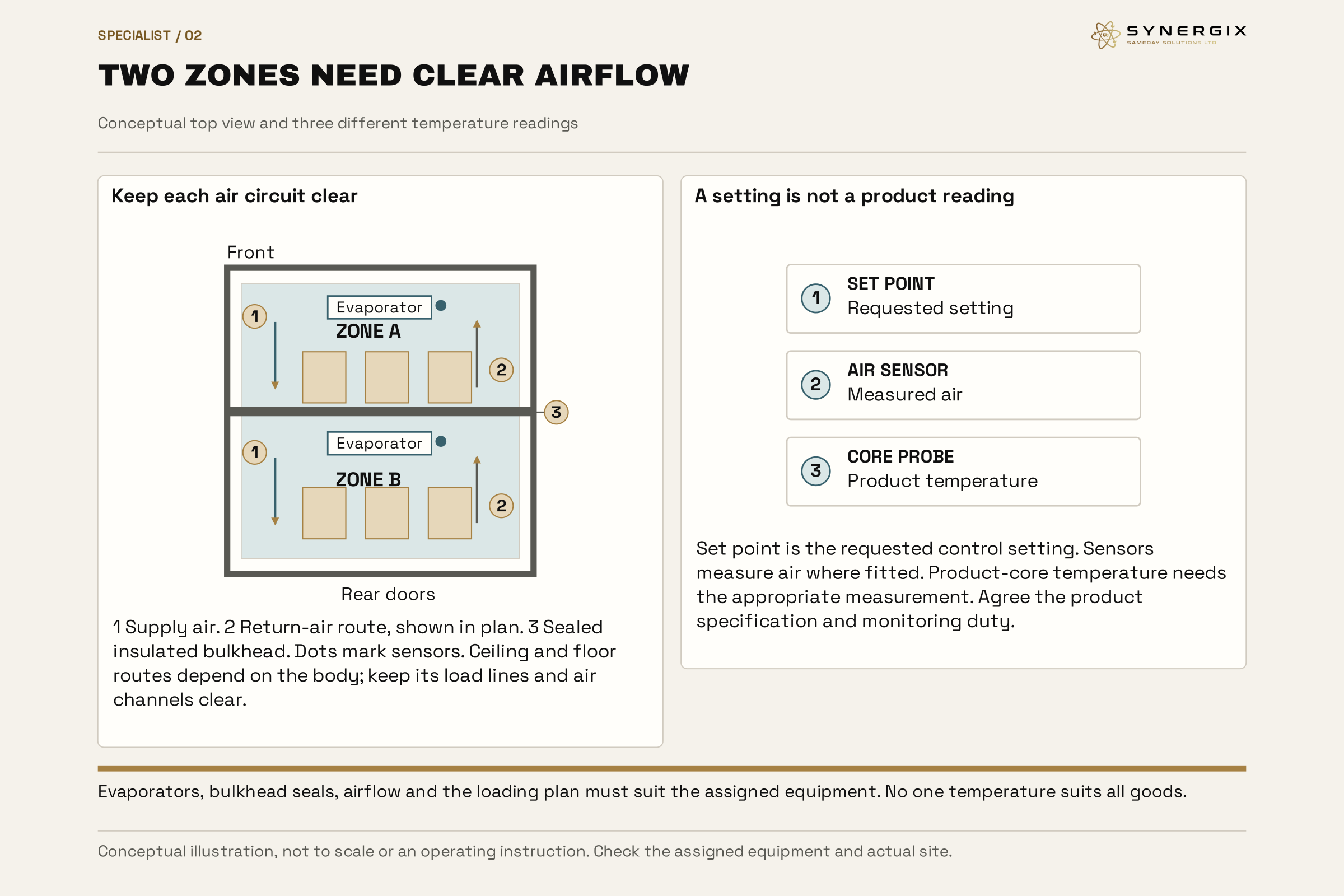
The controller’s set point, supply-air reading, return-air reading and a probe measurement in the goods describe different things. A defrost cycle or open door may change an air reading temporarily without establishing the core product condition. Agree which measurements form the acceptance criteria, where they are taken and how readings are recorded. Do not use a single display photograph as proof of an entire uninterrupted journey.
Temperature logs and fridge records
State before booking whether you need a printed temperature ticket, a downloadable journey log, a calibrated recorder, compartment-specific readings or a live alert arrangement. Useful records identify the unit, time/date, sensors, trip or consignment, set point and relevant exceptions. Agree who obtains the record and when it is available. A vehicle being refrigerated does not automatically include remote customer access or an evidential report in a particular format.
Quick-frozen food and record retention
Quick-frozen food transport has specific air-temperature monitoring and record rules, including applicable standards for recording equipment. Where those rules apply, dated records are normally retained for at least one year, and longer where the product nature or shelf life requires it. Scope and limited local-distribution exceptions need checking. A short trip does not remove the wider duty to maintain suitable food conditions.
Dual-temperature and multi-temperature bodies
A dual-temperature trailer needs compatible compartments and refrigeration control, not simply chilled goods at the front and frozen goods at the back. An insulated dividing bulkhead, suitable evaporators and independent monitoring/control arrangements establish the zones. Give the pallet count, weight and temperature for each compartment. Bulkhead positions, doors and airflow determine useful length. A shared doorway or repeated opening can affect both zones.
Airflow and loading height
Supply air must reach the load and return through the route required by the actual system. Keep goods clear of identified load lines, evaporators and channels. Do not obstruct floor air routes or pack goods against a ceiling duct merely to gain an extra pallet. Pallet wrapping, collapsed packaging and blocked rear circulation can defeat an otherwise correct set point. Use the body manufacturer’s load plan.
Pre-cooling, loading and door openings
Agree when the body is pre-cooled, when product is ready, how long doors may stay open and how the loading dock is managed. The correct unit operating mode during loading depends on the equipment and loading interface. Ask for a planned procedure rather than requiring the engine to run continuously with open doors. Minimise uncontrolled exposure and account for each delivery stop.
Start-stop and continuous operation
Some units can cycle off after reaching the set point; others or certain products require continuous airflow. These are equipment and product choices, not interchangeable fuel-saving shortcuts. Specify the required mode with the temperature instruction. A medicine or sensitive produce shipment may have requirements beyond a routine frozen-food load. No pharmaceutical validation or specialist accreditation is implied by the word refrigerated.
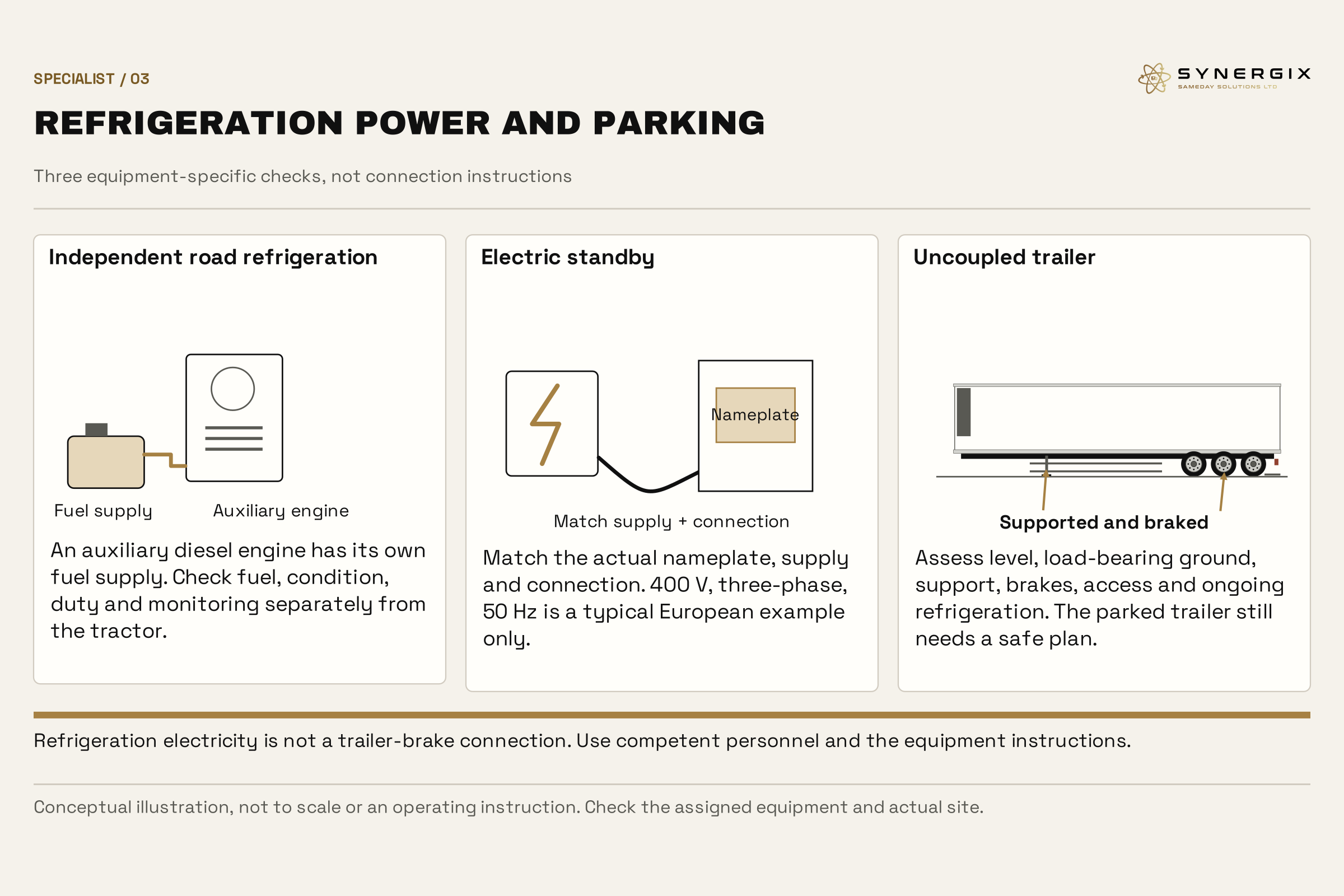
The diesel “donkey engine”
Many trailer refrigeration units have their own auxiliary diesel engine and fuel supply. It can run when the tractor engine is off or the tractor is uncoupled, provided the system and operating conditions permit it. Its fuel is separate from the tractor’s road fuel calculation. Confirm the fuel level, operating duration, refuelling responsibility, noise constraints and what happens if the unit alarms or runs out of fuel.
Three-phase electric standby
Many European trailer systems offer electric standby using a suitable three-phase supply, often 400 V, 50 Hz. The actual unit’s nameplate determines voltage, phases, current, protection and connector. A standard domestic socket is not a substitute. Have a competent person confirm the supply and suitable cable before delivery. Generator compatibility and start-up demand must be checked rather than judged only by its headline kVA.
Electrical connection and event positioning
Agree the socket location, cable length, protection against vehicles/pedestrians, supply availability and who connects the equipment. A refrigeration power cable supplies the refrigeration system; it is not a trailer-brake connection. Isolate and disconnect safely before moving the trailer, following the equipment instructions. Event hire also needs a position that allows ventilation, access to controls and doors, suitable support and a clear emergency arrangement.
Trailer brakes, landing legs and parked operation
An uncoupled trailer must be parked and supported through the approved system, including its parking brake and suitable ground under the landing legs. Disconnecting an air line is not a replacement for deliberately applying the parking brake. Any wheel restraints or chocks form part of the site assessment. Forklift entry can create substantial loading forces; confirm the trailer’s approved support and dock restraints before driving machinery inside.
Load bars, cages and restraint
Refrigerated freight still needs securing. Match rated load bars, shoring beams, tracks, straps or other restraints to the actual body and load. A friction pole is not automatically equivalent to a positive-locking rated bar. A cage’s wheel brake helps parking but is not the complete road restraint. Do not place a bar where it damages the insulation, blocks an evaporator or prevents required circulation.
Cleanliness, separation and odours
Tell us about allergens, raw and ready-to-eat products, packaging integrity, previous-load restrictions and any cleaning evidence required. Chilling does not remove contamination or make incompatible products suitable for a shared compartment. Drainage, condensation and residues need consideration. A temperature-controlled waste or chemical job is not interchangeable with food carriage.
Breakdown and out-of-range arrangements
Agree the site contact, alarm escalation, acceptable time outside the range and who decides whether product can be accepted or released. A refrigeration alarm is not automatically a vehicle breakdown, and restarting a unit does not erase an earlier temperature excursion. Availability of replacement transport, spare power or emergency storage must be agreed rather than assumed. Keep the evidence for the whole incident.
Refrigerants, maintenance and international carriage
Refrigeration servicing includes the engine or electrical drive, heat exchangers, seals, controls, sensors and refrigerant circuit. Applicable F-gas work needs appropriately qualified personnel. International carriage of certain perishable foods can require ATP-compliant equipment and certification; that is separate from product hygiene and journey logs. Tell us the country and goods so the relevant requirements can be checked.
| Requirement | How to specify it |
|---|---|
| Chilled | A product may require a positive set point such as+2°C or+4°C. Give its permitted product range and applicable limits |
| Quick-frozen | Generally−18°C or colder after thermal stabilisation, subject to the applicable rules and permitted limited variations |
| Medicines or sensitive products | A labelled range such as+2 to+8°C requires the actual product and appropriate qualified transport arrangements |
| Controlled ambient | A product may specify a range such as+15 to+25°C and need heating in winter, not only cooling |
These examples do not establish acceptance of pharmaceutical or other specialised products. Product instructions, the applicable law and the confirmed equipment determine the actual temperature requirement. Logging equipment for in-scope quick-frozen transport must satisfy the applicable EN 12830, EN 13485 and EN 13486 requirements, with relevant verification/calibration evidence.
| Give us | Why it matters |
|---|---|
| Product and temperature | Set point, acceptable range and goods condition control the transport instruction |
| Zone plan | Separate dimensions, weights and temperatures for each compartment |
| Records | Recorder/calibration, logging interval, report format and required retention |
| Power | Diesel duration or exact electrical supply, cable and connection responsibility |
| Handling | Dock, tail lift, cages, pallets, pump truck and individual unit weights |
| Contingency | Contacts, alarm escalation and responsibility for accepting affected product |
Discuss refrigerated transport or temperature-controlled delivery. Event positioning and powered storage are separate arrangements to confirm.
Flatbed vehicles and open-deck transport
An open deck provides loading access. It does not remove the need for support, weather protection or a proper restraint system.
Suitable flatbed loads
Steel sections, timber packs, suitable machinery, construction components, tanks, fabricated frames and other self-supporting freight can suit a flatbed. The load must be stable, adequately supported and capable of being restrained without damage. Specify corrosion sensitivity and weather exposure. A flatbed can be preferable where rear doors would block a wide, long or overhead-loaded item.
What is not acceptable without containment
Loose small goods, unstable stacks, unsupported panels and material that can blow or bounce off the vehicle need an appropriate containment and securing arrangement. A pallet alone does not make its contents secure. Open tubs of liquid or unsecured rubble are not ordinary flatbed freight. Dangerous goods, waste and contaminated materials require their own classification and acceptance checks before a suitable body is chosen.
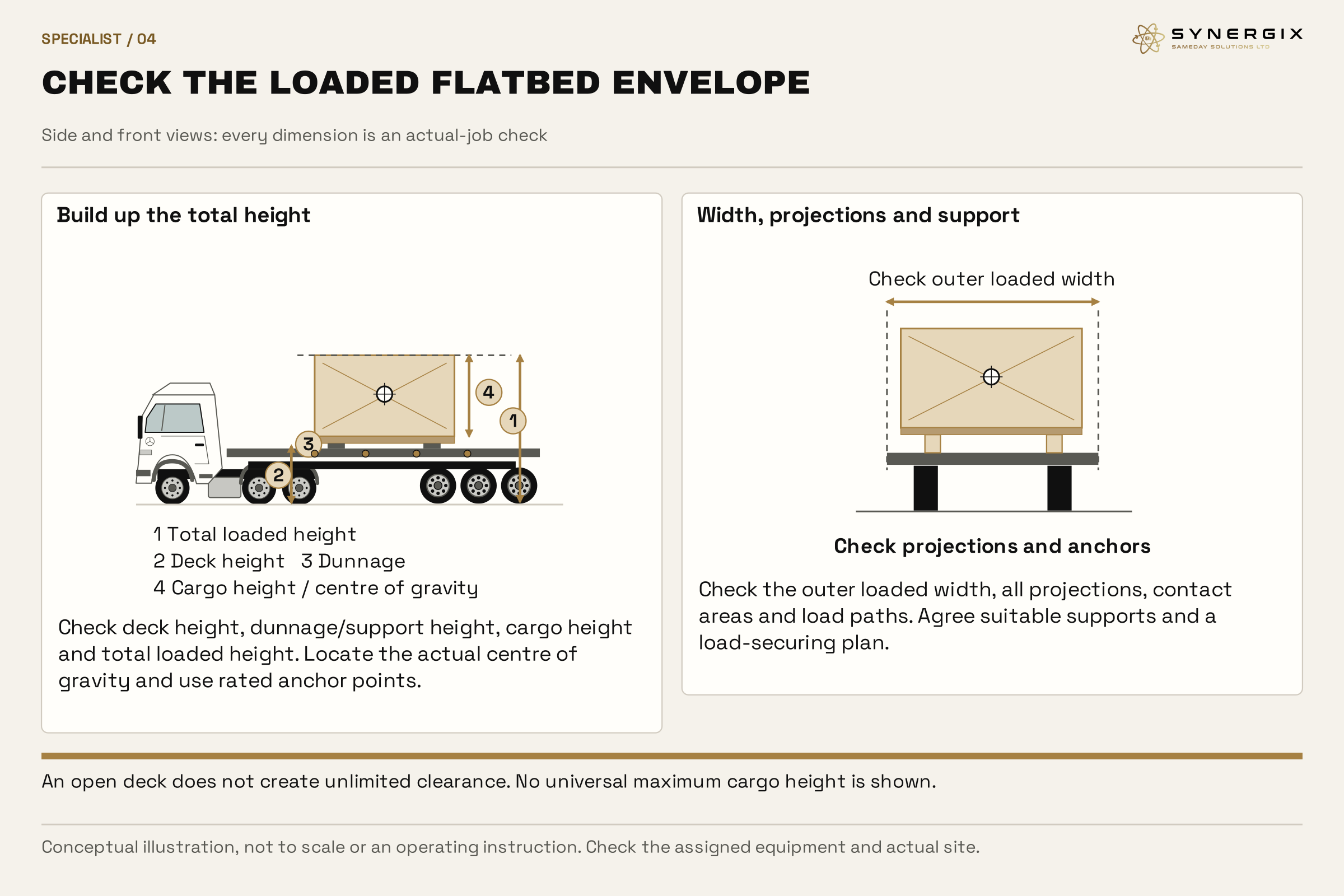
No universal maximum cargo height
Measure the loaded overall height from the ground, including the deck, dunnage, cargo and projections. The allowable load height is governed by the actual vehicle, stability, securing method, route and every entrance or overhead obstruction. Great Britain does not provide one useful flatbed cargo-height allowance for every job. International routes can impose different dimensional limits. A low loader may help a tall item where a higher flatbed would not.
Width, length and overhang
Give the outermost loaded dimensions, including feet, handles, lifting lugs, packaging and projections. Confirm support beneath the load and actual permitted width, length and axle loads. Side or rear overhang can require marking, notification or an abnormal-load arrangement depending on the dimensions and applicable rules. The fact that a load can physically sit on the deck does not establish lawful road carriage.
Supports and deck strength
Dunnage, cradles and load spreaders need sufficient strength and appropriate positions. A long beam cannot be supported arbitrarily where its own structure could bend. A heavy machine can exceed local deck loading through small feet despite being below vehicle payload. Supply support drawings and centre-of-gravity information. The carrier must also be able to attach restraints to rated points without relying on light side guards.
Loading from the side or above
Tell us whether the collection uses a forklift, overhead crane, loader crane or other equipment. Confirm the equipment’s capacity at the required geometry and a clear working area. A wide crate may need long forks or a spreader and enough room for the forklift. A flatbed booking does not automatically include lifting equipment at collection or delivery.
Sheets protect against weather, not movement
An appropriate sheet can limit weather exposure or contain suitable small material. It does not replace blocking and rated lashings. Fragile finishes may need protective packing under straps and sheet edges. Water can pool, wrapping can tear and condensation can form. If weather sensitivity cannot be addressed on an open deck, request an enclosed or appropriately covered body instead.
Restraint for open-deck freight
Design the restraint around the load’s weight, sliding, tipping and rolling risks. Use approved anchor points, suitable lashings, blocking and edge protection. Where a headboard cannot be used because of axle distribution, additional forward restraint is needed. A recovery winch is not the complete transport securing system. Recheck restraint after settlement and at delivery stages through the agreed procedure.
Discuss flatbed and low-loader transport. Give us both ends of the job and the available lifting equipment.
MOFFETT delivery and truck-mounted forklifts
A carried forklift can unload suitable goods where the receiver has no forklift. The load and the ground still have to suit the machine.
MOFFETT versus HIAB
MOFFETT is a truck-mounted forklift brand. The machine detaches from the vehicle and moves forkable goods across a suitable site. A HIAB-type loader crane lifts within its assessed working area. Choose a forklift when the job needs ground travel and suitable pallet/fork handling; choose a crane where an agreed lift over an obstacle or to a placing point is required. Neither vehicle name proves every task is possible.
Maximum lifting weight depends on the actual plate
A manufacturer may offer a 2,500 kg model, but its rating applies at the specified load centre and configuration. It is not permission to lift every 2,500 kg object. The packaging, pallet, attachment and load position all matter. Request the actual machine’s rated capacity for the proposed goods, not the highest figure in the product range. Do not confuse the forklift’s own weight with its lifting capacity.
There is no single maximum load width
The pallet or item width must suit the forks, attachment, balance and site route. Its depth along the forks affects load centre, while sideways length affects turning and clearance. A 3 m timber pack may need a compatible four-way machine and enough ground space; it is not approved merely because its mass is low. Provide both the load footprint and the fork-entry direction.
Load centre changes capacity
Load centre is the horizontal distance from the fork face to the load’s centre of gravity. An unevenly packed crate can have its centre of gravity away from the geometric middle. A deeper load moves the weight farther from the machine and may reduce permitted capacity. Extensions, clamps or other attachments add mass and change geometry. Use an approved attachment and the applicable revised capacity plate.
Fork entry, runners and packaging
Give the pallet base, fork pockets, runner spacing, lift points and any fragile underside. A four-way pallet still needs sufficient clearance for the actual forks and surface. Damaged pallets, unsupported drums, open bundles or unstable packaging may need a suitable frame or stillage. A forklift cannot safely support an arbitrary lifting point simply because it can get a fork underneath.
Single-side unloading and four-way travel
Some models provide reach or attachments to collect a suitable load from the far side of the vehicle. Others need access to both sides. Four-way travel can help with long loads but is an equipment option, not a feature of every machine. Confirm whether access is one-sided and whether long goods must travel through a narrow opening before the vehicle is allocated.
Rough terrain does not mean any ground
Firm, load-bearing ground, gradients, crossfalls, potholes and traction must be assessed for the actual machine. Deep mud, soft verges, wet lawns, unsupported paving, drains and fragile covers can prevent use. The forklift and its load can impose concentrated tyre loads. Photograph the entire travel route, including the final standing position, rather than only the entrance.
The whole machine must fit
Check the forklift’s width, tyre envelope, mast height, ground clearance and turning space, plus the carried load and operator clearance. A gate that admits a pallet may not admit the loaded machine. Overhanging trees, canopies and steps can obstruct the route. Rear mounting on the road vehicle also changes its overall length and turning clearance.
Can a MOFFETT drive on a public road?
Public-road operation is possible only where the actual machine, driver and use comply with the applicable road requirements. Check licence entitlement, registration/tax position where applicable, insurance, equipment compliance and any conditions on the proposed movement. Workplace operator training alone is not road-driving authority. A short crossing or a few metres along the street is not automatically an exemption.
Roadside unloading and traffic
Agree lawful parking, a protected working area and how pedestrians and traffic are kept apart. A forklift travelling between a parked vehicle and a delivery point is a separate activity to simply unloading in a private yard. Do not assume a pavement can bear the load or can be occupied without permission. Customers need to disclose public-road crossings before booking.
Carrying and mounting arrangements
The carrier needs a compatible approved mounting arrangement and enough permitted payload and axle capacity for the forklift, kit and cargo. The machine must be secured for travel and checked in its carried position. Rear overhang, lighting, number plate visibility and the route’s turning geometry matter. A photograph showing a forklift at the tail does not establish an approved installation.
Servicing, checks and LOLER
Follow the actual machine’s manufacturer service schedule, including operating hours and elapsed time. There is no universal 250-hour interval for every MOFFETT. Daily/pre-use checks and maintenance cover lifting parts and the wider machine, including tyres, steering, brakes, hydraulics, guards and mounting equipment. LOLER thorough examination of the lifting system is separate from scheduled servicing; PUWER covers the wider work-equipment safety duties.
Corrosion and transport exposure
A rear-mounted forklift is exposed to road spray, salt, dirt and vibration even on days when it does little lifting. Cleaning, lubrication, inspection and repair requirements still apply. Hoses, electrical connections, mounts and safety-critical structures need attention appropriate to their condition and manufacturer guidance. A low operating-hour count alone does not prove the machine is ready to use.
Price and the delivery boundary
The forklift, mount, competent operator and maintenance add cost and reduce freight allowance. That can still offer good value when the alternative is arranging a separate forklift or crane at the site. Agree the delivery point and any travel distance before quoting. Forklift unloading does not automatically include carrying goods indoors, up steps, assembly or two-person manual placement.
MOFFETT curtainsider
Weather-protected palletised goods can suit a curtain body with a carried forklift. Check that access and restraint still work with the loading sequence, and that the forklift can reach the pallets in the order needed.
MOFFETT flatbed
An open deck can suit long or awkward forkable goods. Specify supports, weather protection and the load centre. Long material can require a different machine or a crane despite being within the lorry’s freight allowance.


Discuss a MOFFETT delivery with the unit weights, pallet footprints, site photographs and required placing point.
Tail lifts, pump trucks and ground-level delivery
A tail lift can connect the vehicle floor to the ground. It cannot solve every pallet size, weight or access problem.
What a tail lift is useful for
A suitable lift and pallet truck can unload appropriate palletised or caged goods where there is no dock or forklift. It can make a relatively small vehicle practical for bulky retail or business deliveries. However, the lift only changes level at the vehicle; the load still has to reach an agreed safe receiving point over suitable ground.
Cantilever, tuckaway, column and specialist lifts
A cantilever platform usually folds vertically at the rear. A tuckaway platform stows beneath the body. Column lifts and other designs have different platform sizes, travels and interfaces. Specialist multi-level lifts can serve particular double-deck trailers. “Tail lift fitted” does not identify the usable platform, operating height or rating. Ask for the specific platform and load-centre information.
Count all the mass on the platform
Include the gross pallet or cage, pallet truck and any authorised rider or other items on the lift. A 1,000 kg pallet plus a 250 kg powered pallet truck already exceeds a 1,200 kg lift before considering an authorised person. This is an illustrative calculation, not our equipment specification. Gross freight weight and tail-lift rating are separate limits.
Load centre and platform position
The safe lifting allowance depends on where the combined load is positioned on the platform, as shown on the lift’s rating chart or plate. A long pallet may put its centre of gravity farther out and reduce the permitted mass. Do not infer full rated capacity at the outer edge. Platform dimensions must also contain and safely support the load and handling equipment.
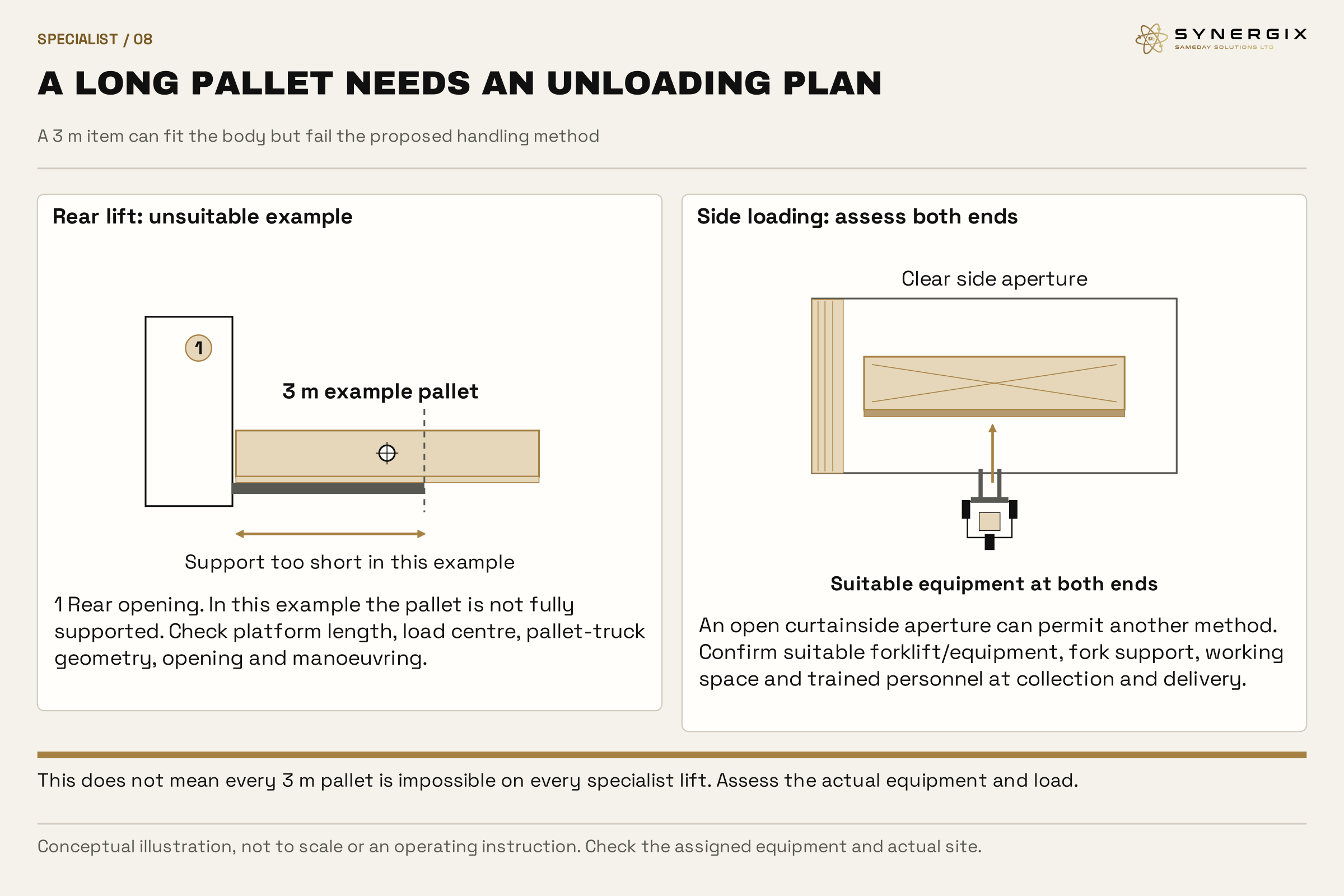
Why a 3 m pallet can fail
A long pallet needs a compatible clear rear aperture, a supported path from the body and a sufficiently large/rated platform. Turning it does not necessarily solve the problem: the cargo bay, doors and pump-truck geometry can obstruct the manoeuvre. A standard lift is not approval for a pallet protruding unsupported. Side-loading with a curtainsider and suitable forklift or crane may be the appropriate arrangement.
Door fit is still a separate check
Measure the packaged item through its actual loading orientation and allow for pallet-truck lift height and handling clearance. A body with a 2.2 m internal height may have a smaller clear rear opening. A lift platform that can raise the weight does not prove that the load can pass safely into or out of the body.
Our powered pump-truck requirement
Under Synergix’s booking rule, an individual loaded pallet weighing 800 kg or more requires an electric pump truck when pallet-truck handling is needed. This is a company handling requirement, not a universal legal threshold. Lighter pallets may also need powered handling because of the surface, slope, distance or task. Tell us before booking rather than assuming any driver carries a powered truck.
Pallet base and powered equipment
Fork length, runner layout, pallet integrity and clearance determine whether a pallet truck can handle the load. Some pallet shapes cannot be picked up from the required side. Powered pallet trucks also add mass, need compatible lift capacity and require a suitable battery/charging plan. The pallet truck cannot traverse steps, deep gravel or unsuitable thresholds simply because it is electric.
Ground, traffic and rolling loads
A suitable level standing area and firm route are essential. Crossfall can make a cage or pallet truck run away; soft asphalt, gravel, damaged paving or a steep driveway can prevent controlled movement. Lift edge protection, roll stops and other controls must suit the load. Parking brakes on cages do not replace all restraint and handling precautions.
People riding a tail lift
A platform intended and approved to carry an operator needs the correct controls and protection. People must not ride a goods-only lift. Any authorised rider is included in the platform load, and the operating instructions govern position and use. Being a delivery driver does not automatically permit riding every platform or using it as access to an upper floor.
LOLER certification means the written examination report
Check the equipment identity, date, next due date and any defects or restrictions in its thorough-examination report. A sticker alone does not establish current suitability. Unless a competent person’s written examination scheme specifies otherwise, equipment lifting people and lifting accessories have six-month examination intervals; other lifting equipment has twelve-month intervals. A tail lift used to carry people therefore needs the relevant people-lifting examination regime.
Servicing is not thorough examination
Routine maintenance, an annual vehicle test, a hydraulic repair and a LOLER thorough examination serve different purposes. All necessary duties still apply. The operator must act on dangerous defects and carry out appropriate pre-use checks. Check the platform, connections, controls, leakage, guards and safety features through the manufacturer’s system. Never override a defect because a delivery slot is urgent.
Tail lift versus a MOFFETT or HIAB
Choose a lift for appropriate ground-level rear unloading on suitable surfaces. A MOFFETT can take compatible goods across an assessed site; a crane can place a load within its lift plan. A tall, long, irregular or heavy item may need side access or lifting points that a standard pallet truck cannot use. Request the handling outcome, not just the cheapest equipment name.
Lift equipment changes the transport price
The lift, pallet truck and fittings use payload and cost money to maintain and examine. Loading/unloading, manoeuvring, waiting and travel beyond the rear of the vehicle use working time. Specify additional people, long carrying distances or access restrictions when enquiring. A tail-lift quote does not automatically include indoor delivery, stairs or assembly.

See the vehicle-selection tail-lift overview or tell us the pallet size and individual loaded weight in your quote enquiry.
HIAB crane vehicles and loader-crane haulage
The required lift is defined by mass, reach, height, configuration, access and ground support. A headline crane size cannot answer all of those.
What HIAB means
HIAB is a manufacturer’s brand commonly used to describe a lorry-mounted loader crane. Other loader-crane brands exist. These are usually folding or articulated cranes installed on a suitable vehicle, not automatically equivalent to a mobile crane. A rigid, crane tractor with trailer and crane-equipped wagon-and-drag combination have different road and working envelopes.
Tonnes carried and tonnes lifted
The freight payload of the vehicle and the crane’s lifting allowance are independent. A crane installation can reduce how much freight travels on the vehicle while still enabling an otherwise difficult lift. The load chart determines whether it can lift an item from the collection position, through the required path and into its final position. Check both collection and delivery, not just the easier end.
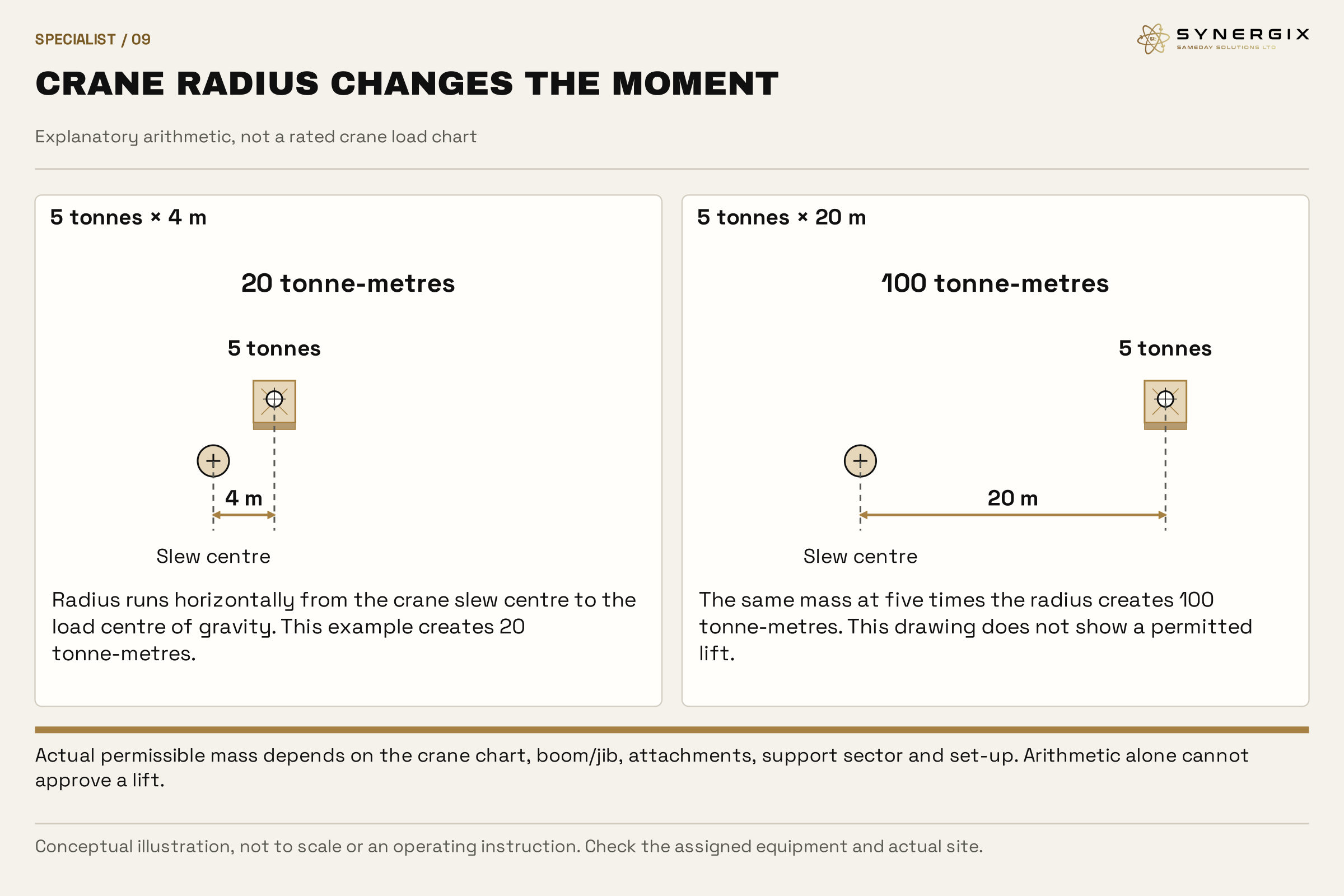
Tonne-metres explain lifting moment
Tonne-metres describe lifting moment, broadly the lifted mass in tonnes multiplied by its horizontal radius in metres. A simplified 5 tonne load at 4 m creates 20 tonne-metres before considering the detailed crane system. That does not mean a crane advertised in a 20 tonne-metre class can lift any 5 tonne load at 4 m. Actual charts include configuration, geometry and other limitations.
Five tonnes close does not mean five tonnes at 20 m
Moving a 5 tonne load from a 4 m radius to a 20 m radius increases the simple load moment from 20 to 100 tonne-metres. Boom weight, hydraulic extensions, attachments, jib geometry and stability also affect capacity. The permitted mass usually reduces at greater outreach. Never quote a maximum close-in lift and the longest reach as if they happen together.
Measure the working radius correctly
Radius is the horizontal distance from the crane’s slew centre to the load’s centre of gravity, not distance from the cab door or the edge of the vehicle. Allow for how far the crane is set back, the vehicle’s standing position and obstacles. A load over a wall or building may require a different boom path, vertical clearance and jib arrangement from an unobstructed ground-level lift.
All lifting accessories count
Slings, chains, shackles, lifting beams, spreaders, pallet forks, grabs or hook attachments add to the suspended mass and can change the load geometry. Supply the cargo weight with packaging and lifting attachments identified. A crane’s rating for a bare hook cannot be assumed to cover the same cargo mass using a substantial lifting beam.
Load chart, jib and stabiliser configuration
The actual chart must match the crane model, extension, jib, lifting attachment, working sector and stabiliser positions. Electronic stability management can restrict a sector or reach based on support deployment. Reduced stabiliser spread does not give the same allowance as full deployment. Manual extensions and supplementary jibs can have their own ratings and limitations.
Outriggers need space and suitable ground
The standing area must support the vehicle and concentrated loads beneath the stabiliser pads. Identify cellars, ducts, trenches, drains, covers, fill and soft verges. Mats or spreader pads distribute load but do not automatically make weak ground suitable. The support assessment must use the actual reactions and ground information. A site that fits the parked lorry may still be too narrow for the assessed stabiliser spread.
Overhead cables are a job-stopping issue until resolved
Tell us about power lines before booking. A crane, load or sling can create a serious electrical danger without touching a conductor. Work near lines needs an assessed arrangement with the network owner, including isolation or suitable exclusion measures as required. Do not invent a universal safe distance from a photograph or assume insulated-looking wires are safe. If the required protection cannot be established, the lift cannot proceed.
Wind, load sail area and weather
The equipment’s operating wind limits and the load’s shape matter. A large lightweight panel, cabin or container can present more wind risk than a compact heavier item. Gusts, visibility, lightning, ice and slippery footing can affect the plan. A stated load mass below the chart is not the whole weather assessment. Delaying an unsafe lift may be necessary even when the road journey is complete.
Lift planning and supervision
LOLER requires lifting operations to be properly planned by a competent person, appropriately supervised and carried out safely. The level of planning should match the risk. A routine assessed lift and a complex blind or tandem lift are different jobs. Specify who provides the plan, operator, slinging/signalling and site control. A transport quote does not automatically include every role needed for a complex lift.
Lifting points, stability and centre of gravity
Provide rated lifting points, structural drawings or the manufacturer’s handling instruction for cabins, machinery and fabricated loads. Do not treat transport tie-down eyes as certified lifting points without evidence. Slings need suitable angles, protection and compatibility. An offset centre of gravity can make a load tilt unexpectedly. A pallet needs an approved lifting arrangement; a loose stack cannot simply be hooked by its wrapping.
Exclusion zones and communication
Keep people away from the suspended load, stabilisers, vehicle movement and trapping points through the site’s agreed arrangements. Blind lifts require suitable communication and supervision, with responsibilities defined before work starts. The crane operator needs control of the work and a safe place to operate. A customer standing beside the load is not a substitute for a competent signaller.
Delivery, installation and lifting people
Placing an item at an agreed location is not automatically installing, connecting or commissioning it. Lifting people requires equipment and arrangements specifically suitable for that task; it is not a standard addition to a freight crane booking. Tell us about any requirement to place goods inside a building or over occupied areas so its separate risks and permissions can be assessed.
Examination, inspection and maintenance
The crane and its lifting accessories need the applicable LOLER thorough examinations, together with maintenance and appropriate checks under PUWER and manufacturer instructions. Accessories normally have six-month examinations; other lifting equipment normally twelve months unless a competent person’s scheme specifies otherwise. Work after damage, major alteration or other exceptional circumstances may need additional examination. An apparently current report does not excuse a new dangerous defect.
Why crane haulage costs more
The crane and reinforced installation add capital cost, tare mass, servicing, inspections and competent operating work. Planning, rigging, set-up, lifting and reinstating the equipment take time beyond road mileage. A long-reach or high-capacity job can require a much larger crane than the cargo’s weight suggests. Supply accurate geometry early so the appropriate equipment is quoted rather than paying for a failed visit.
| Item | Provide |
|---|---|
| Cargo | Verified whole lifting mass, dimensions, centre of gravity, lifting points and photographs |
| Geometry | Horizontal radius from likely slew centre, placing height, boom path and obstacles |
| Support | Standing area, usable stabiliser spread, ground construction and buried hazards |
| Site control | Power lines, traffic, pedestrians, occupied areas, permissions and weather exposure |
| People | Operator, planner, slinger/signaller, supervision and site contacts |
| Scope | Collection/delivery lifts, placing versus installation, waiting and return equipment |
Artic with loader crane
A crane tractor or other crane-equipped artic requires compatible coupling, trailer and load distribution. The crane position can affect both road axle loads and what it reaches on the trailer. Give the trailer length and any lifting requirement from the far end rather than assuming the whole deck is within capacity.
Heavy crane combinations
Large crane units can have additional tractor axles and substantially different tare and carrying allowances. A photograph or extra axle does not establish an ordinary 44-tonne payload promise. The complete vehicle, route and lift plan need an individual assessment.

Enquire about crane haulage or call 01782 911 181. Specialist lifting is supplied only within the agreed scope.
Double-deck box trailers: fixed, floating and lifting floors
A second deck increases useful loading positions for suitable freight. It does not double the legal payload.
Fixed double decks
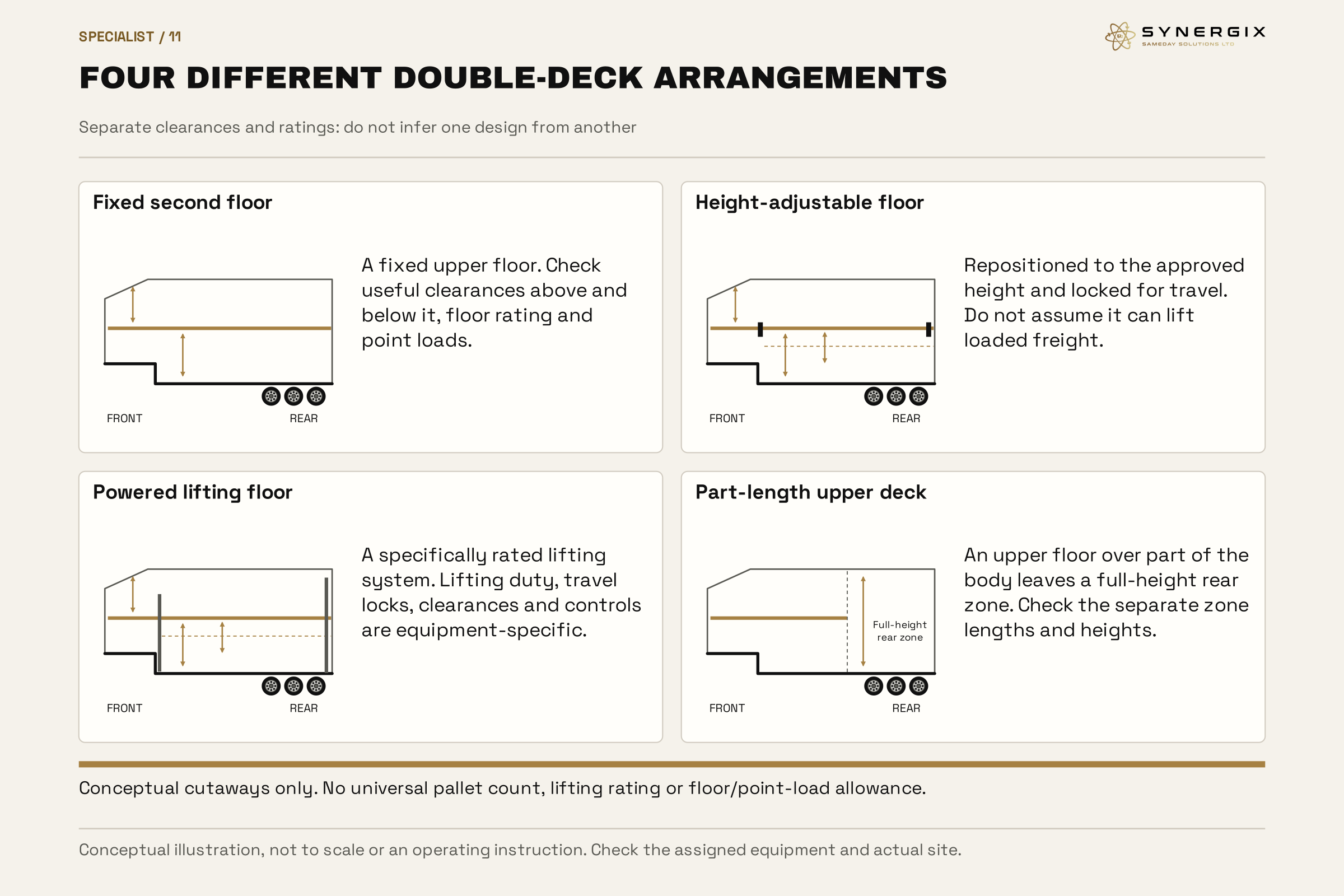
A fixed upper floor creates defined upper and lower loading spaces. It is useful for repeat consignments and docks designed for that trailer. Cargo must suit the clear heights of both decks and the handling arrangement at each level. A standard forklift or dock leveller may serve only one floor. Specify how goods reach the upper level at collection and leave it at delivery.
Adjustable or “floating” floors
Floating floor is an informal description that can refer to different adjustable or lifting systems. Ask for the actual mechanism: a height-adjustable deck locked for travel, a powered deck used for loading, or a split system with separate sections. State whether the adjustment is required with freight on the deck. Do not assume a manually adjustable floor is designed to lift a loaded deck.
Powered lifting decks
A lifting deck can bring an approved load to a suitable loading height, then move to its specified travel position. Capacity during movement, deck locks, interlocks and uniform-load requirements are equipment-specific. The fact that a deck can hold a distributed load does not prove it can take a concentrated machine or a forklift. Keep people clear of the moving floor through the manufacturer’s operating system.
Part-length and split configurations
Some bodies retain a full-height area at the rear and a second deck elsewhere. Others use independent sections or stepped upper levels. These layouts can mix taller and shorter freight, but the useful lengths, clear heights and access paths differ. Provide a load drawing where tall items and upper-deck freight must share the trailer. The floor cannot be treated as one uninterrupted 13.6 m rectangle.
Step-frame box bodies
A lower main deck behind a raised foredeck can increase available internal height or volume. Wheelboxes, the front step and deck structures affect loading paths. A low floor can require a different dock interface and access assessment. The lower floor does not automatically make the whole vehicle low: double-deck bodies can still have substantial overall road height.
Separate floor and point-load ratings
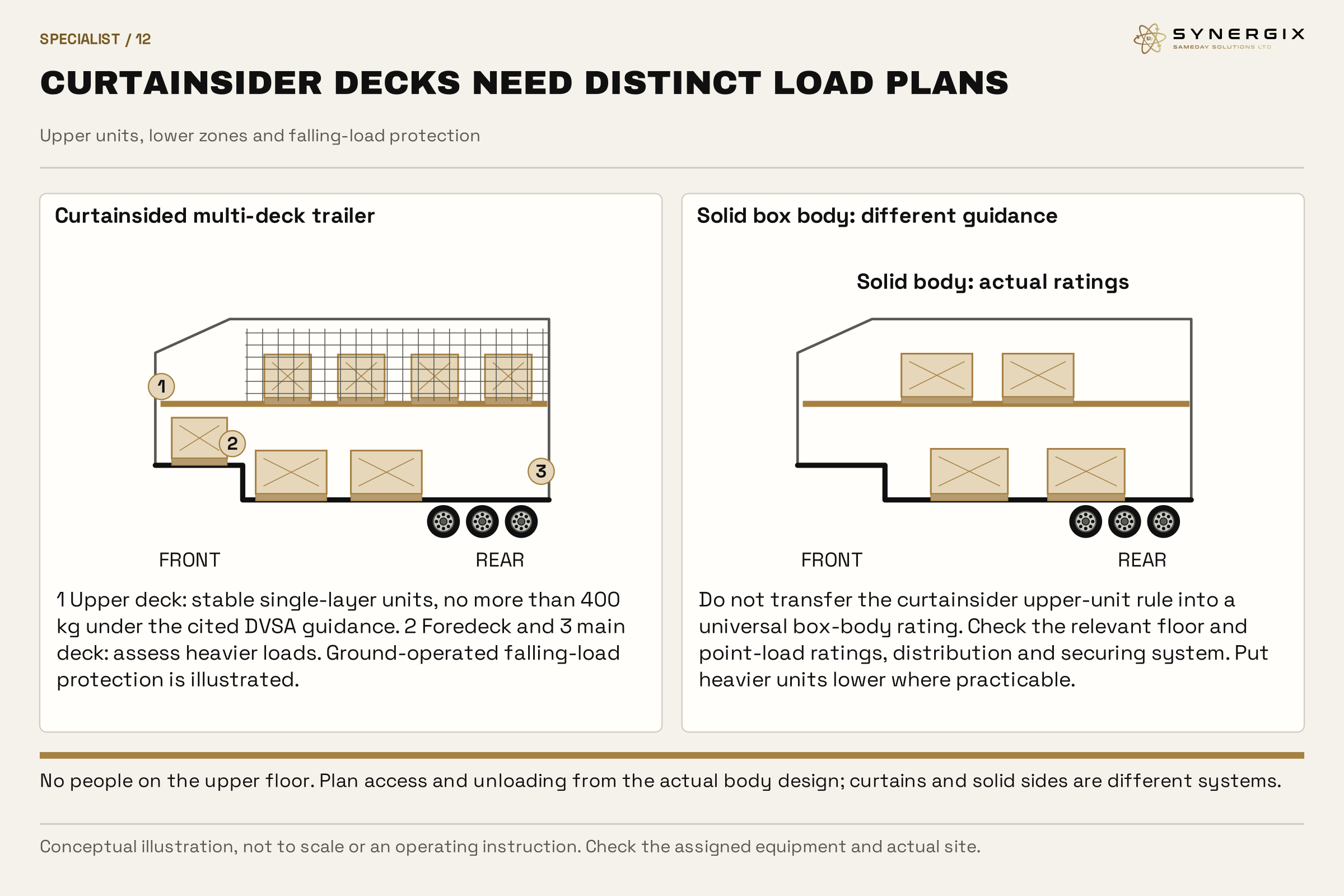
Confirm upper-deck, lower-deck, foredeck and moving-deck ratings, together with local wheel or point loads. Goods on the upper floor also affect the vehicle’s centre of gravity. Heavier suitable freight is generally better kept low, subject to the load plan and axle limits. Do not decide the layout from pallet numbers alone.
Box-body load restraint
Solid sides can contribute to restraint, but goods still need a suitable load plan, rated blocking/bars or other securing where gaps and movement risks remain. Upper-deck pallet limits differ from curtainsided multi-decks: box-sided bodies can accommodate heavier units where deck and body specifications permit. Do not transplant the curtainsider upper-deck rule into every box trailer, or assume a rigid wall approves every stack.
Benefits and disadvantages
Double decks suit volume-limited stock, retail distribution, parcel/cage work and suitable lighter freight. They can reduce vehicle trips where the load, route and receiving equipment support the plan. They add floor weight, machinery or structure and loading complexity. A height restriction, incompatible dock or high point load can make a conventional trailer the better choice despite fewer floor positions.
Double-deck curtainsiders and split floors
Specify the actual floor arrangement and side-loading openings. “Double deck” does not describe one standard layout.
Full-length and 50/50 decks
A full-length upper deck can divide much of the body into two loading levels. A 50/50 description may refer to a roughly equal height split, separate floor sections or another operator’s shorthand. Give the required upper/lower clear heights, useful lengths and cargo positions rather than relying on that label. The actual drawings and ratings control.
Split, folding and removable sections
Some floor sections can fold or be repositioned to create taller bays. Structural supports, handling time, locks and permitted load configurations differ. A section is not movable under load unless the design expressly permits it. Confirm who sets the deck and whether changing configuration between drops is practical. Removed components also need a secure travel position.
Step-frame double decks
A raised foredeck, lower main floor and upper deck create several distinct loading zones. Freight must pass through the relevant openings and remain accessible in delivery order. A low lower floor does not guarantee a tall item can pass the intermediate structure or sit beneath every upper section. Measure each zone independently.
Upper-deck curtainsider restraint
Current DVSA guidance for curtainsided multi-deck loads calls for stable, single-layer upper-deck items weighing no more than 400 kg each, with suitable protection against falling when curtains open. Hanging internal nets or roof buckle straps are not a solution for heavier items or stacks. Heavier freight belongs on suitable lower/foredeck positions with appropriate securing. Deck strength alone does not override the restraint guidance.
XL certification is not the whole answer
An XL body rating applies to the certified complete structure and its loading conditions. Upper-floor falling hazards remain even where the body contributes to road restraint. Gaps, part loads and unloading stages can need extra restraint. Check the manufacturer’s certificate for the actual deck height and load arrangement instead of applying a single-deck positive-fit assumption.
Side access, forks and work at height
The forklift needs enough rated reach and clear aperture to place goods on the upper level. Posts, roof rails and deck beams can restrict access. The operation also needs protection against falls and falling goods; climbing into the upper deck is not a normal shortcut. A receiver with one small forklift may not be equipped to unload the booked trailer.
Pallet count and payload
There is no universal double-deck UK or Euro pallet count. Clear footprint, posts, wheelboxes, upper/lower lengths, load heights and restraint determine usable positions. Freight weight must remain within the whole vehicle, axles and each floor rating. Adding a second floor can make the vehicle more suitable for bulky light stock while reducing the maximum mass available for freight.
When a single deck is better
Tall crates, heavy individual pallets, irregular plant and receivers without upper-level handling can suit a single-deck body. Avoid paying for spare upper space that cannot actually be used. Tell us whether upper-deck freight is lighter and shorter, and whether it is loaded or unloaded separately from the lower deck.
Step-frame trailers and stepped load decks
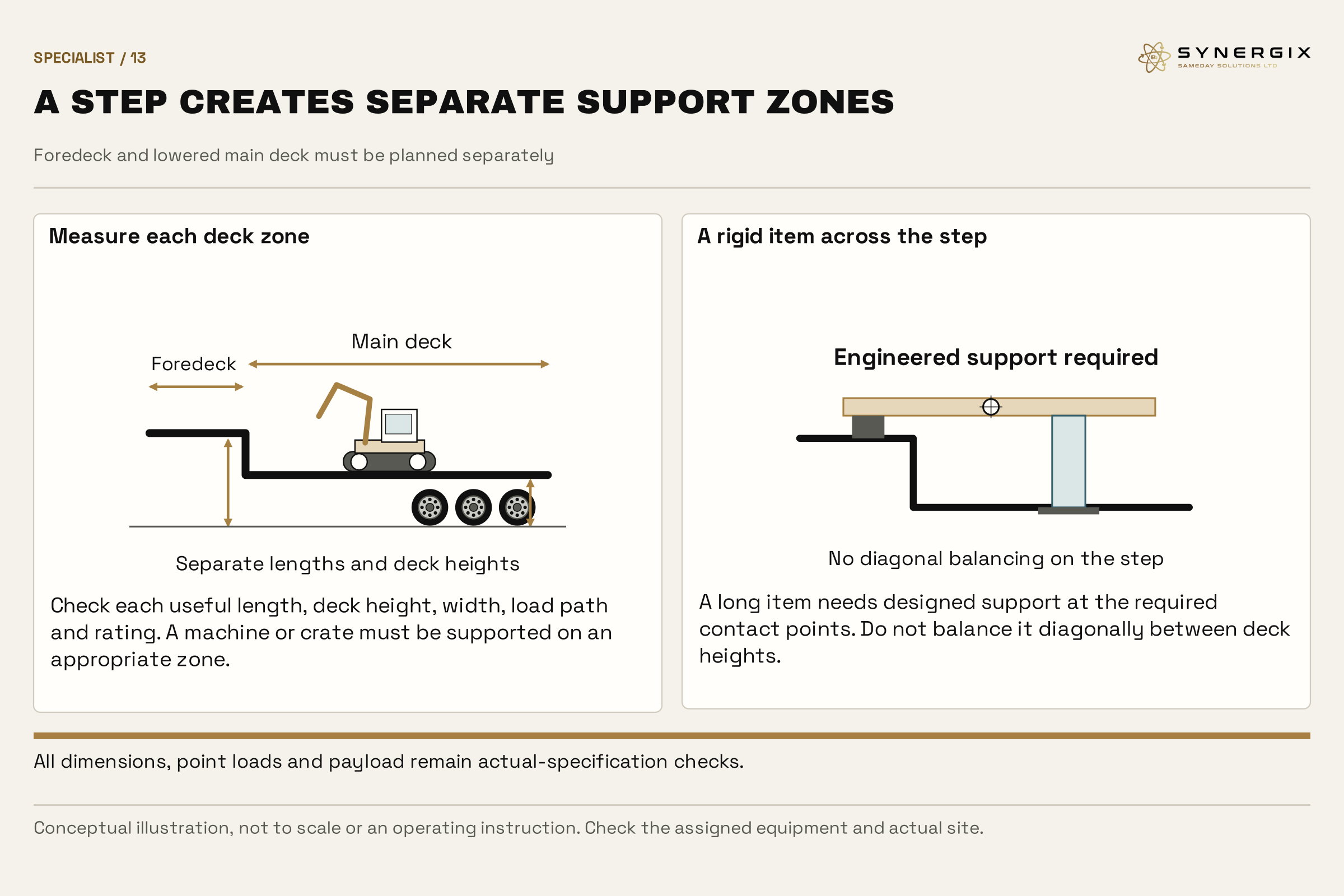
A step frame gives different deck heights and lengths along the vehicle. It is a layout choice, not one fixed payload or clearance.
What a step frame is used for
The front deck sits above the tractor coupling area and the main deck is lower behind it. Depending on the body, this can help with tall machinery, plant, bulky equipment or double-deck freight. Open, enclosed, curtain and other specialist bodies can use a stepped chassis. Request the needed loading outcome rather than assuming all step frames are plant trailers.
Each deck needs its own measurements
Ask for the useful foredeck length/width, the lower-deck length/width, the step height, floor height and any wheel or rear structures. A 4 m machine may fit on the lower deck but not across the step. A long rigid object needs approved continuous support or a designed cradle; it cannot simply bridge two levels where the support geometry is wrong.
Loading method and clearances
Rear ramps, forklift access, crane loading or a detachable front are separate equipment options. Approach and breakover angles, ground clearance and traction matter for wheeled or tracked plant. Tall equipment can meet its travel-height target on the main deck but be unable to negotiate the ramp or step. Include any attachments and whether the machine is mobile.
Payload, point loads and restraint
The actual tare, plate, axles and route determine freight allowance. The deck and step also need to support local load concentrations. Use the equipment’s approved transport tie-down points, suitable lashing angles and blocking. A hydraulic parking brake on carried plant is not the complete road restraint system.
Advantages and trade-offs
A step frame can gain usable cargo height without needing the deepest low-loader well. However, the raised front takes some full-height length away, deck transitions complicate loading and access needs care. For a very low machine or difficult ramp angle, another low-loader arrangement may be more appropriate.
What to send
Supply the machine’s travel dimensions and mass, track/wheel base, ground clearance, centre of gravity, load/support points and photographs. State whether it drives, steers and brakes, how it will be loaded and whether it needs winching. Include any requirement to move a crane boom, cab, bucket or other attachment into transport position.
Low loaders, plant transport and machinery haulage
A low main deck can help with tall or heavy equipment, but loading geometry, concentrated weight and the route still decide the vehicle.
Low loader and semi-low loader are not identical
Semi-low loaders often use a lowered main platform behind a raised neck with rear loading ramps. A deeper low-bed/well trailer may have a detachable neck or another specialist loading arrangement. Names vary between operators and manufacturers. Ask for the actual deck and loading system. Extendable or multi-axle equipment needs its own specification and route assessment.
Payload is not a universal “maximum”
Published technical capacities can refer to a particular trailer, axle configuration or permitted speed and may exceed the allowance for an ordinary road movement. The complete tractor/trailer tare, plates, axle loads, load distribution and movement regime govern usable freight mass. A low deck does not automatically authorise an overweight load. Confirm the loaded plant weight rather than using a dry brochure figure.
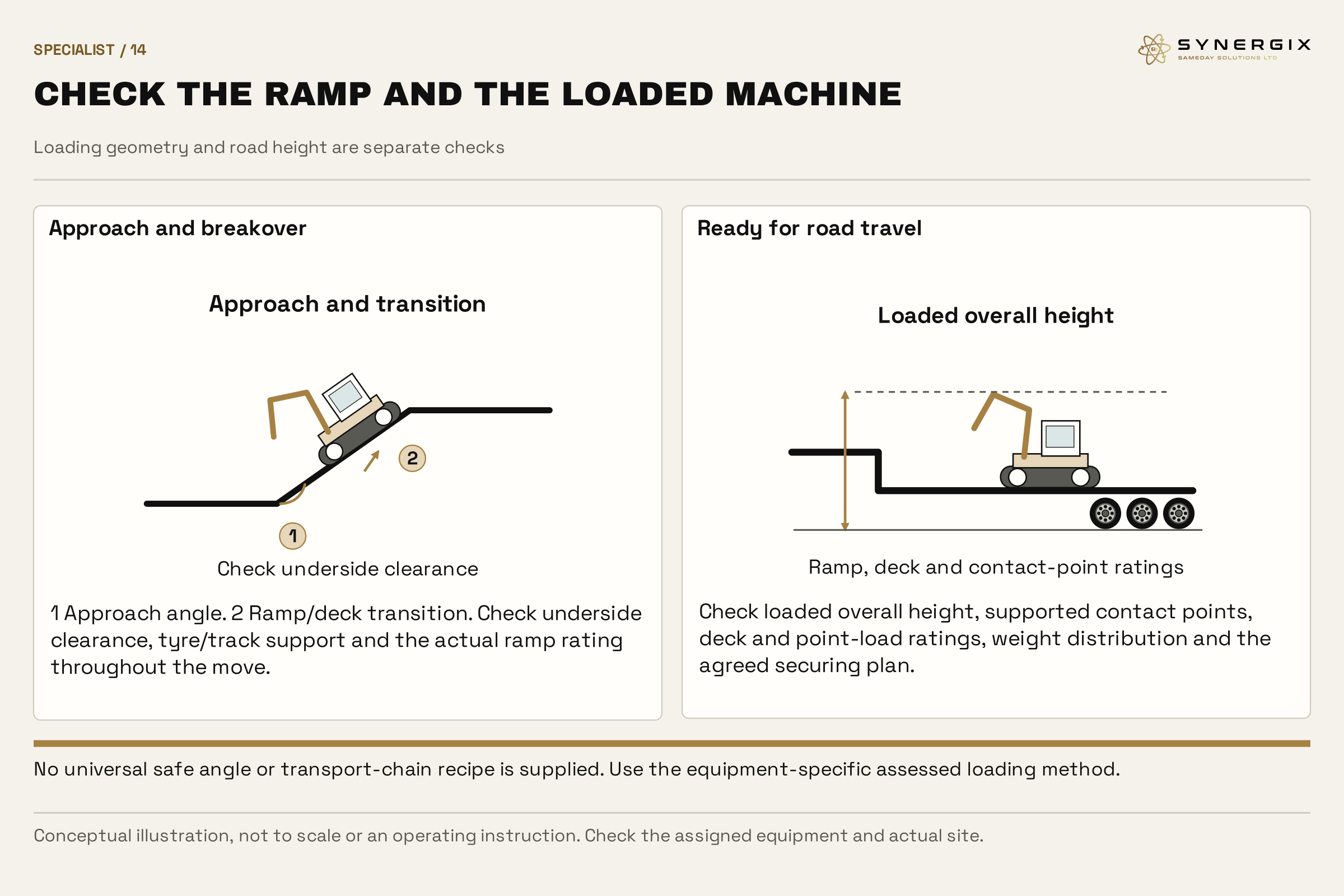
Ramps, traction and loading angles
Ramp width, spacing, length, rating and surface must suit the machine’s tyres or tracks and operating condition. The equipment’s ground clearance, approach angle and breakover geometry affect whether it can load without grounding. A non-running machine needs an agreed recovery or lifting method. Winch capacity, anchor arrangements and the control of movement are assessed separately.
Tracks, wheels and support
The machine must be sufficiently supported through the approved platform or designed support arrangement. Overhanging tracks are not acceptable merely because the central body fits. Concentrated wheel or track loads can exceed local deck strength. Ancillary attachments and their support requirements need declaring. Do not use fragile underbody components as convenient resting points.
Machine transport condition
Include attachments, fuel, buckets, counterweights, cab height and any goods carried within or on the machine when establishing weight and dimensions. Hydraulic booms and articulated parts need their specified travel positions and restraint. Folding a part for the journey must be possible using the approved system; removal or reassembly is separate work to agree.
Load security
Use the approved machine tie-down locations, suitable chains or other restraint, correct geometry, blocking where required and protection against movement of attachments. A brake, transmission lock or winch cable is not the whole securing system. Chains need matching rated fittings and anchor points. Delivery stages and trailer extension changes can alter the arrangement.
Road height and underside clearance
Measure the complete loaded height and every projection. A lower deck can improve bridge clearance but may reduce underside clearance on humps, ramps, steep entrances and uneven sites. Steering behaviour, rear swing and the tractor’s route into the site are part of access planning. A route suitable for a box artic is not automatically suitable for the low loader.
Abnormal-load and project arrangements
Wide, long or heavy loads can need notifications, route surveys, escort arrangements or special orders depending on the actual dimensions and applicable regime. The operator must establish which rules apply. Divisible goods cannot automatically be treated like an indivisible abnormal load to avoid ordinary limits. Tell us what can be dismantled and the required date early enough for the movement to be assessed.
Safe loading area
The loading surface must support the trailer, tractor and plant and provide space for the whole manoeuvre. Segregate other vehicles and people through an agreed system. Do not load beside a drop, on inadequate ground or under unresolved overhead hazards. Loading in darkness or bad weather needs suitable visibility and control, not merely lights on the lorry.
Choosing between flatbed, step frame and low loader
A flatbed may be simpler for a compact machine lifted on and off. A step frame can help with extra cargo height on a suitable deck. A low loader may solve height or ramp-angle requirements at greater cost and with different access needs. Select from the complete cargo and site geometry; the lightest machine is not always the simplest to load.
Discuss plant and low-loader transport with the machine details and photographs.
Skeletal trailers, containers and demountable bodies
A skeletal supports compatible container or body mounting points. It is not an ordinary flatbed with the floor removed.
20 ft, 40 ft and 45 ft containers
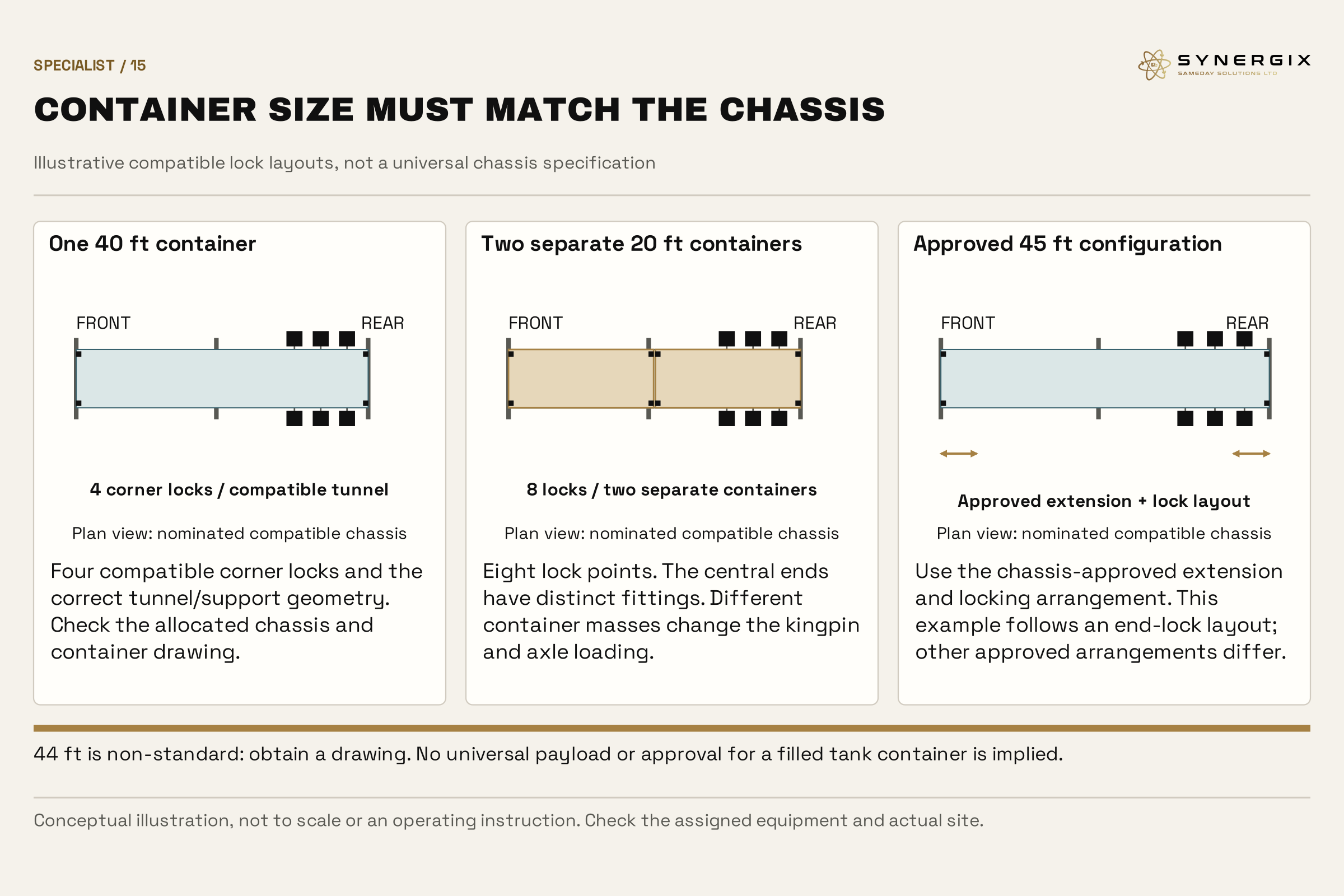
Specify the container’s actual length, width, height, corner fittings and gross mass. Common road-container arrangements include one 40 ft, two 20 ft containers or a suitable 45 ft container on a compatible chassis. A 45 ft pallet-wide unit may require particular extensions and geometry. “44 ft” is not a standard substitute for these labels; non-standard units need their actual drawing and mounting positions.
Two 20 ft containers need the correct chassis
The frame needs approved locks and support positions for both containers, with acceptable kingpin and axle loading. Gross weights do not simply split equally because the containers are the same length. A heavy front container and a light rear container can place different loads on the tractor and trailer group. Handling order, terminal access and whether either box remains after a delivery also matter.
A single 20 ft container may need a different position
A rear-flush 20 ft box can be convenient at a dock but may create an unsuitable load distribution on some chassis. Central, front, rear or sliding arrangements are manufacturer-specific. Use the chassis’s authorised position and load chart, not an improvised placement on spare twistlocks. A lift axle or slide does not automatically cure an overloaded axle.
Container tare reduces product payload
The road freight allowance includes the container, packaging and all goods inside it. If a complete combination can accept 26,000 kg of container-and-contents and the container weighs 4,000 kg, only 22,000 kg remains for goods and their packing before any other limiting check. This is an illustrative subtraction, not a promise of a particular chassis or container allowance.
Container plate and condition
Check the container’s identity, maximum gross rating, tare and relevant safety approval/examination status. Doors, corner castings, structure and floors must be suitable for the load and handling method. International container movements may depend on the CSC safety-approval plate and inspection regime. A container’s permitted gross mass does not override the truck’s lower road or axle allowance.
Twistlocks and approved supports
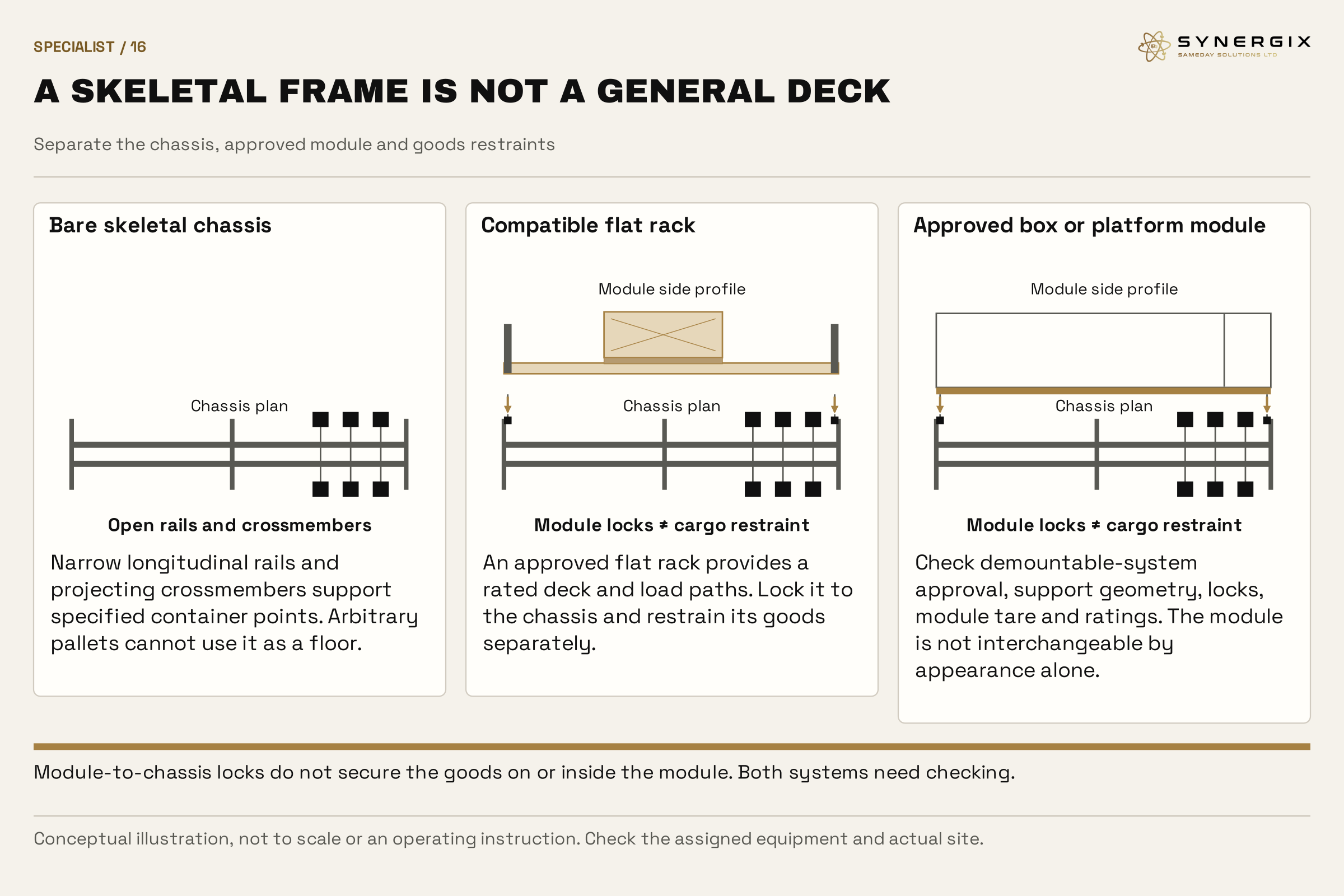
Container locks must correspond to the actual corner fittings and be correctly engaged and checked through the approved system. A skeleton supports a container through designed load paths; freight cannot be balanced on bare chassis crossmembers as though they formed a load deck. Extensions and locking pins require their own checks. A compatible footprint alone does not prove suitable structural support.
Flat racks and approved platform modules
A compatible flat rack or engineered demountable platform can provide an open cargo deck on a suitable skeletal. The module, fittings, chassis and loading conditions must be approved together. This is not permission to put an arbitrary 40 ft or 44 ft flatbed structure on top and strap it down. Include the module’s mass, usable dimensions, point-load ratings and rated cargo anchors.
Box bodies, swap bodies and specialised units
Certain skeletal or swap-body chassis accept approved demountable boxes, tanks or other bodies with the correct fittings and support. Not every container chassis accepts every swap body or filled tank container. Tank loads have different structural and dynamic effects. Specify the actual body and manufacturer approval; a standard skeletal booking does not automatically include a box, platform or container.
High cube and loaded road height
A high-cube container is taller than a standard-height box and must be matched to suitable chassis/coupling height and the route. Measure the overall loaded height, including the carrier. Tunnels, bridges and dock entrances can rule out a combination even when the container is a standard size. International route height limits and port rules also need checking.
The goods inside still need securing
Locking the container to the chassis secures the container, not every item inside it. The packed load needs an appropriate system against movement, including correct distribution and safe access when doors open. A seal is tamper evidence, not proof of load restraint or weight. The packing party must provide enough information for the road movement and acceptance checks.
Ports, VGM and documentation
Where a packed container is shipped by sea under the relevant SOLAS rules, the shipper needs verified gross mass before loading on the vessel. That is separate from checking road weight and axles. Give container number, seal, terminal reference, release status, booking slot, customs requirements and who provides the lifting equipment. A missing release or weight can prevent collection despite a truck being present.
Lift-on, lift-off and ground delivery
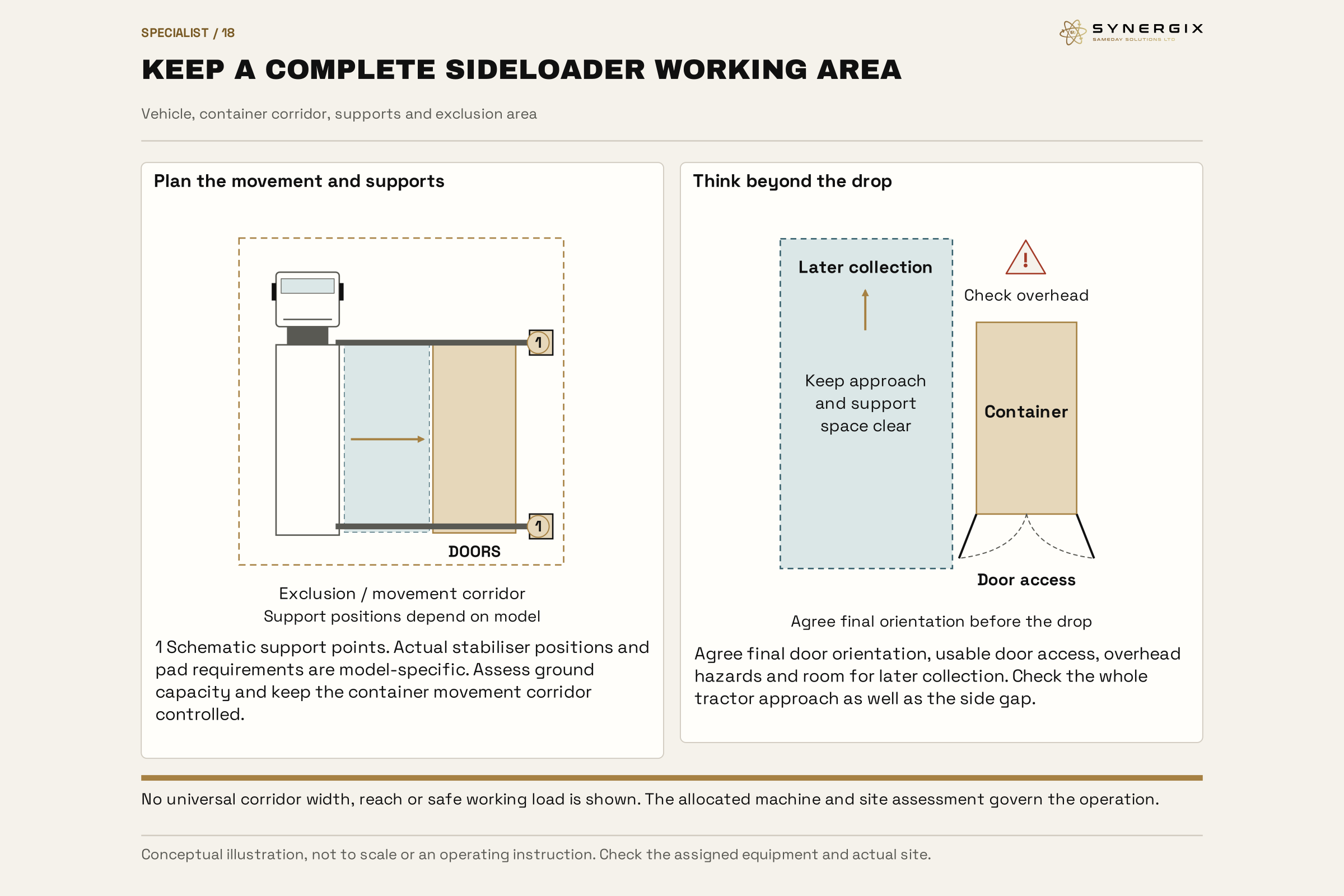
A plain skeletal normally needs external container-handling equipment at the relevant handover points. A Megalift/side-loader or an assessed crane arrangement provides different handling options at greater tare and cost. If the container needs to be left on the ground, say so explicitly. Door orientation, final level and access for later collection must be agreed.
Megalift and container side-loader access
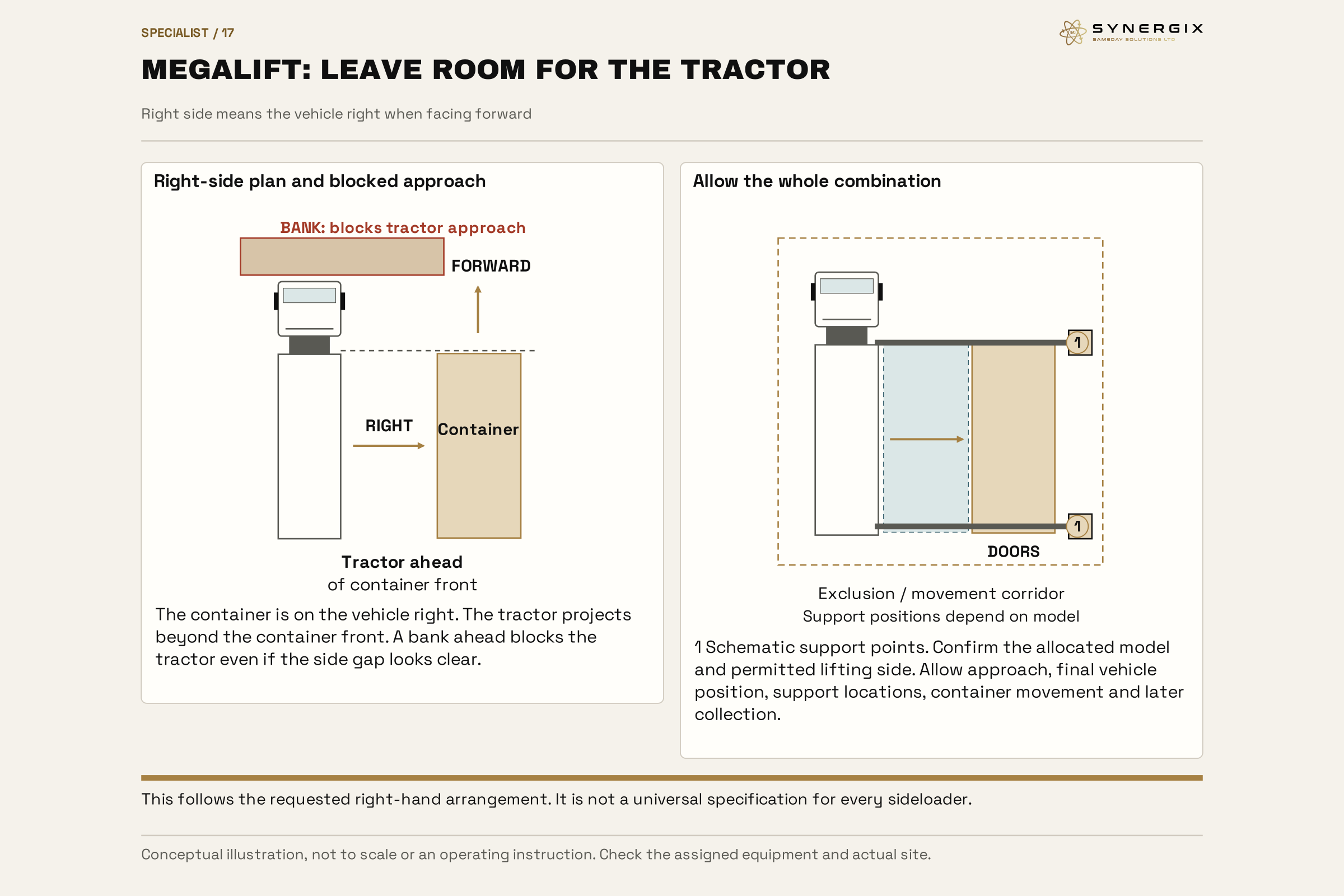
The lifting side and the space for the tractor in front of the container are booking essentials.
What a self-loading container trailer does
Two specialist lifting modules can place a compatible container beside the trailer or perform an approved transfer to another carrier. Lifting capacity, container size, support geometry and working reach depend on the actual installation. It is different from a plain skeletal needing a separate reach stacker, and different from a general loader crane.
Right-hand-side access in this arrangement
For the right-hand-loading Megalift arrangement covered by our booking brief, the container must be accessible on the vehicle’s right-hand side, as viewed facing forwards. Do not orient the drawing from the container’s perspective and accidentally reverse the sides. Other side-loader configurations can differ. Confirm the allocated equipment’s lifting side before preparing either site.
The tractor needs room in front
The trailer can only line up with the container if the whole coupled vehicle can reach and occupy the required position. A bank, wall, building or parked vehicle beyond the container’s forward end can block the tractor, even when there is clear space down the lifting side. Send a site plan showing the full container length and the available area beyond both ends.
Allow for the whole working corridor
The assessment covers vehicle width, the gap to the container, lifting modules, deployed stabilisers, container movement and a controlled exclusion area. Side clearance alone is not the complete requirement. The container may need to move through a curved lifting path, and support legs need rated ground positions. There is no universal clearance number that suits every model and lift.
Container gross mass and lifting condition
Give the container’s gross mass, contents, dimensions and centre-of-gravity concerns. The container and its lifting fittings must be suitable and accessible. Modified units, damaged castings, attached canopies, pipes or air-conditioning equipment can interfere with the lift and travel envelope. The lifting allowance does not automatically equal the permissible road-carried mass.
Two 20 ft containers and transfer jobs
A system may offer specific options for one 20 ft, one 40 ft, one 45 ft or two 20 ft containers. Whether two containers can be lifted together depends on the approved joining arrangement and ratings, not simply adding their weights. Transfer to another chassis, rail or raised position is also configuration-dependent. Declare the actual task rather than asking for a generic container delivery.
Ground, level and overhead obstacles
Both the vehicle and support positions need appropriate load-bearing ground. Declared surface appearance is not proof of strength over drains or buried structures. Overhead cables, trees, canopy roofs and fixed services can obstruct the lift. The final container position needs suitable support and usable door clearance. A large side opening does not make a poorly supported location acceptable.
Cost, payload and booking evidence
Lifting modules, chassis, hydraulics and support equipment add substantial tare and operating cost. Include the container’s own mass within the freight allowance. Allow time for set-up, checks, lifting and collection positioning. Photographs from each end and the intended approach direction are particularly useful. Do not move the container into a tight final position before its future collection route is checked.
Walking floor and moving-floor trailers
A hydraulic moving floor discharges suitable material horizontally, avoiding the need to raise a tipping body.
How the moving floor works
Groups of floor slats move through a controlled hydraulic sequence that advances suitable material towards the rear. WALKING FLOOR is a recognised brand name; moving floor is the wider equipment description. The floor, sidewalls, rear opening, sweeping system and product must work together. Do not assume a generic trailer accepts every material a floor manufacturer advertises.
Useful materials and applications
Appropriate wood products, biomass, agricultural bulk, recyclable material and certain waste streams can suit the right body and floor. Some systems also handle suitable bagged, baled or palletised freight. Material compatibility, prior loads, cleanliness, sharpness, temperature and moisture must be agreed. Product suitability is not established merely by describing it as bulk.
Pallets are a separate loading case
Suitable pallets may require an approved floor layout, unloading aid or tracks. A floor that can move loose wood does not automatically convey every pallet without snagging. A forklift entering the trailer creates wheel loads that the actual floor must support. Loading from the rear also requires a compatible dock or ramp and support arrangement.
Floor choice controls the limitations
Slat thickness, profile, seals and wear resistance vary. Fine powders, sharp scrap, wet loads and abrasive rubble need particular specifications and may be unsuitable. Leak-resistant is not a guarantee of a liquid-tight tank. Sticky or compacted material can bridge or overload the discharge process. Ask for the product-approved floor/body combination.
Maximum payload and bulk density
There is no universal moving-floor payload. The tractor/trailer tare, hydraulic floor, body, axles and road regime determine the permitted mass. A large cubic body can be filled with lightweight material while a dense material reaches the weight limit much sooner. Give the actual density and moisture condition; do not convert a quoted cubic volume into a guaranteed tonne allowance.
Roof sheets and load containment
Book a suitable covering system for the product and ensure the load cannot escape, blow out or create a road hazard. A powered sheet has its own operating instructions and needs to be secured for travel. A load below the sides is not automatically safe without a cover. The operator must justify any permitted uncovered arrangement. Loading height must not prevent the cover from operating correctly.
Unloading space and rear doors
The receiver needs enough space for the rear doors, material discharge and any handling machine. The trailer remains a large road vehicle even though the body does not tip. The site must still provide suitable ground and clearance. Door-release and discharge controls need to protect people from a shifted or pressurised bulk load through the approved procedure.
Hydraulic supply and equipment compatibility
The tractor needs the specified hydraulic/PTO arrangement or other approved power source. Pressure, flow, oil compatibility, return arrangement and connections are equipment-specific. Excess pressure, wrong plumbing or contamination can damage the system and create hazards. A tractor that can tow the trailer does not automatically have the equipment to operate its floor.
Safe use, jams and maintenance
Keep people clear of the moving floor and discharge area. A blockage or jam requires the manufacturer’s isolation and recovery process; do not enter or reach into operating machinery. Slats, seals, hydraulics, guides and controls need maintenance appropriate to use. Product residues can affect hygiene, discharge and mechanical condition.
When it is better than a tipper
Horizontal discharge can help at a receiving point with limited overhead clearance or where raising a body would be unsuitable. It does not authorise use on unsafe ground or under unresolved electrical hazards. A tipper may be better for another compatible material or receiving system. Compare product, floor wear, cleanout, payload, discharge time and site geometry.

Bulk tippers and tipping-body transport
Match the body to the material and the receiving site. Raising the body changes the vehicle’s stability and working height.
What a bulk tipper can carry
Suitable loose aggregate, soil, agricultural material, biomass, scrap or other bulk goods can be carried in an appropriately specified body. Material type determines required structure, wear protection, cleanliness, cover and discharge arrangement. A tipper configured for sharp scrap is not interchangeable with a light grain body. Acceptance of waste or hazardous material needs a separate check.
Maximum payload versus body volume
Subtract the actual ready-to-load tare from the relevant permitted mass, then check axle and body limits. Dense aggregate can reach the weight limit with plenty of body volume left. A high-sided body full of wet material can overload the vehicle. State product density and actual tonnes, not only the number of loader buckets.
Ground and tipping position
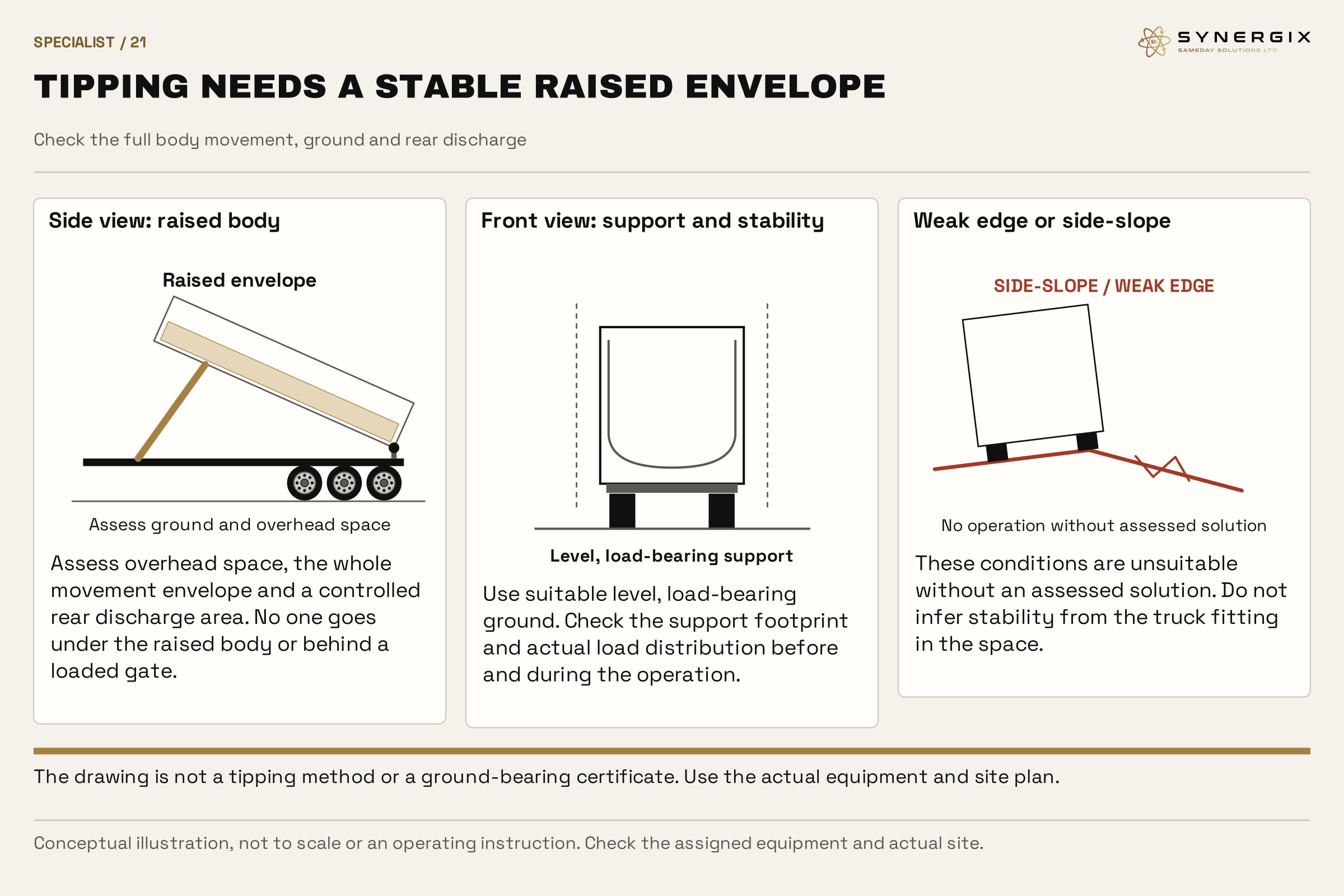
The standing/tipping area must suit the loaded vehicle and raised-body operation. Uneven ground, side slopes, soft edges, drains and trenches can undermine stability. The site needs a controlled tipping point and clear approach/reversing area. Edge protection and required setbacks depend on the site assessment. Do not assume stabilisation is solved by the truck’s tyres being on a paved surface.
Raised height and power lines
Include the full raised-body envelope, not just travel height. Buildings, overhead conveyors, trees and power lines can prevent tipping. Electrical danger must be resolved through the appropriate assessed arrangements. A vehicle that can enter a shed can still be unable to discharge inside it. Consider another compatible discharge method where the raised body cannot be accommodated.
Load sticking and instability
Wet, frozen, cohesive or unevenly distributed material can stay high in the body during tipping, increasing risk. The body and discharge method must suit the product. The operator follows the manufacturer’s controlled system for any failure to discharge; driving, jerking or improvising a release is not an acceptable customer instruction.
Rear gate, discharge and sheeting
Tailgate type, opening, locks and clearance must suit the material. The roof cover may need a particular position during discharge to avoid damage or a vacuum, depending on the equipment. For road travel, containment must prevent escape. Do not rely on material settling after departure or use a net where a suitable sheet is needed.
Waste, product history and cleaning
Declare waste status, contamination and any hazardous classification. The movement may need appropriate carrier registration, records and receiving-site acceptance. Food or feed work needs its applicable hygiene system and restrictions on earlier loads. A visually clean body does not prove it is acceptable for every agricultural or food ingredient.
Receiving and price arrangements
Give the agreed tip point, available hours, weighbridge arrangements, unloading method and permitted time on site. Waiting for a loader or a blocked receiving hopper affects working time. Road mileage is only one part of the price; tipping-system compatibility, body suitability, cleaning and a lawful route also matter.
Alloy U-shaped and half-pipe tippers
A rounded alloy body is a particular construction choice. Its material and floor design determine which loads it can accept.
Alloy, steel and body shape
U-shaped or half-pipe describes the rounded body form; alloy describes its material. A rounded steel body and a rounded aluminium-alloy body are not the same specification. Material, thickness, lining and impact rating control suitability. Do not book sharp demolition chunks or heavy point-impact loads merely because another half-pipe vehicle carries them.
Potential benefits
A suitable lighter body can leave more weight allowance for cargo, and its shape can assist the discharge of certain bulk materials. That benefit is design-specific and still subject to gross/axle limits. The rounded section also affects usable volume and how the material lies in the body.
Material and temperature limits
Give the product’s density, maximum piece size, temperature, sharpness and expected loading impact. Hot materials, aggressive chemicals, large rocks and scrap can require another construction or protective lining. A liner can alter tare, usable volume, discharge behaviour and cleaning. Follow the actual approved body specification.
Payload and loading method
Do not assume an alloy body always carries more than every other tipper. The complete tractor/trailer tare and fitted equipment decide the actual allowance. A loader bucket can impose a damaging impact despite the final load being within payload. Agree how material will be placed and how the loading operator knows the accepted specification.
Tipping and covers
The same stability, ground, gate, raised-height and containment checks apply as to other tippers. An easy-flowing shape does not remove the danger of a wet or frozen load sticking. Compatible sheeting must close without leaving escape gaps and operate through the manufacturer’s intended process.
Cleaning and product acceptance
Previous cargo, residues, corrosion concerns and any food/feed specification need declaring. Cleaning requirements and records can affect turnaround and price. The body shape does not establish food-grade status, waste acceptance or a universal suitable cleaning method.
Tankers: liquid, powder, food-grade and dangerous goods
Select the tank, product-contact system and discharge method for the actual substance. “A tanker” is not one interchangeable vehicle.
Liquid and dry-bulk tankers
Liquids may use gravity, pump or other approved discharge arrangements. Dry-bulk products such as suitable flour, powders or granules can use purpose-built pneumatic systems. A liquid-fuel tanker is not a flour trailer. Product characteristics, tank construction, compartments, hoses, compressor/pump and receiving plant must match the job.
Food-only equipment and previous cargo
Bulk food in liquid, granular or powder form requires equipment reserved for foodstuffs under the applicable hygiene rules. A diesel tanker cannot simply be washed and treated as an acceptable flour or edible-oil carrier. Food-only designation, product-contact materials, previous loads and the approved hygiene system matter. A cleaning ticket does not convert unsuitable non-food equipment into food transport.
Cleaning evidence is product-specific
Agree the approved cleaning process, previous-cargo disclosure, time since cleaning, relevant tank/compartment identification and whether hoses, pumps and other contact equipment are included. Residue-free appearance alone does not prove removal of allergens, odours or chemical contaminants. Receiver requirements may include seals, wash documentation or other verification. No food-safety accreditation or approved wash station is implied by this guide.
Separate products and allergens
Different food products can still be incompatible. A later load may require specific allergen controls, separation or a validated cleaning method. Tank compartments, shared lines, pumps, hoses and valves can provide contamination paths. Specify all previous-load restrictions and the intended receiving process before the tanker is selected.
Chemicals and tank compatibility
The substance must be compatible with the tank, seals, fittings and contact materials at the relevant concentration and temperature. Corrosive, flammable, reactive or toxic products require their own assessment. Give the proper product identity and safety data, not only a trade name. A stainless-steel tank is not universally compatible with every chemical.
ADR and tank carriage
Dangerous goods need the applicable ADR/CDG requirements checked for the substance and movement. Classification, UN number, proper shipping name, packing group where relevant, tank code, segregation and route/tunnel restrictions can govern the job. Where required, the driver needs the appropriate ADR qualifications including the tank specialisation, and the vehicle/tank needs its approvals and examinations. A general HGV licence or a standard transport quote is not enough.
Empty does not necessarily mean non-hazardous
An emptied but uncleaned tank can still contain dangerous residues or vapour and remain subject to dangerous-goods requirements. Cleaning, purging, documentation and applicable exceptions must be assessed, not inferred from the fuel gauge or the word empty. Used hoses and ancillary systems can also retain product.
Documents, markings and emergency arrangements
The applicable movement can require transport documents, written emergency instructions, ADR driver evidence, vehicle approval, markings, placards and suitable equipment. Requirements depend on the product and regime. Agree who provides accurate substance information and dispatch documentation. Any dangerous-goods or hazardous-waste acceptance must be confirmed before the vehicle is sent.
Maximum litres and maximum tonnes
Tank capacity is a volume; freight allowance is a mass. Product density and temperature determine how much a given volume weighs. Allowed filling levels also depend on expansion, tank design and movement/slosh rules. A 30,000 litre body is not permission to load 30,000 kg of every liquid. Compartment loads must also fit the complete vehicle and axle limits.
Slosh, baffles and partially filled compartments
Liquid movement changes vehicle handling and stability. Baffles and compartments can help only within their designed conditions. Approved filling ratios, compartment order and distribution need checking. A low total load can still behave badly in an unsuitable partially filled tank. The driver’s route and driving method must suit the product and equipment.
Discharge connection and receiving capacity
Confirm connection type/size, hose length, receiving tank or silo identity, usable capacity, permitted pressure/flow and access to the inlet. Clearly identify the correct delivery connection. The system may need a suitable pump, compressor, gravity drop or customer equipment. Roadside hose routing, pedestrians and traffic must be controlled. A compatible tank does not prove the receiving equipment is ready.
Pressure, heat and static risks
Pressurised discharge needs equipment, procedures and protection appropriate to the system. Hot product, steam, compressed air and residual pressure can injure people. Flammable vapours and some combustible dusts need suitable ignition/static controls under the relevant risk assessment. Do not loosen fittings or enter a tank to solve a delivery problem; isolation, cleaning and specialist intervention follow the approved system.
Powders, silo filling and contamination
Pneumatic dry-bulk discharge depends on product behaviour, conveying air, pipework and the receiver’s filtration/protection. Moisture, oil contamination, blockages or incompatible product can damage stock or the plant. Flour and other powders can also create combustible dust hazards. Agree the connection and receiving system before dispatch; not every tanker compressor meets every food-contact requirement.
No routine entry into tanks
Tank interiors can present confined-space hazards even when empty. Cleaning or entry requires an appropriate assessed system and competent personnel, with rescue arrangements where needed. This is separate specialist work, not a normal task for a visiting delivery driver. Do not request improvised entry to retrieve a dropped item or inspect a blockage.
Maintenance and testing
The tank body, pressure systems where relevant, valves, hoses, pumps, compressor, seals and vehicle running gear need the appropriate maintenance and inspection regime. ADR vehicle approvals, when required, and tank periodic/intermediate examinations are separate obligations from the roadworthiness test. Dates and certificates depend on the actual tank and service. Ask for the evidence relevant to the confirmed job rather than one generic “tanker certificate”.
What affects the tanker price
Product compatibility, a dedicated food-only or chemical specification, cleaning, wash travel, tanker positioning, permitted discharge time, trained driver and equipment all affect cost. Loads rejected for missing previous-cargo information or an incorrect receiving connection can incur avoidable delays. Send complete product and site details early; acceptance is assessed rather than promised from the illustrated vehicle type.
| Information | Specify |
|---|---|
| Substance | Name, composition/concentration, temperature, density and quantity by mass/volume |
| Classification | Food/feed, chemical, waste or dangerous goods; safety data and ADR details where applicable |
| History | Food-only/previous-load restrictions, required cleaning evidence, seals and contact-system requirements |
| Equipment | Tank/compartment compatibility, hose/connectors, pump/compressor/gravity and discharge limits |
| Receiving site | Identified inlet, spare capacity, personnel, traffic control and agreed unloading time |
| Journey | Countries, restrictions, documents, emergency requirements and collection/delivery windows |
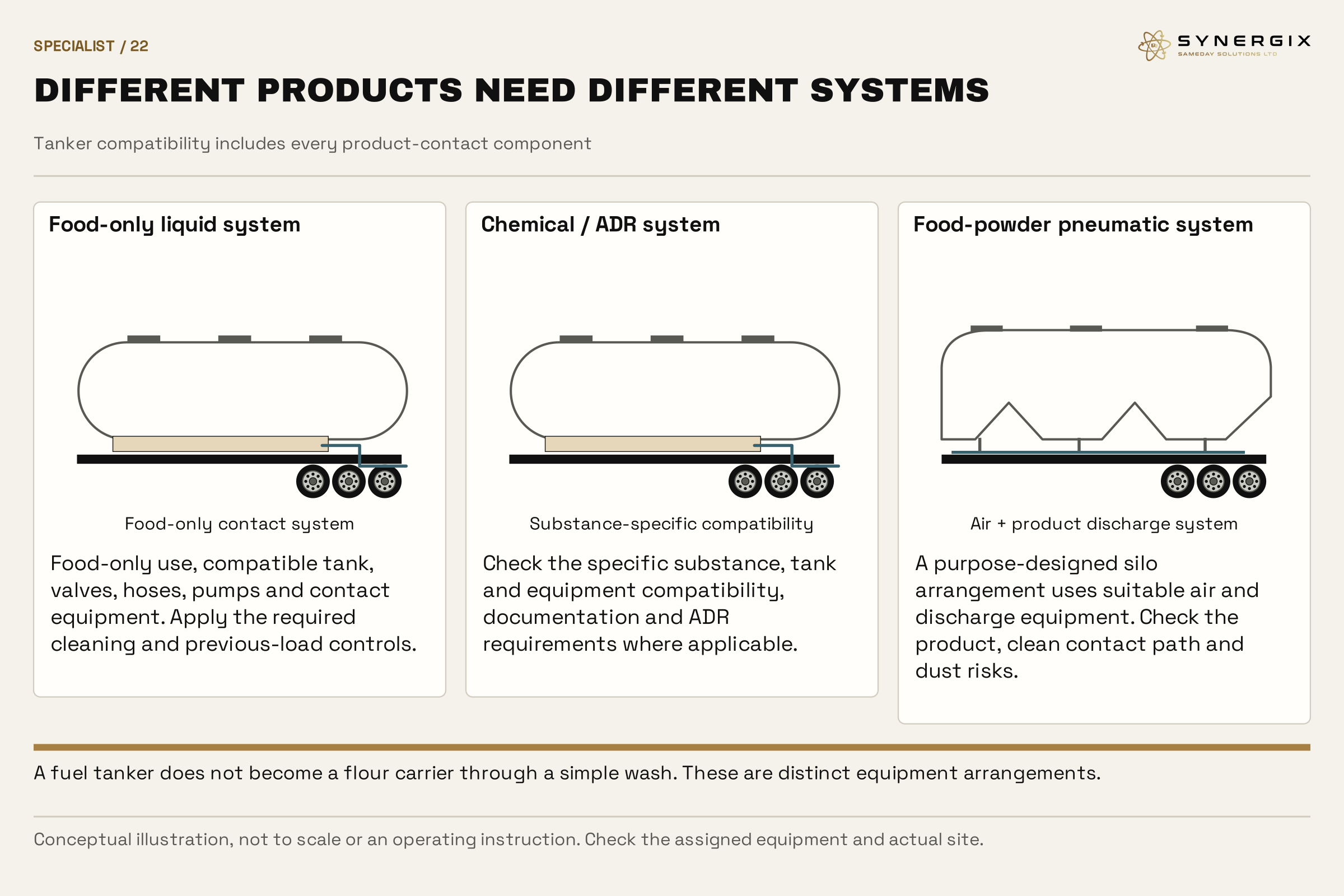
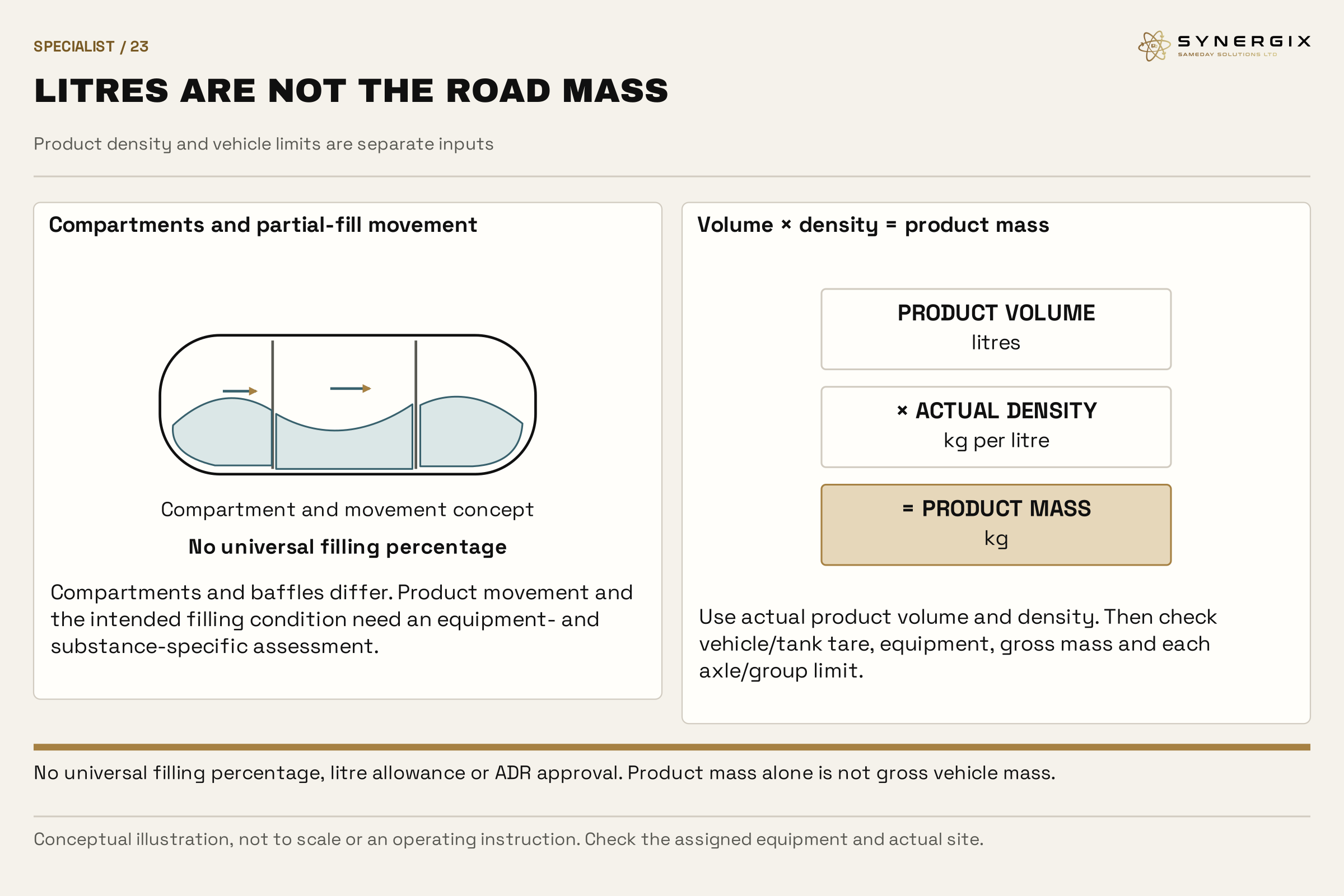
Curtainsiders, Euroliners and high-volume trailers
Side access is useful for ordinary and specialist freight, but body construction and load security must match the load.
Standard curtainsider
Side curtains and the roof protect appropriate freight from weather and provide forklift access when open. The curtain is not a general substitute for load restraint. Posts, roof rails, buckles and side apertures affect loading. Check the actual clear opening for long, tall or heavy goods, and allow sufficient space beside the vehicle for the loading equipment.
EN 12642 XL and partial loads
XL describes the certified complete body structure and its loading conditions, not just stronger replacement curtains. Suitable positive-fit loading may allow the body to contribute to restraint. Gaps and delivery stages can remove that condition and require extra securing. Request the actual body certificate and load plan. Do not assume ordinary hanging roof straps can secure a heavy pallet.
Euroliner, tilt and sliding roof
A Euroliner or tilt can provide particular removable posts, frames or roof-opening arrangements for assessed side/top loading. Not every curtainsider has those features. Tilt does not mean a tipping bulk trailer. Confirm the opening dimensions, safe dismantling process, overhead handling and the ability to close and secure the body after loading.
Mega and low-deck high-cube trailers
A mega trailer commonly provides greater usable internal height through a lower floor and compatible low coupling/tyre arrangement. Exact figures and road height are model-specific. It is not a Megalift container side-loader. Tractor compatibility, underside clearance, dock interface and load restraint need checking. Extra volume does not create extra legal weight allowance.
Longer semi-trailers and specialist extensions
Longer semi-trailers operate under their own approved framework; an extendable open deck is another separate configuration. Neither follows simply from booking a standard 13.6 m trailer. State if your load needs extra length, turning access or a specific body feature. Availability and movement suitability must be established individually.
Weather and handling limits
Curtains can be vulnerable to damage and cutting; sensitive goods may need an enclosed body or other agreed protection. A forklift or crane is included only where booked. A side-loading vehicle may solve the door problem for a long pallet while still failing the site’s space or lifting-capacity checks.
Box trailers, rigid enclosures and specialist body options
An enclosed body protects suitable freight and supports rear-loading operations. The loading interface and internal restraint still matter.
Dry box and retail work
A box can suit rear-loaded pallets, cages, parcels and packaged stock. The body can offer useful enclosure, but locks, seals, parking arrangements and any high-value requirements need agreeing. A dry box has no assured chilled or frozen set point. Specific side doors, hanging rails or other internal fittings must be requested rather than assumed.
Docks, floors and forklift entry
Check floor height, rear opening, dock leveller, floor wheel-load rating and support/restraint of the trailer. Prevent unintended vehicle movement through the agreed site system. An ordinary rear-only box can be unsuitable for a long item that cannot manoeuvre through the doors, even when its cubic volume is small.
Load bars and cages
Use the body’s rated restraint equipment for the actual freight, including required blocking at gaps and behind a diminishing load. Bars, tracks and fittings have their own ratings and correct positions. Cage parking brakes are not the complete road securing system. Open doors cautiously through the approved process where shifted freight is suspected.
Specialist choice rather than automatic inclusion
Double decks, refrigeration, tail lifts, demountable bodies, additional doors and powered decks are separate configurations. Describe the cargo and receiving process. A picture of an enclosed trailer does not prove it has a lift, any particular deck or an approved floor rating for your equipment.
Wagon-and-drag combinations
A rigid vehicle and a drawbar trailer provide two load platforms, with their own weights, access and unloading order.
What the combination offers
A suitable rigid plus trailer can suit particular distribution or specialist movements. Body combinations can include assessed open decks, curtains or crane-equipped arrangements. This is different from an artic: the coupling, turning path, reversing behaviour and allocation of weight are different. The actual combination, not a generic name, determines useful cargo space.
Two platforms, separate limits
Check each deck’s dimensions, payload, axle loads and any local support ratings, together with the whole train limit. Two equally sized platforms do not automatically share mass equally. A full train allowance can coexist with an overloaded rigid or trailer axle. Loading/unloading order must remain legal and stable after each change.
Crane reach across the trailer
A crane fitted to the rigid must be assessed for every required lift on both decks, including radius, working sector, stabilisers and coupling position. The rear-most load can be much farther away than a near-cab load. Turning or uncoupling to alter geometry is a separate operation that needs suitable space and an agreed safe system.
Coupling, parking and site access
The whole combination needs sufficient road and site manoeuvring space. If the trailer must be left, it needs an approved standing/support and braking arrangement. Agree who is allowed to uncouple, where it happens and whether later collection remains possible. A smaller rigid alone fitting a street does not prove the complete wagon and drag fits.
Loading interfaces and transfers
State whether a loading bridge, dock, forklift, crane or ground-level handling is needed for each platform. Passing goods between bodies depends on a specifically compatible arrangement; it is not a standard feature of every drawbar combination. Check step heights and safety of any connection.
When another vehicle is more practical
A single rigid may offer simpler access for a modest load. An artic may suit a continuous long load or a standard dock movement. Wagon and drag can offer value for its particular operational pattern but can add handling and parking requirements. Supply the full route and site plan before selecting from total pallet numbers.
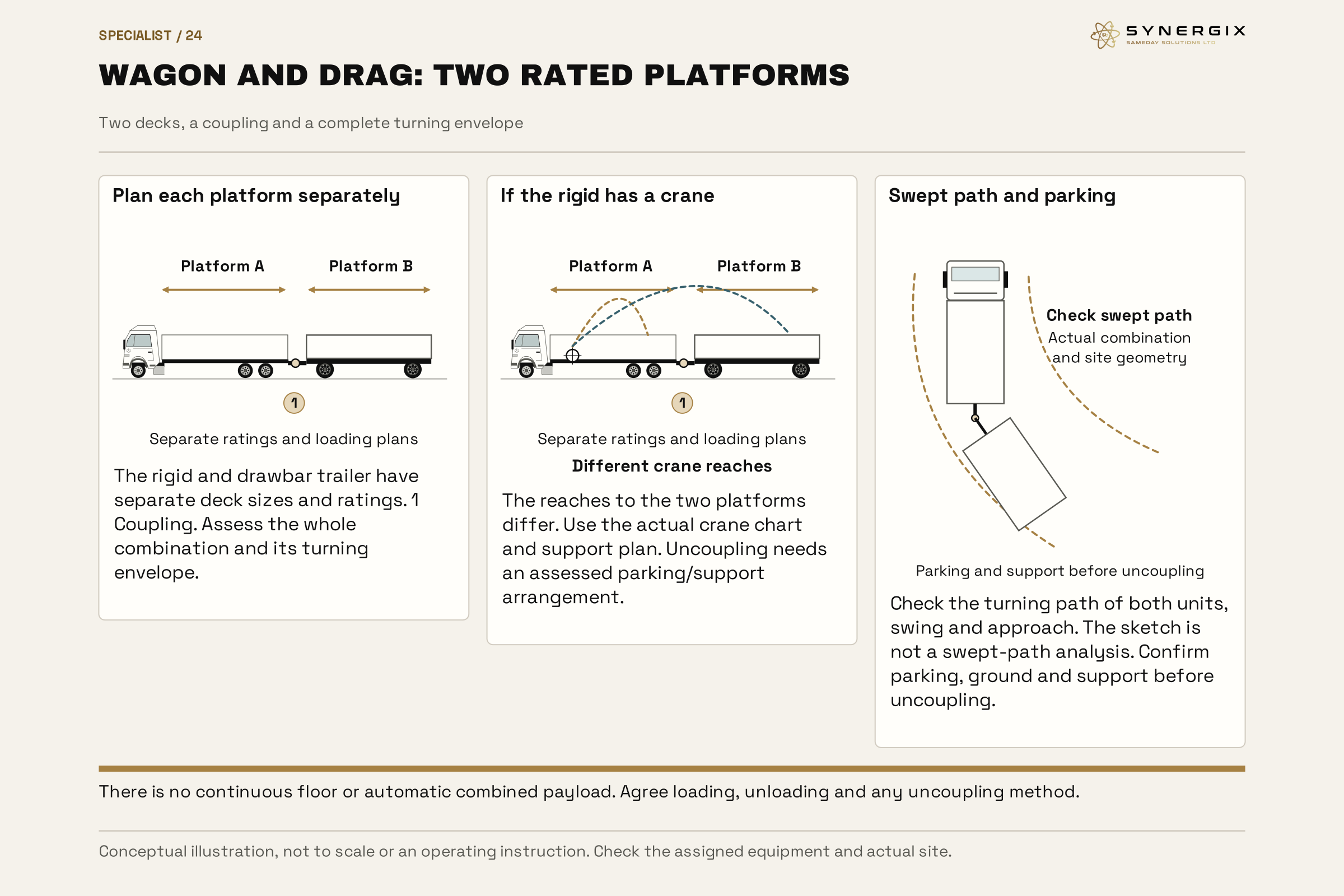
Specialist traction only and trailer compatibility
Where you provide the trailer, the tractor and driver must suit both the road movement and any operating equipment.
Towing and operating are different requirements
A tractor may couple and legally move a trailer without being equipped to run its moving floor, tipper, refrigeration standby or other specialist system. Specify the required hydraulic/PTO or electrical interfaces, approved pressure/flow and responsibility for ancillary systems. Do not assume every traction-only tractor is a wet-kit unit.
Customer trailer information
Provide trailer identity, dimensions, plates, condition and maintenance information, coupling height, kingpin/connection details, actual load and axle distribution, location, release and route. Declare defects or operating restrictions before dispatch. The carrier’s responsibilities are not transferred away merely because the trailer belongs to the customer.
Refrigeration responsibility
Agree who sets and verifies the temperature, checks the unit fuel/power and supplies the journey records. A temperature-controlled traction movement can need more than a driver moving a sealed trailer. Customer monitoring arrangements must fit the actual system, and breakdown/escalation contacts need to be available.
Drop, swap and uncoupled operation
Give suitable standing areas, trailer parking/support requirements, handover authority and any later collection. Specify if a loaded trailer must be left at a dock or for an event. Compatibility, support, braking and safe loading conditions remain essential when the tractor leaves. Dead mileage and waiting are part of the job.
Read the full artic traction-only guide or include the specialist trailer requirements in your enquiry.
Securing specialist loads: the body is only part of the system
Goods must remain stable and secured throughout the journey, during delivery stages and when the body is opened.
Secure the cargo and the carried equipment
Vehicle payload, packaging and load restraint are separate questions. A sound pallet does not stop cartons sliding off it, and an approved container lock does not secure freight inside the container. Forklifts, pump trucks, detached ramps, dunnage and accessories carried on the vehicle also need appropriate travel restraint.
Match the system to the forces
A road load-securing system needs to address forward braking, sideways and rearward movement, including sliding and overturning. Current DVSA guidance uses forces equivalent to the whole load weight forwards and half the weight sideways/rearwards. That does not mean one strap bearing those numbers is automatically enough: friction, angles, blocking, tipping and rated anchorage all affect the solution.
LC, STF and approved anchor points
Lashing capacity and standard tension force describe different properties of a rated strap. The selected method may use direct restraint, tie-down friction, blocking or a combination. Damaged, unlabelled or unsuitable equipment cannot be treated as having its original rating. Match straps/chains, fittings, edge protection and vehicle anchor points to the load plan; do not attach heavy restraints to light side guards.
Boxes and fridges still need a securing plan
Rigid walls can contribute where their construction and loading conditions permit. Significant gaps, rolling cages, stacked or heavy items and diminishing loads still need the appropriate bars, blocking, lashings or other system. Fridge-floor ice or moisture can reduce friction. Weather enclosure is not evidence that the goods are immobilised.
Kegs, barrels, drums and cylindrical goods
Cylinders and round containers can roll or become unstable. Palletise, unitise, block or otherwise secure them through a product-appropriate plan, taking account of full/empty weights and stacking. Special brewery/drinks provisions are conditional, not permission to leave arbitrary kegs unrestrained. Describe loose or returned kegs explicitly so suitable containment and handling can be assessed.
Steel, pipes, timber and machinery
Long packs need sufficient structural support, stable bundling and restraint suitable for their sliding/rolling behaviour. Coils, pipes and machinery may require cradles or blocking and substantial rated restraints. Packaging bands hold a bundle together but are not necessarily the road-securing system. Supply manufacturer handling/transport information and verified unit masses for unusual freight.
Bags, bales, fragile freight and cages
Large bags can deform and settle; bales can relax; crates can have weak panels that do not tolerate straps. Choose a method that restrains without damaging the goods. Roll cages need suitable containment and rated restraint, not only wheel brakes. Unitised pallets, stillages and frames can help where loose goods cannot be secured reliably.
Partial loads and unloading stages
The load plan must remain effective after each delivery or collection. Removing one pallet can create a gap or change axle distribution. Extra restraint may be needed where an XL body relied on positive fit. Secure returns, empty cages and exchange pallets as well as saleable goods. Loading order must balance accessibility with safe distribution.
Responsibilities at collection
The consignor/loading site supplies accurate weights, dimensions and enough information to load and secure safely. The vehicle operator and driver also retain their responsibilities. Agree who loads, provides the restraints and checks the completed system. A sealed load can prevent visual checks; the loader still needs to provide relevant load/distribution/security information.
Shifted loads and safe unloading
Tell the operator if goods may have moved before opening curtains or doors. The receiver needs a controlled unloading plan that protects people from falling freight and prevents unintended vehicle movement. Do not release restraints or open a loaded body simply to see what happens. The appropriate recovery plan depends on the body and load condition.
The artic guide has further load-by-load securing questions. Supply the cargo and handling details rather than requesting a generic number of straps.
Road restrictions, site access and abnormal loads
Check the vehicle in its road configuration and its deployed working configuration. The two can need very different amounts of space.
Measure the whole loaded vehicle
Include the tractor/rigid, trailer, cargo, roof gear, carried forklift and projections. Height above 3 m requires the relevant in-cab overall-height indication under the goods-vehicle rules. Measure the actual maximum where necessary. Internal body height or the vehicle’s name cannot establish bridge, canopy or shopping-centre clearance.
A road restriction and a physical limit are different
A goods-vehicle restriction with a valid “except for access” exemption may allow the necessary access movement under the sign and local order. It does not make the road wide enough, suspend a weak-bridge restriction or authorise entry below a height limit. Read the actual signs and route conditions. A customer address inside a restricted area is not blanket permission to ignore every prohibition.
Approach, turning and rear swing
A vehicle can pass through a gate and still be unable to turn, reverse, align or leave. Account for trailer cut-in, rear swing, mirrors and the full tractor approach. Low decks and long projections add other clearance issues. Tell us about parked cars, tight bends, one-way systems, pedestrian streets and timed access.
Working space is often the deciding factor
Crane legs, forklift detachment, a container lifting corridor, open curtains, tail-lift travel or a raised tipper body need space beyond the parked outline. Draw the final load position and every obstacle. A room-sized gap beside the trailer is not useful if the tractor cannot stand in front or the support feet cannot be placed on sound ground.
Permissions and traffic management
Road occupation, footway use, lifting near public areas and temporary traffic measures can need appropriate permissions and site control. Confirm the responsible party and required arrangements before dispatch. A driver cannot assume that customer ownership of the goods creates permission to close a public street or lift across a neighbouring property.
Abnormal-load assessment
Mass, axle loads, width, length and projections can trigger requirements beyond ordinary haulage. Route notices, surveys, bridge checks, escorts or special orders depend on the actual movement. Do not apply one threshold or a universal two-day notice to every job. The operator must identify the relevant framework, indivisibility and lead time before confirming the movement.
UK regions and international routes
Great Britain, Northern Ireland and other countries do not share every rule, dimension, access arrangement or document requirement. International work can also require customs, dangerous-goods, container or temperature-equipment evidence. Give the full origin/destination and transit route information early; a lawful GB arrangement may not be lawful throughout Europe.
Photographs that help
Send views from the approach, entrance, standing point, both ends and final placing/discharge area. Include measured clearances and a drawing with the vehicle direction shown. Photographs cannot certify hidden ground strength, but they can expose a wall, bank, drain or overhead cable that would otherwise be missed.
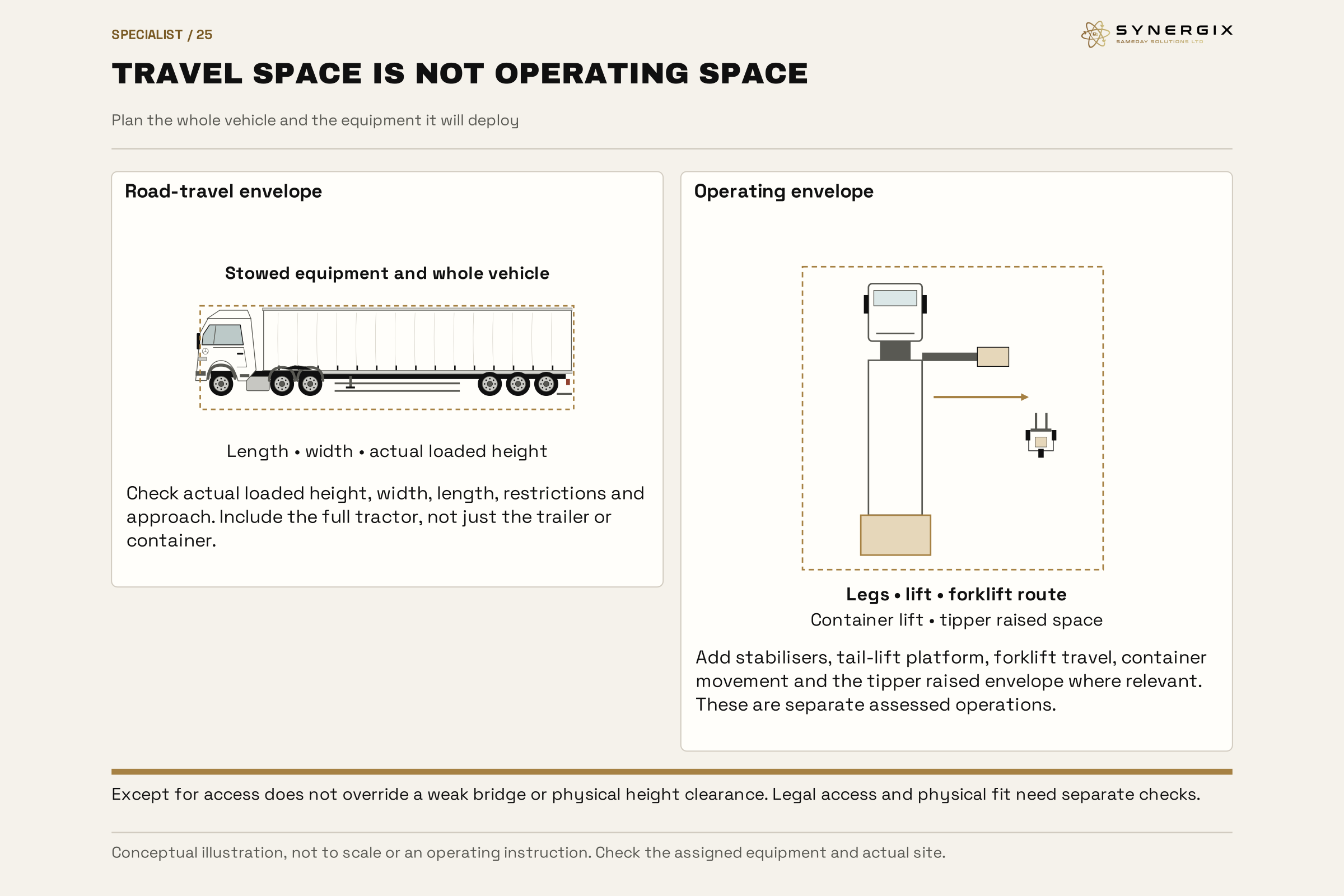
Driving hours, working time and specialist operations
Loading, crane work, forklift operation and discharge take time from a lawful driver schedule as well as from the booking.
| Rule | General position |
|---|---|
| Driving break | After 4.5 hours of driving, a 45 minute break; a qualifying 15 then 30 minute split may be used |
| Daily driving | Normally 9 hours; extend to 10 hours on no more than two days in a week |
| Weekly/fortnightly driving | Normally 56 hours in one week and 90 hours across two consecutive weeks |
| Daily rest | Normally 11 hours; reduced/split options only within their conditions |
| Weekly rest | Regular 45 hours, with reduced-rest and compensation arrangements subject to their rules |
| Working time | 48 hours average weekly; up to 60 in an individual week within the average |
| Night work | Normally 10 hours of work in 24 hours where night work is performed, unless a permitted workforce/collective agreement applies |
These limits are not a delivery-time calculator
The applicable regime, previous duties, other work, rests, route and operator exemptions need checking. A driver starting your collection may already have used driving or working time that day. Road mileage divided by an assumed speed cannot guarantee arrival or unloading time. Specialist jobs often have substantial loading/set-up work at both ends.
Lifting and unloading count as work
Crane set-up, slinging, forklift operation, pump-truck handling, temperature checks and cleaning connected with the transport operation are work. They do not count as a driving break merely because the truck is stationary. Waiting is classified according to the applicable conditions; a known period of availability is not the same as unknown waiting while still responsible for duties.
Working-time breaks are a separate check
Under the mobile-worker rules, work must not continue for more than six hours without a break. Total required breaks depend on the duration of work and may overlap qualifying driving breaks where they are genuine breaks from all work. A 45 minute pause from driving spent operating a crane does not reset the driving clock.
Long journeys, overnight work and day cabs
Sleeper accommodation, overnight parking, hotels, relief drivers or a multi-day plan can affect the price. Some specialist vehicles have day cabs and cannot provide normal sleeper accommodation. Regular weekly rest cannot simply be booked inside a vehicle. Tell us the complete schedule, site hours and waiting expectation so an achievable arrangement can be quoted.
Tachographs and operator requirements
In-scope goods work requires the applicable tachograph, records, driver entitlement and operator arrangements. Specialist equipment does not remove road-transport duties. Driver training for an HGV is also separate from competence to operate the forklift, crane or discharge system. The job must meet both sets of requirements.
Scope has changed for some international vans
Since 1 July 2026, relevant international goods movements between the UK and EU in vehicles/combinations over 2.5 tonnes can fall within expanded drivers’ hours and tachograph requirements. Not every small domestic specialist van has the same regime as a heavy artic. Establish the actual vehicle, use and route rather than saying van work is unregulated.
Inspection, servicing and specialist documentation
Roadworthiness, equipment maintenance, statutory examination and product records are distinct duties.
| Evidence | What it establishes |
|---|---|
| Vehicle maintenance and safety inspections | Roadworthiness of the actual rigid, tractor and trailer |
| Manufacturer service schedule | Planned maintenance of the crane, forklift, refrigeration or discharge equipment |
| LOLER thorough-examination report | Examination of relevant lifting equipment/accessories and recorded defects/restrictions |
| PUWER checks | Suitability, condition, inspection, guards, controls and competent use of work equipment |
| Calibration/temperature records | Evidence relevant to the specified sensor, recorder, trip and product |
| Tank/ADR/pressure-system evidence | Applicable compatibility, approval and examination for that tank/use |
| Cleanliness/previous-load records | Product-specific hygiene and contamination controls, within their stated scope |
The certificate is not the entire safety system
Check identification, dates, scope and defects, and act on newly discovered problems. A vehicle test does not examine every lifting accessory. Servicing a hydraulic system is not automatically a statutory thorough examination. An examination report is not an all-purpose certificate of competence, hygiene or safe use on every site.
Competence follows the equipment and task
The driver, operator, planner, slinger/signaller and site staff need appropriate competence for the work they actually undertake. Training schemes and site requirements can differ. Do not assume a road-driving licence includes a forklift or crane qualification, or that a course card alone proves familiarisation with every model and unusual lift.
Hire and supplied equipment still need checks
Equipment being hired or supplied through another party does not remove the duties of those using or controlling it. Agree responsibility for records, maintenance, defects, safe use and return. Changes to the equipment or task can invalidate assumptions in a routine plan.
Product and site documentation
Ask early for any requested lift plan, load drawing, access survey, temperature report, cleaning evidence or dangerous-goods record. The required format and responsibility should be agreed with the booking. Do not assume every document is automatically included or can be produced retrospectively after the vehicle has completed the job.
Specialist transport prices, fuel, energy and CO₂
Equipment weight, working time, auxiliary power and the whole route affect both the cost and the emissions.
The complete mileage matters
Include travel to collection, the loaded journey, repositioning, returns and travel to a wash, yard or subsequent handover where it belongs to the job. Empty positioning still consumes fuel. The charge also pays for time, the correct vehicle, competent operation, maintenance, examinations and the agreed service scope. A specialist price is not just litres burned between two customer postcodes.
A heavy load changes consumption
Published vehicle or engine figures do not describe every loaded route. Added equipment, gross mass, aerodynamic body, gradients, traffic, temperature, stops and idling affect real use. A heavy crane truck or high double deck should not be assigned the same fuel estimate as a lighter general-haulage vehicle simply because both are HGVs.
Auxiliary diesel and PTO
An independent fridge engine has its own consumption. A crane, tipper or moving floor may use engine-driven PTO or another power source while stationary. Engine running time and operating duty matter. When fuel is measured across the complete job, avoid adding the same PTO fuel a second time. Ask for actual consumption or explicit assumptions where a footprint is needed.
Electric standby and electric specialist vehicles
Suitable refrigeration standby can replace the unit’s diesel operation while parked, but needs the correct supply and contributes electricity use. Battery equipment or an electric road vehicle needs a suitable range, charging plan and reserve for auxiliary demand. Such arrangements can suit known routes and powered sites; time-critical long journeys or unreliable power can make another configuration more practical. No availability is implied.
CO₂, CO₂e and reporting boundaries
CO₂ is carbon dioxide alone. CO₂e combines greenhouse gases on an equivalent-warming basis. Fuel reporting can include combustion and upstream production, while electricity reporting can include generation, distribution and upstream energy. Do not compare tailpipe-only diesel with full-supply electricity, or call an electric vehicle emission-free across its whole life because it has no exhaust.
Manufacture and whole-life comparisons
A full comparison needs vehicle and equipment manufacture, battery where relevant, replacement, maintenance, energy use, refrigerant leakage and end of life over a matched service life. A generic manufacturing number or a fixed 250,000 mile example cannot establish superiority for every crane lorry or refrigerated trailer. Record the assumptions and compare vehicles doing an equivalent job.
Refrigerant leakage and product losses
A refrigeration footprint can include more than the diesel engine or electricity meter. Refrigerant type and leakage matter, as do extra trips or loss of goods caused by a failed cold chain. Those effects need evidence and a stated reporting method. They are not included in the illustrative fuel/energy table below.
Ways to avoid unnecessary cost
Choose equipment that actually solves the handling problem, provide accurate mass/geometry, prepare the site, coordinate receiving slots and avoid failed visits. A larger crane can be cheaper overall than repeated unsuccessful attempts with a smaller one. A simpler body may offer better value where customer equipment is already suitable. Efficient planning does not justify compromising safe handling.
| Assumed use | Energy per 100 miles | Energy-supply emissions |
|---|---|---|
| Road diesel at 40 L/100 km | 64.37 L | 205.65 kgCO₂e |
| Road diesel plus assumed 8 L auxiliary use | 72.37 L total | 231.20 kgCO₂e |
| Metered electricity at 160 kWh/100 miles | 160 kWh | 29.50 kgCO₂e |
The scenarios use 1 mile=1.609344 km. Average-blend diesel uses 3.19455 kgCO₂e/litre including direct and upstream factors; metered electricity uses 0.18436 kgCO₂e/kWh including the stated generation, distribution and upstream factors. Charging losses must be included in metered input. The auxiliary 8 litres and 160 kWh are assumptions, not vehicle specifications. These examples exclude manufacture, replacement, maintenance, disposal and refrigerant leakage, and do not prove equal capability or a full-life break-even point.
Calculate a declared tailpipe CO₂ rate
Use this only where you have a CO₂ rate for the vehicle and duty. It excludes upstream fuel, electricity, manufacture and auxiliary equipment not included in that rate.
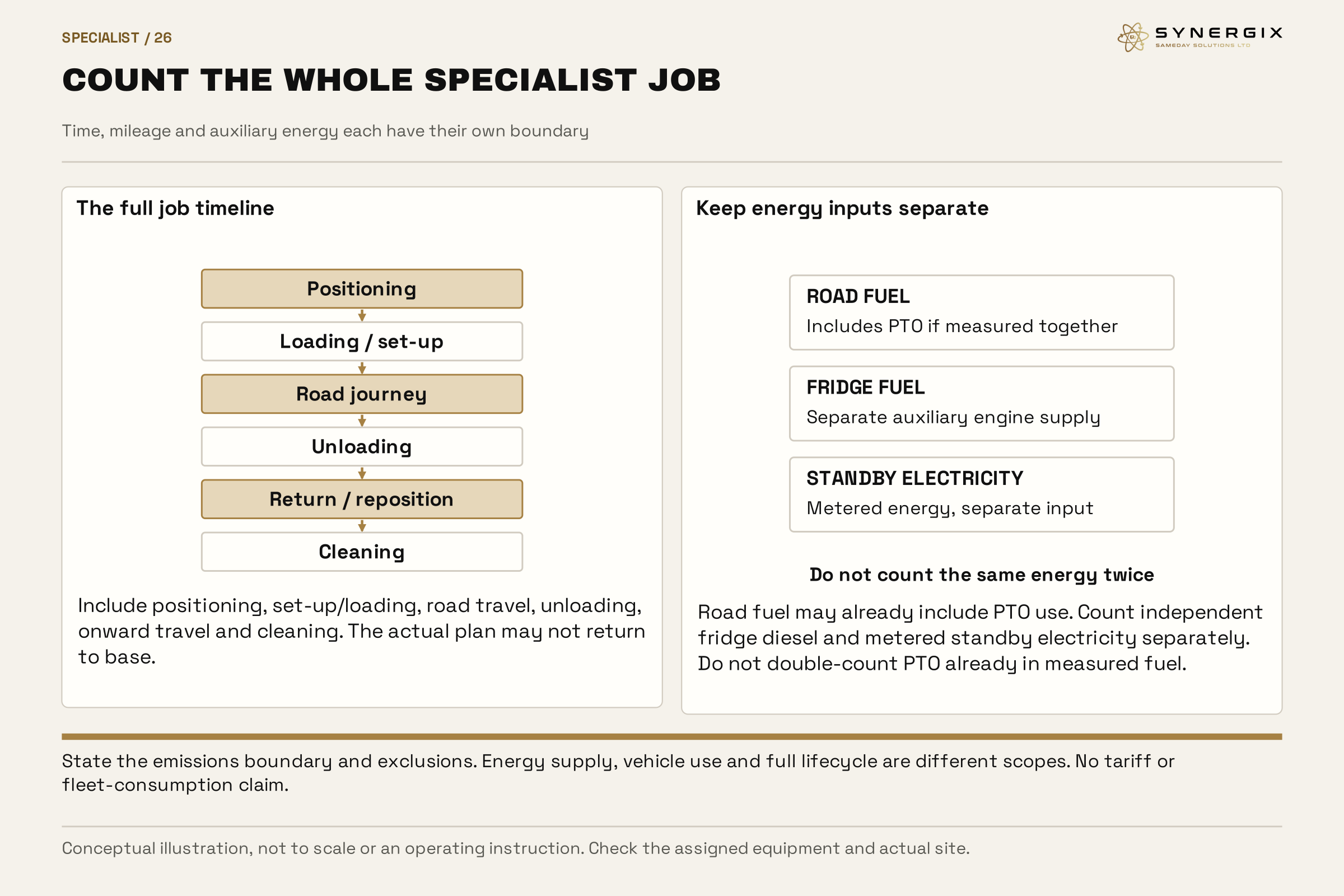
Specialist transport booking checklist
Give us the cargo, the working method, both sites and the whole schedule. We can assess the vehicle against the complete task.
| Topic | What to send |
|---|---|
| Goods | Description, packaging, product/temperature/hazard/waste requirements and photographs |
| Dimensions | Every unit’s packaged size, projections, access orientation and total footprint |
| Mass | Individual gross weights, total load, equipment/attachments and centre-of-gravity information |
| Handling | Forklift/crane/lift/ramps/containerlift/tipping/pneumatic discharge, at both ends |
| Specification | Required body/floor arrangement, lift radius, forkentry, compartment plan or module fittings |
| Sites | Full addresses, approach, doors/gates, ground, supports, overheads and final placing point |
| Time | Ready time, slots, all stops, waiting, set-up, unloading, wash/returns and deadline |
| People | Site contacts, lift planning, loading/unloading roles, permissions and supervision |
| Evidence | Drawings, verified weights, product instructions, release/customs details and requested reports |
For an unusual lift or urgent specialist movement, call 01782 911 181. For written details, use sales@synergixsameday.com or the online quote enquiry.
Specialist transport terms
Useful language for the vehicle, equipment and product requirements.
- Payload
- The freight mass allowed after vehicle/equipment tare and all applicable limits.
- Load centre
- Distance from the fork face to the load’s centre of gravity, relevant to forklift capacity.
- Working radius
- Horizontal distance from a crane’s slew centre to the load centre of gravity.
- Tonne-metres
- A lifting-moment measure, not a constant maximum mass at every reach.
- SWL/WLL
- Rated working-load information for equipment in specified conditions.
- LC/STF
- Different lashing ratings: capacity and standard tension force.
- LOLER
- Lifting Operations and Lifting Equipment Regulations.
- PUWER
- Provision and Use of Work Equipment Regulations.
- PTO/wet kit
- Power take-off and an appropriate hydraulic system for specified equipment.
- Electric standby
- An approved external-power mode for a stationary refrigeration unit.
- Donkey engine
- Informal term for an independent auxiliary engine, commonly a fridge unit.
- Bulkhead
- A separating structure; in a multi-temperature body it can form an insulated zone boundary.
- Skeletal
- A chassis supporting compatible containers or approved demountable units.
- Flat rack
- A compatible container platform for assessed open cargo, with its own ratings.
- VGM
- Verified gross mass for a packed container under the relevant sea-shipping rules.
- CSC
- Container safety approval/examination framework, distinct from road payload.
- ADR
- The dangerous-goods road-carriage agreement and applicable requirements.
- Tare
- Vehicle or container mass without freight; included fuel/equipment basis must be clear.
Specialist transport FAQs
Choose a question group for the equipment, product or delivery issue you need to resolve.
Choosing specialist transport
What counts as a specialist vehicle?
A body or equipment arrangement selected for a particular load or handling task, such as refrigeration, a loader crane, carried forklift, lifting deck, low loader, container chassis or bulk discharge system. It can be a van, rigid, articulated combination or drawbar arrangement.
Do I need a specialist vehicle for one pallet?
Possibly. One pallet can need refrigeration, a tail lift, a forklift or a crane because of its weight, size, product or receiving site. The number of pallets alone cannot select the vehicle.
Should I book the biggest vehicle to be safe?
No. Choose the load space, weight allowance and handling method the job actually needs. Unnecessary size or equipment can increase price and cause access problems. Give us the load and sites so an appropriate arrangement can be assessed.
Are all the pictured vehicles owned by Synergix?
The pictures illustrate body and equipment types. They do not establish fleet ownership, current stock or availability of an exact installation. The actual transport arrangement is confirmed against the job.
Does a specialist quote include all lifting and installation?
Only the agreed scope. State collection/delivery handling, placing point, lifting roles and any installation, carrying or connection work. A transport booking does not automatically include every site activity.
Can specialist transport be used for regular work?
Yes, an assessed repeat arrangement can suit ongoing retail, industrial, temperature-controlled or bulk work. Regularity can improve planning, but each change in goods, sites or handling needs checking.
Weight, dimensions and pallets
Is a 44 tonne truck able to carry 44 tonnes of goods?
No. Gross combination weight includes the tractor, trailer, people, fuel, equipment and freight. Ready-to-load mass, axle limits and route rules determine the freight allowance.
Do cranes and MOFFETTs reduce payload?
Yes. The equipment, installation and accessories add vehicle mass and change load distribution. The actual deduction depends on the installation; it is not one standard percentage.
Can you give one maximum specialist payload?
No. Body, equipment, tractor, plates, tare, axles and route vary. Give the goods’ verified weights so the actual vehicle allowance can be confirmed.
Can I use standard artic pallet numbers for every trailer?
No. The ordinary 26 UK/33 Euro floor guide concerns a suitable standard single deck. Steps, partitions, posts, deck ratings, airflow and equipment can alter the usable layout.
Why do you need individual weights as well as the total?
A single pallet can exceed a lift, floor or forklift limit, and its position can overload an axle even when the total freight mass is acceptable.
Do empty containers and pallets count towards payload?
Yes. Containers, pallets, packing, stillages, cages, accessories and returns form part of the carried mass. Product weight alone is insufficient.
Refrigeration and temperature evidence
Does refrigeration always make the inside smaller?
No. Purpose-built refrigerated bodies can retain broadly comparable internal dimensions. Use the actual body measurements. Local equipment, partitions and airflow needs still affect loading, while additional equipment mass can reduce payload.
What temperature should I request?
Use the product’s transport specification and acceptable range. Provide its condition at collection. Chilled, frozen and temperature-sensitive goods do not all share one legal or operational set point.
Can the trailer freeze warm goods?
Do not assume it can. Transport units normally maintain suitably conditioned product. Rapid freezing or cooling a warm load is a different duty that needs appropriate equipment and an agreed process.
Does a fridge display prove the product stayed cold?
No. A set point or air reading is different from core product temperature and a complete journey record. Agree sensor locations, reporting and acceptance criteria.
Can I get a temperature log?
Request the record format, sensor/compartment coverage, trip period and timing before booking. Printed tickets, downloads and remote access depend on the actual equipment and agreed service.
How long are quick-frozen temperature records kept?
Where the relevant monitoring rules apply, dated records are normally retained for at least one year and longer where the product nature or shelf life requires. Scope and limited exceptions must be checked.
Can one trailer carry chilled and frozen stock?
A suitable multi-temperature configuration can do so within its approved compartment and airflow arrangement. State the quantities and weights for each temperature zone and the unloading order.
Can I put ambient stock in an empty fridge?
Potentially, if product compatibility, cleanliness, loading and any required operating conditions are agreed. A fridge may cost more or have different payload from a dry box, so explain whether temperature control is actually needed.
Are all refrigerated vehicles fitted with tail lifts?
No. Retail configurations may have lifts, while others use docks. Specify the handling method and individual unit weights rather than assuming a lift is included.
Do cage brakes secure a refrigerated load?
They help parking but are not the complete road restraint. Use a suitable rated bar, track, blocking or other load-securing arrangement for the actual body and cages.
Fridge power and parked trailers
What is a donkey engine?
An informal name for an independent auxiliary engine, commonly the diesel engine in a trailer refrigeration unit. Its fuel and operating time are separate from the tractor’s road movement.
Can the fridge run with the tractor removed?
A suitable independent unit can, within its approved operating conditions. The trailer must still be safely parked and supported, with fuel/power and contingency responsibilities agreed.
Can I use a domestic plug for a refrigerated trailer?
Not unless the specific unit is designed for that supply. Many trailer standby systems require suitable three-phase power. Check the nameplate, current, protection and connector.
Is every three-phase socket suitable?
No. Voltage, frequency, current capacity, protection, connector and cable arrangement must match the unit. Have the supply checked by a competent person.
Can a generator power the fridge?
Only an appropriately compatible and rated supply can. Start-up demand and electrical requirements matter, not just the generator’s advertised output.
Does standby electricity hold the trailer brakes on?
No. Refrigeration electricity and trailer braking are different systems. Parking brakes, support and site restraints need their own approved arrangement.
Can a forklift enter an uncoupled refrigerated trailer?
Only if its floor, standing/support arrangement and site loading system are suitable and approved. Forklift wheel loads and movement forces must be assessed.
Who deals with a fridge alarm at an event?
Agree monitoring, fuel/power responsibility, alarm contacts, response and product decisions before delivery. Event hire is not automatically unattended emergency cover.
Flatbeds and open loads
Can any pallet go on a flatbed?
No. Goods must be suitably packaged, stable, supported, weather-protected where necessary and capable of being restrained. Loose or fragile contents may need another body or containment.
What is the maximum load height on a flatbed?
It depends on deck height, cargo, supports, stability, restraint, route and site clearance. Measure the complete loaded height; there is no one practical cargo-height allowance for every flatbed job.
Can a load overhang the sides?
Only where the actual support, road rules, markings/notifications and movement assessment permit it. Declaring the full dimensions before booking is essential.
Does a tarpaulin secure the load?
It may provide weather protection or containment but does not replace the required blocking and rated restraint.
Can a flatbed carry heavy machinery on small feet?
Only if local deck loading and supports are suitable. Total payload does not establish an acceptable pressure through a small support area.
Will a flatbed include a forklift or crane?
Only where specified and agreed. Tell us how the load will be put on and taken off at both sites.
MOFFETT handling and road use
Will every MOFFETT lift 2.5 tonnes?
No. Models and configurations differ, and rated mass applies at the stated load centre. Attachments and load geometry can reduce capacity.
What is the maximum pallet width for a MOFFETT?
There is no single width for all loads and machines. Fork entry, support, balance, load depth, sideways length and site clearance need assessing together.
Can it unload a 3 m pack?
Only if the actual machine, attachment, load centre and travel route suit that pack. A four-way model or a crane may be needed; low cargo weight alone does not prove suitability.
Can a MOFFETT unload from one side only?
Some models provide suitable reach systems; others need both sides. Declare one-sided access before allocation.
Can it drive over a lawn or gravel?
Not automatically. Load-bearing strength, traction, slopes and surface damage risk need assessing for the loaded machine.
Can a MOFFETT use a public road?
Only where the machine, driver and movement meet the applicable road requirements. Workplace training is not road-driving authority, and a short crossing is not automatically exempt.
Is a forklift training card a road licence?
No. Competence to operate workplace equipment is separate from the road-driving entitlement and vehicle compliance required for public-highway use.
How often is a MOFFETT serviced?
Follow its actual manufacturer schedule, operating hours, elapsed time and condition. There is no one service interval for every model, and servicing is separate from LOLER examination.
Why can a light crate still be unsuitable?
An offset centre of gravity, fragile base, poor fork pockets, excessive depth or unsuitable site can make handling unsafe despite a modest mass.
Tail lifts and pump trucks
Does the tail-lift rating cover the pallet truck too?
The rating applies to the whole relevant platform load, including goods, pallet truck and any authorised rider. Their combined centre of gravity must also suit the chart.
Why can a long pallet exceed the lift limit?
Its centre of gravity can lie farther out on the platform and reduce the permitted mass. Support, aperture and handling clearance also need checking.
Is every 3 m pallet impossible on a tail lift?
No universal statement is appropriate. Standard arrangements often cannot support or manoeuvre it, while specialist equipment may differ. Confirm the actual platform, chart and opening rather than assuming suitability.
When must I request an electric pump truck?
Under Synergix’s booking rule, when an individual loaded pallet weighs 800 kg or more and pallet-truck handling is needed. Lighter pallets may need powered handling too.
Is 800 kg a legal manual pallet limit?
No. It is our booking requirement. The actual handling assessment considers ground, slope, distance, people and equipment, including weights below 800 kg.
Can anyone ride a tail lift?
Only if the equipment and agreed operating system permit authorised people to ride it. A goods-only platform must not be used as a people lift.
Does the lift need LOLER paperwork?
Relevant lifting equipment requires the applicable thorough examination and written report. Identity, dates and defects must be checked; a sticker alone is not enough.
Is a six-month examination always required?
The default interval is six months for people-lifting equipment and lifting accessories, twelve months for other lifting equipment, unless a competent person’s written scheme specifies otherwise. Check the lift’s actual use.
Does tail-lift delivery include inside delivery?
Only where agreed. The route beyond the vehicle, carrying distance, steps, lifts and any two-person handling must be included in the booking.
HIAB crane reach and planning
What does tonne-metre mean?
It describes lifting moment, broadly mass multiplied by horizontal radius. It is not a constant maximum mass the crane can lift anywhere.
Can a 5 tonne crane lift 5 tonnes at 20 m?
Do not assume so. A close-in maximum and longest reach are different operating points. Use the actual chart at the required radius, height, configuration and stabiliser arrangement.
Where is crane radius measured from?
From the slew centre to the load’s centre of gravity horizontally, not from the cab door or edge of the truck.
Do slings and lifting beams count towards the lift?
Yes. Their mass and configuration affect the complete suspended load and the chart/application requirements.
Can a HIAB lift over my house or wall?
That needs a specific lift plan for reach, height, boom path, ground, visibility, occupied areas and any hazards. A vehicle name or headline capacity cannot approve it.
Can it work near overhead cables?
Only under an assessed arrangement resolving the electrical risk with the appropriate network-owner/planner measures. Contact is not necessary for electrical danger. If protection cannot be established, the lift cannot proceed.
Do mats make any ground safe?
No. The actual support loads, ground construction and buried features must be assessed. Mats do not automatically bridge a void or make soft ground suitable.
Can you use only partly extended stabilisers?
Only if the actual crane configuration, chart/control system and plan permit the lift. Partial spread does not provide the same capacity as full deployment.
Does the driver provide the lift plan and slinger?
The responsibilities must be agreed. Routine and complex lifts need different competence and supervision. Do not assume every role is included in a haulage price.
Can a crane lift people?
Only equipment and arrangements specifically suitable and approved for that task can. It is not a normal addition to a freight loader-crane booking.
Why might a light cabin need a larger crane?
Large radius, sail area, attachment weight, boom geometry and limited support space can control the equipment more than cargo mass alone.
Double decks, step frames and low loaders
Does a double deck double the payload?
No. The additional floor and machinery add mass; gross and axle allowances remain. It principally gains useful positions for suitable volume-limited freight.
Are floating floors and powered decks the same?
Not necessarily. Floating is informal language. Confirm whether the actual floor is manually adjustable, power-lifted, split or locked at an agreed travel height.
Can a forklift drive onto an upper deck?
Only where the actual deck and loading system explicitly allow the relevant wheel loads and operation. A distributed goods rating does not prove forklift suitability.
Are upper-deck weight rules the same for box and curtain bodies?
No. DVSA guidance treats curtainsided upper-deck stable single-layer units up to 400 kg differently from appropriately specified solid-sided bodies. Actual floor/body ratings and fall protection still apply.
How many UK or Euro pallets fit in a double deck?
There is no universal count. Obtain the actual useful footprint, deck heights, ratings, posts and load plan rather than multiplying a single-deck count.
Does a step frame have one continuous low floor?
No. The foredeck and lowered main deck have different heights and useful lengths. A long rigid item needs suitable support through the actual geometry.
Can a low loader carry any plant below its total payload?
No. Ramps, track/wheel support, point loads, clearance, restraint and route limits can prevent carriage even where the total mass appears acceptable.
Can non-running machinery be loaded?
Only with an agreed suitable winching, recovery or lifting arrangement. Declare steering, brakes, ground clearance and machine condition before booking.
Containers, skeletal trailers and Megalift
Can one skeletal carry two 20 ft containers?
A compatible chassis can, within its approved support/lock positions and load distribution. Give each container’s gross mass and the loading/unloading sequence.
Can it carry a 40 ft or 45 ft container?
Only in the configuration approved for that size and fittings. A 45 ft or pallet-wide unit may require particular extensions and route checks.
What about a 44 ft container or platform?
Provide actual drawings and fitting locations.44 ft is not a standard substitute for common 40 ft/45 ft container terminology.
Can I load pallets straight onto a skeletal frame?
Not as though it were a flatbed. It needs an approved compatible container, flat rack or engineered platform module with suitable cargo support and restraints.
Can a box body be fitted to a skeletal?
Certain approved swap-body/chassis combinations can accept a suitable box. The fittings, support, mass and complete arrangement must be compatible.
Does container weight count against payload?
Yes. The road allowance includes the container and all its contents and packing.
Does the container seal prove the load is secured?
No. A seal is tamper evidence. The packing party still needs suitable distribution and restraint for the contents.
Can a Megalift unload from either side?
Do not assume it. The right-hand-loading arrangement in this guide needs access on the vehicle’s right as viewed forwards. Other configurations differ; confirm the allocated lifting side.
Why do you need space in front of the container?
The tractor extends beyond the trailer/container alignment. A bank or wall can block the whole vehicle even when the lifting side appears clear.
Is its lifting rating also its road payload?
No. Crane/module rating and legal road-carried allowance are independent. Equipment and container tare reduce cargo allowance.
Can the container be left anywhere?
No. Final support, level, door access, lift clearance and a workable future collection approach need agreeing.
Moving floors and tippers
Does a walking floor need to tip?
It discharges compatible material horizontally through its moving floor. Ground, clearance and product compatibility still need assessing.
Can a walking floor take pallets?
Certain systems can handle suitable general cargo, but the actual floor, pallets, loading equipment and unloading arrangement must be approved for the job.
Can every moving floor take wet or sharp waste?
No. Floor profile, seals, body, wear/impact resistance and product acceptance differ. Leak-resistant is not the same as a liquid tanker.
Can I fill the trailer to the roof?
Only within the permitted mass, body/floor limits and containment/cover arrangement. Density and moisture can make a partly full body overweight.
Does a load below the tipper sides need no sheet?
Not automatically. The operator must ensure containment and justify any permitted uncovered arrangement. A suitable cover may still be necessary.
Can tipping take place inside a low shed?
Only if the full raised-body envelope and other safety conditions permit it. A suitable horizontal-discharge system may be a better option.
Can any half-pipe tipper take scrap?
No. Body material, thickness, lining, impact and abrasion rating must suit the product. Alloy and steel are different specifications.
What if the material sticks in the tipper?
The operator uses the manufacturer’s assessed process. Jerking, moving or improvising a release can create danger and is not an acceptable customer instruction.
Tankers, hygiene and ADR
Can a fuel tanker carry food after cleaning?
Do not treat cleaning as approval. Bulk food needs equipment reserved for foodstuffs and the appropriate product-contact/previous-load system. A diesel tanker is not interchangeable with a flour or edible-oil tanker.
Can a liquid tanker transport flour?
Normally that needs a purpose-built suitable dry-bulk/pneumatic system. Product, air, tank, hoses and receiving silo must all be compatible.
Does a wash certificate prove complete food suitability?
No. Check tank and compartment identity, previous loads, method, contact equipment, allergens and receiver requirements. A certificate’s scope matters.
Does every tanker need ADR?
ADR depends on the substance and applicable carriage requirements. Food-only or non-dangerous products can have other hygiene/equipment duties instead. Confirm classification before selecting the tanker.
Is an emptied chemical tank automatically exempt?
No. Uncleaned residues and vapour can remain dangerous and the applicable carriage rules may still apply.
Can maximum litres be treated as maximum tonnes?
No. Product density, temperature, filling rules, tank tare, axles and gross weight control the load.
Can the driver use any receiving connection?
No. Confirm inlet identity, connector, hose, capacity, pressure/flow and unloading method. Wrong or incompatible connections can prevent delivery.
Can the driver climb into the tank to inspect it?
Tank entry is separate confined-space work requiring an appropriate assessed system and competent people. It is not a routine delivery task.
Time, price and booking
Does crane operation count as a driving break?
No. Operating equipment and associated transport duties are work. A qualifying driving break must be a genuine break from driving and other work.
Is waiting always a period of availability?
No. Classification depends on the conditions and whether the duration is known in advance. Waiting while performing or retaining active duties cannot simply be labelled rest.
Why can an urgent delivery need an overnight plan?
Previous driving/work time, loading duties, distance, site slots and rest obligations can prevent a lawful single-shift completion. Accommodation or relief arrangements affect the quote.
Does an access exemption remove a bridge weight limit?
No. An except-for-access goods restriction is different from a structural weak-bridge limit and does not make a vehicle physically fit.
What affects the specialist price besides mileage?
Equipment specification, positioning, payload, competent operating work, set-up, site waiting, power/fuel, cleaning, examinations, permissions and the agreed scope.
Can electric equipment reduce job emissions?
It can alter energy use where suitable, but compare equivalent capability and matched reporting boundaries. Electricity, batteries, manufacture and auxiliary demand are not automatically zero.
What if the load or site changes after quoting?
Tell us immediately. Even a modest change in mass, reach, temperature, access or unloading can require a different vehicle, method, schedule or price.
How do I get the right specialist quote?
Send the checklist information, drawings/photographs, verified weights and both site requirements. We assess the actual vehicle and method before confirming a booking.
Tell us what needs moving.
Send the verified weights, dimensions, site photographs and handling requirements. We can assess the appropriate specialist arrangement.