
Synergix / Specialist vehicle guides
Flatbed vehicles and trailers.
An open deck gives flexible access for suitable long, bulky and machinery loads. Compare rigid and articulated layouts, supports, weather protection and unloading before choosing the platform.
Body, equipment and receiving method considered together.
Understand carrying limits, loading and the complete working area.
Clear handling scope, timing and specialist availability.
The practical guide
Choose your layout.
Start with the layout and the job it needs to do.
Jump to the layout that interests you, then compare its useful capability, loading method and trade-offs. The actual vehicle and equipment are agreed for your job.
Stationary list of the layouts explained
Before choosing a vehicle
Dimensions, weight and handling.
Use these measurements to describe the requirement. They are separate limits, not interchangeable ways of approving a load. A standard body’s dimensions or payload must not be copied to a conversion without its own specification.
| Check | What to establish | Why it matters |
|---|---|---|
| Deck | Usable length, width and height above ground | Headboard, posts, timbers and restraints can occupy space. |
| Each item | Packed outer dimensions, mass, supports and centre of gravity | Include feet, lugs and overhangs, not just the main casing. |
| Carrying limits | Ready-to-load mass, axle and coupling distribution | Freight payload and local deck strength are separate checks. |
| Delivery | Fork or crane access, unloading side and working area | An open platform does not supply unloading equipment by itself. |
For an ordinary road arrangement, permitted gross mass includes the vehicle or combination, body, people, fuel, equipment and goods. Subtract actual ready-to-load mass for a nominal freight allowance, then check axles, coupling, local floor/support loads and handling separately. Enough total payload does not prove one item can be lifted or supported.
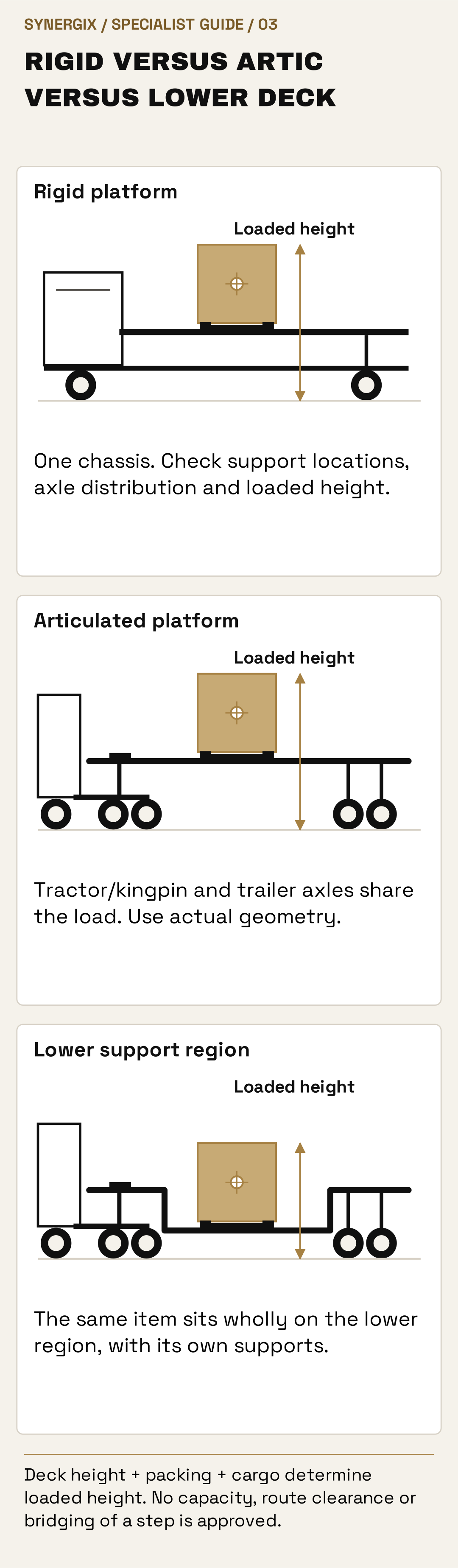
Deck height + packing + cargo determine loaded height. No capacity, route clearance or bridging of a step is approved.
Open full-size desktop diagram · Open full-size mobile diagramConfiguration explained
Rigid flatbeds.
One chassis with an open freight platform.
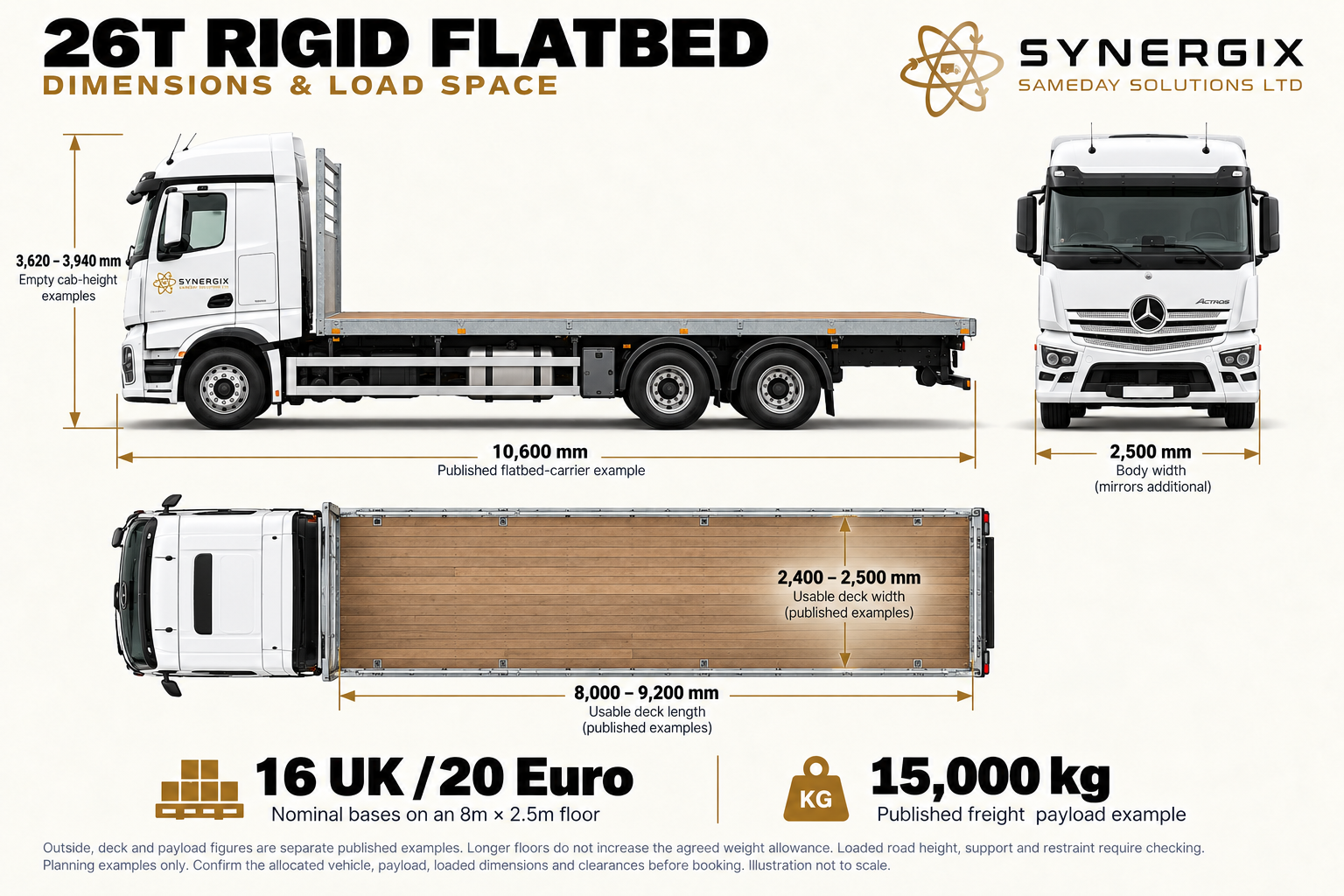
26 t rigid flatbed
Published planning examples. The actual vehicle, equipment, load distribution and access must be checked for your booking.
Open the full-size diagramDimensions and planning figures in text
Complete-length carrier example 10,600 mm; empty cab-height examples 3,620–3,940 mm; body width 2,500 mm. Deck 8,000–9,200 × 2,400–2,500 mm. 16 UK /20 Euro on 8 m deck. Freight example 15,000 kg.
No crane or forklift. External, deck and payload data are from separate published builds.
Published example sources:
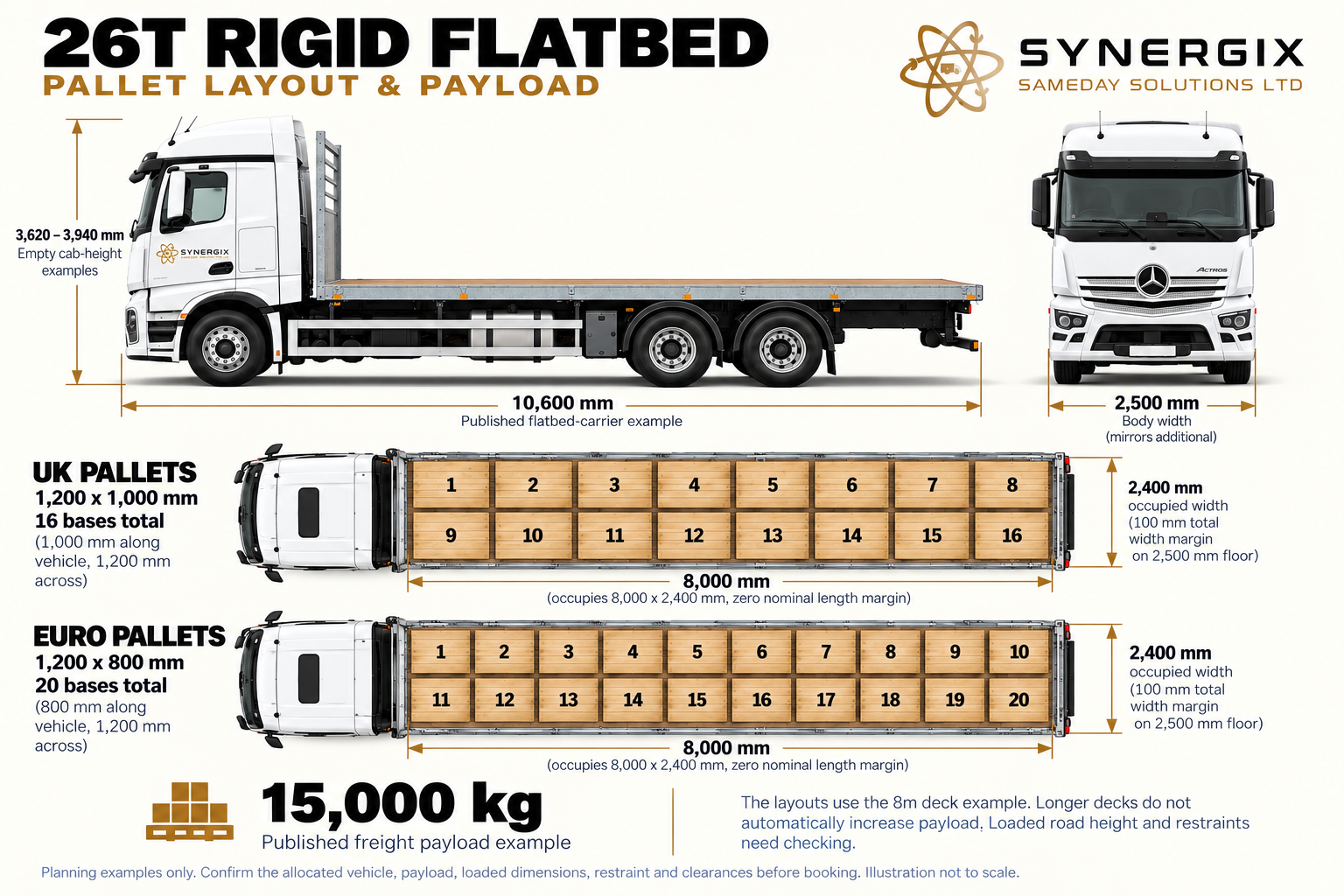
26 T Rigid Flatbed: pallet layout
Published planning examples. The actual vehicle, equipment, load distribution and access must be checked for your booking.
Open the full-size diagramDimensions and planning figures in text
16 nominal UK / 20 nominal Euro bases. 8,000 × 2,500 mm worked deck. 15,000 kg published freight example.
Both arrangements occupy 8,000 × 2,400 mm: zero nominal length margin and 100 mm total nominal width margin. Not a clearance guarantee.
Published example sources:
Construction and useful capability
A rigid can be a practical choice for a load that fits one platform and needs side or overhead loading. The cab and body move together, avoiding the articulation of a semitrailer. That can help some receiving sites, although the actual wheelbase, rear swing, width and turning room remain decisive. Rigid flatbeds in different gross-weight classes have different freight allowances; body length alone does not identify the class.
Loading, limitations and booking implications
Use a rigid when its useful deck, support positions and loading equipment fit the goods. A dense machine on small feet may need a deck-strength assessment before the overall vehicle payload is reached. If the vehicle carries a crane or forklift, the equipment has its own duty and changes road loading. Those equipped configurations need their specialist checks as well as the flatbed fundamentals.
Configuration explained
Articulated flatbeds.
A long open semitrailer deck behind a tractor.
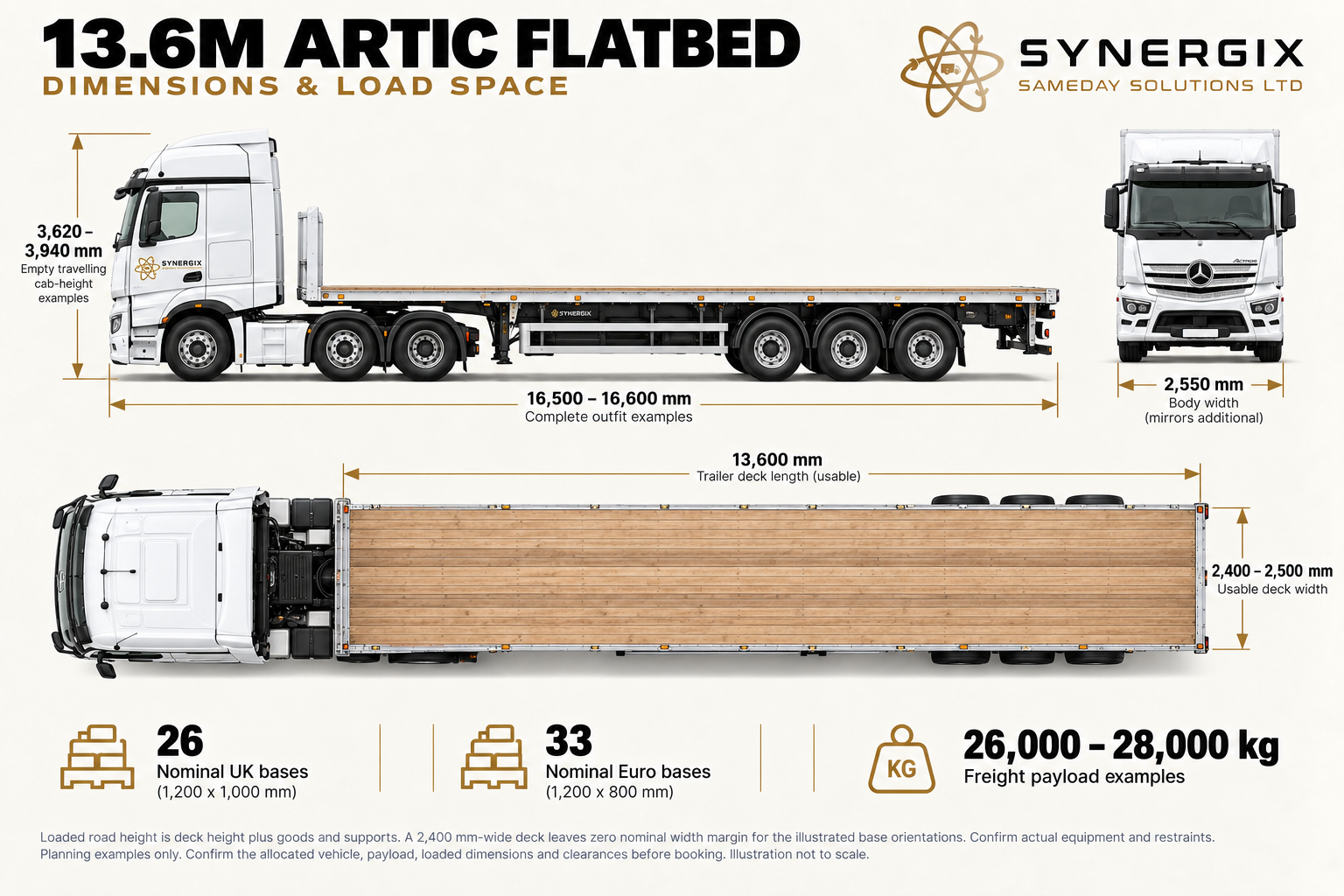
Articulated flatbed
Published planning examples. The actual vehicle, equipment, load distribution and access must be checked for your booking.
Open the full-size diagramDimensions and planning figures in text
Complete outfit 16,500–16,600 mm; empty cab height 3,620–3,940 mm; body width 2,550 mm. Deck 13,600 × 2,400–2,500 mm. 26 UK /33 Euro references. Freight 26,000–28,000 kg.
Empty cab height is not complete loaded road height. Nominal pallet positions are not guaranteed fit.
Published example sources:
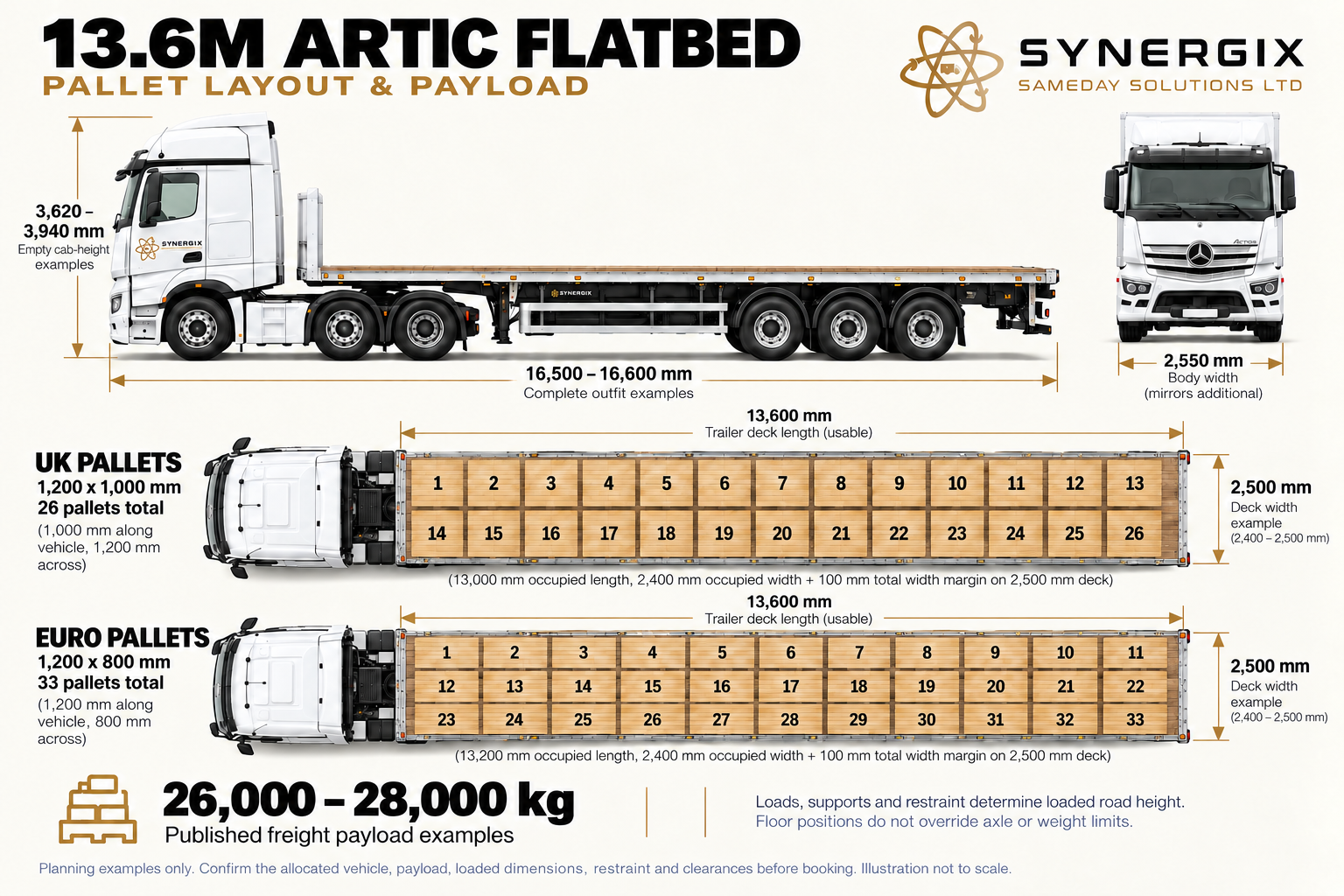
13.6 M Artic Flatbed: pallet layout
Published planning examples. The actual vehicle, equipment, load distribution and access must be checked for your booking.
Open the full-size diagramDimensions and planning figures in text
26 nominal UK / 33 nominal Euro bases. 13,600 × 2,500 mm worked deck. 26,000–28,000 kg published freight examples.
UK occupied footprint 13,000 × 2,400 mm; Euro 13,200 × 2,400 mm. Empty cab height does not establish loaded road height.
Published example sources:
Construction and useful capability
An articulated platform can offer continuous support space for long packs, fabricated frames, suitable plant and larger construction consignments. Open sides remove curtain-post and door-aperture constraints. The headboard, deck structure, securing points and permitted loaded envelope still govern what can be carried. Loads must be supported at positions suitable for both their own structure and the trailer.
Loading, limitations and booking implications
A long platform requires a route and yard that accommodate the complete combination. Freight position shares load between the trailer bogie and tractor through the kingpin. Filling the front or rear simply because it looks convenient can overload one part of the outfit while the train total is acceptable. Delivery order, lifted-off pieces and any returns belong in the initial layout.
Configuration explained
Flatbeds with a HIAB or MOFFETT.
Different solutions where receiving equipment is unavailable.
Construction and useful capability
A loader crane lifts a suspended load through an assessed radius and working sector. A carried forklift supports compatible goods on forks and travels over a suitable site route. These mechanisms solve different problems. Crane placement over an obstacle and forklift travel into a yard cannot be treated as interchangeable forms of free unloading.
Loading, limitations and booking implications
Describe the final receiving point, support or lifting points and individual masses. Crane legs, rigging and lifting geometry add requirements; a MOFFETT adds demounting space, fork geometry and a ground route. Both add equipment mass and change axle loading. The general flatbed payload or a sender’s large forklift cannot establish the assigned specialist vehicle’s capability.
Configuration explained
Step frames and low loaders.
Lower platforms when height or drive-on loading decides the job.
Construction and useful capability
A step frame provides separate higher and lower deck regions. A low loader offers a specialist low-bed arrangement for suitable machinery and tall cargo. Neither is simply a normal flatbed with the same dimensions and a different name. Each needs a drawing of usable deck zones, axle positions, loading interfaces and support restrictions.
Loading, limitations and booking implications
Reducing deck height can help a tall item clear the route, but underbody clearance, ramps and breakover become more important. A machine must be able to climb the selected loading system without grounding and remain adequately supported. Where no ramp is provided, suitable external lifting remains necessary. Choose the platform around the complete loading and travelling envelope.
The practical guide
How the equipment works.
Suitable flatbed loads
Steel sections, timber packs, suitable machinery, construction components, tanks, fabricated frames and other self-supporting freight can suit a flatbed. The load must be stable, adequately supported and capable of being restrained without damage. Specify corrosion sensitivity and weather exposure. A flatbed can be preferable where rear doors would block a wide, long or overhead-loaded item.
What is not acceptable without containment
Loose small goods, unstable stacks, unsupported panels and material that can blow or bounce off the vehicle need an appropriate containment and securing arrangement. A pallet alone does not make its contents secure. Open tubs of liquid or unsecured rubble are not ordinary flatbed freight. Dangerous goods, waste and contaminated materials require their own classification and acceptance checks before a suitable body is chosen.
No universal maximum cargo height
Measure the loaded overall height from the ground, including the deck, dunnage, cargo and projections. The allowable load height is governed by the actual vehicle, stability, securing method, route and every entrance or overhead obstruction. Great Britain does not provide one useful flatbed cargo-height allowance for every job. International routes can impose different dimensional limits. A low loader may help a tall item where a higher flatbed would not.
Width, length and overhang
Give the outermost loaded dimensions, including feet, handles, lifting lugs, packaging and projections. Confirm support beneath the load and actual permitted width, length and axle loads. Side or rear overhang can require marking, notification or an abnormal-load arrangement depending on the dimensions and applicable rules. The fact that a load can physically sit on the deck does not establish lawful road carriage.
Supports and deck strength
Dunnage, cradles and load spreaders need sufficient strength and appropriate positions. A long beam cannot be supported arbitrarily where its own structure could bend. A heavy machine can exceed local deck loading through small feet despite being below vehicle payload. Supply support drawings and centre-of-gravity information. The carrier must also be able to attach restraints to rated points without relying on light side guards.
Loading from the side or above
Tell us whether the collection uses a forklift, overhead crane, loader crane or other equipment. Confirm the equipment’s capacity at the required geometry and a clear working area. A wide crate may need long forks or a spreader and enough room for the forklift. A flatbed booking does not automatically include lifting equipment at collection or delivery.
Sheets protect against weather, not movement
An appropriate sheet can limit weather exposure or contain suitable small material. It does not replace blocking and rated lashings. Fragile finishes may need protective packing under straps and sheet edges. Water can pool, wrapping can tear and condensation can form. If weather sensitivity cannot be addressed on an open deck, request an enclosed or appropriately covered body instead.
Restraint for open-deck freight
Design the restraint around the load’s weight, sliding, tipping and rolling risks. Use approved anchor points, suitable lashings, blocking and edge protection. Where a headboard cannot be used because of axle distribution, additional forward restraint is needed. A recovery winch is not the complete transport securing system. Recheck restraint after settlement and at delivery stages through the agreed procedure.
The practical guide
Make an open platform work for the goods.
Long packs need a support plan
Steel, timber and fabricated components can sag or twist if supported at inappropriate positions. Tell us where bearers are permitted and whether the load has transport braces. Bundle bands may keep a pack together but do not necessarily restrain it to the vehicle. Restraint must work without crushing a finished edge or imposing an unsupported bending load.
Machinery, skids and concentrated loads
A machine’s gross mass can be modest while the pressure beneath one foot is high. Provide foot locations, contact areas and the centre of gravity, plus any restrictions on transport orientation. A skid, spreader or cradle needs its own suitable design. The same information helps the receiver plan lifting and avoid discovering that a forklift cannot approach beneath the load.
Weather protection needs a purpose
Decide whether the goods tolerate rain, spray, dirt and wind, or require wrapping, sheeting or an enclosed body. A sheet can rub a painted surface or trap moisture. Transit protection must survive the journey and allow safe removal. If a product needs a reliably enclosed environment, a curtainsider or box may be a better starting point than elaborate improvised wrapping.
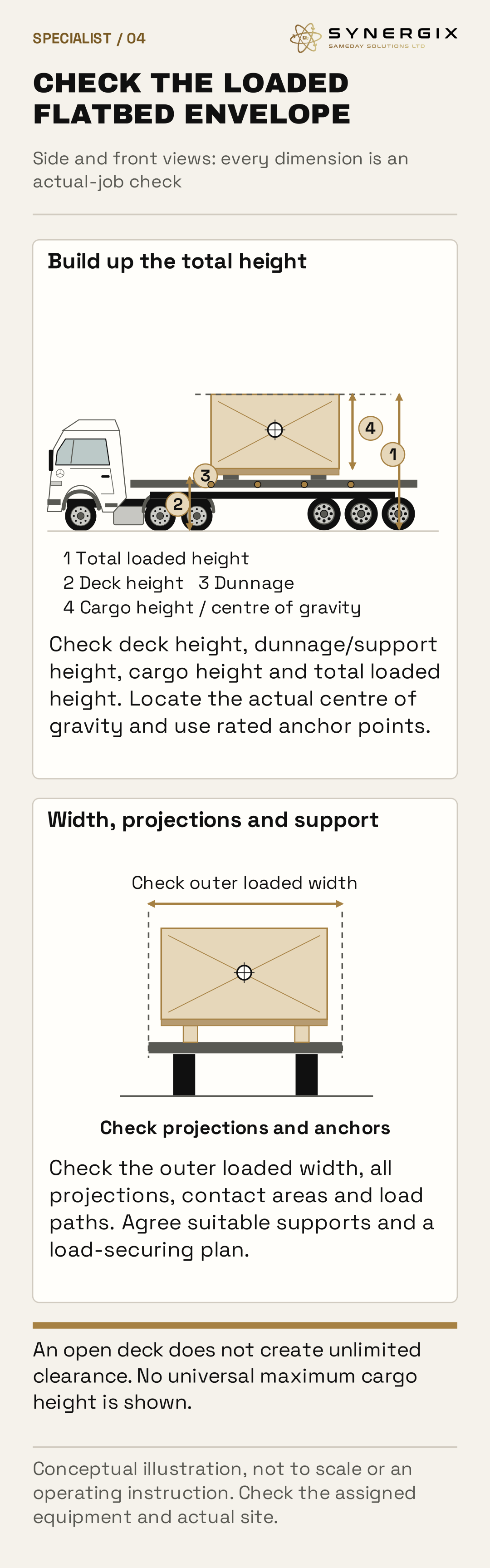
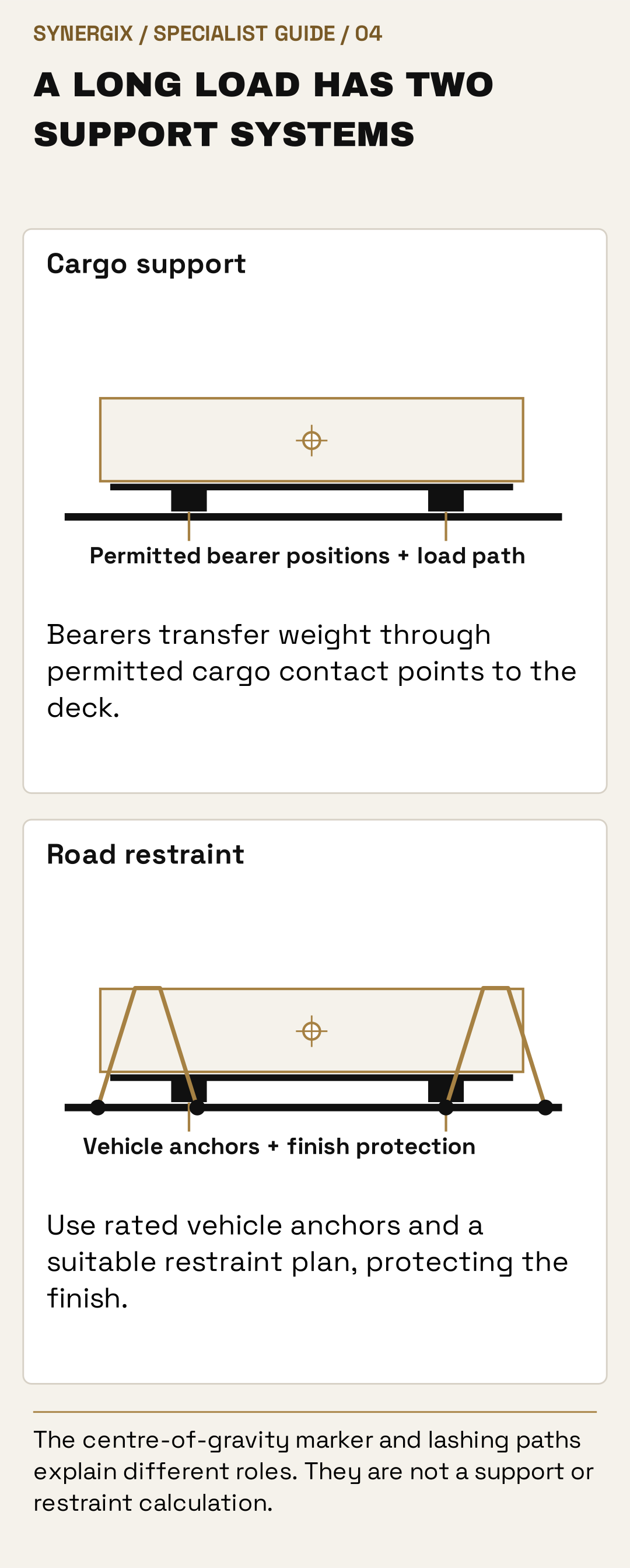
The centre-of-gravity marker and lashing paths explain different roles. They are not a support or restraint calculation.
Open full-size desktop diagram · Open full-size mobile diagramThe practical guide
Loading and equipment condition.
Who does what at each end
Confirm the loader, equipment capacity, lift points or fork pockets, working side and the receiving authority. Access from above is useful only if a suitable crane is available. Include the time to remove sheets and restraints, fit lifting accessories and prepare supports. Installation, bolting down or moving goods inside a building require a separately agreed scope.
The deck is a working structure
Inspect for damaged boards or metalwork, weakened anchorages, loose posts, defective headboards and insecure equipment. Supports and edge protection should match the planned load. Restraints need legible ratings and sound fittings; a strap with a cut or a distorted hook cannot be credited with its original capacity. The roadworthiness programme and load-equipment checks both matter.
Load movement changes the unloading risk
If a pack has shifted, opening access and releasing restraints can expose the receiver to falling goods. Stop and agree an appropriate recovery method. Do not ask someone to steady a heavy piece while its last restraint is removed. A sound receiving plan includes the condition of the freight on arrival as well as how it was originally loaded.
The practical guide
The complete approach and working area.
The gate is only one part of access
Use the actual loaded vehicle dimensions and assess the approach, bends, mirrors, rear swing, gradients and departure. A route that admits the cab may still be unsuitable for the trailer or its load. Height includes the body, supports and cargo, not just the nominal vehicle category. Where required, the in-cab height indication must represent the actual overall height.
Space to complete the operation
The site must accommodate bearer placement, sheeting, lifting coordination, restraint and weather protection. Add working space to the parked outline, with suitable ground and separation from people and traffic. Overhead lines, canopies, drains, buried services and weak edges may be relevant. Photographs help identify obstacles, but cannot certify hidden ground strength or approve a machine’s duty.
Permissions and receiving authority
Give timed-access rules, parking/road occupation constraints, site inductions, authorised contacts and the actual receiving point. An except-for-access exemption does not suspend a weak-bridge or physical height restriction. For unusual mass, width, length or projections, the operator establishes the appropriate road framework and any surveys, notices or other arrangements. GB, Northern Ireland and international movements can have different requirements.
The practical guide
Condition, records and responsibility.
Condition on the day
For this family, focus on deck/headboard/anchor condition, suitable restraints and external lifting arrangements. Pre-use checks and defect reporting remain essential alongside scheduled maintenance. A current annual test or an equipment sticker cannot approve a newly damaged component. Stop using defective equipment and have it assessed through the appropriate competent process.
Servicing, tests and examinations are different
The road vehicle/trailer needs its roadworthiness programme. Specialist mechanisms need manufacturer-based maintenance suited to age, duty, environment and condition. Where lifting or pressure equipment falls within a statutory inspection or examination regime, its reports and defect actions have their own purpose. Do not replace all of these with one claim that the vehicle is serviced annually.
Agree the roles
The consignor supplies accurate goods, weights, dimensions and handling information. The carrier and driver retain their own road and equipment responsibilities. The receiver provides the agreed access, receiving arrangement and authority. Identify who loads, operates machinery, provides documents and receives the goods. Ownership or hire of equipment does not remove the duties of those using or controlling it.
The practical guide
Driver hours and a realistic schedule.
Driving is only part of the job
Allow for bearer placement, sheeting, lifting coordination, restraint and weather protection, as well as travel, queues and departure. Loading, equipment operation and checks are normally work, not a driving break simply because the vehicle is stationary. Waiting has to be classified under the applicable conditions; unknown waiting with continuing duties is not automatically rest.
The usual in-scope HGV limits
For a normal in-scope operation, the assimilated rules generally allow nine hours of daily driving, extendable to ten twice a week, with 56 hours in a week and 90 across two consecutive weeks. After 4½ hours of driving, a qualifying 45-minute break is required, which can normally split as 15 then 30 minutes. Rest, working time, the actual regime and any valid exceptions also need consideration. These limits are not an arrival-time calculator.
Working time, rest and overnight work
Mobile-worker rules generally limit working time to a 48-hour weekly average and 60 hours in an individual week, with separate break and night-work provisions. Previous duties can reduce what the assigned driver can do on your job. A long movement can require suitable overnight parking, sleeper/hotel arrangements, relief or a multi-day plan. A specialist day cab does not automatically provide sleeper accommodation.
Routes and vehicle scope matter
The actual vehicle, activity and route determine the applicable rules. Since 1 July 2026, relevant UK/EU international light-goods movements over 2.5t can fall within expanded hours/tachograph scope; that is not a blanket statement about every domestic van. International requirements, borders, site hours and ferry timings belong in the schedule.
The practical guide
What the quotation needs to cover.
Quote the whole movement
The useful starting specification is unit supports, weather sensitivity, load envelope and handling at both ends. The price covers the suitable vehicle/equipment, competent people, full route, agreed handling, availability and time. It is not simply a loaded-mile fuel calculation. Tell us about urgency, exact slots, extra stops, waiting, returns and work beyond the vehicle.
Positioning and onward mileage
The vehicle may need to travel to collection, reposition, return equipment, use a wash or move to another agreed handover. Empty mileage still uses time and energy. Uncoupled hire, delayed release or a second visit can create additional work. Agree these elements in the quotation, including what happens if the site or goods are not ready.
Good preparation helps value
Accurate dimensions and weights, clear access, prepared receiving equipment and a ready contact reduce the risk of a failed visit. Appropriate specialist equipment can cost more per mile while completing the actual job more effectively. The cheapest vehicle description is not a useful comparison if it excludes the handling you need.
The practical guide
Fuel, auxiliary power and emissions.
Count the actual energy sources
The energy plan includes road travel, any agreed crane/forklift duty and additional handling time. Load, equipment mass, road speed, gradients, traffic, stops and weather all affect consumption. Published economy for another body or a lightly loaded vehicle is not a reliable specialist-job MPG. Use measured data or clearly declared assumptions for an estimate.
Avoid double counting
If fuel is measured for the complete movement, do not add the same engine-driven PTO consumption again. A separate refrigeration engine, compressor, generator or metered supply may need its own entry. Include positioning and the agreed return scope. Distinguish an energy estimate from an actual vehicle record and avoid claiming a single consumption figure for the whole equipment family.
Electric feasibility is a duty decision
Electric road vehicles or auxiliaries can suit appropriate known routes with compatible power, range, charging and reserve. Their suitability depends on the load, deadline, auxiliary demand and reliable supply; availability is confirmed separately. Electric standby on a trailer is different from an electric tractor and does not make the entire movement electric.
Use a consistent reporting boundary
CO₂ measures carbon dioxide; CO₂e includes other greenhouse gases on an equivalent basis. Compare like-for-like combustion and upstream fuel, or electricity generation/supply, as applicable. A whole-life comparison also needs manufacture, batteries/equipment, maintenance and end of life. No exhaust at the vehicle is not the same as no lifecycle impact. A calculated footprint needs its date, factors and assumptions.
Choose the equipment for the outcome
Compare the adjacent choices.
| Alternative | Reason to assess it |
|---|---|
| Curtainsider or box | Where enclosure works with the goods and loading openings. |
| Step frame or low loader | Where height, support or drive-on loading requires a lower arrangement. |
| HIAB or MOFFETT | Where an assessed independent unloading method is needed. |
Put the information to work
Three practical booking examples.
A long fabricated frame
Supply a drawing with overall dimensions, mass, centre of gravity and permitted bearer positions. Check continuous deck support, restraints, route envelope and cranes at both ends. Do not select by cubic volume alone.
Weather-sensitive machinery
Compare an enclosed body against the proposed wrapping and flatbed method. Door/side access, finishes, supports and lifting access may favour one option even when both can carry the gross weight.
A small site without a forklift
Compare an equipped rigid or artic against arranging receiving equipment. The right choice depends on fork support, lift points, placement and working space, rather than only the flatbed’s size.
Terminology in plain English
Useful equipment terms.
- Dunnage
- Suitable supports or packing between the freight and deck.
- Point load
- Weight concentrated through a small contact area rather than spread across the floor.
- Headboard
- The front structure, whose suitability as restraint depends on its construction and use.
- Load envelope
- The complete outer dimensions of the loaded vehicle, including projections.
- LC and STF
- Lashing capacity and standard tension force, different properties relevant to restraint selection.
- Centre of gravity
- The load’s balance point, important for support, lifting and stability.
Why Synergix
Confidence in the whole delivery.
Practical transport experience
Three generations of family transport experience support useful decisions about the load, site and receiving operation. We bring those details together before agreeing the movement.
Direct delivery and wider capability
Dedicated direct delivery and UK/European capability help connect collection with the required handover. Specialist equipment, route, timing and availability are confirmed for the actual job.
Tracking and proof of delivery
Live tracking and delivery evidence help you follow progress and establish receipt. Any specialist temperature, cleaning or equipment record needs to be requested in the required format before booking.
Insured transport and active support
Insured transport and active operational support provide reassurance through the movement. Declare goods, value and unusual handling so applicable cover and terms can be confirmed. No unlimited cover or automatic acceptance is implied.
Specialist equipment availability and mobilisation are confirmed for the job. Synergix’s separate 60-minute UK courier collection proposition is not a universal guarantee for these specialist vehicles.
Flatbed vehicles and trailers FAQs
Your questions answered.
Does a flatbed include a crane?
No. A standard flatbed is the carrying platform. Request crane, carried-forklift or other handling explicitly.
Is a flatbed an HGV?
Many flatbed trucks and articulated combinations are HGVs. Flatbed describes the body, so it does not by itself identify vehicle weight class or driver entitlement.
What is the maximum load height?
Use deck height plus supports and cargo to find loaded overall height. Stability, restraint, route and entrance clearances determine suitability; there is no one cargo-height allowance for every flatbed.
Can goods project beyond the deck?
Only through an assessed lawful arrangement with adequate support, restraint and any required marking, notifications or other measures. Give the full projections before quotation.
Can you collect steel or machinery?
Describe the material or machine, weights, dimensions, support positions and handling. Suitable equipment and acceptance are confirmed for the actual job.
Are sheets enough to secure a load?
No. Weather protection and road restraint have different purposes. The load needs an appropriate securing system.
Does a longer flatbed carry more weight?
Not necessarily. Structure, ready-to-load mass, axle/kingpin limits and cargo position govern the freight allowance.
What affects the price?
Vehicle and equipment, full mileage, dimensions, preparation, sheeting, loading/unloading, waiting, timing and any abnormal-load planning all matter.
Before you book
Tell us what needs moving.
You do not need to identify every equipment model before contacting us. Start with unit supports, weather sensitivity, load envelope and handling at both ends.
Describe the goods
Product/type, quantity, packed dimensions, verified gross unit weights or density/volume as relevant, support/handling points, condition, value and any hazards, hygiene or temperature instructions.
Show both sites
Postcodes, approach, restrictions, measured openings, ground, working space, loading/discharge equipment, receiving position, contacts and useful photographs or drawings.
Define the work
Date/time windows, stops, loading/unloading roles, equipment operation, placement or transfer, parked periods, returns, cleaning and required documents. Include any installation or indoor handling as a separate requested scope.
Agree the arrangement
The team confirms the appropriate equipment, availability, scope, price and conditions. A vehicle illustration or LoadCheck calculation is planning help, not a reservation or approval for specialist handling.