
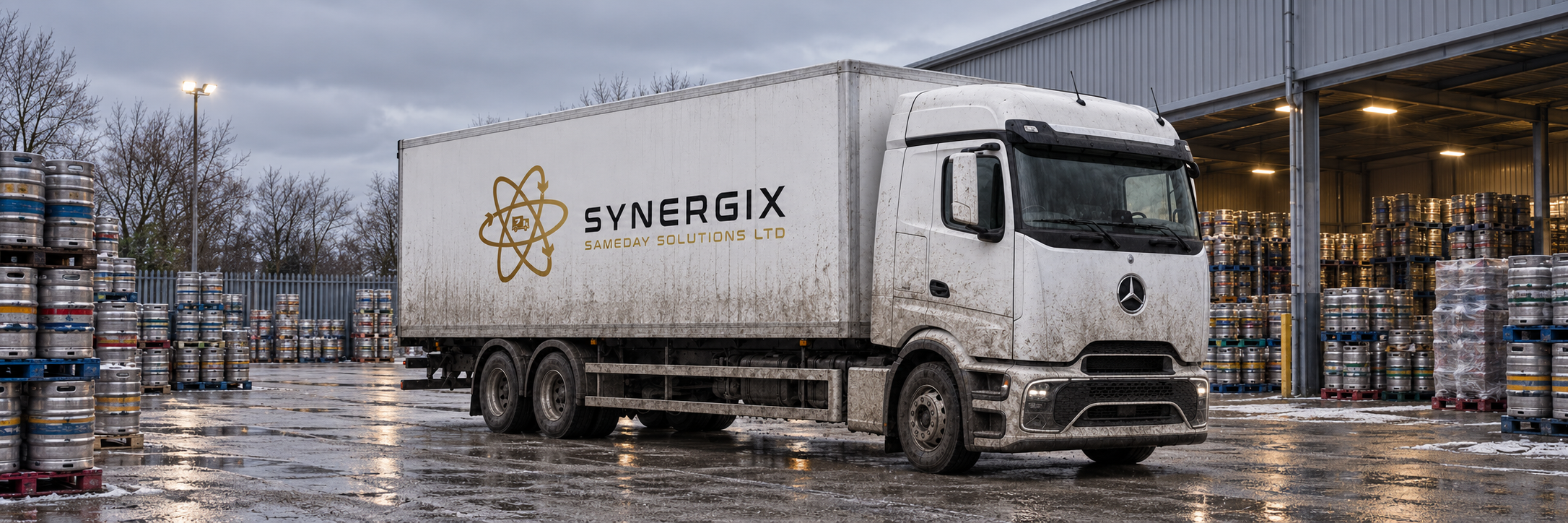
26-tonne truck
courier service
Available 26-tonne truck body types
Choose the body and the unloading method together. All specialist arrangements are subject to the load, site and vehicle checks.
| Configuration | Useful for | What must be checked |
|---|---|---|
| Box | Enclosed pallet, stock, machinery and distribution loads. | Rear aperture, dock compatibility, load security and any tail lift. |
| Curtainside | Pallets or long items that need forklift access from the side. | Clear side opening, roof rails, load restraint and side access at both sites. |
| Refrigerated / temperature-controlled | Temperature-sensitive retail stock, food or other agreed goods. | Temperature, airflow, equipment weight, payload and handling. |
| Flatbed | Steel, timber, building materials and suitable open-deck freight. | Deck, support, weather protection, restraint and external loading equipment. |
| Flatbed with HIAB / loader crane | Suitable loads that need lifting on or off and placing within an assessed working area. | Reduced payload, crane chart at required radius, lifting points and stabiliser ground. |
| Curtainside with Moffett | Palletised goods needing weather protection and a carried forklift for unloading. | Reduced payload, forklift chart, fork access, unloading sides and ground route. |
| Flatbed with Moffett | Suitable palletised building materials and open-deck goods without a receiving forklift. | Reduced payload, load support, protection, forklift access and delivery ground. |
The equipment decides the booking.
Box, curtain and fridge describe the body. A tail lift, loader crane or truck-mounted forklift describes a handling capability. These are separate decisions. A standard 26-tonne truck does not automatically arrive with any of them.
Tell us whether there is a forklift, loading dock or crane at collection and delivery. We can assess a suitable body and agreed unloading arrangement rather than find out at the gate that the goods cannot be moved.
A fridge does not automatically mean a smaller body.
Purpose-built refrigerated bodies can retain internal dimensions comparable with dry bodies. Do not deduct a fixed amount from every refrigerated truck’s floor length or width. Confirm the actual body.
Refrigeration machinery, insulation, partitions and an often-fitted retail tail lift add weight. Evaporators, ducts and the airflow around goods can still affect usable loading positions. These are separate from the measured interior dimensions.
26-tonne truck dimensions and load space
Check the complete vehicle and the actual opening. The body guide helps shortlist a truck, but does not confirm a booking.
| Check | Synergix initial guide |
|---|---|
| Total consignment weight | Up to 15,000 kg on a suitable standard vehicle |
| Internal load length | 8,000 mm / 8.0 m |
| Internal load width | 2,500 mm / 2.5 m |
| Internal load height | 2,600 mm / 2.6 m |
| Calculated rectangular volume | 52 m³, calculated from 8.0 × 2.5 × 2.6 m |
| UK pallet reference | Up to 16 bases, 1,200 × 1,000 mm |
| Euro pallet reference | Up to 20 bases, 1,200 × 800 mm, with a full suitable 8 m floor |
| Specialist payload | Confirm the actual completed vehicle with all equipment aboard |
| Outside dimensions and door apertures | Request the assigned truck’s measurements |
Why two 26-tonne trucks can be different.
Most are specified as a chassis with a separately built body. Wheelbase, cab, chassis layout, body length, doors, refrigeration and unloading equipment change the finished vehicle. The number on the vehicle category does not set its inside length.
A manufacturer’s chassis drawing does not prove the completed body’s loading dimensions. The 52 m³ figure is a rectangular planning calculation, not measured cargo volume for every conversion.
Check the opening and the route through it.
An 8 m floor does not guarantee that an 8 m-long rigid item can be loaded. Rear-door width and height, side apertures, pillars, roof rails and the manoeuvre into the body can be more restrictive than its final floor position.
Measure packaged goods at their widest and tallest points, including pallets, wrapping and protrusions. Confirm whether they can be turned or tilted. Heavy equipment may not be safely rotated to make an optimistic fit calculation work.
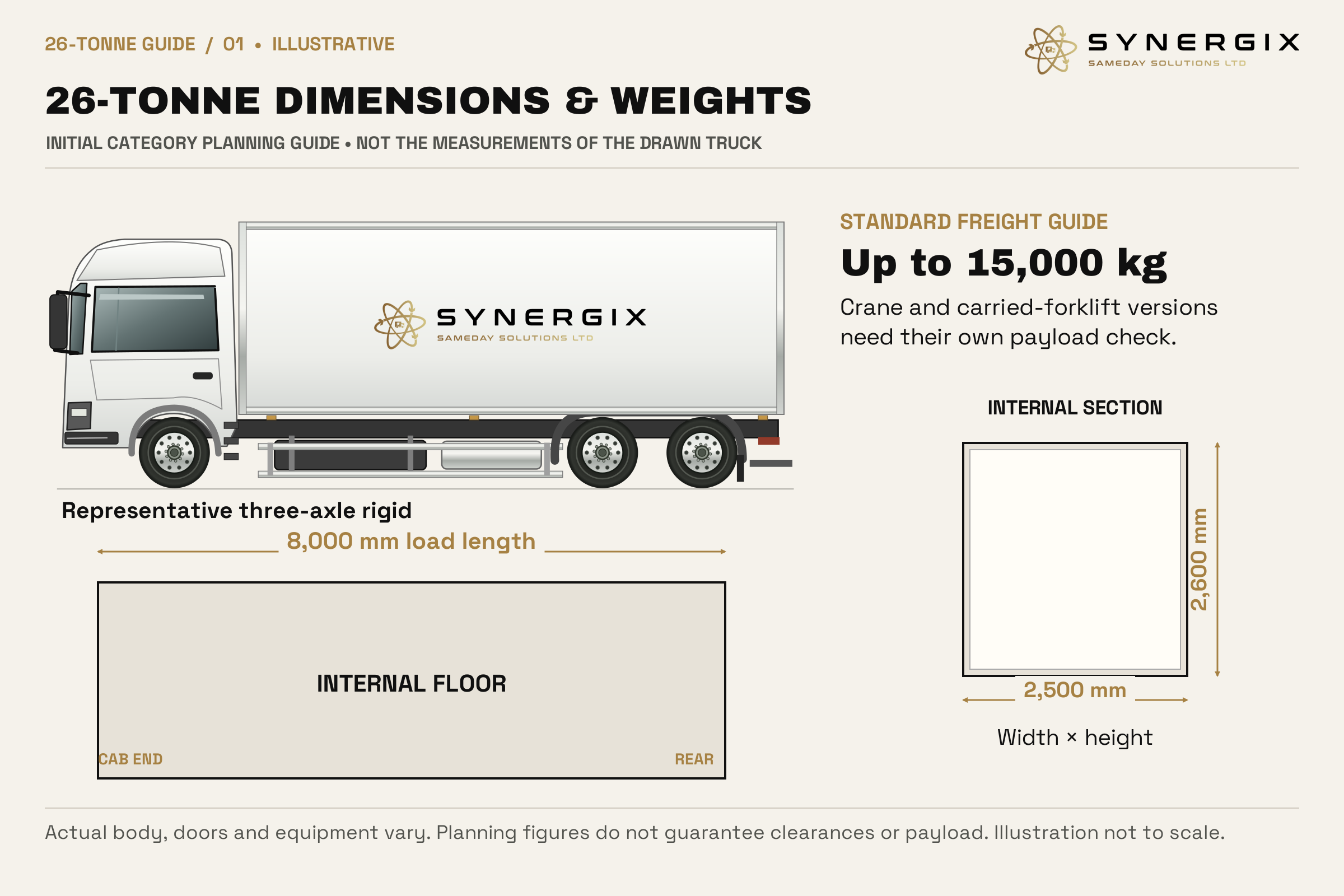
Keep the illustration separate from the booking guide.
The drawing shows a representative truck alongside category planning figures. It does not supply exterior measurements or establish the assigned vehicle’s dimensions, equipment or body. The initial guide remains 8.0 × 2.5 × 2.6 m and up to 15,000 kg for a suitable standard body.
For a crane, forklift, fridge or tail lift, request the converted vehicle’s usable dimensions and payload. Do not treat a photograph or a larger illustration figure as permission to exceed the agreed booking figures.
26-tonne courier and haulage work
Match the truck to the goods, receiving site and deadline. Bigger capacity is useful only when the complete job works.
A high-capacity rigid for heavier deliveries.
A 26-tonne rigid carries its body on the same chassis as its cab. It offers a step up from an 18-tonne truck when the freight weight, pallet count or body specification needs it, while avoiding an articulated combination where that would be unsuitable.
It suits substantial dedicated loads, regular haulage and distribution. Its benefit is useful capacity with the right unloading arrangement. It still needs enough road, entrance, working and turning space. It is not a small vehicle simply because it is rigid.
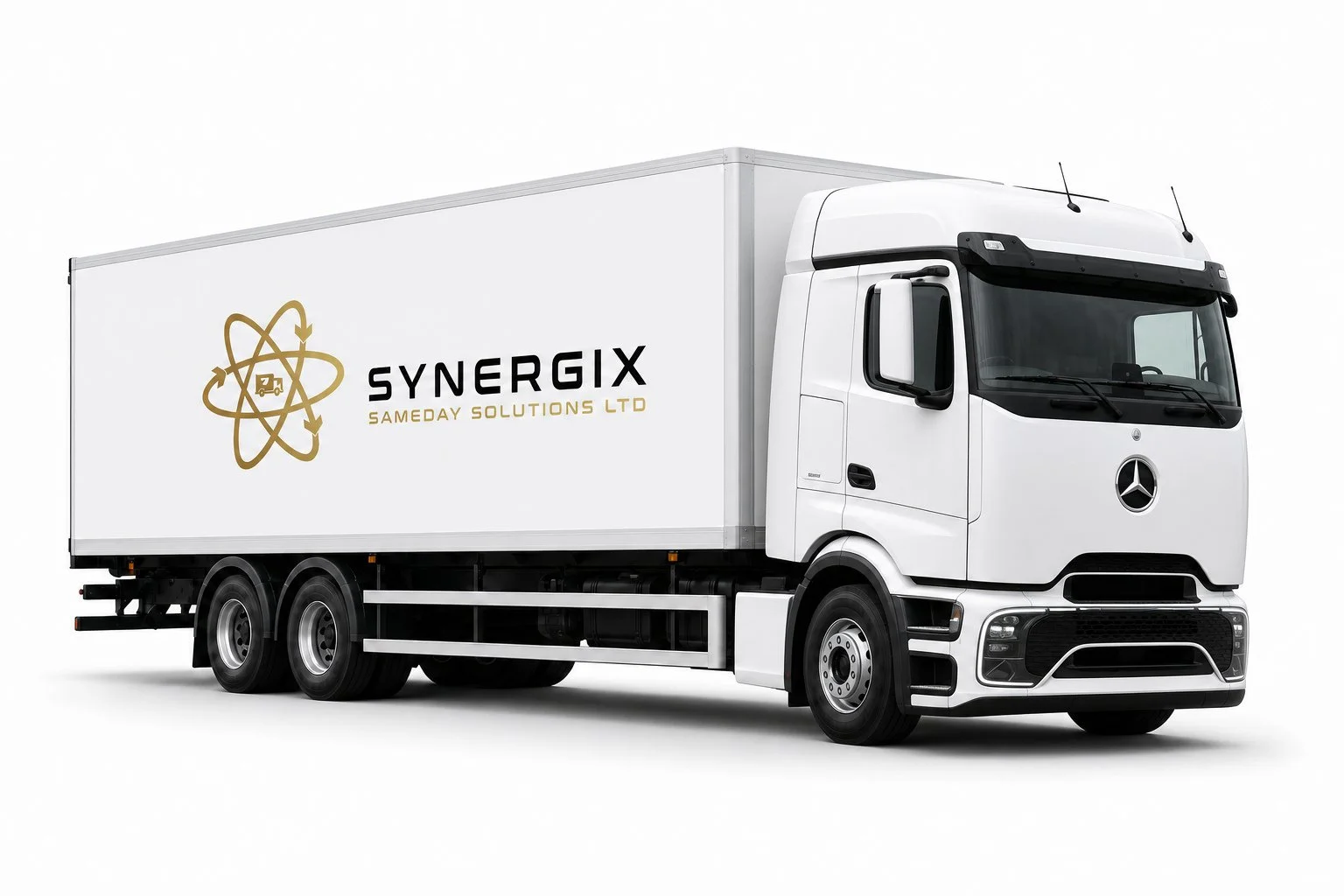
General and regular haulage.
Move palletised stock, packaging, industrial supplies or other substantial freight on a planned dedicated movement. Regular work can align dispatch, loading slots and receiving capacity rather than arranging a different vehicle each time.
Construction and merchants.
Bricks, blocks, bagged materials, timber and steel can need considerable weight capacity. A site without a forklift may need a Moffett; a load needing placement by lifting may need a HIAB. The equipment must match the individual item, not just the consignment total.
Retail distribution and replenishment.
A suitable truck can carry store stock, drinks, fixtures or seasonal goods. Receiving slots, pallet returns, multi-drop order, loading bays and tail-lift requirements need planning. A shopping centre may accept a 7.5-tonne truck or Luton and still refuse this vehicle.
Machinery, engineering and urgent freight.
A dedicated truck may suit an urgent industrial load when a smaller vehicle cannot carry it. Machines need their true transport weight, centre of gravity, lifting or forklift provisions, floor support and restraint assessed. Same-day urgency does not remove those checks.
Refrigerated work and events.
Agree the required temperature, product condition, monitoring and loading process. Vehicle refrigeration is not automatically a means to chill warm goods quickly. Event access, timed arrivals and positioning require separate instructions.
Consolidation and return movements.
Warehousing, cross-docking or consolidation may help organise multiple consignments before the larger movement. Return pallets, packaging and collected goods add weight and space and must be included. Two-person delivery or installation is a separately agreed service.
How many pallets fit a 26-tonne truck?
Use separate UK and Euro layouts. A pallet position establishes floor geometry, not a promise that its load can be carried or unloaded.
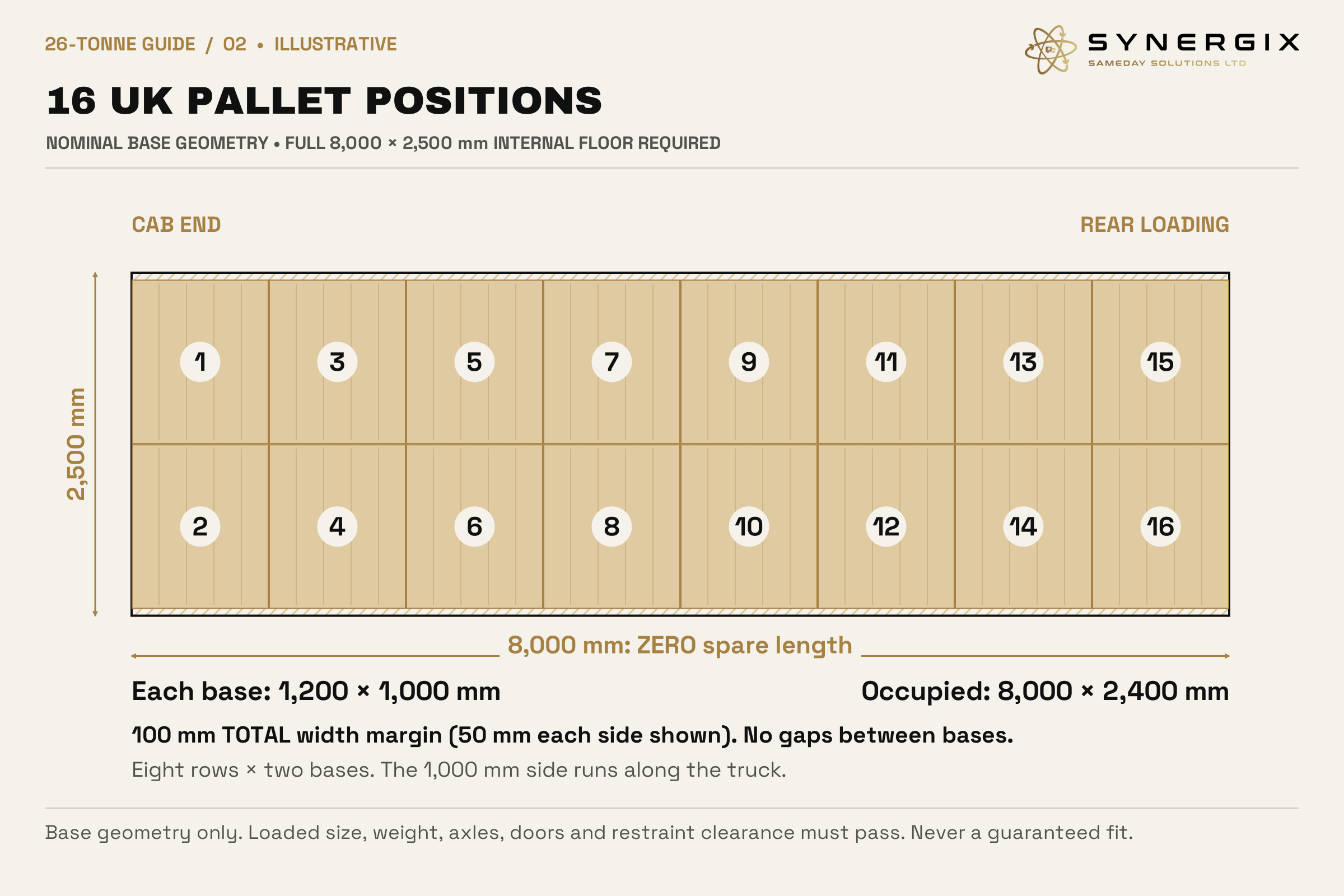
UK pallets: up to 16 on a suitable standard body.
A UK standard base is 1,200 × 1,000 mm. On the 8.0 × 2.5 m example, two bases across at 1,200 mm each use 2,400 mm of width. Eight rows at 1,000 mm along the body use all 8,000 mm of length.
That gives 16 pallet-base positions with 100 mm of spare width in total and no spare length. It is a geometric illustration. If the usable floor is shorter, the doors need clearance or goods overhang, this arrangement may fail.
Euro pallets: up to 20 where the full floor is usable.
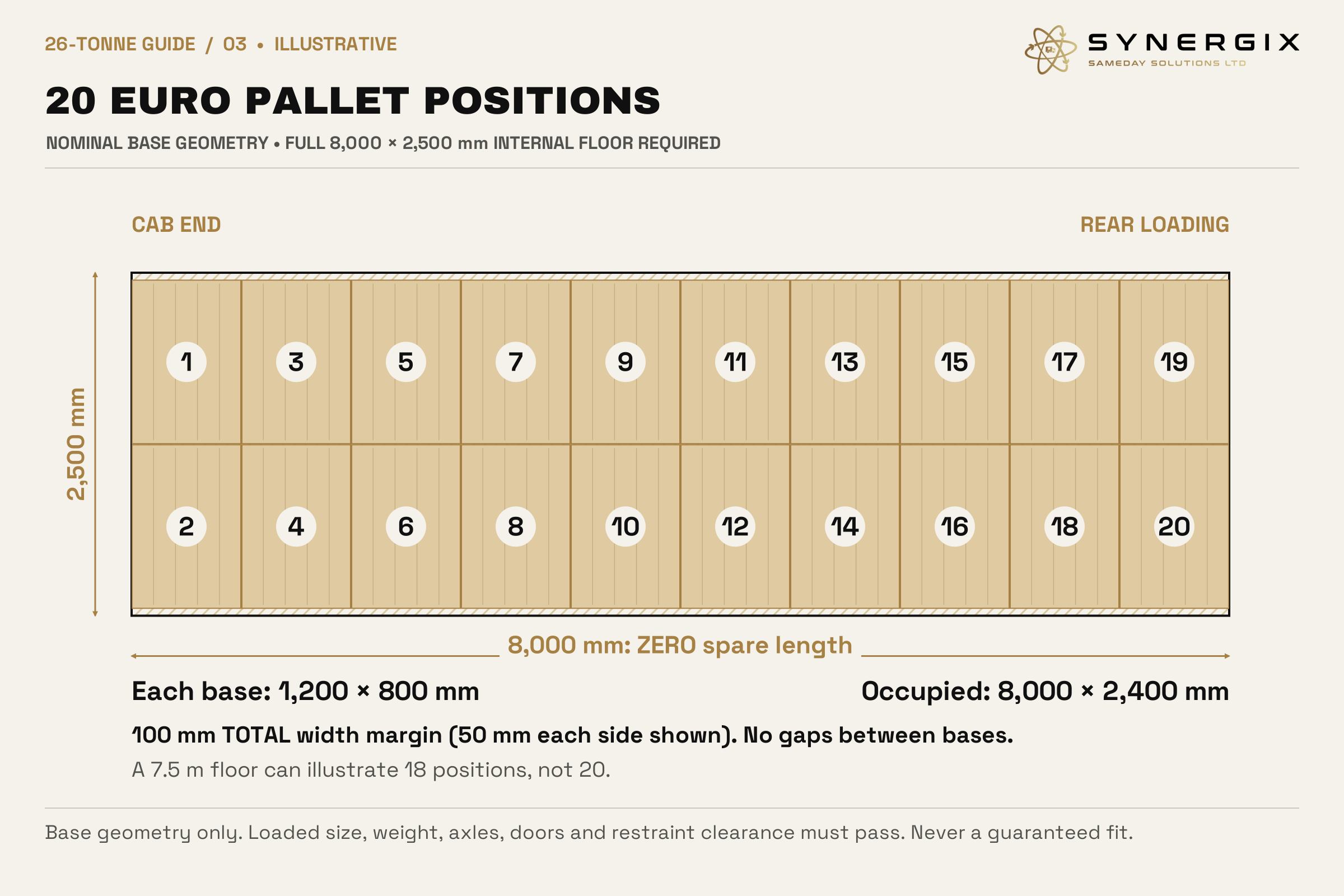
A Euro base is 1,200 × 800 mm. Two across use 2,400 mm of width. Ten rows at 800 mm along the truck use 8,000 mm. This gives 20 base positions on a suitable wider body.
There is again no spare length. On a body with only 7.5 m of useful floor, nine rows of two use 7.2 m and give 18 Euro positions instead. Request a measured layout when the last positions matter.
| Illustrative load | Total weight | Initial result |
|---|---|---|
| 16 UK pallets at 900 kg each | 14,400 kg | Below the standard freight guide; other checks remain |
| 16 UK pallets at 950 kg each | 15,200 kg | Exceeds the standard freight guide |
| 20 Euro pallets at 750 kg each | 15,000 kg | Uses the entire standard guide; verify actual payload |
| 20 Euro pallets at 800 kg each | 16,000 kg | Exceeds the standard freight guide |
A base count is not a loading plan.
Measure the loaded pallet rather than the bare wooden base. Shrink-wrap bulges, overhang, leaning goods and tall stacks can use extra room. Reusable cages and stillages have different footprints and may require different handling.
Fork-entry direction, pallet condition and the load’s centre of gravity matter to unloading. Position heavier goods for the permitted axle loads and arrange multi-drop deliveries so earlier freight can be reached without unsafe rearrangement.
Stacking must be agreed.
Do not double the count because there is room above the first layer. Packaging, lower-pallet strength, stability, product damage, total height and restraint must support the proposed stack. Never stack fragile or non-stackable goods without approval.
Refrigerated loads may need air circulation above, beside or between goods. A flatbed or specialist body can have different obstructions, support and restraints. Its nominal base count does not automatically equal the enclosed-body example.
26-tonne truck payload and equipment weight
Useful freight capacity changes substantially when the truck carries the equipment needed to unload it.
Gross weight includes the whole vehicle.
The 26,000 kg category is maximum gross vehicle weight for an appropriately plated truck, not a cargo allowance. The chassis, cab, completed body, driver, fuel, machinery, mounting equipment and freight all count.
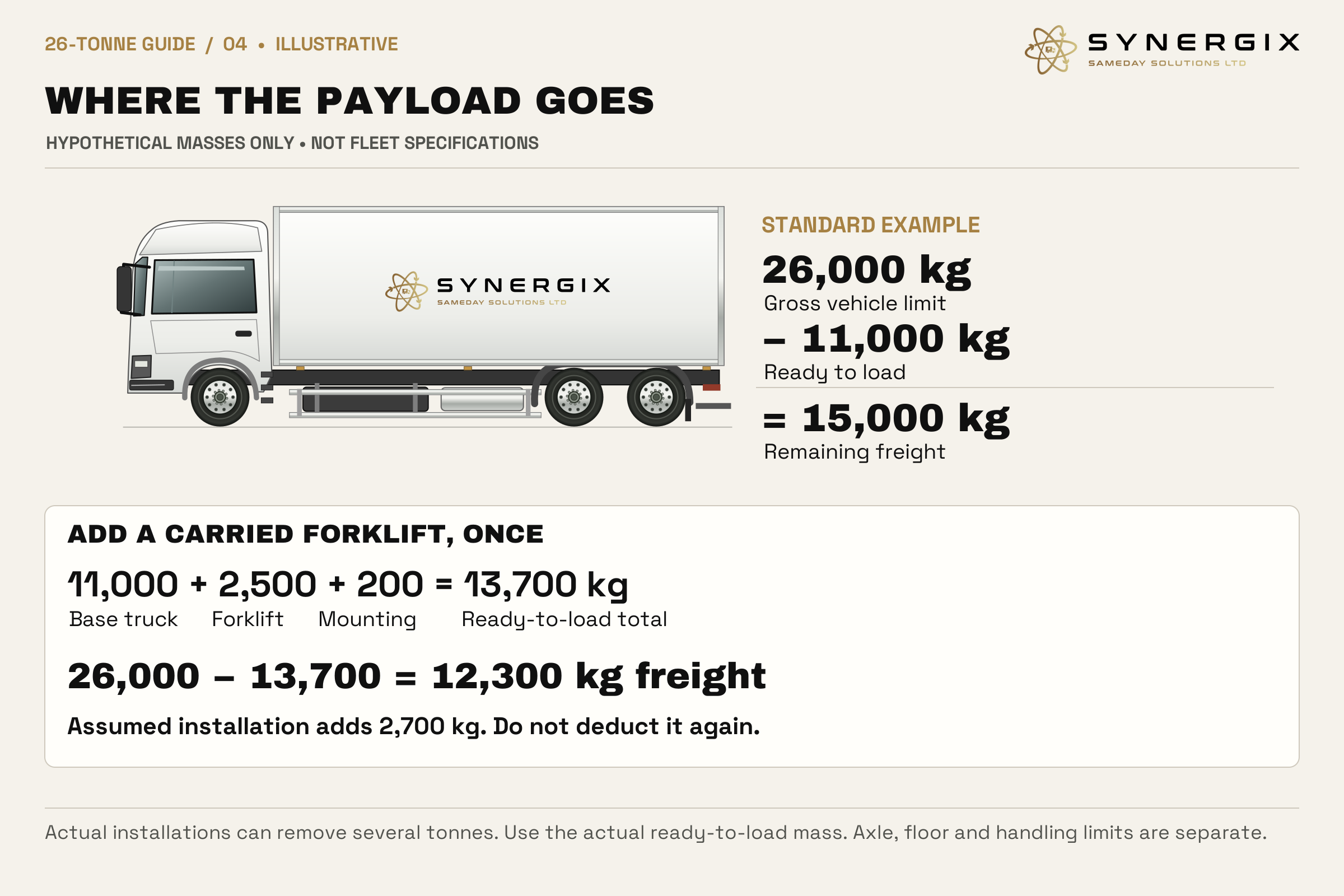
For illustration, 26,000 kg minus an 11,000 kg ready-to-load vehicle leaves 15,000 kg for freight. A 13,500 kg ready-to-load vehicle leaves 12,500 kg. These are hypothetical calculations, not quoted weights for a particular truck.
Equipment mass must be included once.
A permanently fitted crane and stabilisers belong in the completed truck’s ready-to-load mass. A carried Moffett and its mounting also consume the gross allowance. If the supplied payload already includes them, do not subtract them twice.
For a like-for-like gross limit, another tonne of ready-to-load mass removes a tonne of gross-based freight allowance. Actual usable payload can fall further because an axle or another limit is reached first.
| Hypothetical starting point | Calculation | Gross-based freight allowance |
|---|---|---|
| Standard truck, ready to load | 26,000 − 11,000 kg | 15,000 kg |
| Same starting point plus 2,500 kg carried forklift and 200 kg mounting allowance | 26,000 − 13,700 kg | 12,300 kg |
| A different completed crane truck weighing 14,000 kg ready to load | 26,000 − 14,000 kg | 12,000 kg |
The forklift example deliberately uses assumed masses to explain the calculation. The machine’s actual weight, attachments, mounting and the truck’s completed specification must replace them. A larger crane installation can impose a greater reduction. There is no reliable fixed “HIAB deduction” or “Moffett deduction” for the whole category.
The rear-mounted forklift changes axle loading.
A forklift carried behind the rear axles adds more than a simple lump of weight to the loading problem. Its position can increase rear-axle reactions and unload the front axle. Do not assume a truck that is under 26,000 kg is therefore legal on every axle.
Rear axle group, individual axle ratings, steering load, tyre limits and the mounting arrangement must be checked. Unloading some freight at the first stop changes the distribution for the remaining journey.
Concentrated loads need more than a total weight.
A machine or bundle of steel can be below the total freight allowance and still overload the floor locally, its supports or a handling device. Send its footprint, support points and centre of gravity as well as its weight.
A body builder’s payload, a crane lift capacity, a forklift rating and a tail-lift rating answer different questions. The smallest relevant capacity may govern the job. The total freight guide cannot be used as the rating of any unloading equipment.
6×2 and 6×4 describe the driven wheel positions.
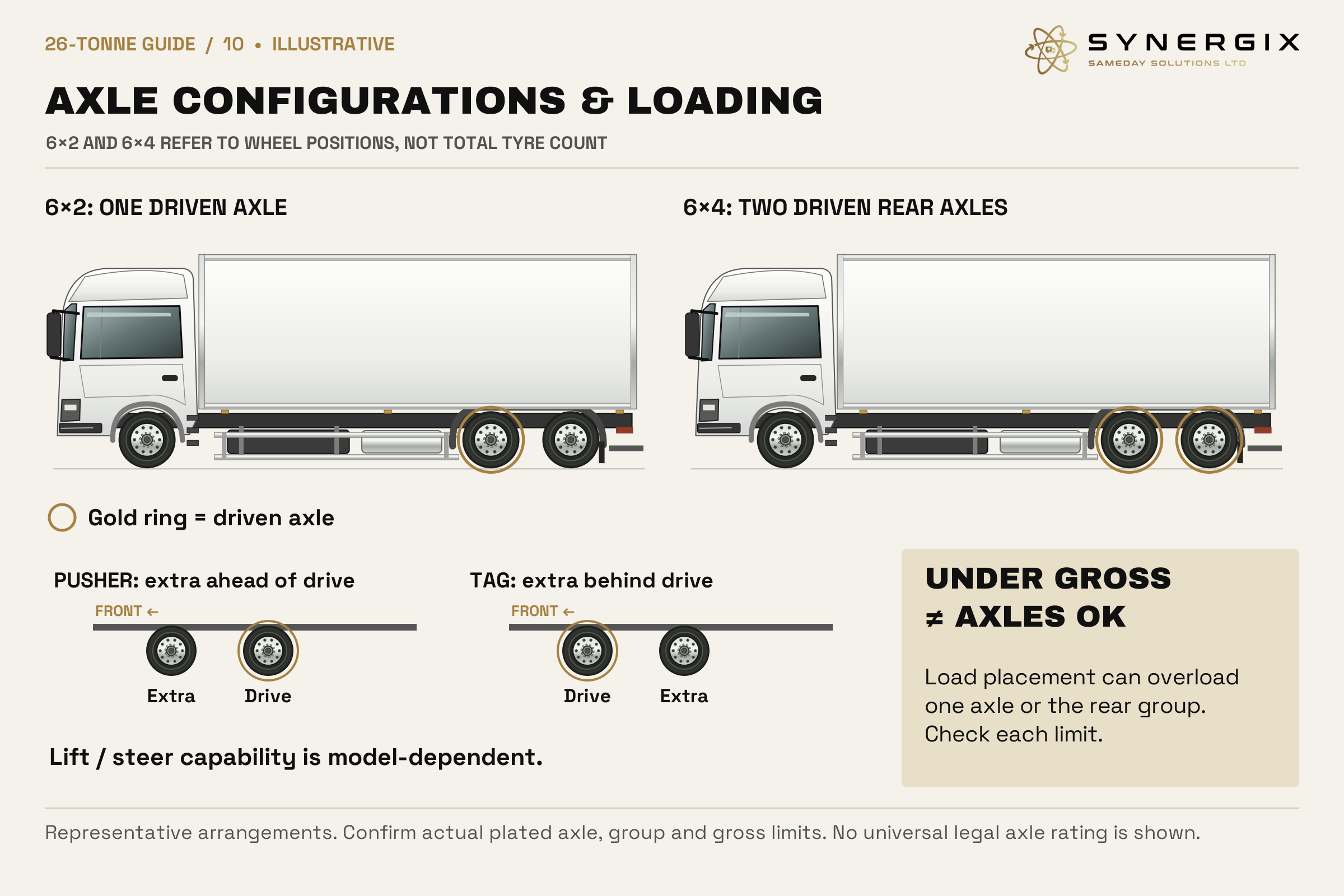
A typical three-axle rigid may be 6×2: six wheel positions, with two driven. That normally means one driven axle. In 6×4, four positions are driven, normally across both rear axles. Twin tyres do not change the notation.
A 6×2 can have a non-driven pusher axle ahead of the drive axle or a tag axle behind it. Lift and steering functions depend on the specification. A 6×4 can offer useful traction for some site work, but adds driveline considerations. Neither configuration guarantees a particular payload or off-road access.
A lift axle is not spare capacity.
An axle may be lifted or have its loading adjusted only within the vehicle’s approved operating conditions. Raising it can put more weight onto the axles still carrying the truck. Do not assume the full gross allowance remains available with an axle raised.
A steerable additional axle can help manoeuvring, but wheelbase, overhang and rear swing still matter. Specify the real site constraint rather than request a configuration as a substitute for measuring the access.
| Check | Assumed limit | Passing example | Failing example |
|---|---|---|---|
| Front axle | 8,000 kg | 8,000 kg | 6,000 kg |
| Drive axle | 11,500 kg | 11,000 kg | 12,000 kg |
| Additional rear axle | 7,500 kg | 7,000 kg | 7,000 kg |
| Rear axle group | 19,000 kg | 18,000 kg | 19,000 kg |
| Gross vehicle | 26,000 kg | 26,000 kg | 25,000 kg |
The failing example is below gross weight but exceeds its assumed drive-axle limit by 500 kg. The three individual assumed maxima add to 27,000 kg, yet the truck’s gross maximum remains 26,000 kg. Separate axle-group restrictions also apply. Use the actual plate, tyre and suspension limits and applicable road rules; three axles alone do not establish permission to operate at 26 tonnes.
For a dense load or a rear-carried machine, obtain an appropriate axle-loading assessment and weight check. Moving freight, dismounting a Moffett or unloading at successive stops changes the reactions. A gross-only weighbridge result cannot establish each axle weight. See the official HGV maximum-weight guidance.
HIAB vs Moffett vs tail lift
These names describe different equipment. Choosing the right method can prevent a failed delivery and avoid paying for equipment the job does not need.
HIAB: a loader crane lifts and places the load.
HIAB is a widely used brand name for truck-mounted loader cranes. A flatbed HIAB can lift suitable goods from the vehicle to an assessed landing point. It is useful where suspended lifting or placement is needed, rather than travelling with a pallet on forks.
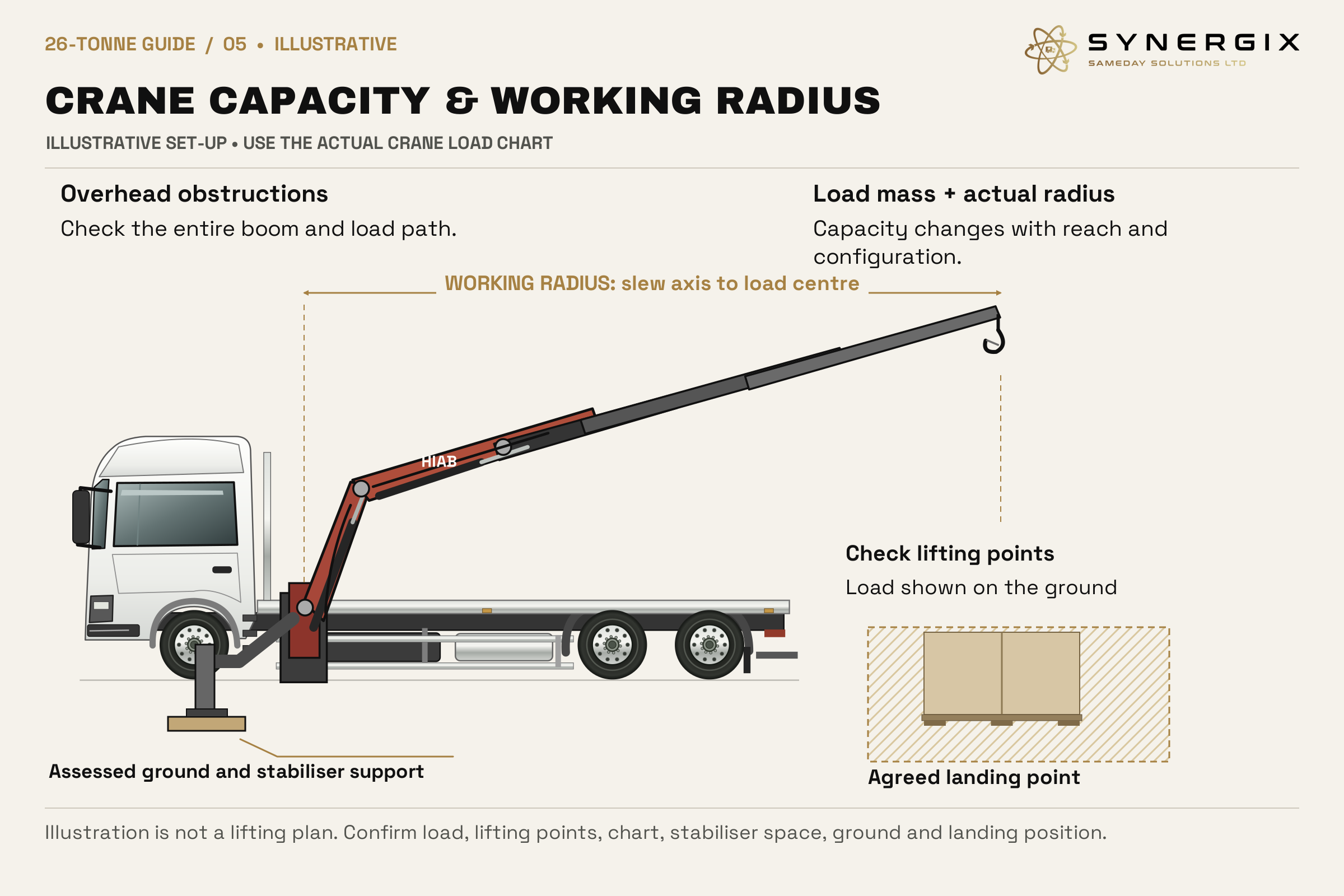
Specify the individual weight, dimensions, centre of gravity, lifting points, pickup position and landing position. Provide the horizontal working radius from the crane to the load, required height, obstructions and photographs. Truck size alone does not establish crane reach or lifting capacity.
Moffett: a carried forklift unloads and travels with it.
A Moffett Mounty is a truck-mounted forklift, usually carried at the rear for transport. It can unload suitable fork-compatible goods and move them along an assessed route to an agreed accessible position. A curtainside or flatbed truck can carry one.
Specify pallet-entry openings, loaded weight, dimensions, centre of gravity, delivery distance from the truck, surface, slopes and gateways. Its rough-terrain design does not make deep mud, soft ground, steps, fragile paving or steep gradients automatically acceptable.
| Situation | Likely method to assess | Essential condition |
|---|---|---|
| Receiver has a suitable forklift | Standard truck with compatible rear or side loading | Forklift can lift and reach each item |
| Suitable pallet to firm ground beside the truck | Tail lift and appropriate pallet truck | Platform, load centre, total platform weight and ground pass |
| Pallets need moving away from the truck, with no receiver forklift | Moffett-equipped truck | Forklift, item and travel route are suitable |
| Goods need suspended lifting or placement within assessed reach | HIAB / loader crane | Lift plan, load chart, lifting points and stabiliser support |
| Very long goods needing side loading | Suitable curtainside or flatbed and handling arrangement | Access and support available at collection and delivery |
Crane capacity falls with reach.
The crane’s rated capacity must be checked at the actual radius and configuration, including any attachments and lifting accessories. A large capacity close to the truck does not mean the same mass can be lifted across a garden, fence or building.
Stabilisers need assessed support and operating space. Drains, cellars, services, edges, overhead lines and public movement can change the plan. Lifting into a building, over a roof or across an occupied area requires specific assessment; do not assume a normal delivery includes it.
Forklift capacity depends on the real load.
The rated load centre, fork length, attachments and load chart matter. A long pallet can place its centre of gravity farther forward than a compact one of the same weight, reducing what the machine can safely handle.
Fork pockets must accept the allocated machine. Four-way travel and specialist attachments are model-specific options, not a feature of every Moffett. A forklift can move suitable goods along a route; it is not a substitute for a crane reaching over obstacles.
An HGV driving entitlement does not establish competence to operate a loader crane or forklift. The operator needs suitable training, familiarisation and authorisation for the equipment and task. A different person may be needed for slinging, signalling or supervision. Agree those roles before arrival.
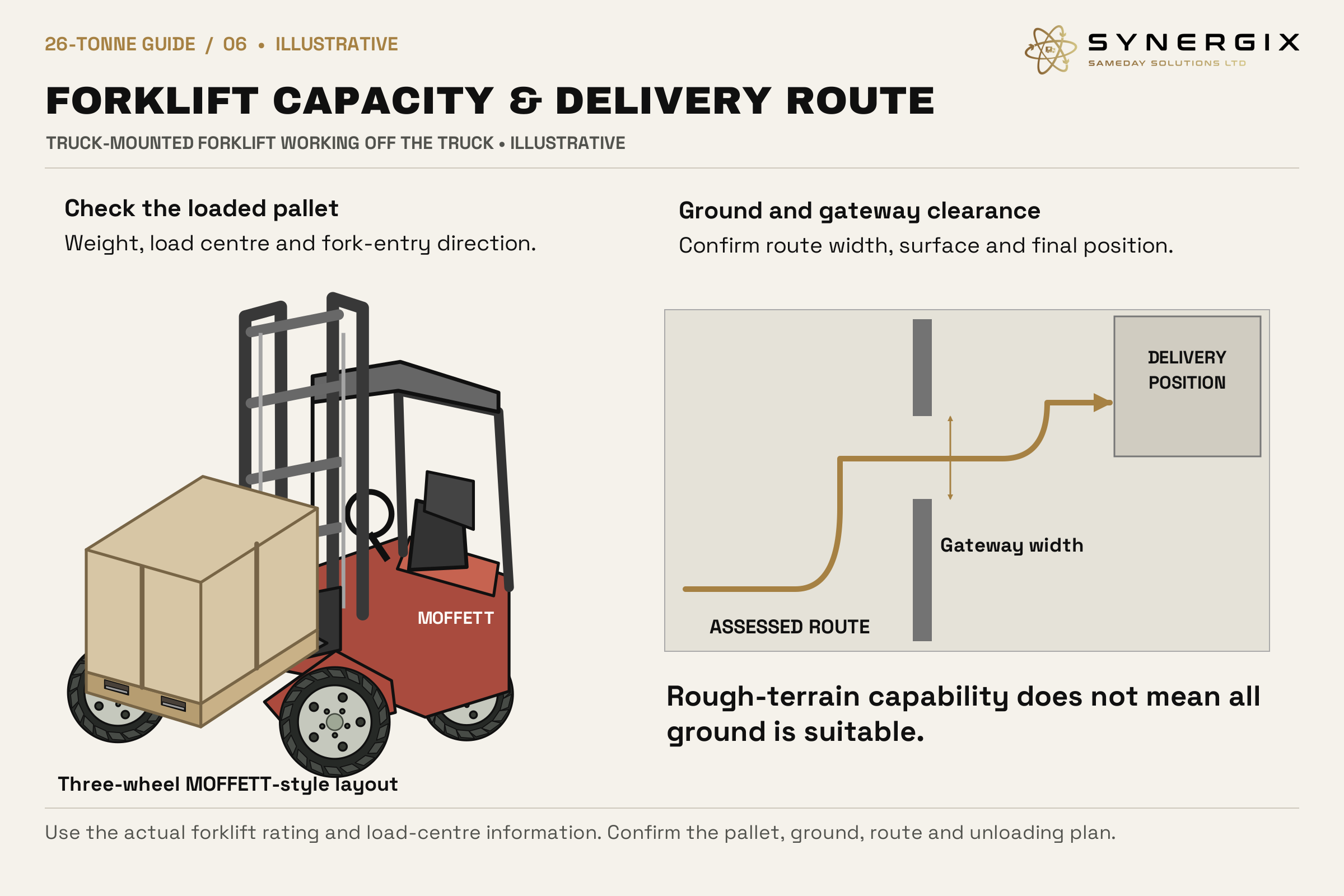
For further forklift-delivery information, see our Moffett delivery guide. For a crane or a combined requirement, send the lifting and site details with your enquiry. Specialist equipment and placement are supplied only where agreed.
18-tonne vs 26-tonne vs articulated truck
Book enough vehicle for the load and handling. Avoid choosing a larger vehicle simply because its headline capacity looks reassuring.
| Category | Standard freight guide | UK / Euro reference | When to assess it |
|---|---|---|---|
| 18-tonne rigid | Up to 9,000 kg | Up to 14 UK / 18 Euro | A suitable smaller rigid when weight, space and access pass |
| 26-tonne rigid | Up to 15,000 kg | Up to 16 UK / 20 Euro | More freight capacity or an appropriate specialist specification |
| 13.6 m articulated vehicle | Up to 26,000 kg | Up to 26 UK / 33 Euro | Longer floor, more pallets or heavier substantial loads |
18-tonne vs 26-tonne.
If the shipment fits the 18-tonne truck’s actual weight, floor and unloading arrangement, the larger truck may add unnecessary cost or make access harder. For example, 14 pallets at 600 kg each total 8,400 kg and can pass the initial 9,000 kg weight guide.
The same 14 pallets at 800 kg each total 11,200 kg, which exceeds that initial guide. A suitable standard 26-tonne truck may carry them. A crane- or forklift-equipped version still needs its own check.
26-tonne vs a 13.6 m artic.
A rigid can suit some sites where an articulated combination is difficult to manoeuvre. An artic can provide much more floor length and pallet capacity, but its turning, coupling sweep, site entry and unloading requirements are different.
A 16-tonne load exceeds our standard 26-tonne rigid freight guide even if its pallet footprint fits. More than 16 UK positions or a long indivisible item may also point towards a longer body or an artic. A larger vehicle is useful only if both sites accept it.
Read the 18-tonne truck guide or 13.6 m articulated vehicle guide when considering the adjacent categories. If a rigid needs a trailer, that is a separate wagon-and-drag arrangement with its own dimensions, licence, mass and access checks.
Loading, tail lifts and delivery limitations
A successful journey includes a safe, workable collection and unloading plan. Describe the complete movement.
Rear, side and dock loading.
A box normally needs rear access, while a curtainsider may provide useful side access for a forklift. A dock must match body height, opening, leveller capacity and any lift or rear-mounted forklift obstruction. Confirm rather than assume that “HGV bay” means compatible.
Side loading needs space for the forklift and long goods. Curtains, posts and straps have to be handled before loading. Curtains generally provide weather cover; goods still need the appropriate restraint unless a verified body system is suitable for the specific load.
Tail-lift capacity is separate from freight payload.
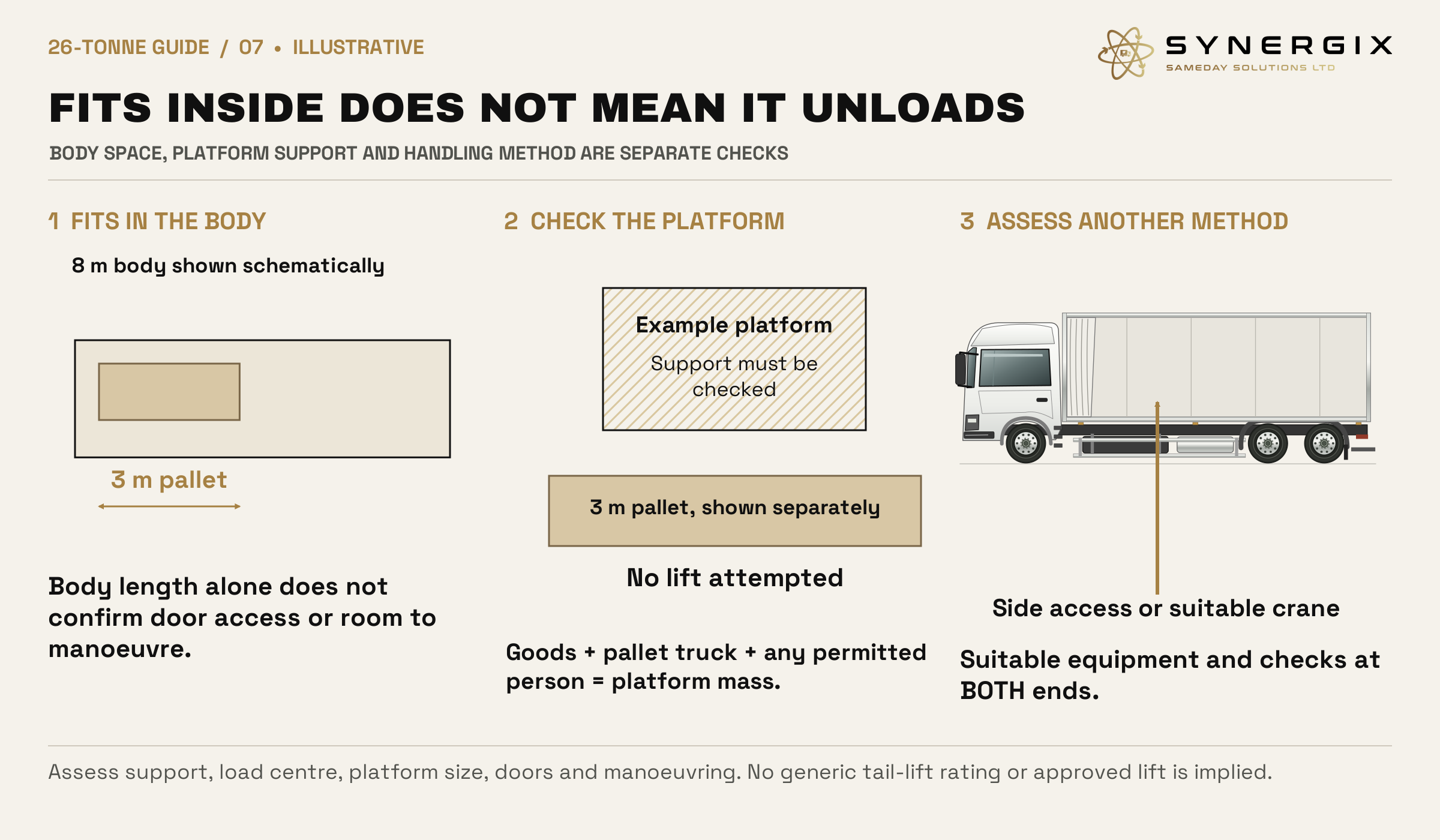
Column, cantilever and tuckaway lifts have different arrangements and platform sizes. Check the allocated lift’s chart, platform support, load centre and operating conditions. Do not apply an assumed 1,000 or 2,000 kg rating to every truck.
The platform must carry the goods, pallet truck and any permitted person together. A 15,000 kg truck freight allowance does not help a single loaded pallet that exceeds the lift’s capacity. Ground, kerbs and the transition off the platform also matter.
Manual and powered pallet trucks.
A pump truck needs a suitable pallet, enough fork clearance and a firm, level surface. Loose gravel, broken paving, cambers and slopes can make even a relatively light pallet difficult or unsuitable. Tail-lift delivery does not promise movement indoors or across a garden.
When pallet-truck handling is needed for an individual loaded pallet weighing 800 kg or more, request an electric pump truck. This is Synergix’s booking requirement, not a universal legal threshold. Lower weights can also need powered handling; actual equipment suitability still needs checking.
Long pallets need a planned method.
A 3 m-long pallet may fit the floor yet fail the rear aperture, tail-lift platform or pallet truck. Its support points, load centre and fork-entry direction can rule out the apparent solution. Do not treat total floor length as a loading method.
Side loading using a suitable forklift, or an assessed crane lift with approved lifting provisions, may be needed. Confirm access and compatible handling at collection as well as delivery. A receiving Moffett does not solve an unsuitable collection loading arrangement.
Secure freight for the whole journey.
Goods need support and restraint suitable for their weight, shape and body. Packaging is not a substitute for securing the load. Ask about delicate surfaces, high centres of gravity, rolling goods, sharp edges and concentrated supports at quotation stage.
Progressive unloading can leave gaps and alter axle loads. The load may need re-securing after each drop. Returns and packaging collected later also change the final arrangement.
Define the delivery boundary.
A transport quotation must distinguish delivery to an accessible agreed unloading point from room-of-choice handling, assembly, installation, positioning by crane or carrying goods upstairs. These require separate agreement and suitable people and equipment.
A site contact must be available to receive the load. Give us booking references, time windows, induction or PPE requirements, permitted unloading areas and the instructions for any failed access or rejected goods.
Why specialist 26-tonne trucks cost more
The extra price pays for the unloading capability, equipment and people as well as the journey. There is no honest universal percentage uplift.
Why HIAB and Moffett deliveries cost more.
Henry’s practical point is straightforward: the quote has to fund a truck and a handling machine. Acquisition or rental, financing, specialist installation, maintenance and repairs are additional to the normal vehicle costs.
The driver may also operate the plant, requiring appropriate training and competence. Site setup, machine deployment, lifting or forklift travel, packing away and reporting all take time. An ordinary truck mileage rate does not describe that whole service.
Maintenance includes the carried machine.
A rear-carried forklift is exposed to road spray, dirt and winter road salt. Cleaning, corrosion protection, lubrication and checks help protect exposed parts, chains, hydraulic components and the mounting. The work and exposure vary; there is no fixed six-month season or universal failure rate.
This is a maintenance cost consideration, not a claim that Moffetts are unreliable. Manufacturer servicing and condition checks, replacement wear parts and downtime planning are part of supplying dependable equipment.
LOLER reports and servicing are different.
Lifting equipment needs appropriate thorough examination by a competent person, with a written report. Unless a suitable examination scheme specifies otherwise, the usual intervals are 12 months for other lifting equipment and six months for lifting accessories or equipment used to lift people.
A valid report, often called a LOLER certificate, does not replace maintenance, pre-use checks or a properly planned lift. Deterioration, damage or exceptional events may require further examination or action. A model-specific examination scheme can set different intervals.
Pay for the capability you need.
If both sites have suitable forklifts, a standard truck may avoid the cost and payload loss of carrying one. If the destination has no unloading equipment, a correctly selected specialist vehicle may avoid a failed delivery, extra site hire or a second movement.
Compare complete alternatives: standard truck plus hired site forklift; Moffett delivery; crane delivery; or smaller staged loads. Include site labour, permits, waiting, machine capability and the achievable landing position rather than comparing headline transport prices alone.
26-tonne truck access and loading-bay checks
A legal access exemption does not make a truck fit through a low entrance or provide ground strong enough for a lift.
Road permission and physical fit are separate.
A lorry-symbol weight restriction normally refers to plated maximum gross weight, so sending the same truck with less freight does not make it a smaller category. Where an “except for access” or loading exemption applies, a qualifying delivery may be permitted under the exact restriction.
Check the sign, traffic order, times and whether the journey qualifies. It is not permission to take a convenient shortcut. A separate structural restriction, low bridge, width limit or private-site limit still needs its own check.
Measure shopping-centre and residential access.
A site can have a large goods bay but limit arrivals to 7.5-tonne trucks, smaller rigids or Luton vans. Entrance ramps, low beams, loading corridors, security gates and tight corners can prevent a 26-tonne vehicle using it.
Obtain the truck’s actual total outside height, width including mirrors, length including carried equipment and turning requirements. A Moffett on the rear can change the length and sweep. Internal body dimensions do not establish external clearance.
Leave room to use the equipment.
Crane stabilisers, tail-lift platforms and forklift deployment require a working area beyond the parked truck. Confirm ground capacity, gradients, underground structures, overhead services and separation from pedestrians.
A truck fitting through the gate is only the first check. It must park in the right orientation, operate, place the goods and leave safely. A delivery photograph should show the approach and wider surroundings, not just the intended pallet position.
City rules need route-specific checks.
Clean-air requirements, timed freight restrictions and London safety-permit requirements can affect routing and vehicle selection. London’s Direct Vision Standard applies to HGVs over 12 tonnes maximum gross weight; Euro VI emissions compliance is a different requirement.
Tell us about permits, pedestrian zones, site bookings and local instructions. Any highway occupation, traffic control or lifting across public space needs appropriate arrangements where required. Do not assume the vehicle operator can resolve a missing site permission on arrival.
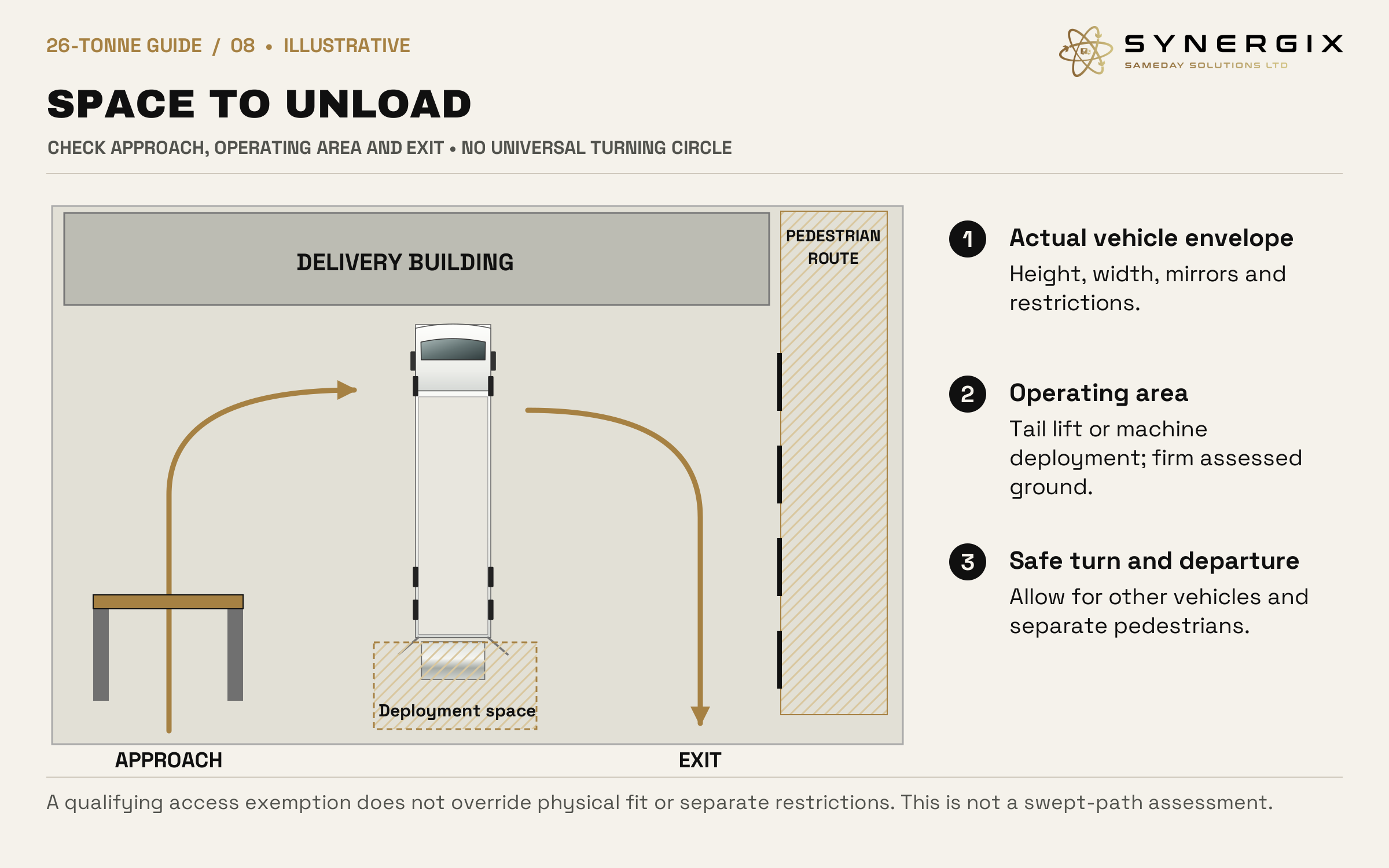
Useful checks are explained in the official traffic-sign guidance. For London, consult the Direct Vision Standard requirements. Check the actual route and job rather than relying on a general example.
Driving hours, tachographs and overnight work
Loading and specialist machine work consume time as well as the driving. A feasible deadline must account for all of them.
| Control | Normal rule |
|---|---|
| Driving break | 45 minutes by 4 hours 30 minutes driving; a qualifying split is at least 15 minutes then at least 30 |
| Daily driving | Normally 9 hours; extend to 10 hours twice in a week |
| Weekly / fortnightly driving | No more than 56 hours in a week or 90 in two consecutive weeks |
| Daily rest | Normally 11 hours; reductions and split rest have specific conditions |
| Weekly rest | Normally 45 hours; reductions require the relevant conditions and compensation |
| Working time | 48 hours a week on average; up to 60 in a single week if the average is met |
| Breaks from work | No more than six consecutive hours without a break; required daily totals depend on hours worked |
| Night work | Normally no more than 10 hours of work in 24 hours when night work is performed, unless a valid agreement varies it |
Crane and forklift operation use working time.
Driving is one clock; total work and required rest are others. Loading, vehicle checks, machine deployment and operating a crane or forklift are work. They are not a driving break just because the truck is parked.
Positioning to collection and earlier jobs use the driver’s available allowance. An hour unloading does not reset accumulated driving. Delays can use up the feasible delivery window or change whether onward travel can be completed.
There is no fixed daily mileage promise.
Road type, traffic, unloading, breaks, booked slots and previous duties decide the distance achievable. A 300-mile statement cannot describe every job. A clear motorway movement and multiple city deliveries use time differently.
Tell us the required arrival time and whether it is flexible. Where one driver cannot legally complete the plan, a staged journey, driver change or different arrangement may be needed, subject to feasibility and agreement.
Rest, sleeper cabs and hotels.
An 18- or 26-tonne category does not guarantee a sleeper cab. If the allocated truck has a day cab and the job needs an overnight stay, suitable accommodation, parking and any transfers affect the plan and price.
A sleeper berth can support some rest arrangements subject to the rules, but regular weekly rest must not be taken in the vehicle. A fresh calendar day alone does not create a fresh driving allowance without the required rest.
Tachographs and driver requirements.
Normal in-scope commercial operations require the correct tachograph recording of driving, other work, availability and rest. An urgent customer deadline is not a general exemption. Machine operation must be recorded correctly as work.
A typical rigid requires the appropriate Category C entitlement and professional Driver CPC where applicable. Specialist equipment needs additional competence for its operation. Any trailer or different combination needs its own licence and operating checks.
Working-time averaging normally uses a 17-week reference period, extendable to 26 weeks by an appropriate agreement. Six to nine hours of work requires at least 30 minutes of breaks in total; more than nine hours requires at least 45 minutes. Qualifying portions are at least 15 minutes. Night-time for goods operations normally covers 00:00 to 04:00. A valid collective or workforce agreement can vary the night-work limit; there is no individual opt-out from the average 48-hour limit.
Speed and international journeys.
For goods vehicles over 7.5 tonnes, national limits in England and Wales are 50 mph on single carriageways and 60 mph on dual carriageways and motorways. Scotland’s corresponding limits are 40, 50 and 60 mph. Posted limits, conditions and any limiter can be lower.
European movements need the actual route, customs documents, border and ferry plan, vehicle permissions and applicable driver/tachograph requirements checked. Do not price the job as uninterrupted road driving.
Waiting needs the right classification.
Waiting is not automatically a break, daily rest or period of availability. The driver’s duties and whether the duration is known affect its treatment. Monitoring loading or being required to operate equipment can still be work.
A booked delivery slot that runs late can affect the rest and return plan. Give us realistic loading time and a receiving contact so problems can be communicated before the driver’s available time is exhausted.
A reduced daily rest is at least nine hours and is normally limited to three occasions between weekly rest periods. Regular daily rest can be split into at least three hours followed by at least nine hours. Reduced weekly rest is at least 24 hours where permitted, with the reduction compensated by the end of the third following week. Weekly rest must start by the end of six consecutive 24-hour periods from the previous weekly rest. International patterns and other exceptions have additional conditions; plan the actual duty from the detailed rules.
Commercial operation of a heavy goods vehicle normally requires an appropriate goods-vehicle operator licence, subject to the applicable rules and exemptions. That is distinct from the individual driver’s licence, Driver CPC and equipment competence. The vehicle operator must plan the permitted operation and maintenance; a crane examination report does not replace those obligations.
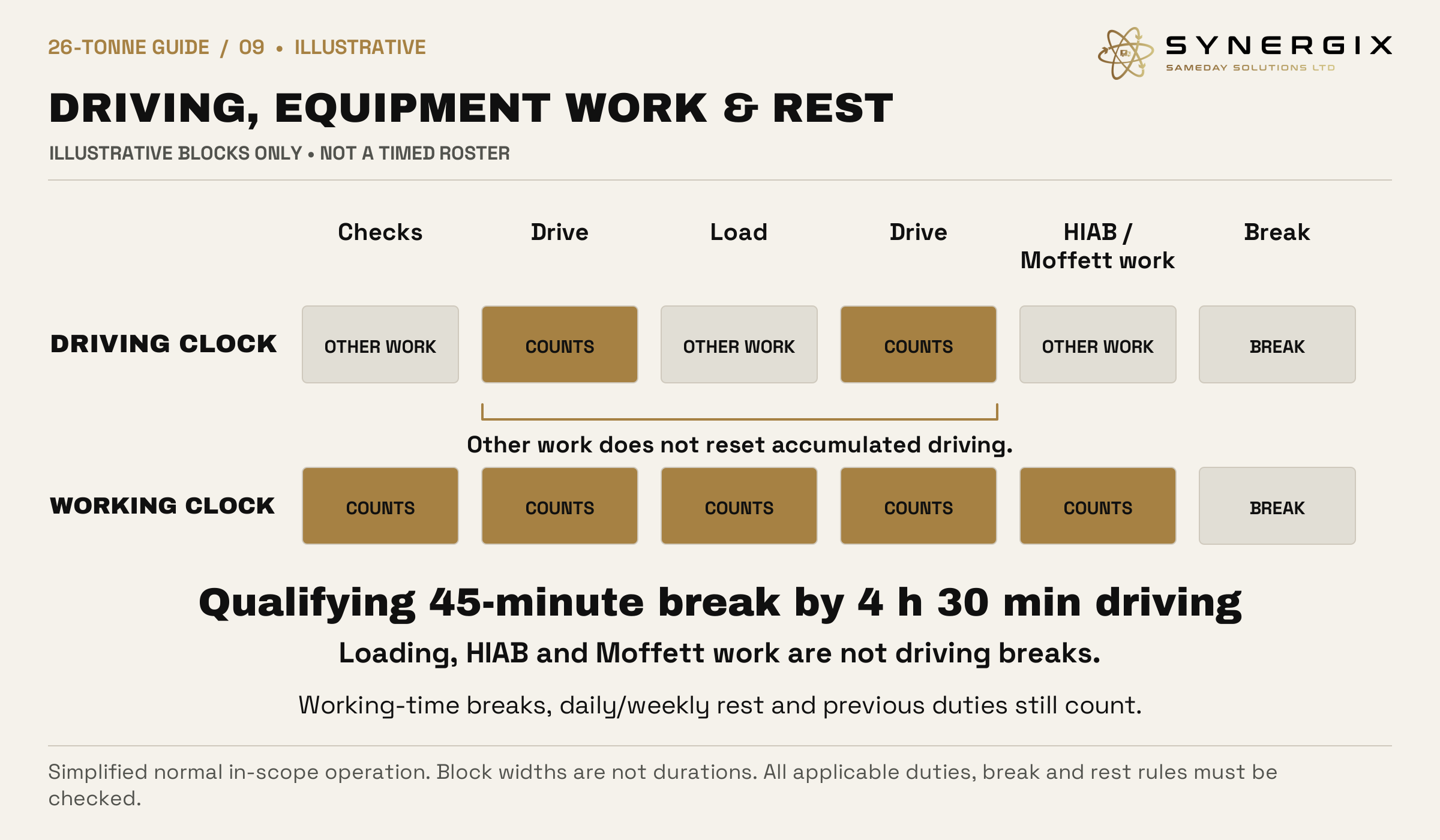
See the official driving-hours summary and goods-vehicle working-time guidance for the detailed conditions. This guide is not an approved duty roster.
26-tonne fuel economy and electric trucks
Look at the completed vehicle and the complete duty. A fuel-only calculation is not the courier or haulage price.
There is no honest single 26-tonne MPG figure.
Body height, aerodynamics, engine, gearbox, gearing, tyres, axle configuration, gross mass, terrain and traffic all affect economy. A crane truck, tall box and distribution truck do not automatically have the same performance.
A fully loaded truck generally needs more energy for acceleration and climbing. Stop-start deliveries, hills, headwinds, idling, machine operation and refrigeration can make a quoted empty or steady-road figure unrepresentative.
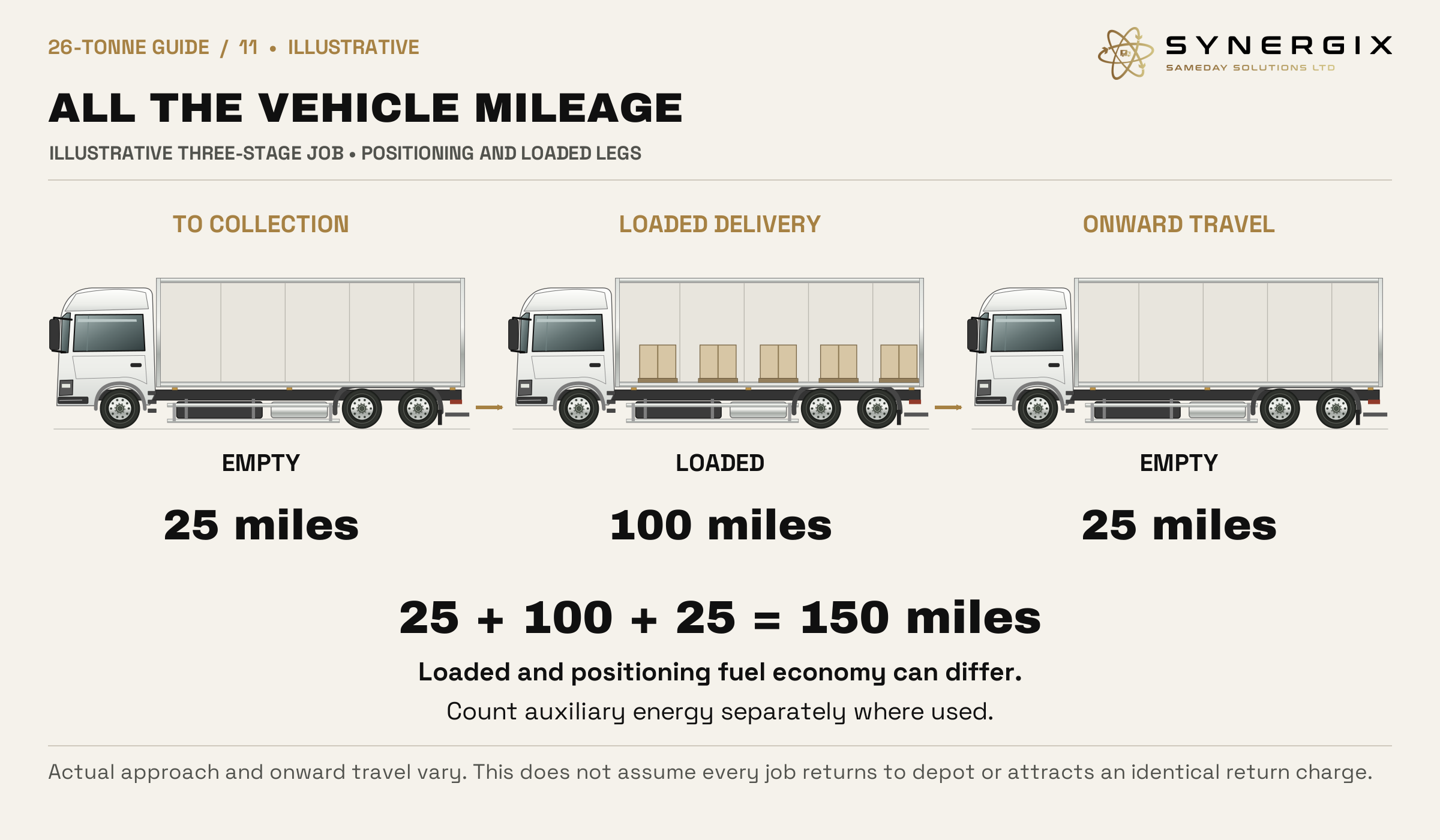
Include the miles needed to get there.
The vehicle may travel to collection, complete the loaded movement and then reposition for its onward work. These legs can have different consumption. Include auxiliary energy and waiting where relevant, rather than multiply only the customer’s loaded miles by an optimistic economy.
Fuel is one part of the price. Driver time, machine ownership, loading, rest, maintenance, permits and accommodation can remain significant even on a short distance.
| Assumed imperial MPG | Litres / 100 miles | Fuel cost | Combustion + fuel supply CO₂e |
|---|---|---|---|
| 8 | 56.83 L | £90.92 | 181.53 kg |
| 10 | 45.46 L | £72.74 | 145.23 kg |
| 12 | 37.88 L | £60.61 | 121.02 kg |
| Assumed metered energy | At £0.30/kWh | At £0.70/kWh | UK electricity-supply CO₂e |
|---|---|---|---|
| 180 kWh | £54.00 | £126.00 | 33.18 kg |
| 220 kWh | £66.00 | £154.00 | 40.56 kg |
| 260 kWh | £78.00 | £182.00 | 47.93 kg |
The table rates are deliberately assumed scenarios, not manufacturer ranges or Synergix measurements. Replace them with consumption and tariffs relevant to the actual truck, route and work. Higher public charging prices, charging losses or auxiliary demand can alter the comparison. Diesel and electric figures use different physical units and should not share a misleading common consumption scale.
Diesel offers flexible long-distance operation.
Fast refuelling, established filling infrastructure and flexible onward routing make diesel practical for urgent long movements and changing sites. A remote unloading location or unpredictable return journey can make a charging-dependent plan difficult.
Euro VI concerns regulated air pollutants; it does not mean a truck has no CO₂ emissions. Alternative fuels need vehicle compatibility and credible fuel-supply evidence. A renewable label alone does not establish a whole-job carbon result.
Electric can suit a planned duty.
Electric rigid trucks exist in this category, including configurations in the Volvo FE Electric range. A predictable distribution route with suitable depot charging and a verified loaded range can be workable. This is not a claim that an electric specialist truck is available for every Synergix job.
Urgent long-distance work needs the starting charge, loaded range, usable chargers, plug compatibility, charger access for the truck, charging time and onward energy checked. An unplanned charging stop can compromise a deadline. A promised advertising range is not enough.
The electric truck and the forklift are separate machines.
An electric Moffett can be carried on a diesel truck. That may remove forklift exhaust during unloading, but does not make the road journey electric or remove transport emissions. Include both machines when assessing the job.
Crane hydraulics, power take-off, refrigeration and battery charging can have separate energy arrangements. Ask how the allocated specification powers them, and what that means for payload, range and noise.
Evaluate the useful service.
A truck with a heavier battery or equipment installation may need a different freight limit. More journeys to move the same goods can change time, cost and carbon. Compare the same service and delivered freight rather than two incompatible headline figures.
Noise or local air-quality requirements may favour a suitable electric arrangement, but the unloading equipment and site rules still need to pass. Petrol and plug-in-hybrid van figures are not substitutes for specifications of a 26-tonne truck.
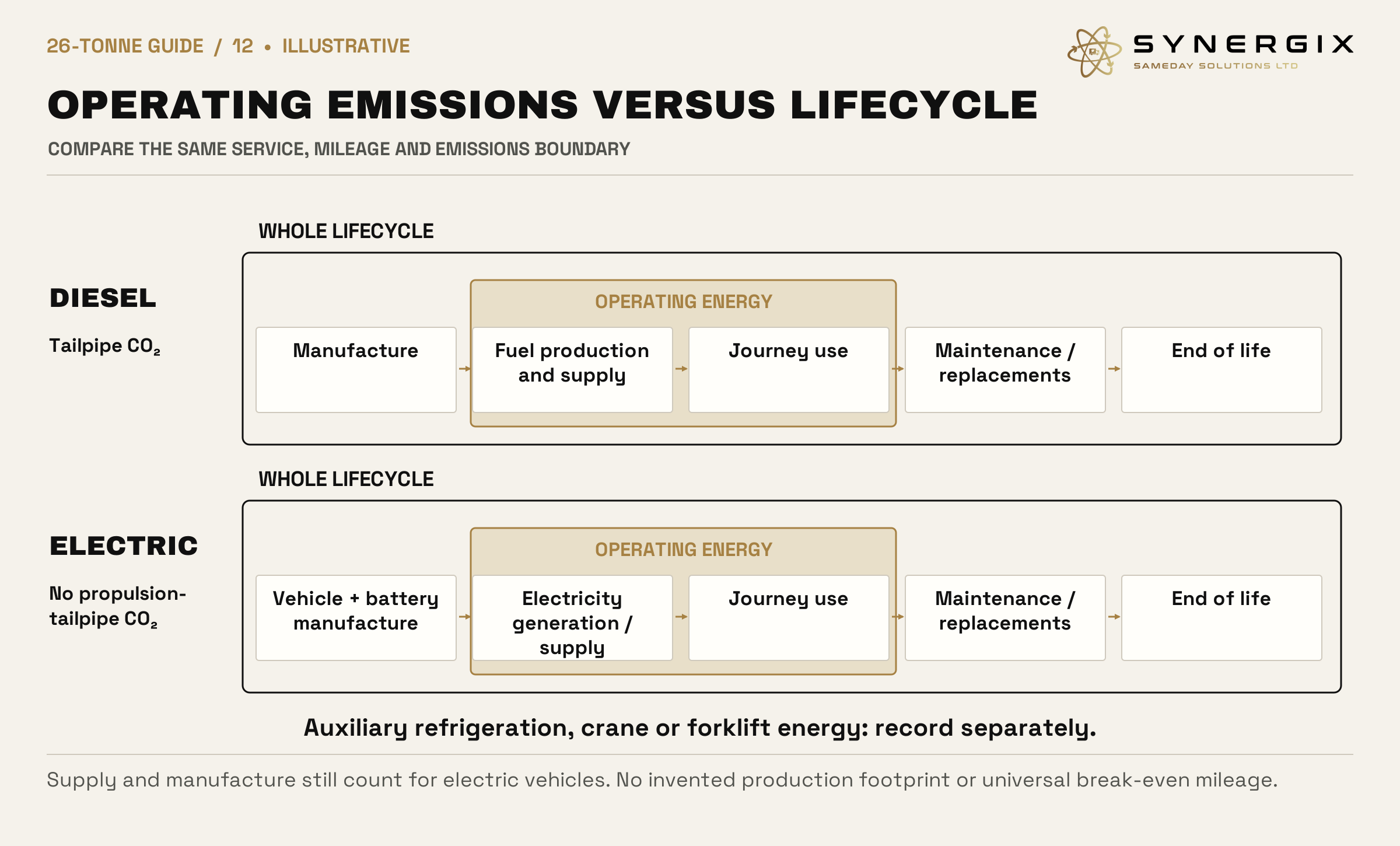
26-tonne truck CO₂ and lifecycle emissions
Use the same mileage and service when comparing diesel and electric. A precise decimal does not remove uncertainty in the assumptions.
CO₂, CO₂e and the calculation boundary.
CO₂ is carbon dioxide. CO₂e expresses greenhouse gases on a comparable basis. Tailpipe CO₂ excludes upstream fuel production and supply. An electric truck has no propulsion tailpipe CO₂, while the electricity supply and vehicle manufacture can still cause emissions.
The examples here combine diesel combustion and upstream fuel supply, or UK electricity generation, transmission/distribution and relevant upstream energy. They exclude vehicle manufacture and separately supplied auxiliary energy.
The factors and assumptions are stated.
Using the 2026 UK reporting factors, the illustrative diesel total is 2.58354 + 0.61101 = 3.19455 kg CO₂e per litre. The UK electricity example totals 0.13096 + 0.01299 + 0.03682 + 0.00359 = 0.18436 kg CO₂e per metered kWh.
These are reporting assumptions, not a measured exhaust test or guaranteed future grid mix. Biofuel-related CO₂ may also be reported outside the main scopes under the reporting method. An overseas charging mix, supplier methodology or different fuel must be assessed separately.
| Illustrative powertrain scenario | Energy over 250,000 miles | Operating emissions |
|---|---|---|
| Diesel at 8 imperial mpg | 142,065 L | 453.83 tonnes CO₂e |
| Diesel at 10 imperial mpg | 113,652 L | 363.07 tonnes CO₂e |
| Diesel at 12 imperial mpg | 94,710 L | 302.56 tonnes CO₂e |
| Electric at 180 metered kWh / 100 miles | 450,000 kWh | 82.96 tonnes CO₂e |
| Electric at 220 metered kWh / 100 miles | 550,000 kWh | 101.40 tonnes CO₂e |
| Electric at 260 metered kWh / 100 miles | 650,000 kWh | 119.83 tonnes CO₂e |
Include production before making a lifecycle claim.
Building a diesel truck, an electric truck and a battery each has a footprint. Body construction, crane or forklift manufacture, maintenance, replacement components and end-of-life treatment can also matter. Reliable actual-vehicle evidence is needed to total these.
We do not attach an invented production figure or battery replacement count to the category. Total lifecycle emissions equal evidenced production and replacements, plus operation on the chosen boundary, plus other included lifecycle stages.
Carbon break-even needs compatible evidence.
If electric production emissions exceed diesel production emissions, an illustrative break-even distance is that additional production footprint divided by the operating saving per mile. The result is meaningful only if the denominator is positive and the compared boundaries and service match.
Holding current grid factors and consumption constant for 250,000 miles is a sensitivity exercise, not a prediction. Future electricity, real loaded use, payload-driven extra trips and auxiliary demand can change the result.
Refrigeration and specialist machinery count.
Separate diesel for a refrigeration unit or forklift needs including where the reporting boundary covers the job. Electricity for an electric forklift and crane operation also matters. Refrigerant leakage can add greenhouse-gas emissions distinct from fuel use.
Do not call a specialist job emission-free merely because its truck or forklift has an electric motor. State which equipment, mileage and energy are covered.
Choose the vehicle that completes the work.
A correctly sized vehicle and workable unloading plan can prevent another journey after a failed delivery. Consolidation, sensible route order and return use may reduce waste, but the actual movements and freight must be known before claiming a quantified saving.
A higher-capacity truck can have greater journey emissions but a lower result per unit of freight when well used. A nearly empty truck can reverse that comparison. Report the load and service alongside the carbon figure.
Calculate tailpipe CO₂ from a known rate.
This tool is arithmetic only. It excludes upstream energy, manufacture and separate machine energy.
At an assumed 1,200 g CO₂/km, 100 miles produces 193.12 kg tailpipe CO₂. This is a different boundary from the fuel-supply CO₂e examples, so the figures cannot be compared directly as if they measure the same thing. Use an actual rate or clearly identify your assumption.
The source is the 2026 UK greenhouse-gas reporting factors. Calculations are illustrative and must use a consistent boundary for the actual service.
Get a 26-tonne truck quote
A clear description lets us check the useful payload, the required handling and the duty before confirming a suitable vehicle.
Send the full freight description.
Give the collection and delivery postcodes, required date and time, goods description, number of items, packaged measurements, individual weights and total weight. Include pallet type, overhang, stackability and the heaviest single item.
For machinery, provide supports, fork pockets, lifting points and any relevant handling documentation. For temperature-controlled goods, include temperature range, product condition, monitoring and receiving requirements. Dangerous goods or unusual loads need specific declaration and agreement.
Explain both ends of the job.
Tell us what unloading equipment exists, whether there is a dock and which sides can be accessed. Send site contacts, bay openings, restrictions, ground and approach photographs. State the required delivery point and any travel distance from the truck.
For a HIAB, include lift radius, height, obstructions and stabiliser support. For a Moffett, include fork-entry details and the ground route. A safe solution at delivery does not prove collection can load the vehicle.
Agree the service and price.
Tell us whether the job is dedicated, scheduled or suitable for an agreed consolidated arrangement. The price depends on positioning and loaded miles, body, equipment, operator requirements, site time, duty limits, access and any overnight or return plan.
Part-load possibilities, tracking arrangements, proof of delivery, insurance or extra handling must be agreed for the job. Do not infer them from a vehicle photo or a generated enquiry reference.
Give us the important changes early.
A heavier pallet, missing forklift, blocked bay or changed destination can alter the vehicle and price. Tell us before dispatch so the plan can be reassessed. If an actual site is unsafe or inaccessible, the original unloading arrangement may not be possible.
Provide an authorised receiving contact and instructions for delays, waiting, rejected freight and any return. We can discuss a workable alternative; an enquiry is not a confirmed booking.
Declare value and handling sensitivity.
Tell us the goods’ value, vulnerability, packaging and any temperature or orientation restrictions. Transit liability, lifting operations, consequential loss and any additional cover are different questions. Confirm the agreed terms and cover rather than assume the vehicle’s capacity establishes insurance protection.
Specify placement without assuming installation.
Agree exactly where the goods are to be unloaded, whether transport or lifting equipment is supplying the move, and who is responsible for supports, landing preparation and final acceptance. A crane placing a machine on an agreed support is not automatically commissioning or installing it.
Truck and equipment terms explained
The distinctions matter when capacity, unloading or price is being checked.
- Rigid truck
- The cab and load body are carried on the same chassis, rather than a separate articulated semi-trailer.
- Maximum authorised mass / gross weight
- The permitted complete vehicle mass, including truck, people, fuel, equipment and freight.
- Ready-to-load mass
- The mass of the completed vehicle with the people, fuel and equipment included for the proposed duty.
- Payload
- The freight allowance after relevant vehicle mass is accounted for, subject to other controlling limits.
- Axle group
- A group of nearby axles with a combined limit in addition to individual axle and gross limits.
- 6×2 / 6×4
- Wheel-position and drive notation. For the usual three-axle truck, one or two axles respectively are driven.
- Pusher / tag axle
- An additional axle ahead of or behind the drive axle. Lift and steer functions vary by specification.
- Load centre
- The relevant distance to a load’s centre of gravity used when assessing handling capacity.
- Working radius
- The crane’s horizontal distance to the load under the definition used by the applicable load chart.
- Moffett Mounty
- A truck-mounted forklift carried to a delivery, not a loader crane.
- HIAB / loader crane
- A vehicle-mounted crane used for an assessed suspended lift or placement.
- LOLER thorough examination
- A competent examination of lifting equipment with a written report. It is distinct from routine servicing.
- CO₂e
- Carbon dioxide equivalent, used to express greenhouse gases on a comparable basis.
- Operating / lifecycle emissions
- Energy-use emissions are one part of the wider footprint, which can also include manufacture and end of life.
26-tonne truck FAQs
Weight, fit, equipment, sites and the complete journey.
Vehicle choice and the standard guide
What is a 26-tonne truck?
It is a rigid HGV category based on maximum gross vehicle weight. The cab and body share the chassis. The 26 tonnes includes the truck, people, fuel, equipment and freight; it is not a 26-tonne cargo allowance.
How much freight can a 26-tonne truck carry?
Our initial standard-vehicle guide is up to 15,000 kg. The actual completed vehicle can have a lower allowance because of its body, crane, carried forklift, tail lift, refrigeration or axle limits. We need the allocated specification before confirming heavy freight.
What are the standard planning dimensions?
Use 8.0 m length × 2.5 m width × 2.6 m height as the initial enclosed-body guide. Actual bodies and apertures vary. A flatbed or equipment-fitted truck must be checked separately. These internal dimensions do not prove outside height or site clearance.
Is a 26-tonne rigid the largest rigid truck?
No. Other gross ratings and configurations exist. This page describes the 26-tonne category, not every rigid HGV. Compare the useful space and payload with the job rather than assume the largest rigid is always required.
When is an 18-tonne truck enough?
When its actual payload, usable floor, apertures, handling method and access pass. Our initial 18-tonne guide is up to 9,000 kg with up to 14 UK or 18 Euro pallet positions on a suitable body. A larger truck can be unnecessary for freight that fits.
When should I move from a 26-tonne rigid to an artic?
Assess an artic when the rigid cannot provide the required useful payload, floor length, pallet positions or handling specification. Our standard 13.6 m artic guide is up to 26,000 kg freight, but site access and any specialist equipment must also be checked.
Can a 26-tonne truck be booked for same-day work?
Enquire with the load, route, deadline and handling requirements. Feasibility depends on a suitable available vehicle, the driver’s remaining duty, the sites and the journey. A time-critical job does not bypass driver-hour or loading requirements.
Can it be used for regular distribution as well as urgent jobs?
Yes, the category is relevant to planned haulage and regular distribution as well as dedicated urgent freight. Agree the route, frequency, load pattern, receiving slots and unloading equipment. Do not infer a contract commitment from the guide alone.
Bodies, dimensions and temperature
Which body types should I ask about?
Box, curtainside and refrigerated bodies cover many enclosed loads. Flatbeds, flatbed HIABs and curtainside or flatbed Moffett vehicles suit different handling tasks. State both the goods and what must happen at collection and delivery; a body name alone does not establish equipment.
Is a curtainsider suitable for long freight?
Side access can help when a long item cannot be loaded through the rear. Check the clear side opening, posts, roof rail, floor support, fork or lifting provisions and handling at both sites. Curtain sides do not remove payload, restraint or legal load-dimension limits.
Does refrigeration always reduce internal space?
No. Purpose-built refrigerated bodies can retain comparable internal dimensions. Confirm the actual body rather than make a fixed deduction. Equipment mass reduces useful freight capacity, and airflow, evaporators or partitions can affect how much of the measured space can be used.
Do refrigerated trucks always have tail lifts?
They are commonly fitted for retail work, but confirm the allocated specification. A fitted tail lift adds weight and has its own capacity and platform limits. Refrigeration and a tail lift do not guarantee that a heavy pallet can be unloaded at the destination.
Can chilled and frozen goods share the same truck?
Only if an appropriate multi-temperature specification, partitions and operating plan are agreed. One refrigeration unit or a general refrigerated label does not establish separate temperature zones. Include product condition, temperatures, monitoring and receiving requirements.
Can vehicle refrigeration cool warm products quickly?
Do not assume it. Transport refrigeration is commonly used to maintain suitable product temperature. The product, loading condition and temperature-control plan must be agreed. Warm goods can affect other freight and the required duty.
Does an 8 m floor guarantee an 8 m item will fit?
No. The door or side opening, loading manoeuvre, supports, body shape and securing clearance can prevent it. Supply packaged dimensions and handling restrictions. Do not assume a heavy rigid item can be tilted or turned safely to reach the final position.
What measurements matter at a low loading bay?
Request total outside height, width including mirrors, total length including rear-carried equipment and turning requirements. Compare these with the complete entrance, ramp, bay and exit. Internal load dimensions cannot establish whether the truck fits.
UK pallets, Euro pallets and loading order
How many UK pallets fit?
The initial guide is up to 16 bases on a suitable 8 m floor. Eight rows of two 1,200 × 1,000 mm bases occupy 8,000 × 2,400 mm. There is no spare length in that illustration. Loaded overhang, restraint, doors, weight and axle checks can reduce the usable count.
How many Euro pallets fit?
Up to 20 base positions are illustrated on a full suitable 8 m floor: ten rows of two 1,200 × 800 mm bases, occupying 8,000 × 2,400 mm. It is a geometric example with no spare length, not a guaranteed loaded-pallet capacity.
Why might a different 26-tonne truck carry fewer pallets?
Usable length, width, doors, internal fittings, restraint clearance, loaded footprints and weight can differ. A 7.5 m floor can illustrate 18 Euro positions in nine rows of two. Do not apply an 8 m count to a shorter body.
Can UK and Euro pallets be mixed?
Yes, an appropriate arrangement may be possible, but it needs its own loading plan. Send each type’s actual loaded footprint, height and weight. Combining two separate maximum counts does not give a mixed-load capacity.
Can pallets be double-stacked?
Only where the goods, pallets and packaging safely support the proposed arrangement and it is agreed. Height, stability, compression, damage risk, weight, restraint and unloading all matter. The published single-layer count is not automatically doubled.
Can 20 pallets all weigh 800 kg?
That totals 16,000 kg, which exceeds the standard 15,000 kg freight guide before considering a lower equipment-fitted payload. Twenty at 750 kg already use the full standard guide. Assess the actual truck and axle distribution.
Are pallet cages and stillages counted like wooden pallets?
No. Their footprint, support, height, weight, fork entry and stackability may differ. Provide the actual measurements and loading provisions. A cage that looks pallet-sized may need a different floor arrangement or handling method.
How does multi-drop delivery affect loading?
Goods must be accessible in the delivery order while maintaining suitable restraint and axle loading at every stage. Removing the first pallets changes distribution. Returns collected later also count. Plan the sequence rather than leave heavy freight to be rearranged at the roadside.
Payload, axle weights and configurations
Why can an underweight truck still be overloaded?
Gross weight is only one limit. Freight distribution can overload an individual axle or the rear axle group even when the whole vehicle is below 26,000 kg. Floor, support, tyre or equipment limits may also govern. Use the allocated vehicle’s actual limits.
What does 6×2 mean?
For the usual three-axle rigid, it means six wheel positions and two driven positions, normally one driven axle. It does not count every individual tyre. It also does not guarantee that the extra axle lifts or steers.
What does 6×4 mean?
For a usual three-axle rigid, four wheel positions are driven, normally on both rear axles. It can suit duties where additional traction is useful. Actual vehicle mass, body, ground suitability and payload still need checking.
What is a tag axle compared with a pusher axle?
A tag is an additional axle behind the drive axle; a pusher sits ahead of it. Steering and lifting functions vary by vehicle. Their position affects load distribution and manoeuvring, so the actual chassis configuration matters.
Does a lift axle let the truck carry more freight?
It is not extra permission to exceed any plate or road limit. Raising an axle changes the load on those remaining on the road and must remain within the approved conditions. Do not assume the full gross allowance remains available while it is lifted.
Are all three-axle trucks allowed to operate at 26 tonnes?
No. Legal conditions, the approved vehicle specification and its plate determine the permitted weights. Three axles alone are insufficient evidence. Do not transfer another truck’s gross, individual axle or axle-group limits onto the allocated vehicle.
Why does a rear-mounted Moffett affect axle weights?
Its mass is carried behind the rear axles, changing axle reactions as well as total mass. Rear loading can increase while the front is unloaded. Its mount, truck wheelbase and freight position need assessment, including after progressive unloading.
Can I add the individual axle maxima to find payload?
No. Their sum may exceed the permitted vehicle gross mass, and a rear group has a separate limit. Payload also needs the ready-to-load truck mass deducted. Each applicable limit must pass; they are not interchangeable allowances.
Moffett and HIAB handling
Is a Moffett the same as a HIAB?
No. A Moffett is a carried forklift that handles suitable fork-compatible loads and can travel with them along an assessed route. A HIAB loader crane performs an assessed suspended lift. They answer different unloading and placement needs.
How much payload does a Moffett remove?
The actual forklift, attachments and mounting mass consume freight allowance. The rear position can make axle limits controlling too. The reduction can be several tonnes, but there is no single deduction for every model or truck. Obtain the converted payload.
Does a carried forklift use up pallet floor space?
A rear mounting can keep the machine outside the cargo floor, but it still adds mass and changes the vehicle’s overall length and axle loading. Body design, fork access and loading compatibility can also matter. No floor loss does not mean no payload loss.
Can a Moffett carry a pallet into a garden or building?
Only to an agreed accessible point on a suitable route. Surface strength, slopes, width, gates, height and the machine’s operating limits must pass. Steps, soft lawns, fragile paving or unsuitable indoor access can prevent it. Placement is not unlimited.
Can every Moffett carry long pallets sideways?
No. Four-way capability and attachments depend on the model. A long load’s centre of gravity, fork support and route can limit handling even if its weight seems acceptable. Request the actual specification and assessment.
What weight can a HIAB lift?
The crane’s chart at the actual radius, configuration and operating conditions governs the lift. Attachments and lifting accessories count. The truck’s gross rating and total payload do not establish the weight of a single lift.
Can a HIAB lift over a fence or roof?
Potentially for an appropriately planned job, but do not assume it is a standard inclusion. Radius, height, sight lines, obstacles, landing point, lifting provisions, stabiliser support and public protection all need assessment. Some jobs require a different crane or arrangement.
Can the same truck have both a crane and a Moffett?
Specialist combinations exist, but availability, payload, body compatibility and the operating plan must be confirmed. Both sets of equipment can add mass and constraints. Do not assume that asking for a 26-tonne specialist truck includes both.
Tail lifts, ground and receiving sites
Does a 26-tonne truck automatically have a tail lift?
No. Request it when needed and confirm the actual lift, platform and rating. A rear-mounted forklift or a dock-loading specification can change compatibility. The truck category alone does not establish any unloading equipment.
Can a tail lift unload a one-tonne pallet?
Only if the actual platform, capacity at the load centre and operating conditions support the combined platform load. Include the pallet truck and any permitted person. Ground and the route off the lift must also be suitable.
When must I request an electric pump truck?
If pallet-truck handling is required for an individual loaded pallet weighing 800 kg or more, request an electric pump truck under Synergix’s booking rule. It is not a universal legal threshold. Lower weights may also need powered handling, and actual suitability must pass.
Why can a 3 m pallet be unsuitable for a tail lift?
The platform may not support it and its centre of gravity may be outside the permitted load centre. Doors and fork access can fail too. Suitable side loading or an assessed crane arrangement may be required at both ends.
Will a pump truck work on gravel?
Do not assume it. Pallet trucks need an appropriate firm, level surface and enough clearance. Gravel, slopes, kerbs or broken paving can prevent safe movement. Explain the actual ground before selecting a lift-and-pump-truck service.
Does a curtainsider need straps?
Goods need restraint appropriate to the load and body. A curtain is not automatically the load-securing system. Any claimed load-bearing body capability must be verified against the actual goods and arrangement. Packaging alone is not sufficient restraint.
Does tail-lift delivery include taking goods indoors?
Only where that handling and route are specifically agreed. Ground-level unloading at an accessible point is different from room-of-choice delivery, steps, assembly or installation. Those can require other people or equipment.
Can a shopping centre refuse a 26-tonne truck?
Yes. Private vehicle-size limits, bay openings, ramps, turning space or receiving policies can rule it out. Some sites accept only smaller trucks or Lutons. Obtain their actual restrictions rather than rely on the fact they receive HGV deliveries.
Access, competence and equipment costs
Does except for access allow a larger truck into a 7.5-tonne zone?
A qualifying delivery may be permitted where the actual sign and restriction provide that exemption. Check the exact wording, order and times. It is not blanket permission or a shortcut exemption, and separate restrictions and physical access still apply.
Can an empty 26-tonne truck ignore a plated-weight restriction?
No. A relevant gross-weight restriction can use the plated maximum, not the freight aboard at the time. Only an applicable explicit exemption changes the restriction. Check the actual sign and order instead of assuming travelling empty is sufficient.
Do HIAB and Moffett drivers need more than an HGV licence?
Operating the equipment requires appropriate competence, training, familiarisation and authorisation in addition to driving requirements. Crane jobs may also need suitable slinging, signalling and supervision. A driving licence does not establish equipment competence.
Is there a universal government forklift driving licence?
Do not confuse a training certificate or operator authorisation with an HGV road licence. What matters for the job is suitable training, competence and authorisation for the machine and task, including familiarisation. Site-specific schemes or card requirements may also apply.
Why are specialist trucks more expensive?
The quote funds the truck, handling equipment, acquisition or hire, specialist fitting, trained operation, servicing, repairs, examinations and deployment time. Useful payload is lower too. The premium depends on the specification and job; there is no universal percentage.
Does road salt cause extra Moffett maintenance?
Rear-carried equipment encounters road spray, dirt and winter salt. Cleaning, lubrication, corrosion protection and checks are relevant costs. Exposure and servicing needs vary by machine and duty. That does not mean a fixed six-month season or an inevitable breakdown.
Is a LOLER report the same as a service record?
No. Thorough examination is a separate competent examination with a written report. Servicing, pre-use checks and safe task planning remain necessary. A report alone does not make a particular lift or forklift movement suitable.
How often is lifting equipment examined?
Unless an appropriate examination scheme sets other intervals, the usual LOLER intervals are 12 months for other lifting equipment and six months for lifting accessories or equipment used to lift people. Condition, damage or exceptional events can require additional action. Confirm the actual equipment’s regime.
Driving, working time and planning
How long can the driver drive before a break?
For normal in-scope goods operation, a qualifying 45-minute break is required by 4 hours 30 minutes of driving. A permitted split is at least 15 minutes followed by at least 30. Equipment operation and loading are not driving breaks.
What are the normal daily and weekly driving limits?
Normally nine hours of daily driving, extendable to ten twice in a week, with no more than 56 hours in a week or 90 in two consecutive weeks. Required rest and the driver’s previous duties must also be considered.
Does crane or forklift time count as work?
Yes. Machine deployment, operating it, loading and relevant checks are work. Being parked does not make the time a break. Working-time limits and the accumulated driving clock both need to remain compliant.
How many miles can a 26-tonne truck cover in a day?
There is no reliable fixed figure. The route, traffic, collection positioning, loading, machinery, breaks, previous duties and delivery slots govern the plan. A long clear-road movement differs from several urban drops.
Do all 26-tonne trucks have sleeper cabs?
No. Confirm the cab. Day-cab overnight work may need suitable accommodation, parking and transfers. A sleeper cab supports some rest arrangements under the rules, but does not eliminate duty limits or permit regular weekly rest in the truck.
Can an urgent delivery ignore the tachograph rules?
No. A customer deadline is not a general exemption. Assess a legal duty plan, appropriate vehicle and driver availability. If one driver cannot complete it, another agreed arrangement may be needed.
Does waiting at the site count as rest?
Not automatically. The driver’s obligations and the circumstances determine whether it is work, availability, a break or rest. Monitoring the load or operating equipment remains work. Provide realistic slot and unloading details.
Are European movements assessed differently?
The route, border and ferry plan, customs documentation, vehicle permissions and applicable driver and tachograph requirements need checking. Do not treat an international job as uninterrupted UK motorway driving. The equipment and both receiving sites still need assessment.
Fuel, electric operation and carbon
What MPG does a 26-tonne truck achieve?
There is no single reliable figure for the category. Load, body, engine, route, traffic, axles and auxiliary equipment affect it. The page’s 8, 10 and 12 imperial MPG rates are explicit sensitivity assumptions, not measured fleet or manufacturer economy.
Will it use more fuel when fully loaded?
Extra mass increases acceleration and climbing energy, but the actual effect depends on the duty. Stop-start work, hills and machine or refrigeration use can add demand. Do not apply one universal loaded percentage to all trucks.
Why include positioning miles in the price?
The truck must get to collection and have a feasible onward plan. Those movements consume energy and driver time even when the freight is not aboard. Actual positioning varies; a quoted job is more than the customer’s loaded mileage alone.
Can an electric 26-tonne truck do urgent long-distance work?
Only where the actual loaded range, starting charge, usable charging, time and onward plan support the duty. Unplanned charging can compromise urgent deadlines. Predictable routes with suitable charging can be workable; it is not an automatic yes or no for the category.
Does an electric Moffett make the truck journey electric?
No. The forklift and road vehicle can use different power sources. An electric forklift may reduce exhaust during unloading while the truck remains diesel. Include both machines and their energy in a whole-job comparison.
How much CO₂ is produced per 100 miles?
Specify the actual energy use and boundary first. At an assumed 10 imperial MPG, the fuel example uses 45.46 litres and totals about 145.23 kg CO₂e for combustion plus supply. It excludes manufacture and separate auxiliaries; it is not a measured class average.
Which is cleaner over 250,000 miles, diesel or electric?
The page provides operating scenarios using stated rates and 2026 reporting factors. A full lifecycle comparison additionally needs actual vehicle and battery production, replacements, auxiliary energy and end-of-life evidence. The operating table alone cannot prove the whole lifecycle result.
Why is no production CO₂ total given for an electric truck?
A credible value must describe the actual truck, battery, body and included manufacturing boundary. Assigning a generic number would create false precision. The guide explains how to add evidenced production figures without claiming an unsupported universal footprint.
Getting the right quote
What should I send for a standard truck quote?
Goods, item count, packaged dimensions, individual and total weights, pallet types, both postcodes, date, deadline, site contacts and loading arrangements. Include temperature, access restrictions, overhang, stackability and any returns.
What extra information is needed for a HIAB quote?
Individual load weight, dimensions, centre of gravity, lifting provisions, pickup and landing positions, radius, height, obstructions and stabiliser ground. Photographs of the working area help. Crane capacity and placement must be assessed for the task.
What extra information is needed for Moffett delivery?
Loaded pallet or item weight, footprint, height, fork entry and support, plus the unloading area, delivery distance, surface, slopes, gates and placement point. Collection loading also needs a suitable method.
Can I book a truck without knowing the load weight?
Do not confirm heavy or specialist freight on a guess. Obtain a reliable weight including packaging and supports. The individual item weight controls handling while the total controls freight capacity. Missing weight can change both vehicle and unloading method.
Is a forklift at collection enough?
No. Delivery must have a compatible unloading method too. Confirm each end’s available equipment, capacity, access sides and staff. A capable receiving machine cannot solve an unsuitable collection arrangement, or vice versa.
Is truck hire the same as a transport service?
This guide concerns arranging a transport movement with the agreed vehicle and handling service. It should not be read as advertising self-drive rental or equipment-only hire. State the complete task when enquiring.
What if the load or destination changes?
Tell us before dispatch so weight, space, equipment, access, driver duty and price can be reassessed. A vehicle chosen for the original job may no longer be suitable. Do not leave a missing forklift or changed heavy item until arrival.
Does an enquiry reference confirm the booking?
No. A submitted enquiry or generated reference is not proof of booking, payment, email receipt or allocated capacity. The vehicle, handling, timing, terms and price must be confirmed for the job.
Tell us the load and the unloading task.
We can assess the right 26-tonne truck, or an appropriate alternative, around the goods, sites and deadline.

26 Tonne truck box/curtain
26t Trucks
A 26t truck, also known as a rigid HGV, is one of the largest rigid vehicles operated by transport companies in the UK. These trucks are widely used for regional and national deliveries, particularly for retail distribution, palletised goods, and construction materials. Their increased payload capacity makes them ideal for businesses that require efficient transportation of heavy and bulky items.
Average Pallet Capacity:
A 26t truck can typically carry up to 16 Euro pallets or 14 UK standard pallets, depending on its internal dimensions and layout.
Average Internal Dimensions:
The internal dimensions of a 26t truck vary depending on the body type and manufacturer, but an average size is:
8.0m – 9.5m (length)
2.4m – 2.5m (width)
2.4m – 2.7m (height)
Average Payload Capacity:
The payload capacity of a 26t truck is usually around 13,000kg – 15,000kg, though this depends on the weight of the vehicle itself, cargo type, and additional equipment.
Average External Dimensions:
The external dimensions of a 26t truck can vary but are typically:
10m – 12m (length)
2.55m (width)
3.6m – 4.0m (height)
Types of Body
26t trucks come in various body configurations to suit different industries, including:
Box bodies (for enclosed, secure transport)
Curtain side bodies (for easier side-loading)
Flatbeds (for transporting construction materials and oversized loads)
Types of Tail Lift
Many 26t trucks are equipped with tail lifts to assist with loading and unloading. Common tail lift types include:
Column lifts
Tuckaway lifts (allowing for bay loading)
Cantilever lifts
Tail lifts typically have weight capacities ranging from 1,000kg to 2,000kg.
Maximum Mileage in One Day:
The maximum mileage for a 26t truck depends on the driver’s hours regulations, the truck’s condition, and the type of journey. In the UK, drivers must take a break after 4.5 hours of driving and cannot exceed 9 hours of driving per day. This means a 26t truck can typically cover 300 miles per day, depending on road conditions and traffic.