
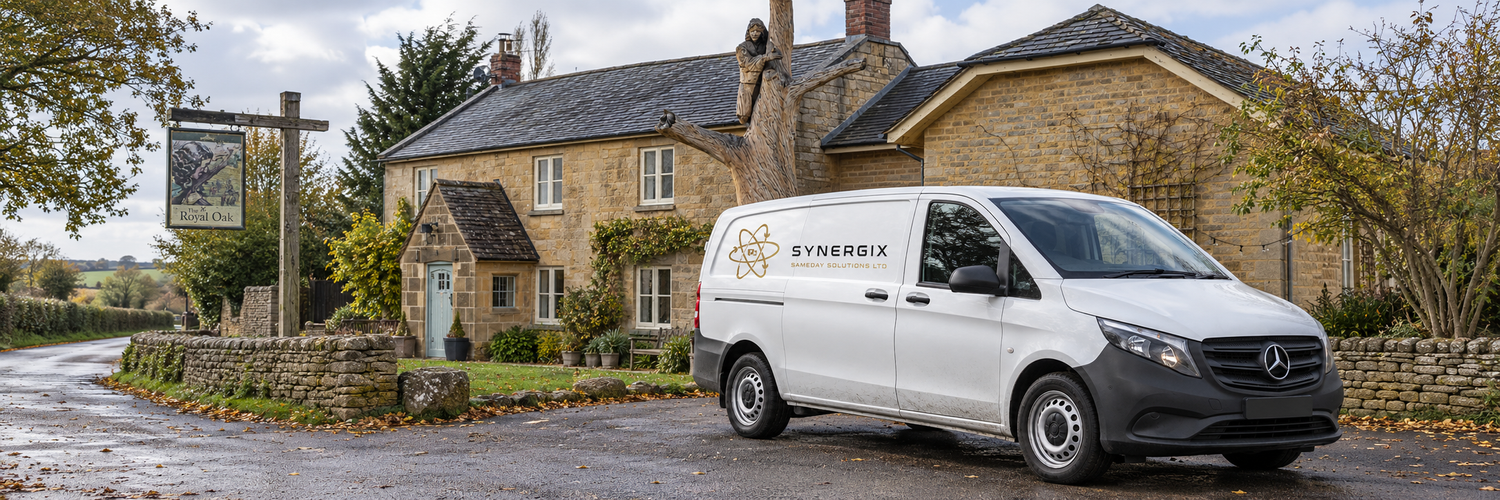
SWB van
courier service
More room for the goods, with a vehicle that still works for everyday business deliveries. Our short wheelbase van courier service suits urgent parts, palletised stock, trade supplies and regular routes, with people taking responsibility for the job.
Available SWB van body types
For this courier category, the main choices are a standard enclosed panel van or a refrigerated / temperature-controlled van. Tell us which the goods need when enquiring. Body type affects useful space, working payload, loading and the vehicle we can allocate.
Standard enclosed panel van
The usual choice for parts, cartons, palletised stock, tools, printing and other goods that do not need an actively controlled temperature. The solid body keeps the load enclosed during transport, with rear doors and model-dependent side access.
Start with 240 × 120 × 120 cm, up to 800 kg including packaging and up to two suitable pallets. These are booking guides. The doors, load shape, restraint and actual vehicle still need checking. A standard van is not chilled, frozen or temperature regulated.
Refrigerated / temperature-controlled van
For goods that need an agreed temperature during the journey, request the appropriate converted vehicle in advance. Tell us the required temperature range, product, packaged size, total weight, ready temperature, journey and any monitoring or handling requirement.
Insulation and refrigeration equipment take up space and add weight. Do not assume the standard 800 kg allowance, two-pallet layout or load dimensions apply to a refrigerated SWB. Confirm the converted vehicle's usable capacity and temperature capability before booking. Availability and suitability are checked for the job.
SWB describes the wheelbase category, not a refrigeration specification. Cooling, freezing, heating, temperature records and multi-temperature compartments must each be agreed where needed. Refrigerated transport is separate from leaving a fridge trailer at an event.
SWB van dimensions and pallet capacity
Use these figures to start planning. The assigned van must still accept the goods through its doors, accommodate their shape and leave room for safe loading and restraint.
- Planning load length
- 240 cm / 2.4 m
- Planning load width
- 120 cm / 1.2 m
- Planning load height
- 120 cm / 1.2 m
- Calculated rectangular volume
- 3.456 m³
- Total shipment weight
- Up to 800 kg
- Pallets
- Up to two, subject to checks
- Loading access
- Rear doors; side access varies
- Tail lift
- Not a standard SWB feature
Why a brochure may show more space
Mercedes-Benz Vito, Ford Transit Custom, Renault Trafic, Vauxhall Vivaro and similar medium vans have different body lengths, roofs, equipment and generations. “Short wheelbase” alone is not a specification. Passenger and crew versions also lose cargo space to seats and bulkheads.
Our 3.456 m³ figure is the rectangular planning space calculated from 2.4 × 1.2 × 1.2 metres. A manufacturer's larger cargo-volume figure may count shaped areas around the load bay, space above the wheel arches or a particular measurement method. It does not prove that a rigid box of the same volume will fit.
Wheel arches, sloping bodywork, lining, shelves, insulation and equipment affect the usable shape. The widest point is not necessarily the width available at floor level. Door apertures can be smaller than the bay behind them.
For site access, check the actual outside length, mirror width and height with fitted equipment. The space needed to turn, open the rear doors or use a sliding door is additional to the parked vehicle's dimensions.
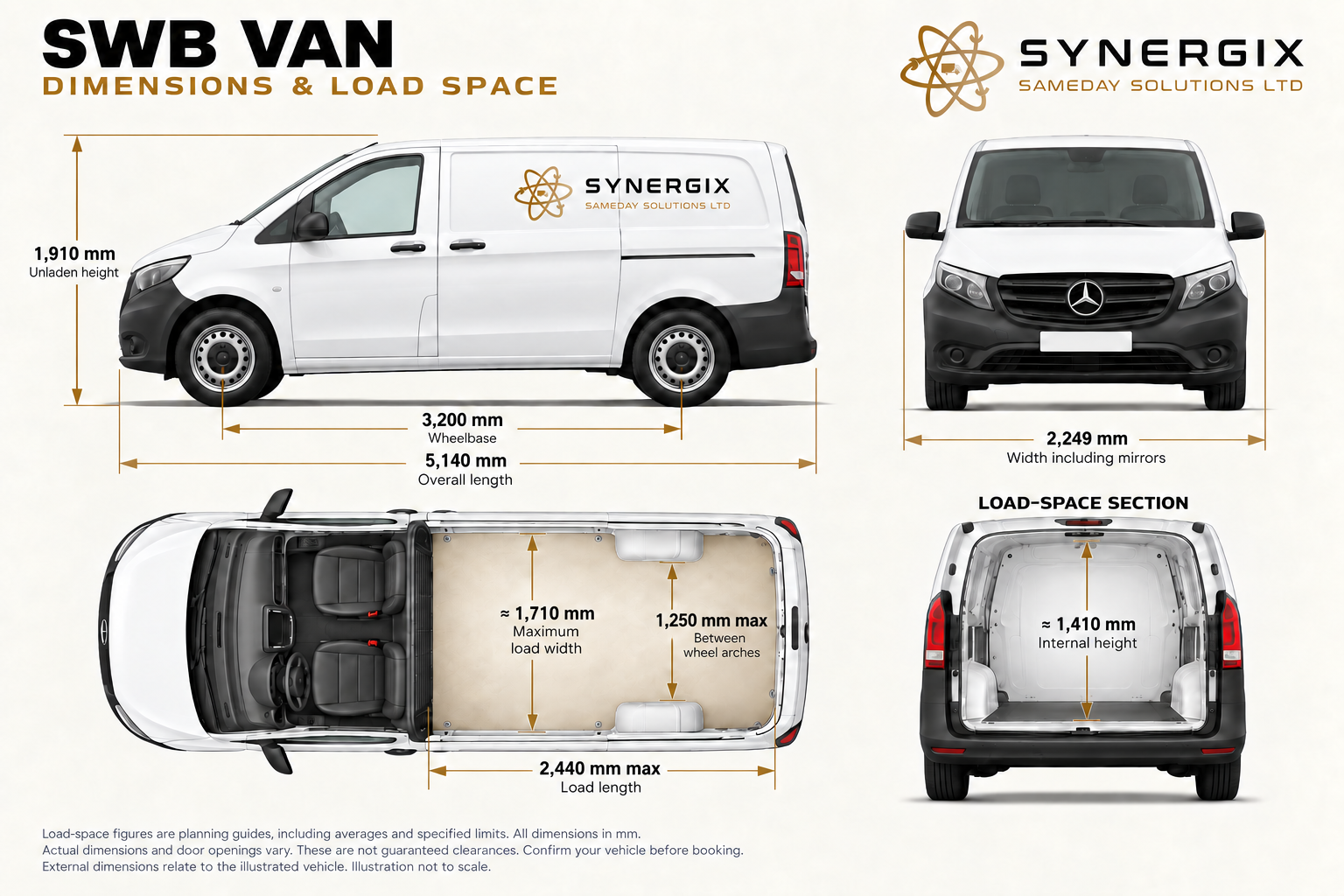
SWB van dimensions and load space. The illustration combines planning guides, approximate figures and the marked maximum dimensions. Its exterior figures relate to the illustrated vehicle. It is not to scale and does not guarantee the clearance of the van supplied.
For your booking, continue to use our 240 × 120 × 120 cm planning space and up to 800 kg total consignment weight. The larger illustrated measurements do not replace these booking figures. Actual doors, lining, equipment and room to secure the load still need checking.
Read the diagram measurements
Illustrated load-space guide: load length 2,440 mm maximum; maximum load width approximately 1,710 mm; width between wheel arches 1,250 mm maximum; internal height approximately 1,410 mm. These are illustration/planning values, not guaranteed minimum clearances across every SWB van.
Illustrated exterior: overall length 5,140 mm; wheelbase 3,200 mm; unladen height 1,910 mm; width including mirrors 2,249 mm. Measure the allocated van for a restricted entrance, parking bay or height barrier.
Can two pallets fit in an SWB van?
Up to two suitable pallets can be considered, with a combined shipment weight of no more than 800 kg. That is the weight of both loaded pallets together, including their bases, wrapping and any additional goods. It is not an 800 kg allowance for each pallet.
An EPAL Euro pallet has a 120 × 80 cm footprint and is 14.4 cm high before goods are added. A common UK pallet footprint is 120 × 100 cm, although “standard pallet” can describe other sizes. Give the actual loaded length, width and height, including any overhang, protruding straps or protective packaging.
Two 120 cm-long pallets placed end to end occupy 240 cm before loading clearance. Two UK pallets in that orientation can sit within a nominal 120 cm-wide planning space, but the actual van must provide sufficient length, door access and restraint room. Euro pallets may allow other orientations, depending on the real cargo bay. There is no universal layout that works for every van.
With a 120 cm planning height, a 14.4 cm-high Euro pallet leaves a theoretical 105.6 cm for the goods before extra clearance. The total loaded pallet height is the useful booking measurement. A fork truck or pallet truck can raise it further during handling, so fit must be checked in the loading position as well as when resting on the floor.
A 2.4 m floor does not guarantee a 2.4 m long crate.
The bulkhead and cab shape can reduce usable length above floor level. On some SWB vans, long items between approximately 2.2 and 2.4 metres need the next size vehicle when they are tall or bulky. Tell us the complete shape and orientation; do not assume a floor-length measurement applies at every height.
A load-through hatch, under-seat tunnel or diagonal position is a model-specific facility. It must suit the goods, doors, seating and restraint system. It is not an automatic extension to our SWB booking guide.
Measure the packaged goods
Use the outermost points once the load is prepared. Count handles, frames, pallet overhang, corner protection and any parts that cannot fold. Identify items that must remain upright or cannot be stacked.
Check the whole loading path
A crate needs to pass through the doors and reach its planned position. Confirm door opening, sill height, lifting equipment, turning room inside and access to securing points. Internal height alone cannot answer those questions.
Cartons do not pack like liquid
For illustration, 40 × 30 × 30 cm cartons form a theoretical 6 × 4 × 4 grid in the planning box, or 96 cartons. That leaves no dimensional tolerance or restraint clearance and says nothing about weight or stacking strength. It is not a confirmed carton allowance.
Wheelbase, body length and roof height: what the labels mean
Wheelbase is axle-centre distance. Overall length includes the front and rear of the vehicle. Load length is the usable cargo dimension. Changing rear overhang can change body length without changing wheelbase.
L1, L2 and L3 identify a manufacturer's length choices. H1 and H2 identify roof choices. Those labels are relative to that model range: L1 in one range is not necessarily the same length or roof clearance as L1 in another. A manufacturer's LWB low-roof medium van is also not automatically the same category as Synergix's larger LWB booking guide.
For a named example, Ford's published Transit Custom specifications list L1 H1 at 5,050 mm overall length with a 3,100 mm wheelbase, and L2 H1 at 5,450 mm with a 3,500 mm wheelbase. Its published L1 cargo dimensions differ from our cross-vehicle planning guide. Model, derivative, equipment and measurement point must stay attached to any specification.
What is a short wheelbase van courier?
It is a collection and delivery service using a short wheelbase commercial van and driver. At Synergix, this category bridges a compact small van and a larger long wheelbase van, with an 800 kg shipment limit and approximately 2.4 metres of planning length.
“SWB” means short wheelbase. Technically, wheelbase is the distance between the centres of the front and rear axles. In courier booking, the label also helps describe a vehicle category. It does not identify a single make, exact body length, roof height or legal payload.
A dedicated booking is planned around your consignment and agreed journey. It can avoid parcel-network sorting and repeated depot transfers. This is useful when goods are bulky, a pallet needs a direct movement, a production line is waiting for a component or a site needs a specific handover.
The same vehicle size can support regular supplier collections, branch transfers, retail replenishment and planned deliveries. The important question is whether the complete load and both sites suit the allocated van, rather than whether the job is urgent.
Why do we book up to 800 kg when a van may advertise 900 kg?
800 kg is Synergix's SWB consignment limit. It gives a consistent starting point across vehicles with different specifications and working equipment. An advertised 900 kg figure is not automatically the weight available for your freight on the day.
There are three different figures
The manufacturer's stated payload applies to a defined derivative and measurement basis. Fuel, occupants, options and fluids may already be accounted for, or may need a further allowance. Definitions and table headings need reading together.
The actual available goods capacity depends on the van as it will operate: its permitted weights, real working mass, people, fuel, equipment and load distribution. The vehicle's gross limit and each axle limit all matter, as explained in GOV.UK van weight guidance.
The courier booking limit is the service allowance used to assess a consignment. Our SWB allowance is up to 800 kg, including pallets, cases and packaging. If the assigned vehicle or job needs a lower limit, the team must account for that when selecting it.
What takes up working weight?
- The driver and any additional passenger or crew member.
- Fuel and operating fluids, to the extent they are not already included.
- Factory options and equipment fitted after manufacture.
- Floor and side lining, shelving, partitions and security equipment.
- Straps, blankets, tools, trolleys and a pallet truck where carried.
- Insulation, refrigeration and other specialist conversions.
- The actual vehicle's manufacturing variation and operating condition.
These factors vary. They do not create a universal 100 kg deduction from every 900 kg advertisement, and 800 kg is not a measured average payload of all SWB vans.
Do not subtract the driver or fuel twice.
A brochure may already include a standard fuel fill or an occupant allowance. Work from that specific definition and the actual vehicle weight. A full tank still counts towards gross weight, but it should not be deducted again from a figure that already includes it.
For your enquiry, report the gross weight of the shipment. The operator separately checks the van's working capacity. You do not need to invent a fuel or driver allowance for the goods you are booking.
An illustrative operating-weight calculation
Suppose a van is permitted to weigh 2,800 kg in total and weighs 2,000 kg ready for this job, with its driver, fuel and equipment already aboard. The arithmetic leaves 800 kg before checking the axle limits and loading plan. These are invented example weights, not a specification for our fleet.
If its ready-to-work mass were 2,100 kg, that same gross limit would leave 700 kg. An 800 kg category guide cannot override the lower real capacity. A suitable vehicle must be allocated or a different arrangement agreed.
Does wear and tear reduce the payload?
Regular heavy operation can put more demand on tyres, brakes, suspension and other components. An operator can choose a conservative service allowance to support consistent operation, but maintenance concerns do not create a fixed legal deduction.
A vehicle with a defect needs the proper inspection or repair. A lower load does not make an unsafe tyre, damaged restraint point or faulty brake acceptable. Legal weights, tyre ratings, floor support and maintenance remain separate checks.
| Example load | Total gross shipment weight | What it tells you |
|---|---|---|
| Two pallets, each 350 kg goods plus 25 kg base/packaging | 750 kg | Within the category weight guide. Size, loading and axle distribution still need checking. |
| Two fully loaded pallets of 420 kg each | 840 kg | Exceeds the SWB booking limit. Request a different vehicle assessment. |
| 780 kg of goods plus 40 kg of cases and packing | 820 kg | The goods-only figure conceals an overweight consignment for this category. |
| One 300 kg machine on small feet | 300 kg, plus its packaging | Weight may fit, but concentrated floor loads, stability and lifting arrangements are decisive. |
An even-looking load can still overload an axle. Do not add the two axle limits together and treat the result as a replacement gross limit. Accurate supplier weights, scales or a weighbridge are appropriate when weight is unknown or close to a limit.
Common SWB courier loads
The SWB is useful for small-to-medium business consignments that need more space or weight allowance than a small van. These are typical applications to assess, rather than a promise that every item in the category will be accepted.
Engineering & manufacturing
Replacement parts, tooling, boxed components, protected assemblies and production samples. A longer cargo floor can accommodate several cases or a compact machine. Identify sharp edges, oil, lifting points and any requirement to keep the load upright.
Building & fit-out supplies
Fixings, fittings, packaged flooring, plumbing parts, electrical materials and smaller trade consignments. Dense items can reach the weight limit with plenty of space left. Tall sheet material and long lengths need careful height and bulkhead checks.
Print, signage & display
Printed cartons, protected panels, exhibition graphics and point-of-sale materials. More floor space can help keep fragile or non-stackable pieces separate. Give the complete frame, crate or protective-board size, rather than the artwork size alone.
Retail & branch stock
Shop replenishment, supplier deliveries, inter-branch transfers and returns. An SWB can suit quantities beyond a few parcels without requiring a large van. Delivery slots, back-door access, stock references and receipt procedures should be agreed.
Drinks & hospitality
Boxed drinks, packaged dry goods, bar supplies and suitable keg consignments. Filled kegs, glass and liquids add weight quickly. Declare the total gross weight, breakage risks, loading method and any temperature requirement.
IT & electronics
Computers, network equipment, replacement units and protected demonstration equipment. Cases and cartons may need space between them. Declare batteries, value, fragile screens and orientation restrictions; a dedicated journey does not replace packaging.
Events & production
Audio-visual flight cases, production spares, display components and urgent consumables. Confirm gate instructions, accreditation, site contacts and collection after the event. A loading dock or large flight case can change the appropriate vehicle.
Documents, samples & artwork
Archive boxes, contracts, product samples, protected pictures and presentation material. The SWB becomes useful when several pieces need floor space or a small van is too short. Agree the recipient and any documented handover.
Furniture & appliances
Smaller protected pieces, boxed appliances and agreed business deliveries. Check upright height, loading aids, weight and the path into the premises. Carrying an item to a room, stairs, unpacking or installation requires a separately agreed service.
Fashion & garments
Boxed clothing, accessories, samples and store stock. Ask specifically about hanging arrangements: rails, hangers and usable drop height are not standard in every SWB. A specialist garment vehicle may be needed.
Medical & laboratory goods
Eligible equipment, consumables and properly declared consignments. Samples, medicines, temperature controls, handling records and dangerous-goods classification need assessment before acceptance. An ordinary van is not automatically a clinical transport solution.
Warehouse transfers & returns
Stock movements between suppliers, storage sites and customers, plus agreed collection of returns. Record piece counts and check where each collection adds weight or volume. Consolidation helps only when timing and handling remain suitable.
Choose by the load, not the industry name.
A brewery can need anything from a sample box to a full load. A construction site can need one urgent fitting or equipment beyond a van's capacity. The goods, loading, access and deadline determine the transport, so send those details with your enquiry.
SWB van benefits and limitations
Why customers choose an SWB
Useful capacity without a large body. An SWB can bring several packages or two suitable pallets together in one dedicated movement. It provides a step up from a compact van while often remaining easier to position than a longer, taller alternative.
Practical urban and site access. A shorter vehicle can need less turning and parking room within a comparable model range. That can help at workshops, hospitality premises and retail loading areas. Mirror width, roof height and restrictions still need checking.
A controlled collection and delivery. Dedicated work can follow agreed times and handover instructions, with fewer transfers. The customer can discuss the actual goods and consequences of a delay with someone responsible for arranging the job.
Flexible repeat work. Scheduled collections, supplier runs, multi-stop routes and returns can be planned around predictable quantities. The van still needs to fit the largest load carried on any leg, rather than the quietest day.
Where the SWB reaches its limits
Length and height can rule it out early. A bulky 2.4 m item may not fit at its required height. Tall pallets, large panels and several non-stackable pieces can need an LWB even if their weight is modest.
800 kg is a total shipment limit. Dense stock can exhaust it before the floor is full. A heavier pallet needs a different assessment. Large cargo volume and large legal payload are separate things.
Loading equipment is not automatic. Most SWB panel vans have no tail lift. A pallet truck cannot lift a pallet from ground level into the van. High loading bays may also be unsuitable for a low van floor.
It may not be the cheapest or lowest-emission option. Dedicated transport includes a driver and journey. A parcel network may suit flexible parcels, while a larger vehicle may complete a bulky job in one trip that would take two SWBs.
Turning, parking, fuel economy and running cost depend on the models being compared and their duty cycle. “SWB” does not guarantee car-like access, a particular fuel figure or a universal price advantage.
Small van vs SWB van
Choose a small van when a compact consignment fits comfortably. Choose the SWB when extra length, width, height, weight allowance or floor positions make the job workable.
| Planning item | Small van | SWB van |
|---|---|---|
| Shipment weight, including packaging | Up to 400 kg | Up to 800 kg |
| Load length × width × height | 120 × 100 × 100 cm | 240 × 120 × 120 cm |
| Calculated rectangular planning volume | 1.2 m³ | 3.456 m³ |
| Suitable pallets | Up to 1, subject to checks | Up to 2, subject to checks |
| Useful applications | Compact parts, documents, samples and a limited quantity of parcels | Several cases, larger trade consignments and suitable pallet movements |
| Main trade-off | Smaller vehicle, lower load allowance | More capacity, generally more space needed for access and parking |
What changes in practical terms?
The SWB guide doubles the consignment weight allowance and planning length. Its width and height guides increase by 20 cm each. The calculated rectangular volume is 2.88 times the small-van planning box. That is a comparison of our figures, not a claim that every SWB has 2.88 times a manufacturer's usable cargo bay.
For illustration, a 250 kg load of compact cartons may suit a small van. A 550 kg packaged machine or two suitable 350 kg loaded pallets exceeds the small-van weight guide and warrants an SWB assessment. A 180 cm-wide display is outside both width guides, regardless of weight.
Which gives better value and uses less fuel?
A smaller vehicle can be economical when the goods genuinely fit. The SWB can make better use of one driver and one trip when the load would otherwise need two compact vehicles. Mileage to collection, waiting, handling and vehicle availability also affect the quote.
Fuel and CO₂ should be compared for the actual vehicles and the complete movement. A compact diesel and an SWB diesel do not have identical test figures, but choosing a fuel-efficient van that cannot carry the whole job can create more mileage. See the fuel and emissions comparison below.
SWB van vs LWB van
Move to an LWB when the load needs more usable length, height, weight allowance or floor positions. Book around the actual consignment rather than trying to force a borderline load into a smaller category.
| Planning item | SWB van | LWB van |
|---|---|---|
| Shipment weight, including packaging | Up to 800 kg | Up to 1,250 kg |
| Load length × width × height | 240 × 120 × 120 cm | 360 × 120 × 180 cm |
| Calculated rectangular planning volume | 3.456 m³ | 7.776 m³ |
| Suitable pallets | Up to 2, subject to checks | Up to 3, subject to checks |
| Good reason to choose it | A medium load that fits with proper clearance | Longer or taller freight, more floor positions, or a load above 800 kg |
| Access and equipment | Check actual doors, mirrors, roof and handling | Check the longer body, higher roof, doors and handling |
What does the larger guide add?
Our LWB guide adds 120 cm of planning length, 60 cm of planning height and 450 kg of shipment allowance. Its calculated rectangular box is 2.25 times the SWB planning box. The same 120 cm planning width is used, so an item too wide for the SWB guide is not automatically solved by moving to LWB.
Illustrative move-up examples include a suitable 950 kg shipment, a 150 cm-high loaded pallet or an upright crate that needs more length above the SWB's bulkhead. The actual vehicle still needs the correct doors, support, restraint and loading equipment.
When can an SWB still be the sensible choice?
If the full load fits with adequate clearance and remains within 800 kg, an SWB may avoid paying for space the job does not need. A shorter, lower body can also be easier to accommodate at some premises. Check the assigned model instead of assuming every SWB fits beneath a 2 m barrier.
An LWB can avoid extra journeys for a bulky load. It is not automatically less efficient per shipment, and the courier price is not calculated from fuel alone. A tail lift, refrigeration or other conversion can reduce available payload even on a larger vehicle.
Need more width, ground-level pallet loading or special handling?
Another panel van may not solve the problem. A suitably equipped Luton, curtainsider, lorry or specialist vehicle could be appropriate. Tell us whether a forklift, tail lift, powered pallet truck or two-person service is needed before collection.
SWB van courier services
An SWB can support a one-off deadline or an ongoing delivery schedule. We agree the service around the goods, route, handling and handover.
Same-day delivery
For goods that need moving today. Give the earliest ready time and latest acceptable arrival. We aim for collection within 60 minutes on many bookings where a suitable vehicle is available; postcode, traffic, goods and access affect the time confirmed for your job. A larger or specialist requirement may need more preparation.
Advance bookings
Arrange a known collection date, production deadline or delivery appointment. Booking ahead creates time to check both sites, packaging, vehicle dimensions and documentation. Raise changes in quantity or timing before the van attends.
Planned next-day transport
For work that can be arranged ahead but still needs agreed handling and timing. Confirm collection and delivery windows, any overnight arrangements and recipient availability. “Next day” should describe a service that has been agreed for the route.
Through-the-night delivery
Overnight movements can suit early site starts or time-critical stock. Both premises need workable access, an agreed handover and a reachable contact. A night-time deadline still needs a legal driving and rest plan.
Regular planned routes
Daily or weekly supplier runs, branch transfers, store deliveries and scheduled collections. Share frequency, peak load, opening hours, expected waiting and return quantities. The plan should cover busy periods and what happens when a day's goods exceed the usual allowance.
Multi-stop, half-day and full-day work
A van and driver can be arranged for an agreed programme. Define stops, mileage, waiting, working time and handling. Each collection or delivery changes the load carried on the next leg, so the whole route must stay within capacity.
Dedicated van or parcel network?
A dedicated movement is useful when control, timing, shape or handover matters. A pallet, protected display or urgent component can justify its own vehicle even if it does not fill the bay.
A parcel network can be economical for appropriately packed parcels that suit its rules and delivery windows. Its sorting, transfers, size limits and service terms are different. Compare the actual need rather than assuming all courier services work the same way.
Updates and proof of delivery
Tracking, notifications and electronic proof of delivery are available according to the service and account setup. Agree the required updates, recipient, delivery reference and any photographs or signature instructions before dispatch.
Registered customers can use their separate customer portal for supported account functions. An online quote request starts an enquiry; it is not evidence that a vehicle has been allocated or a booking confirmed.
For longer and cross-border movements, discuss our European courier service. An SWB is not limited to local journeys: suitability depends on the load, route, documents and driver plan.
Loading, packaging and safe handling
A van being able to carry 800 kg does not mean its driver can lift an 800 kg item. Loading and unloading arrangements are part of choosing the vehicle.
Prepare the consignment
- Use packaging suitable for road transport, with protection for edges, surfaces and fragile parts.
- Give the total number of pieces and the outer dimensions of each packaged item.
- Declare the full shipment weight, including pallets, crates, cases, wrapping and packing.
- Identify what must remain upright, cannot be tilted or cannot have other goods stacked above it.
- Secure cartons and goods appropriately to their pallet. Stretch wrap alone does not secure a pallet to the van.
- Keep liquids in suitable closed containers and disclose leaks, contamination risks or dangerous-goods classifications.
- Label collection/delivery references and distinguish multiple recipients or return goods.
Agree both handovers
- Confirm who provides a forklift, lifting aid or additional people at collection and delivery.
- Check that the equipment can reach and safely load the allocated van.
- Explain steps, thresholds, slopes, gravel, narrow entrances and the distance from the van to the handover point.
- Specify loading bay, reception, workshop, kerbside or internal-room delivery requirements.
- Book two-person or white-glove handling separately when needed.
- Provide a reachable site contact and any booking slot, gate code or induction instruction.
- Allow space to open doors, position lifting equipment and work without obstructing other traffic.
Floor and axle loading
Spread and support the goods according to the vehicle and load. A dense machine on small feet creates concentrated pressure. Heavy freight at the rear can overload an axle before the gross limit is reached. The loading plan matters as much as the total kilograms.
Restraint and stability
Follow the DVSA load-securing guidance and use suitable anchorage and restraints for the goods and vehicle. Movement during braking, cornering and normal road use must be controlled. A closed door, heavy item or bulkhead is not a complete securing plan. Protect delicate surfaces from strap pressure.
Manual handling
The HSE explains that there is no universal legal safe lifting weight for every person and task. Grip, shape, posture, distance and ground conditions affect the work. Declare awkward individual pieces so people and lifting aids can be assessed before attendance.
Forklifts, pallet trucks and loading bays
A forklift can lift a pallet to the van's floor if its approach, reach, capacity and the vehicle's access are suitable. The supplier and delivery site need to confirm workable equipment; a forklift at one end does not solve unloading at the other.
A pallet truck moves a suitable pallet on a suitable surface. It does not bridge the height between the ground and a van floor. Pallet base openings, fork length, wheel clearance and space for the handle can affect its use inside a short cargo bay.
A high lorry dock may not match an SWB's floor height. Dock levellers and ramps must suit the vehicle, load and equipment. Do not assume the driver can safely pull a heavy pallet across an improvised gap.
Tail lifts and powered handling
A tail lift is not standard on an SWB panel van. Where ground-level pallet loading is needed and no suitable lifting equipment is available, request an appropriately equipped vehicle.
If pallet-truck handling is needed for an individual loaded pallet of 800 kg or more, request an electric pump truck. This is Synergix's booking requirement, not a universal legal weight threshold. Lower weights can also need powered handling because of distance, gradients, surfaces or access.
The powered truck's own weight and dimensions must be allowed for. Tail-lift platform size, rated capacity, load centre and everything carried on the platform need checking. A powered pallet truck does not make unsuitable ground or a steep slope acceptable.
The load changes after every stop.
For a multi-drop route, goods can become less stable as other pieces are removed. Collections may add new weight, and empty pallets or returns occupy space. Plan the sequence, access and restraint for each leg. “It fitted at the first stop” is not enough for the whole route.
Awkward loads: upright goods, long lengths and fragile equipment
Give the orientation that must be maintained and describe the point where dimensions change. A machine may have a compact base but a wide head; an appliance may need to remain upright; a flight case may have handles and castors beyond its nominal box size.
Do not plan to remove packaging or turn fragile goods purely to fit a smaller van unless the sender approves and a suitable loading/restraint arrangement is confirmed. Manufacturer handling instructions and declared centre of gravity can be useful for machinery.
Long materials need support and secure retention. A load-through opening or roof rack is not a standard booking allowance. Roof loads count towards the vehicle's weights and alter outside height, drag and handling. Request a suitable vehicle instead of assuming the doors can stay open.
SWB van fuel economy and running costs
There is no single MPG figure for an SWB van. Engine, gearbox, gross-weight version, equipment, load and route affect fuel use. A manufacturer test is a comparison point, not a promise for your delivery.
The Transit Custom range includes diesel, petrol plug-in hybrid and fully electric vans. These named combined-test examples are for Trend SWB low-roof derivatives, using manufacturer specifications checked on 2 October 2026:
| Transit Custom example | Published combined consumption | Calculated consumption / 100 miles | Test tailpipe CO₂ |
|---|---|---|---|
| 280S, 2.0 EcoBlue diesel, 136 PS, manual FWD | 39.8 UK MPG / 7.1 L per 100 km | 11.43 L diesel | 186 g/km |
| 280S, 2.0 EcoBlue diesel, 136 PS, automatic FWD | 37.2 UK MPG / 7.6 L per 100 km | 12.23 L diesel | 200 g/km |
| 320S, 2.5-litre petrol plug-in hybrid | 1.6 L per 100 km, weighted test, with electric operation | 2.57 L petrol on that weighted basis, plus electricity | 36 g/km, weighted |
| E-Transit Custom 320S, 71 kWh, 100 kW, RWD | 2.8 miles/kWh | 35.71 kWh electricity | 0 g/km while driving |
WLTP is a standard test procedure. The diesel and PHEV litre conversions use published L/100 km × 1.609344; electric consumption uses 100 ÷ miles/kWh. MPG and litre values are rounded separately. These figures use different energy units and test boundaries, so their numerical sizes do not rank the powertrains. The PHEV's weighted fuel figure includes electric driving and is not the petrol consumption of an uncharged long-distance journey. Its charging electricity must also be counted. Zero tailpipe CO₂ does not mean zero whole-life emissions.
A fully loaded van can use substantially more than the headline figure.
Carrying a heavy consignment increases the energy needed to accelerate and climb. A fully loaded SWB can achieve substantially worse fuel economy than a brochure figure, particularly on hills, in stop-start traffic or during faster motorway work. The same load can also reduce an electric van's achievable range.
There is no honest fixed percentage for every van and route. Plan using achieved consumption for the actual load and conditions. Refrigeration, roof equipment, wind, cold weather and repeated stops can add further demand. A favourable test figure should not become a promise for a loaded courier job.
What changes real-world economy?
Stop-start work, cold starts, idling, hills, headwinds, road speed and acceleration change consumption. A loaded motorway journey and a congested delivery round can use different fuel despite covering the same distance.
Tyre pressure and condition, maintenance, vehicle load, roof equipment, heating and air conditioning also matter. Refrigeration can add an energy demand as well as equipment weight. Steady driving, a sensible route and avoiding unnecessary waiting can reduce wasted energy.
Figures from older NEDC tests should not be treated as directly interchangeable with newer WLTP results. US MPG uses a smaller gallon than UK MPG. Check the unit and test before comparing an attractive headline with a different vehicle.
How much diesel for 100 miles?
These achieved-economy scenarios show the arithmetic. They are not a claimed real-world range for the Synergix fleet.
| Achieved UK MPG | Litres for 100 miles |
|---|---|
| 30 mpg | 15.15 L |
| 35 mpg | 12.99 L |
| 40 mpg | 11.37 L |
| 45 mpg | 10.10 L |
| 50 mpg | 9.09 L |
Calculation: 454.609 ÷ UK MPG, using a 4.54609-litre imperial gallon. Multiply the unrounded litres by the actual price per litre for fuel cost.
Fuel cost is one part of the courier price.
At an illustrative 40 UK MPG and an assumed £1.50 per litre, a 100-mile movement uses about 11.37 litres and costs about £17.05 in fuel. That simple calculation leaves out the drive to your collection site, any allocated onward or return movement, and the effect of carrying your goods.
A worked full-job example: assume 20 miles to reach collection, 100 loaded miles to deliver and 30 allocated onward miles. If the 50 positioning/onward miles achieve 40 UK MPG but the 100 loaded miles achieve 30 UK MPG, the van uses about 20.84 litres. At the same assumed price, that is about £31.25 in fuel, before driver time or any other operating cost.
The 30 and 40 MPG figures are illustrative achieved-economy assumptions, not a claimed full-load penalty or Synergix fleet measurement. The price is an example, not a current pump-price quote. The quotation considers the vehicle reaching your site, the loaded route, agreed positioning or return requirements, driver time, waiting, additional stops and handling.
Businesses operating their own vans also need to account for servicing, tyres, repairs, insurance, depreciation or lease payments, tax, energy and time off the road. Purchase price or the fuel cost of the delivery leg alone does not establish the cost of the complete job.
How much CO₂ does an SWB van produce per 100 miles?
At the named diesel test rates above, 100 miles equates to approximately 29.93 kg of tailpipe CO₂ at 186 g/km or 32.19 kg at 200 g/km. An actual delivery can differ because of its vehicle, load, route and operating conditions.
Convert g/km into a journey total
One hundred miles is 160.9344 kilometres. For any declared rate:
kg CO₂ per 100 miles = g CO₂/km × 0.1609344
For a different distance, multiply miles × 1.609344 × g/km, then divide by 1,000. This converts a rate; it does not measure the exhaust emissions of a real journey.
| CO₂ rate used | Calculated tailpipe CO₂ |
|---|---|
| 150 g/km | 24.14 kg |
| 186 g/km | 29.93 kg |
| 200 g/km | 32.19 kg |
| 250 g/km | 40.23 kg |
| 0 g/km, battery electric | 0 kg at the tailpipe |
Convert a CO₂ figure
Enter the rate for the vehicle you want to compare. The starting values are an explanatory example.
Tailpipe CO₂ only. This tool measures no journey and does not calculate a lifecycle footprint or make a booking.
Count the full job mileage
Positioning to collection, the loaded movement, extra stops and allocated return or onward travel can all matter. A customer's 100-mile route does not establish that the vehicle drove only 100 miles.
For illustration, 20 miles to collect, 100 loaded miles and 30 allocated onward miles total 150 vehicle miles. At an assumed 186 g/km, the calculation is 44.90 kg CO₂. State consistently which movements belong to the shipment's report.
Small van, SWB or LWB: compare the whole movement
The named Ford Transit Courier Leader 1.5 EcoBlue manual example used in our Small Van guide is 140 g/km, giving 22.53 kg over 100 miles. The SWB diesel example above is 29.93 kg. This compares named test figures, not every small van and SWB.
A 700 kg shipment exceeds our small-van booking limit. Two illustrative 100-mile small-van movements at 140 g/km total 45.06 kg, compared with 29.93 kg for one illustrative SWB movement at 186 g/km, before considering positioning or returns. It shows why trip count matters; it is not a guaranteed saving.
For a load requiring two SWB trips, two 100-mile movements at 186 g/km total 59.87 kg. One suitable larger-van movement at an assumed 250 g/km would total 40.23 kg. The 250 g/km rate is a scenario, not a measured LWB fleet rating. Obtain actual vehicle data before drawing a conclusion for a real job.
CO₂ and CO₂e differ
CO₂ is carbon dioxide. CO₂e expresses different greenhouse gases as a carbon-dioxide equivalent. A tailpipe CO₂ total is not a complete CO₂e footprint.
Zero tailpipe is one boundary
A battery-electric van has no tailpipe CO₂ while driving. Electricity supply, vehicle manufacture and batteries have other emissions. Do not call the whole service zero carbon on that basis.
Vehicle totals need allocation
The van's total is not automatically the emissions of every parcel it carries. Shared routes need a consistent allocation method. Dedicated work still needs an agreed boundary for positioning and returns.
Electricity and fuel reporting examples
The revised UK government's 2026 factors give 0.13096 kg CO₂e/kWh for UK electricity generation and 2.58354 kg CO₂e/litre for average-biofuel-blend diesel combustion. They cover different stages and do not represent complete lifecycle footprints.
For illustration, 40 kWh of metered charging electricity × 0.13096 gives 5.24 kg CO₂e at the generation boundary. Separately, 12 litres of the specified diesel × 2.58354 gives 31.00 kg CO₂e at the combustion boundary. These are example activities, not matched van journeys or a like-for-like lifecycle comparison.
Electricity transmission, distribution and upstream energy emissions need the relevant additional factors where the chosen reporting method requires them. Fuel extraction, processing and distribution are also separate from combustion. If a consumption figure already includes charging losses, do not add those losses again.
For formal reporting, use actual litres, metered electricity or suitable vehicle activity data, the reporting year's method, a stated scope and a consistent shipment allocation. Ask what data is available for the agreed service. The examples on this page are not a verified Synergix carbon report.
Accurate load details, one suitable vehicle, ready sites, sensible delivery windows and agreed consolidation can help avoid unnecessary journeys. Vehicle size or fuel type alone does not establish the lowest-emission solution.
Diesel, petrol, plug-in hybrid or electric SWB?
Choose around the duty cycle and available vehicle. Fuel type alone does not establish payload, running cost, access or environmental performance. State any electric-vehicle requirement when enquiring so availability and suitability can be checked.
Urgent long-distance courier work needs a vehicle that can meet the deadline.
For an urgent long-distance job that cannot allow time for charging, a battery-electric SWB is not a suitable choice. Its available charge and realistic loaded range must cover the complete job, or a workable charging stop must be built into the agreed schedule. Hoping to find a charger on the way is not an acceptable delivery plan.
Getting to collection, motorway running with the goods aboard, the next leg and a sensible reserve all count. A charger detour, queue, unavailable unit, access restriction or slower-than-expected charging can turn a tight deadline into a failed delivery. Cold weather, load and refrigeration can reduce the margin further.
As a manufacturer example, Ford quotes approximately 39 minutes to charge an E-Transit Custom from 10% to 80% with suitable 125 kW DC charging under its stated conditions. That excludes travel to the charger and any wait for a bay. It is not a full charge or a guaranteed stopping time for every van and journey.
Diesel's quick refuelling can make it the more practical choice for unpredictable, sustained long-distance work. Electric vans can suit planned routes with dependable charging, or an urgent journey entirely within a verified energy allowance. For a time-critical delivery, confirm the complete route, vehicle and charging requirements before agreeing the job.
Diesel
Can suit sustained road mileage, long-distance work and routes where quick refuelling matters. Fuel use varies with specification and load. Modern exhaust treatment and maintenance need to suit the operating pattern, especially repeated short trips.
Diesel does not automatically mean poor emissions-zone compliance, and a newer van is not automatically compliant everywhere. Check the registration, emissions standard and actual destination. AdBlue is separate from diesel on vehicles that use it.
Petrol
Petrol is another possible combustion powertrain, but availability within medium-van ranges varies. It is more common in some compact or older model ranges than others. An SWB category is not a promise of a petrol vehicle.
Compare achieved consumption, fuel price, maintenance and the actual duty cycle. Petrol is not automatically cheaper per mile or lower in CO₂ than a particular diesel. Avoid transferring a small petrol van's MPG to a larger medium van.
Plug-in hybrid
A PHEV combines a combustion engine with a rechargeable battery. Regular charging and trips that make useful use of electric operation can matter to its energy consumption. Once the usable electric range is depleted, a long route still uses fuel.
For a named test example, the current Ford Custom Trend 320S PHEV row gives 36 g/km and 1.6 L/100 km. These are weighted test figures involving electric operation. They are not a promise of that fuel use or CO₂ on an uncharged 100-mile courier trip, and purchased electricity must also be counted.
Battery electric
An electric van has no tailpipe CO₂ while driving and can suit routes with predictable energy demand and dependable charging. Stop-start work can benefit from regenerative braking, while high speeds, cold weather, heating and load can reduce achievable range.
Check payload, cargo access, departure charge, delivery mileage, positioning, return needs and a charging contingency. Battery size does not by itself tell you available goods weight. An electric vehicle is not promised as standard on this service.
How much electricity does an electric van use over 100 miles?
A published figure in miles/kWh converts using 100 ÷ miles/kWh. A figure in kWh/100 km converts using kWh/100 km × 1.609344. Keep the stated test and charging boundary attached to the result.
| Manufacturer example | Published combined consumption | Calculated energy / 100 miles | Published test range |
|---|---|---|---|
| Ford E-Transit Custom Trend 320S SWB, 71 kWh, 100 kW, RWD | 2.8 miles/kWh | 35.71 kWh | 230 miles combined |
| Mercedes-Benz eVito Panel Van, 60 kWh usable battery, published range variants | 26.4–26.5 kWh/100 km | 42.49–42.65 kWh | 159–160 miles WLTP |
Ford example: manufacturer specification effective 1 June 2026. Mercedes example: official UK electric-van figures checked 2 October 2026. The eVito example concerns medium cargo vans, whose manufacturer length names differ from Ford's SWB labels. It is not the passenger Tourer. These are different specifications and do not predict identical routes, loads or weather performance.
Range is more than the delivery postcode
Allow for travel to collection, all loaded legs, the return or next job and a workable reserve. Motorway speed, wind, terrain, temperature, heating, payload, battery condition and traffic can change energy demand. Published WLTP range is not guaranteed available range on a loaded winter journey.
For illustration, a 120-mile round requiring 0.4 kWh/mile would use 48 kWh before reserve. A nominal battery size is not all freely usable energy, and the departure charge may be below full. Assess the specific van and route rather than booking right up to a headline range.
Regenerative braking recovers some energy during deceleration; it does not remove the energy required for an extended motorway route. Repeated stops also add handling and timing demands, even when the vehicle's energy use is favourable.
Charging and electricity cost
AC depot charging can fit planned downtime. DC charging can extend a journey where a suitable charger is available, but charge speed depends on the vehicle, battery state, temperature and charger. A peak power headline is not a constant charging rate.
Confirm connector compatibility, site access, usable bay size, opening hours and a backup. Queues, a blocked charger or an unexpected top-up can affect a time-critical movement. A charging plan should remain workable with the goods aboard.
For illustration, 40 kWh purchased at an assumed 25p/kWh costs £10.00; at an assumed 75p/kWh it costs £30.00. These are arithmetic tariffs, not current market quotes or a courier rate. Use metered energy and the applicable tariff, including losses and fees on the correct basis.
Electric does not automatically mean free city access.
Zero tailpipe emissions and a clean-air-zone exemption are different from parking permission, loading restrictions, road-user charges and congestion charging. Check the registration and journey against the actual scheme. A delivery still needs legal, practical access.
Specialist goods and extra service requirements
An SWB can be the right size without being the right specification. Temperature, value, classification, security and handling requirements must be assessed separately.
Food and temperature-sensitive goods
Explain the required temperature range, journey duration, packaging, cleaning, separation and any monitoring or records. A standard panel van is not refrigerated. Insulation and refrigeration can reduce usable space and payload, and some products need controls beyond simply keeping the air cool.
Refrigerated transport is a different requirement from refrigerated trailer hire for an event. If stock needs storage on site for several days, explain that need so the appropriate event refrigeration arrangement can be discussed.
Batteries, chemicals and dangerous goods
Declare lithium batteries, aerosols, gases, paints, chemicals and any other classified goods. Provide the product details, UN number and safety information where applicable, quantity, packaging and condition.
Small quantity, limited quantity or excepted quantity arrangements have conditions. A small box or short route does not create a blanket exemption. Damaged batteries, mixed loads or waste can need a very different solution. Acceptance is confirmed for the particular consignment.
Medical and laboratory consignments
State whether the goods are equipment, consumables, medicines, specimens or another product. Classification, time limits, packaging, temperature control, chain of custody and handling records can affect what is suitable.
Do not assume that a dedicated ordinary van meets every clinical, pharmaceutical or laboratory requirement. Describe the controls needed so vehicle, driver and service arrangements can be assessed before collection.
High-value and fragile items
Declare value, sensitivity, handling instructions and any security requirement. Protective cases, suitable restraints and an agreed recipient can be part of the plan. Vehicle locks alone do not define the complete security arrangement.
Have cover, limits, exclusions and applicable contract terms confirmed before booking. Do not assume every consignment has automatic full replacement-value insurance or that an undeclared specialist item is covered.
Two-person and white-glove delivery
An SWB courier booking normally concerns transport with a driver. Extra people, stairs, room placement, unpacking, assembly, installation or removal of packaging require an agreed scope.
Give the item size and weight, floor, lift dimensions, doorway widths, parking distance and site conditions. The appropriate vehicle may change once people, equipment and safe handling are included. See two-person delivery and white-glove arrangements.
Events, retail and warehousing
An SWB can support store replenishment, event build-up, urgent spares and agreed return collections. Share delivery slots, accreditation, loading access, piece counts and the person authorised to receive or release stock.
When goods need holding, consolidation or transfer between movements, discuss storage and warehousing or cross-docking. These are logistics arrangements to agree, not automatic features of every courier booking.
A box fitting through the doors does not establish acceptance. Tell us about specialist goods before dispatch, so the job can be assessed honestly and the required arrangements confirmed.
UK routes, European journeys and access
An SWB is useful for local, regional and long-distance work when the load, vehicle and schedule fit. The service must account for both addresses and the journey between them.
Collections and deliveries across the UK
Supply full addresses and postcodes, site names, ready times and delivery deadlines. A postcode identifies an area; it does not explain a factory gate, loading entrance or room inside a building.
Flag remote access, islands, ferry legs, restricted roads and booked delivery windows early. Availability and journey time depend on the actual vehicle position, route, traffic and site arrangements. An SWB is not limited to local work, but it cannot bypass those practical constraints.
For planned routes, explain which stops have firm appointments and which allow flexibility. Consolidation can help when goods and timing permit it, but should not compromise a time-critical handover.
Europe, Northern Ireland and cross-border work
Cross-border movements can be assessed subject to goods, documentation, route and availability. Tell us the customs status, commodity details, values and whether the job involves a sale, return, temporary export or exhibition goods.
Ferries, tunnels, border processes and country-specific rules affect the plan. Transport over a border does not mean customs clearance or import taxes are automatically included. Agree who supplies documents and who handles any required declarations.
For in-scope international hire-or-reward van work, permitted vehicle weight and operator licensing matter. Under the rules applying from 1 July 2026, relevant international goods vehicles or combinations over 2.5 tonnes are also within expanded tachograph and drivers' hours requirements, subject to the applicable exemptions and rules. These concern vehicle permitted weight, not whether the shipment weighs 800 kg.
Height, width and turning room
Check the van with mirrors and fitted equipment. Roof racks, refrigeration equipment and antennas can affect clearance. A nominal low roof does not guarantee access beneath a 2 m barrier. Allow room for manoeuvring and door opening.
Parking and loading restrictions
Tell us about pedestrian areas, timed loading bays, permits, red routes, private estates and delivery appointments. Hazard lights do not create permission to park. Safe, legal access can influence the vehicle and handover point.
Ground, gates and loading docks
Soft ground, narrow gates, low overhangs, steep approaches and unsuitable docks can make a collection impossible. Rain and mud can change access. An SWB panel van is not automatically equipped for off-road or construction-plant work.
Road speed, clean-air zones and driver planning
Under Great Britain's national speed-limit rules, many goods vans up to 7.5 tonnes have limits of 50 mph on single carriageways, 60 mph on dual carriageways and 70 mph on motorways when not towing, subject to posted limits and the vehicle's legal classification. Car-derived and qualifying dual-purpose vehicles have different treatment. “SWB” is not a legal speed-limit classification. These figures do not override local restrictions or safe driving conditions.
Check clean-air-zone and ULEZ treatment using the actual registration and destination. Fuel type, appearance and van size alone do not establish compliance. Emissions-zone charges, congestion charging, tolls and parking are distinct matters.
Driving time, working time and rest requirements depend on the vehicle, work and route. They still apply when the consignment is urgent. A delivery plan must allow the driver to carry out the work properly, rather than rely on an impossible nonstop journey.
Driving licences, maintenance and towing
For businesses considering their own van, Great Britain's Category B guidance distinguishes a 3,500 kg maximum authorised mass for petrol, diesel and hybrid vehicles from 4,250 kg for qualifying zero-emission electric or hydrogen vehicles. Check the driver's actual entitlement, restriction codes, vehicle and jurisdiction. Those are fully loaded vehicle limits, not goods allowances, and they do not change Synergix's 800 kg booking limit.
A working van needs appropriate tax, roadworthiness and insurance for its use. In Great Britain, a normal van generally needs an annual MOT once it is three years old, with the applicable test class depending on its specification. A current MOT does not replace ongoing maintenance or checks of tyres, brakes, lights, doors and restraints. Follow the DVSA van guidance and the vehicle's service requirements.
A trailer is not a standard addition to this courier category. Towing changes the vehicle combination, loading, access, speed limits and potentially the operator and driver rules. Gross train weight, permitted trailer weight, nose weight, licence entitlement and the particular journey need assessment. A headline towing capacity cannot simply be added to the van's freight allowance.
SWB courier prices and booking information
The price is based on the job that needs doing. The vehicle, positioning, mileage, driver time, deadline, stops, waiting and handling all matter. There is no universal SWB rate that describes every journey.
What affects the quotation?
- Collection and delivery locations, including the drive to your collection site and agreed onward or return requirements.
- Goods weight and the effect of carrying the load on fuel use or electric range.
- Ready time, deadline, distance and any booked appointment.
- Total shipment weight, dimensions, piece count and pallet layout.
- Additional stops, collections, returns and expected waiting.
- Forklift, tail-lift, powered pallet-truck or extra-person requirements.
- Restricted access, special equipment, temperature or security needs.
- Out-of-hours arrangements, tolls, ferries and cross-border requirements.
- The service scope and agreed commercial terms.
An accurate description helps avoid the cost of a failed collection or the wrong vehicle. If the goods change after quoting, tell the team before dispatch.
Send this with your enquiry
- What the goods are, including any specialist classification.
- Number of pieces and packaged dimensions of each piece or pallet.
- Total gross shipment weight, plus individual heavy-item weights.
- Full collection and delivery addresses/postcodes.
- Earliest ready time and latest acceptable arrival.
- Site contacts, references, delivery slots and access instructions.
- Loading/unloading method and who provides equipment.
- Value, temperature, upright/stacking and security requirements.
A photograph can help explain an awkward shape, but it does not replace measurements or weight. Include a view of the loading access if that is likely to determine the vehicle.
A quotation request is not a confirmed booking.
The team must agree the price, vehicle, service and booking arrangements. An enquiry reference or submitted form does not prove vehicle allocation, payment or confirmed collection. For urgent work, telephone contact lets the team discuss the details directly.
Changes and extra goods
Tell us promptly if size, weight, stops or timing change. Another collection may alter capacity and the driver plan. Do not add a pallet when the vehicle arrives and assume the original quote still covers the work.
Waiting and failed access
Have goods ready and make the recipient available. Delays, inaccessible premises or unavailable lifting equipment can affect timing and charges. Agree waiting and redelivery arrangements for the actual service.
Terms, payment and cancellation
Confirm applicable terms before booking, including cover, payment, cancellation and any account arrangement. Credit is subject to agreement. There is no universal free cancellation window or automatic account entitlement.
Illustrative jobs: what would we check?
| Situation | Why an SWB might suit | What could change the decision |
|---|---|---|
| Two loaded pallets, 350 kg each, for a workshop | 700 kg combined fits the weight guide | Loaded height/overhang, clearance, axle distribution and equipment at both ends |
| Urgent 180 × 80 × 90 cm protected assembly | The planning box provides more length than a small van | Actual weight, orientation, lifting points, doors, restraint and deadline |
| Retail round with deliveries and returns | Several packages can share one agreed programme | Maximum load on each leg, return volume, waiting and delivery slots |
| A 150 cm-high pallet weighing 300 kg | Weight alone is modest | Height exceeds the SWB planning guide, so a larger category needs assessment |
| One 900 kg pallet | It may occupy little floor space | Weight exceeds this service's 800 kg limit; assess another vehicle and powered handling |
SWB van courier FAQs
Find the detail on size, weight, handling, energy, timing and booking.
SWB meaning, dimensions and vehicle choice
Which SWB body types can I request?
The main choices for this courier category are an enclosed panel van and a refrigerated or temperature-controlled van, subject to availability and a suitability check. Give the required temperature, goods, dimensions and total weight at enquiry. Insulation and refrigeration equipment reduce useful space and add weight, so the standard panel-van load and payload guides do not automatically apply.
What does SWB mean?
SWB means short wheelbase: the distance between the front and rear axle centres is shorter than another variant in the same range. Couriers also use it as a booking category. It does not establish one universal body length, roof height or carrying capacity.
Is an SWB van the same thing as a small van?
On this Synergix guide, they are separate categories. The small-van guide is up to 400 kg and 120 × 100 × 100 cm. The SWB guide is up to 800 kg and 240 × 120 × 120 cm. The actual vehicle and goods still need checking.
What are Synergix's SWB load dimensions?
Start with approximately 240 cm long, 120 cm wide and 120 cm high. These are booking-planning figures, not a guarantee that every item at those maximum dimensions will fit. Give packaged measurements and any orientation restriction so doors, bulkhead and restraint space can be assessed.
Why does the diagram show bigger internal measurements?
The supplied diagram is an illustration with planning guides, approximate figures and marked maxima. It is not a guaranteed minimum specification across all allocated vehicles. Continue to book using 240 × 120 × 120 cm and up to 800 kg, then have actual clearance confirmed.
Is the 3.456 m³ figure the manufacturer's cargo volume?
No. It is the rectangular volume of our 2.4 × 1.2 × 1.2 m planning box. Manufacturers can publish larger volumes using other measurements and shaped areas. Matching cubic volume alone does not prove that a rigid consignment can fit through the doors or sit securely.
Can a tall 2.4 m-long crate fit?
Not automatically. Usable length can decrease above floor level because of the bulkhead and body shape. Some bulky loads between approximately 2.2 and 2.4 m need a larger vehicle. Give length, width, height, orientation and a photograph if helpful before allocation.
Can long goods go through a bulkhead hatch?
Only if the assigned vehicle has a suitable load-through opening and the goods can be handled and secured appropriately. The hatch's cross-section, cab/seating arrangements and loading path matter. It is not a standard extension to the SWB booking dimensions.
Are L1 and H1 the same across manufacturers?
No. Length and roof labels are relative to the particular model range. They should stay attached to the make, model, year and derivative. A low-roof LWB medium van is not automatically equivalent to the larger LWB category in our planning guide.
How long and wide is an SWB outside?
There is no single outside size for the category. The diagram's exterior values describe its illustrated vehicle. For your booking, ask for the allocated vehicle's overall length, width including mirrors and height including fitted equipment, especially where access is restricted.
Will an SWB fit under a 2 m height barrier?
Do not assume it will. Vehicle specification, roof equipment and the actual measured height matter. Confirm both the vehicle clearance and the site's barrier or approach before attendance. Low roof is a model description, not an access guarantee.
Is the door opening as large as the load bay?
Not necessarily. Door frames, hinges, sills and body shape can make the aperture smaller. A pallet raised by handling equipment also needs clearance in that position. Check the full loading path, not just the empty cargo bay.
How many pallets can an SWB carry?
Up to two suitable pallets can be considered, subject to their loaded dimensions, combined gross weight, the actual van and loading/restraint arrangements. The total shipment must stay within 800 kg. Do not assume that two pallet bases mean two loaded pallets will fit.
Can two UK pallets fit?
Two common 120 × 100 cm pallets placed end to end occupy 240 cm before clearance. Actual floor length, door access, wheel arches and room for restraint determine whether the load is workable. Give loaded measurements including overhang, rather than only the nominal pallet base.
Does pallet height include the wooden base?
Yes. Report the total loaded height from the ground to the highest point, including the pallet and packaging. Also allow for temporary lifting during loading. The goods-only height can understate the clearance needed.
How many boxes fit in an SWB?
It depends on packaged box sizes, total weight, permitted stacking and the actual bay. Dividing cargo volume by carton volume ignores shape, wheel arches and restraint clearance. Provide the piece list or a suitable load plan rather than relying on a theoretical box count.
When should I use a small van instead?
Use the small-van guide when the complete load fits comfortably within its 400 kg and 120 × 100 × 100 cm allowance and the required handling is suitable. A smaller dedicated vehicle can make sense for compact goods. Price still depends on the route and service.
When should I move from SWB to LWB?
Request an LWB assessment when the consignment exceeds 800 kg, needs more useful length or height, or requires additional floor positions. The LWB planning guide is 360 × 120 × 180 cm and up to 1,250 kg, subject to actual vehicle checks. A width problem may need a different body type.
Does a larger van always have a higher payload?
No. Body size, gross-weight version, battery, options, equipment and conversions affect available carrying weight. A larger body with a heavy tail lift or refrigeration can have less goods capacity than expected. Choose using actual specification and shipment details.
Can I request a Mercedes Vito or a particular model?
State a model or equipment requirement when enquiring. Availability and suitability need confirmation, and this category does not guarantee a specific make, generation or derivative. The illustrated van does not establish the vehicle allocated to every booking.
Payload, fuel weight and the 800 kg limit
What is the maximum SWB shipment weight I can book?
Use up to 800 kg for the complete consignment, including goods, pallets, cases and packaging. The allocated vehicle may need a lower allowance because of its working weight, equipment or load distribution. A heavier consignment needs another vehicle assessment.
Why use 800 kg when some vans advertise 900 kg?
800 kg is this Synergix booking category's limit across varying vehicles and operating configurations. An advertised figure belongs to a specific derivative and definition. It is not automatically the goods capacity available with the actual driver, fuel, equipment and load distribution.
Is 800 kg a measured average across the fleet?
No measured fleet average is claimed here. It is the SWB booking limit specified for this guide. Manufacturer figures and actual available capacity vary, so the job still needs vehicle selection and weight checks.
Does the 800 kg include the driver and diesel?
It describes the customer's gross shipment, including packaging. The operator accounts for people, fuel and equipment separately when checking available vehicle capacity. Customers should provide the actual goods weight, without inventing a driver or tank allowance.
Should a full fuel tank always be deducted from payload?
Fuel counts towards the vehicle's actual weight, but the advertised payload may already allow for a defined fuel fill. Read the manufacturer's calculation basis and use the real operating weight. Subtracting the same fuel twice would give an inaccurate result.
Is there always a 100 kg deduction for the driver and equipment?
No. Occupants, equipment and what the published figure includes vary. The difference between an advertisement and the booking limit cannot be explained by a universal deduction. Check the actual vehicle rather than treating an example calculation as a rule.
Can you accept 850 kg if the van is legally rated to carry it?
850 kg exceeds this page's SWB booking limit. Tell us the accurate weight so the team can assess another category or suitable arrangement. A higher brochure maximum does not override the service allowance.
Is 800 kg available for each of two pallets?
No. It is the combined gross weight of the whole shipment. Two 420 kg loaded pallets total 840 kg and exceed the guide. Include packaging, additional cartons and anything collected later on the route.
Does wear and tear make the 800 kg limit a legal requirement?
No. The booking policy and the vehicle's legal gross and axle limits are different. Maintenance and conservative operating choices can matter, but wear does not create a standard 100 kg legal deduction. A defective vehicle needs the appropriate repair or inspection.
What if I do not know the weight?
Get an accurate gross weight from the supplier, appropriate scales or a weighbridge. Say clearly if a number is only an estimate. A heavy or borderline consignment cannot be confirmed on an optimistic guess, especially where individual pieces are dense.
Can a load be under 800 kg and still overload an axle?
Yes. Goods position and the van's existing working weight affect axle loading. Dense goods concentrated at the rear can be unsuitable even when the shipment total is within the category guide. Gross, axle, floor support and tyre limits need their own checks.
Loading, equipment and handling
Does an SWB courier van have a tail lift?
A tail lift is not standard on an SWB panel van. If ground-level pallet loading is needed without suitable site equipment, request an appropriately equipped vehicle. Platform size, capacity, load centre and all weight on it must be checked.
Can a pallet truck lift goods into the van?
A pallet truck moves a suitable pallet on a suitable surface; it does not lift it from ground level to the vehicle floor. A forklift, suitable lift or agreed dock arrangement is needed to bridge that height. Equipment must work at both ends.
When must I request an electric pump truck?
When pallet-truck handling is required for an individual loaded pallet of 800 kg or more, request an electric pump truck under Synergix's booking requirement. Lower weights can also need powered handling. Capacity, surfaces, gradients, distance, access and the equipment's own weight still matter.
Will the driver load and unload everything?
Do not assume every item can be lifted or handled by one driver. Agree the method, assistance and equipment before booking. A van's carrying capacity is not a manual lifting limit, and internal delivery or stairs may require a different service.
What is the maximum safe weight for a person to lift?
There is no universal legal kilogram limit that makes every lift safe. Shape, grip, posture, frequency, distance, ground and the person affect the task. Declare awkward or heavy pieces so appropriate people and lifting aids can be planned.
Can goods be stacked to make them fit?
Only when the goods, packaging and restraint arrangement allow it. Non-stackable cases and fragile cartons need their own floor space. Extra vertical capacity does not justify placing weight on equipment or packaging that cannot support it.
Can an appliance or machine travel on its side?
Follow the sender's or manufacturer's handling instructions and tell us the required orientation. Do not assume an item can be tilted purely to fit a smaller van. Upright height, stability, lifting points and restraint may change the vehicle choice.
Do straps and closed doors make any load safe?
No. A securing plan must suit the goods, anchorage and vehicle. Packaging, support, stability and restraint act together. Closed doors or a bulkhead do not replace a proper assessment, and unsuitable strap pressure can damage fragile goods.
Can the van collect from a high loading dock?
Only if the dock, leveller or agreed equipment can safely work with the actual van's floor height and load. Lorry-height docks are not automatically suitable for an SWB. Confirm the approach, equipment and handover rather than improvising on arrival.
Can two-person delivery, room placement or installation be included?
Those requirements must be separately agreed. Provide item weights, stairs, lift and doorway dimensions, floor level and parking distance. The service and vehicle may change once extra people, equipment and handling are assessed.
What happens to load security on a multi-drop route?
The load may need reassessment as goods are removed or collected. New gaps can affect restraint and stability; returns add weight and volume. The route must remain suitable on every leg, not only at the first collection.
Who provides packaging and protective materials?
Prepare the goods in suitable transport packaging before collection. Tell us if packaging help, blankets, straps or other protective materials are required so the arrangement can be agreed. Packaging the goods and restraining them within the vehicle are separate tasks; do not assume unmentioned materials will be available.
Can you collect from a home or a site without a forklift?
These collections can be assessed, but the goods and loading method must be suitable. Give individual weights, packaged dimensions, parking, steps and the handover distance. A ground-level pallet without appropriate lifting equipment may require a different vehicle or agreed handling arrangement.
Fuel economy, electric vans and emissions
What MPG does an SWB van do?
There is no single category figure. Engine, gearbox, equipment, load and operating conditions affect achieved economy. This guide supplies named manufacturer examples and arithmetic scenarios, not a measured Synergix fleet range or a delivery guarantee. A fully loaded journey can achieve substantially worse economy than its published test figure. There is no fixed full-load reduction that applies to every van and route.
Is UK MPG the same as US MPG?
No. UK MPG uses an imperial gallon of 4.54609 litres, while a US gallon is smaller. Check the unit before comparing figures. Litres per 100 km can provide a common basis, provided the test and vehicle specification are also comparable.
How do I calculate litres for 100 miles?
For UK MPG, divide 454.609 by the achieved MPG. Alternatively, multiply litres per 100 km by 1.609344. Published figures are rounded, so the two methods can show small differences when using rounded inputs.
Is diesel fuel cost the price of the courier job?
No. Fuel is one operating cost, and the loaded delivery leg is only part of the complete movement. Travel to your collection site, allocated onward or return mileage and the load's effect on consumption also need consideration. Driver time, running costs, loading, waiting, additional stops and specialist arrangements remain part of the quotation.
How much CO2 does an SWB produce over 100 miles?
It depends on the vehicle's rate and actual use. Multiply g CO₂/km by 0.1609344 for an explanatory 100-mile tailpipe total. The guide's named examples do not measure your actual shipment or include every lifecycle stage.
Are CO2 and CO2e interchangeable?
No. CO₂ refers to carbon dioxide. CO₂e expresses greenhouse gases as a carbon-dioxide equivalent. State the boundary and method, rather than describing a simple exhaust calculation as a complete carbon footprint.
Does an electric van create no emissions?
A battery-electric van has no tailpipe CO₂ while driving. Electricity generation and supply, manufacturing and batteries have other emissions. Zero tailpipe does not mean a complete delivery has a zero lifecycle footprint.
How do I compare electric energy per 100 miles?
Divide 100 by a published miles/kWh figure, or multiply kWh/100 km by 1.609344. Check whether the figure represents metered charging or another energy boundary. Do not add charging losses again if they are already included.
Can I request an electric SWB courier?
State the requirement when enquiring so a suitable vehicle, availability and route can be checked. Electric is not promised as standard. Payload, charging, departure state of charge, weather, positioning and return mileage all need to fit the job. If an urgent long-distance job needs charging stops that cannot fit its deadline, a battery-electric van is not suitable. The complete job must fit a verified energy allowance or an agreed charging schedule with contingency.
Is advertised electric range guaranteed with a full load?
No. Load, speed, temperature, wind, terrain, heating, battery condition and departure charge affect range. Include positioning and return needs, allow a workable reserve and plan suitable charging. A published test range is not a booking distance guarantee.
Why can plug-in hybrid fuel figures look unusually low?
PHEV test figures can include weighted electric operation with external charging. They do not predict an uncharged long-distance trip. Fuel and purchased electricity must both be assessed for the actual duty cycle and reporting boundary.
Is an SWB always lower in CO2 than an LWB?
No. Compare actual vehicles, load suitability and full job mileage. One suitable larger van may complete freight that would require two SWB trips. A smaller vehicle is useful only when it can perform the agreed job without creating unnecessary movements.
Does electric transport automatically avoid all city charges?
No. Clean-air-zone treatment differs from congestion charges, tolls, parking and loading restrictions. Check the registration and actual scheme. Zero tailpipe emissions do not grant access or permission to stop anywhere.
Can I use this page's carbon total in a company report?
Treat it as an explanatory calculation. Formal reporting needs actual activity data, the appropriate reporting-year factors and methodology, a stated boundary and a consistent allocation to the shipment. Ask what data is available for the agreed service.
Does a fully loaded SWB use more fuel or electricity?
Carrying weight increases the energy required for acceleration and hills. A fully loaded van can achieve substantially worse economy or electric range than its published test figure, depending on route, speed, weather and equipment. There is no single percentage that applies to every van. Use achieved consumption for the actual operating conditions.
Is an electric SWB suitable for an urgent long-distance delivery?
Only when the complete job fits within a verified loaded energy allowance, or charging time and contingencies fit the agreed deadline. If the job needs charging stops but cannot allow for them, a battery-electric SWB is not suitable. Travel to collection, loaded miles, onward or return travel, charger access, queues and realistic charge times all need assessment. Diesel can be more practical for unpredictable long-distance work.
Timing, routes and specialist consignments
Can an SWB be booked for same-day delivery?
Yes, subject to vehicle suitability, availability, route and timing. Provide the earliest ready time and latest acceptable arrival, together with goods and loading details. The team confirms what can be arranged for the particular booking.
Can you always collect within 60 minutes?
No universal collection time is promised. We aim for collection within 60 minutes on many bookings where a suitable vehicle is available. Postcode, traffic, access, load and specialist requirements affect the time confirmed for the job.
Can an SWB travel long distances or through the night?
Yes, where the vehicle, goods and route can be planned appropriately. Both sites need agreed access and a reachable contact. Driver hours, rest and workable handovers still apply to an urgent or overnight movement.
Can I arrange weekends or out-of-hours work?
We have 24-hour telephone contact and can discuss these movements. Vehicle availability, the required service and practical access at both premises must be agreed. A recipient being unavailable can still prevent delivery.
Can you organise repeat routes, returns and several stops?
Yes, these can be scoped as part of the service. Provide every stop, time window, goods quantity and return collection. The vehicle must remain within its capacity on every leg, including later collections and empty pallets.
Can an SWB deliver to Europe or Northern Ireland?
These routes can be assessed subject to goods, documentation, availability and the journey plan. Customs, ferry/tunnel arrangements and applicable operator and driver rules remain relevant. Provide cross-border details early, especially for returns and temporary exports.
Do all SWB vans follow car speed limits?
No. SWB is not a legal vehicle classification. Many goods vans follow different national limits from cars, and posted limits or towing can change the applicable maximum. The operator checks the actual classification and route.
Can I book a refrigerated SWB?
Ask with the goods, temperature range, journey time, packaging and monitoring requirements. Suitable options are subject to confirmation. Refrigeration and insulation can reduce both space and payload; a standard panel van is not refrigerated.
Can you carry lithium batteries, chemicals or medical samples?
Declare them before booking so classification, quantity, condition, packaging, documentation and suitable arrangements can be checked. Small size or a short journey does not automatically remove the controls. Acceptance is confirmed for the specific goods.
Are high-value goods automatically covered at full replacement value?
Do not assume this. Declare value and the goods, then have applicable cover, limits, exclusions and contractual terms confirmed before booking. Packaging, security and handling arrangements also need to match the consignment.
Can a standard car licence cover an SWB van?
SWB is not a licence category. In Great Britain, current Category B guidance distinguishes up to 3,500 kg maximum authorised mass for petrol, diesel and hybrid vehicles from up to 4,250 kg for qualifying zero-emission electric or hydrogen vehicles. Check actual entitlement, restrictions, jurisdiction and vehicle. These are loaded vehicle limits, not shipment allowances.
Does an MOT prove the van is suitable for a heavy load?
No. The appropriate MOT, ongoing roadworthiness and maintenance are separate from the loading decision. Actual gross and axle limits, floor support, tyres, securing points and handling still need checking. A smaller load does not make a defective vehicle acceptable.
Can a trailer extend the SWB booking capacity?
A trailer is not a standard part of this courier category. A combination needs its own assessment of permitted weights, load, access, licence, operator requirements, speed and driver rules. Do not add an advertised towing capacity to the van allowance or assume a trailer has been included in the quote.
Price, booking and communication
Is an SWB always the cheapest dedicated vehicle?
No. A small van may be more suitable for compact freight, while a larger van can avoid a second trip for bulky goods. Vehicle location, route, urgency, waiting and handling affect the quotation. Compare the service needed as well as the price.
What information do you need to quote?
Send the goods description, quantity, packaged dimensions, gross weight, collection and delivery addresses/postcodes, ready time and deadline. Add loading equipment, site access, value and any temperature, security, dangerous-goods or extra-person requirement.
Will I receive tracking and electronic proof of delivery?
Tracking, notifications and proof of delivery are available according to the service and account setup. Agree required updates, recipient details and any special handover record. Registered customers can use their separate portal for supported account functions.
Does submitting an online enquiry reserve a van?
No. The team must agree the quotation, service and booking arrangements. A submitted form or generated reference does not prove vehicle allocation or a confirmed collection. Telephone the team when the timing is urgent.
Can I change or cancel the job?
Contact the team promptly. Changes in load, route or timing can affect allocation, mileage and charges, especially after dispatch. Waiting, cancellation and redelivery arrangements follow the agreed terms rather than a universal free period.
Do you offer the SWB without a driver?
This page describes courier transport with a driver and an agreed collection and delivery. It does not offer self-drive rental or vehicle sales. Enquire with the goods and journey details so the required service can be assessed.
Van and courier terms explained
| Term | What it means for your job |
|---|---|
| SWB / LWB | Short / long wheelbase. Technical axle spacing and booking category labels need the make, model and actual specification. |
| Payload | A stated carrying allowance on a defined weight basis. Read the manufacturer definition; the available goods weight can differ in operation. |
| Gross consignment weight | All goods plus pallets, crates, cases and packing. This is the shipment figure to report. |
| MAM / GVW / GVM | Maximum authorised mass / gross vehicle weight / gross vehicle mass terminology. The permitted fully loaded vehicle limit must be distinguished from actual measured weight. |
| Kerb mass / MIRO | Kerb mass / mass in running order. Definitions specify which fluids, fuel, people and equipment are included. They are not interchangeable assumptions. |
| Axle weight | The weight supported by an axle. Its limit can be exceeded even when the total vehicle weight is below the gross limit. |
| Bulkhead / load-through | Partition behind the cab / a specific opening for suitable long goods. Neither guarantees full cargo length at every height. |
| Tail lift / pump truck | A platform that raises goods to vehicle floor level / a pallet truck for moving a suitable pallet. One does not automatically replace the other. |
| POD / ePOD | Proof of delivery / electronic proof of delivery. Agree the recipient and required record. |
| WLTP / UK MPG | A standard vehicle test procedure / miles per imperial gallon. Test figures and US MPG should not be mixed without adjustment. |
| BEV / PHEV | Battery-electric vehicle / plug-in hybrid electric vehicle. PHEVs also use fuel, so charged and uncharged operation differ. |
| CO₂ / CO₂e | Carbon dioxide / carbon-dioxide equivalent for greenhouse gases. State whether the figure covers exhaust, energy supply or a wider lifecycle. |
| Cross-docking | Transferring goods between inbound and outbound movements, with limited holding where agreed. It is a separate logistics arrangement. |
Specifications and reporting references
Named vehicle examples were checked against Ford's UK Transit Custom specifications, Ford Transit Courier information and Mercedes-Benz UK electric van figures. Carbon-reporting examples use the UK government's 2026 conversion factors. External references open in a new tab.
These sources describe specified vehicles and reporting methods. They do not establish the van allocated to your booking. Synergix's 800 kg and 240 × 120 × 120 cm figures remain this page's consignment and space guides.
Compare vehicles
Plan the wider service
Transport and logistics services
Storage and warehousing
Two-person delivery
Check the handling
Tail lifts and pallet trucks
European courier enquiries
Request a quotation
Book the right van for the job.
Send the packaged dimensions, total weight, collection and delivery postcodes, ready time, deadline and loading requirements. We will assess the vehicle and handling, then give you a clear quotation.