
Small van
courier service
Available small van body types
The usual choice is an enclosed panel van. Refrigerated or temperature-controlled transport needs a separate specification and availability check.
Standard enclosed panel van
A covered load compartment suits suitably packed cartons, components, documents and equipment. Rear loading is usual; side-door access depends on the vehicle. The cab and load area are separated, but an ordinary panel van does not provide a controlled temperature, humidity or clean-room environment.
Use up to 400 kg and 120 × 100 × 100 cm to start your enquiry. Check the actual doors, restraint points, floor, lining and handling method before assuming the shipment fits. A panel van's roof, floor and bulkhead are not substitutes for appropriate packaging and securing.
Refrigerated or temperature controlled
For an eligible load needing an agreed temperature range, tell us the product, quantity, packaged size, gross weight, starting temperature and maximum time outside the required conditions. Chilled, frozen and controlled ambient are different requirements. Availability and the complete service must be confirmed.
Insulation, cooling equipment, partitions and power systems take up room and add weight. Do not assume the standard 400 kg allowance or planning dimensions apply to a converted van. Airflow, door opening, preconditioning and monitoring requirements can also affect usable space and the collection plan.
The body type can decide the vehicle size.
Insulation and cooling equipment can reduce a small van’s usable space and payload.
Send the packaged dimensions, total weight and required temperature so we can check a suitable vehicle.
Small van dimensions and pallet capacity
Use our figures to start planning. The actual van must still accept the load through its doors, support its weight and leave room to secure it.
- Planning load length
- 120 cm / 1.2 m
- Planning load width
- 100 cm / 1.0 m
- Planning load height
- 100 cm / 1.0 m
- Calculated rectangular volume
- 1.2 m³
- Total shipment weight
- Up to 400 kg
- Pallets
- Up to one, subject to checks
- Loading access
- Rear doors; side access varies
- Tail lift
- Not a standard small-van feature
Why a brochure may show more space
“Small van” covers different makes, body lengths and generations. Mercedes-Benz Citan, Ford Transit Courier, Renault Kangoo, Citroën Berlingo and similar compact vehicles do not all have the same cargo bay.
Synergix's 1.2 m³ figure is the rectangular planning space calculated from 1.2 × 1.0 × 1.0 metres. It is deliberately separate from a manufacturer's total load-volume claim. A larger published volume may include areas that your particular consignment cannot use.
Wheel arches, the bulkhead, door frames, lining, shelves, refrigeration and securing equipment can reduce useful room. A long item can be too large even when its cubic volume is small. A load that fills every centimetre may leave no workable loading or restraint clearance.
For restricted access, ask for the assigned vehicle's outside length, width including mirrors, and height including fitted equipment. A generic external dimension is not a reliable clearance check.
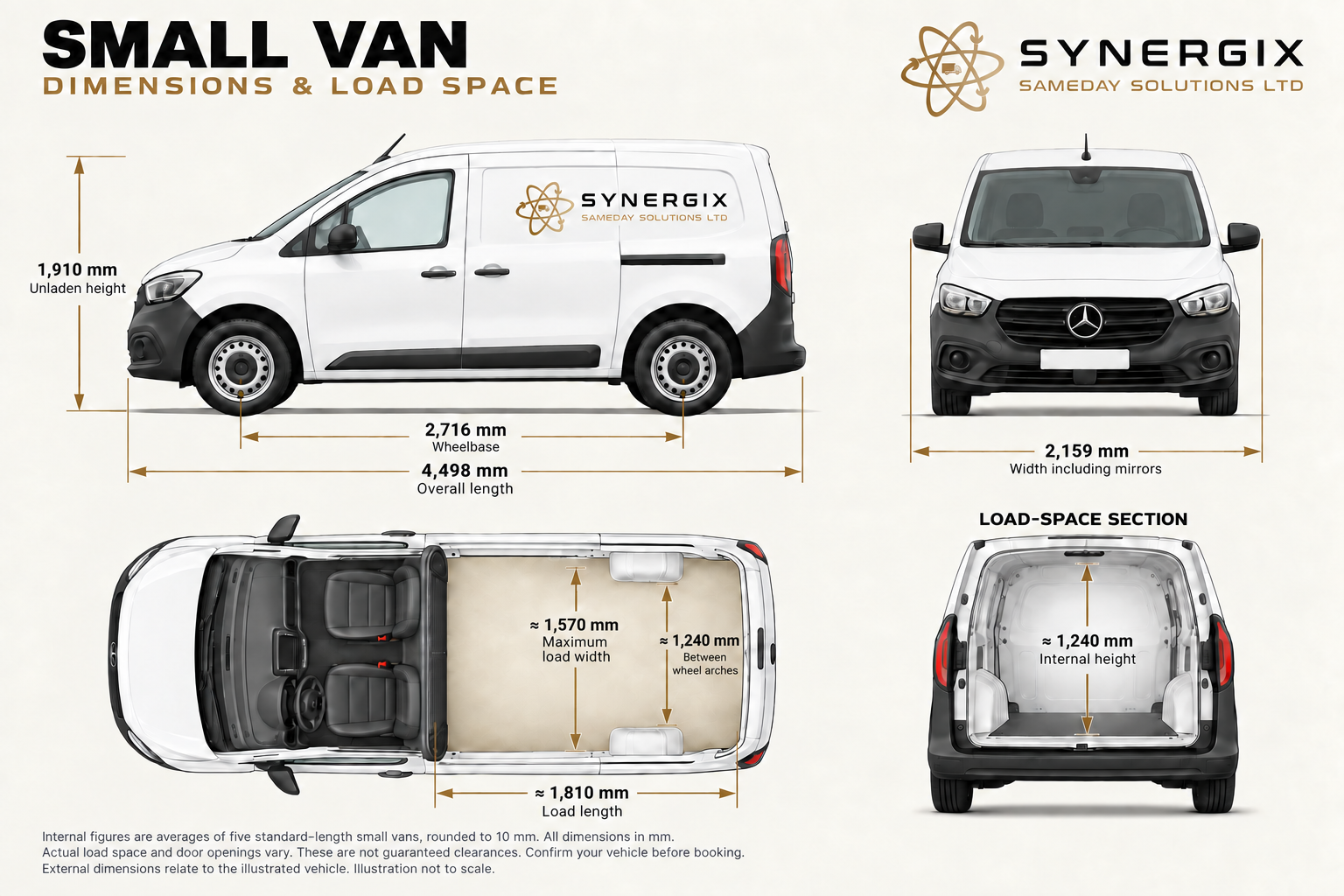
Small van dimensions and load space. Internal figures are rounded averages across five standard-length small-van models. External dimensions relate to the illustrated vehicle. The drawing is not to scale and does not guarantee the clearance of the van supplied.
For your booking, continue to use our 120 × 100 × 100 cm planning space and up to 400 kg total consignment weight. The larger average dimensions in the illustration do not replace those booking figures. Actual doors, lining, equipment and room to secure the load still need checking.
Read the diagram measurements
Approximate average internal dimensions: load length 1,810 mm; maximum load width 1,570 mm; width between wheel arches 1,240 mm; internal height 1,240 mm. These are averages of five standard-length models, rounded to 10 mm, rather than guaranteed minimum clearances.
Illustrated vehicle's external dimensions: overall length 4,498 mm; wheelbase 2,716 mm; unladen height 1,910 mm; width including mirrors 2,159 mm. Check the assigned vehicle for any access restriction.
Can one pallet fit in a small van?
A standard UK pallet has a nominal footprint of 120 × 100 cm. A Euro pallet is 120 × 80 cm. The UK footprint already fills our stated planning floor area, so “one pallet” always needs an actual vehicle check.
Measure the loaded pallet, including the base, wrapping and any overhang. The 100 cm planning height includes the pallet. An EPAL Euro pallet base is 14.4 cm high, leaving a theoretical 85.6 cm for the goods within that height before extra clearance or packaging is allowed.
Pallet weight counts too. If goods weigh 380 kg and the actual pallet and packing add 30 kg, the consignment weighs 410 kg and exceeds our small-van booking limit.
Confirm how the pallet gets into the vehicle and how it comes out. A pump truck moves a pallet on a suitable surface; it does not lift it from road level into a van. A small van's floor height and rear opening may not suit a warehouse loading dock or the available forklift.
A useful measurement is the whole finished load.
Send the longest, widest and highest points of each item, its weight, quantity and whether it can be stacked or turned. Include cases, handles, protrusions, pallets and protective packaging. Photographs help with unusual shapes but do not replace measurements.
A 1.2 m floor does not guarantee a 1.2 m long crate.
Measure the clear opening where the load enters, then the usable length at the height it will occupy. A shaped bulkhead, door trim, handles or a sloping roof can reduce clearance above the floor. A long narrow tube and a rigid rectangular crate of the same length pose different loading problems.
Give the packed dimensions in the required transport orientation. If a case is 110 cm high and must remain upright, it exceeds the 100 cm planning height even if it is only 60 cm long. Turning it onto its side is only an option when the contents, packaging and handling instructions allow it.
Ask about the rear opening, side opening if needed, width between wheel arches, floor height and the space left for securing. A pallet or crate might fit inside but fail to pass through the door. Neither the diagram's average measurements nor a manufacturer's maximum length establish a guaranteed rectangular opening.
Do not plan a load against every boundary with no allowance for hands, straps, protective materials or the movement needed to enter the van. A confirmed vehicle check is more useful than treating centimetres in a generic table as guaranteed clearance.
| Example load | What the calculation says | What still needs checking |
|---|---|---|
| 36 cartons, each 40 × 30 × 25 cm | A theoretical 3 × 3 floor grid and four layers gives 36 cartons. At 8 kg each, the cartons total 288 kg before additional packing. | Safe stacking, actual doors, layout, weight of any pallet and restraint clearance. This is not a guaranteed box count. |
| The same cartons cannot be stacked | The same simple grid provides nine floor positions, rather than 36. | Orientation and the actual floor layout. Volume division cannot replace floor-space planning. |
| Goods 380 kg plus pallet and packing 30 kg | 410 kg gross exceeds the 400 kg small van limit even if the dimensions fit. | A larger category and suitable loading equipment at both ends. |
| Light upright case, 60 × 60 × 110 cm | Its small volume does not cancel the 110 cm height, which exceeds the 100 cm planning height. | A taller appropriate vehicle or a specifically permitted alternative orientation. |
These are hypothetical planning exercises. They explain why piece dimensions, gross weight and stacking rules are needed together. They do not promise that every illustrated arrangement can be loaded safely.
What is a small van courier?
It is a collection and delivery service using a compact commercial van and driver. It suits goods that need their own transport but do not need the space of a larger van or lorry.
The load may be one replacement component, several cartons, a protected piece of equipment or a small pallet. What matters is the complete consignment: size, weight, handling, collection point, delivery point and timing.
A dedicated booking is arranged around your goods and agreed journey. It can avoid the depot sorting and repeated transfers associated with a parcel network. That can be useful when the deadline is tight, the item is awkward or the recipient needs a particular handover.
Why book 400 kg when a van advertises 600 kg?
Our small-van booking limit is up to 400 kg of consignment, including packaging. A manufacturer's 600 kg figure may describe a different specification or weight calculation. Both numbers can be valid without meaning the same thing.
Permitted total weight
Gross vehicle weight, also called maximum authorised mass, is the permitted total for the vehicle and everything on it. It includes people, fuel, equipment and cargo. Each axle also has its own limit.
Brochure payload
The headline allowance depends on what the manufacturer has already included in the vehicle's base weight. Options, body length, engine and conversions can change it. “Up to” usually describes a particular configuration.
Usable cargo allowance
We have to match the real working vehicle to the complete shipment. Our 400 kg category limit provides a consistent starting point. An individual van or specialist conversion may require a lower limit.
Driver, fuel and equipment all have weight
A driver, passenger, fuel, tools, straps, protective blankets, lining, racking and fitted accessories use part of the vehicle's total weight allowance. Refrigeration equipment and insulation add weight as well as taking up space.
However, do not subtract the same weight twice. Some published figures already include fuel and a standard driver allowance. Others exclude the driver or use a different fuel level. Check the definition for the exact vehicle, then account for differences between that reference specification and its working condition.
For example, where a 75 kg driver is already allowed for and the actual driver weighs 95 kg, the additional difference is 20 kg, not another full 95 kg. Where 90% fuel is already included, a full tank does not require subtracting the entire tank again.
The practical calculation
Permitted vehicle weight minus actual ready-to-work vehicle weight = remaining gross cargo allowance.
Ready-to-work weight needs to include the actual people, fuel and equipment. A weighbridge can establish the real weight when there is doubt. Axle distribution, floor loading, tyres, securing and the booking limit must still be checked separately.
Your accepted load cannot exceed the lowest applicable limit. An apparently generous gross allowance does not cancel an overloaded axle, an unsuitable floor or a lack of safe loading access.
| Hypothetical starting point and deductions | Weight |
|---|---|
| Allowance before driver, fuel and added working equipment | 600 kg |
| Driver, not included in this example's starting figure | −90 kg |
| Fuel, not included in this example's starting figure | −40 kg |
| Added equipment and lining, not already included | −50 kg |
| Remaining gross cargo allowance | 420 kg |
| Illustrative operating margin below that allowance | −20 kg |
| Total consignment booking allowance | 400 kg |
These are invented example weights to explain the arithmetic, not Synergix weighbridge readings or a universal 200 kg deduction. A real 600 kg brochure figure may already include some of these items. The 400 kg includes the pallet and all consignment packaging; the driver's weight is not something the customer adds to their shipment declaration.
What about wear and tear?
Load affects the work a vehicle has to do. Acceleration, braking, gradients, road condition and repeated stop-start deliveries all influence operating demands. Good vehicle selection avoids forcing a marginal load into a category simply because it might just fit.
Wear and tear is an operating consideration, not a fixed legal deduction of 200 kg. A correctly specified, maintained van can operate within its rated limits. A worn tyre, brake or suspension defect needs attention; carrying less freight is not a substitute for repairing an unsafe vehicle.
We use the 400 kg category to plan consistently across the vehicles that may be assigned. It also leaves the actual job open to the checks that matter: equipment, weight distribution, securement and handling. We do not claim that every small van is legally limited to 400 kg or that a load above 400 kg is inherently unsafe in every small van.
If your finished consignment exceeds 400 kg, tell us. We will assess a larger vehicle. Do not understate the weight, leave packaging out of the total or assume a short journey makes overloading acceptable.
Why a working van can carry less than the headline
A maximum advertised payload normally relates to a defined specification. A longer body, different engine, automatic gearbox, extra seats, heavier trim or fitted conversion may change its base weight. Battery-electric versions have their own permitted weight and specification, so do not assume their payload equals the diesel or subtract a generic battery weight.
Synergix uses a consistent 400 kg small van booking guide across a category in which the vehicle supplied can vary. That is an operating limit, not a measured average payload of every vehicle or a claim that every small van has exactly 200 kg of driver, fuel and equipment to deduct. The chosen van must still have enough real capacity for the accepted load.
A working margin allows a job to be assessed without treating a brochure maximum as an everyday target. It does not allow an estimate to replace a known weight. An overweight shipment is not accepted merely because the distance is short or the cargo bay looks empty.
Check both gross and axle weights
Suppose a hypothetical van has a permitted gross weight of 2,100 kg and a measured ready-to-work weight of 1,650 kg. The remaining gross allowance is 450 kg, but this page's booking limit remains 400 kg. If extra equipment raises the working weight to 1,750 kg, only 350 kg remains. The lower figure controls acceptance.
These invented weights are not a Synergix specification. The actual vehicle plate, working weight and individual axle limits matter. A concentrated load behind the rear axle may breach an axle limit before the overall limit is reached. Point loads, floor condition and suitable anchorage need their own check.
What can a small van carry?
Small vans are particularly useful when the importance of the delivery is greater than the size of the load.
The examples below are typical applications, subject to the actual goods, packaging, weight and handling requirements. They are not claims about named customer jobs.
Engineering & manufacturing
Replacement bearings, motors, sensors, tools, machined components and maintenance parts. Give the real weight of dense metal items and identify lifting points or cases. A small component can be surprisingly heavy.
Printing & signage
Proofs, printed cartons, brochures, display components and protected signs. Check long dimensions and whether the item must stay flat. Paper can reach the weight limit well before the space is full.
Retail & stock replenishment
Short runs of boxed stock, shop supplies, samples and urgent replacement items. Confirm store booking slots, access and the correct person to receive the goods, especially before or after trading hours.
IT & electronics
Boxed computers, network equipment, replacement hardware and demonstration units. Use protective packaging and declare batteries, value, fragile screens and any requirement to keep equipment upright.
Documents & artwork
Contracts, legal papers, archive boxes, framed work and protected prints. Specify the handover and packaging needed. Dedicated transport does not remove the need for suitable protection.
Fashion & samples
Garment samples, boxed clothing, accessories and presentation materials. Ask about hanging arrangements before booking; a hanging rail and the necessary clear height are not standard in every small van.
Medical & laboratory items
Eligible supplies, compact equipment and declared specimens. Classification, packaging, temperature, time limits and documented handover must be assessed before acceptance. An ordinary panel van is not automatically a clinical transport solution.
Events & production
Small audio-visual cases, production spares, passes, printed materials and urgent consumables. Share the gate, accreditation process, site contact and delivery slot. Larger event equipment needs a different vehicle.
Drinks & trade supplies
Samples, boxed drinks, limited brewery consignments, fixings and compact building supplies. Liquids, glass, kegs and dense materials need careful weight and restraint checks. Empty space does not mean spare payload.
Goods that suit the compact format
A small van works particularly well when the pieces are manageable, the total load is modest and the delivery has a clear purpose. One protected component may be worth a dedicated journey because production depends on it. Several sealed cartons may suit a planned branch transfer when the sender and receiver need a specific handover.
Provide the packed weight of each unusually heavy piece. Castings, paper, bottled drinks, tiles, batteries and tools can reach the weight limit with much of the bay unused. Light bulky goods do the opposite. A quantity that fits by kilograms can still need a larger vehicle because it cannot be stacked.
Goods that need a different assessment
Long boards, tall cabinets, large exhibition cases and wide equipment may exceed the planning space. Unprotected fragile goods, unstable liquids, dangerous goods, live or clinical materials and anything needing controlled conditions require an assessment of the actual service. A compact load is not automatically a standard parcel.
For returns and multi-stop collections, tell us the maximum load carried together on any leg. Empty packaging, reusable containers and rejected goods take space too. If the outward van is full, the driver cannot automatically add returns before the original goods are unloaded.
Why choose a small van?
Less unused vehicle space
For one compact consignment, a small van may be the most economical dedicated option. You are booking the driver and the journey as well as the cargo space, so filling a larger van is not necessary when the goods do not need it.
Practical access
A compact vehicle can be easier to position in restricted yards and urban loading areas. That can simplify some collections and handovers. Parking restrictions, height barriers and pedestrian zones still apply; compact size does not create permission to stop anywhere.
A direct, controlled movement
Dedicated transport can reduce transfers and let the journey follow a specific deadline or delivery instruction. This is useful for urgent parts, protected equipment and consignments that are awkward for automated parcel handling.
A good fit for repeat work
A predictable daily or weekly quantity can make a regular small-van route sensible. Plan for peak volumes, returns and additional collections so a route that fits on a quiet day still works when business is busy.
Move up a size when the job needs it.
Choose a larger vehicle when the load exceeds 400 kg, is too long or tall, needs more floor positions, cannot be stacked safely or needs equipment the small van cannot provide. One appropriately sized vehicle may be better value and use less fuel overall than two small-van journeys. A larger body does not automatically mean a higher payload, especially with a tail lift or specialist conversion.
Disadvantages to recognise early
Payload, height and floor area are limited. A tail lift is not a standard feature, and even a single pallet may require a different loading method or vehicle. Temperature conversions and extra equipment can reduce capacity further. A load-through opening does not provide full-height room for a long crate.
Choosing the smallest vehicle regardless of the task can cause a failed collection or repeated trips. For a larger consignment, one appropriately sized vehicle can be more practical and use less total fuel than two compact vans. Avoiding a failed visit helps the deadline as well as the quotation.
Small van vs SWB van
Choose a small van for a compact consignment. Choose an SWB when the weight, length, height or floor layout needs the extra room.
| Booking consideration | Small van | Short wheelbase van |
|---|---|---|
| Total shipment weight | Up to 400 kg | Up to 800 kg |
| Planning length × width × height | 120 × 100 × 100 cm | 240 × 120 × 120 cm |
| Calculated rectangular planning volume | 1.2 m³ | 3.456 m³, approximately 3.46 m³ |
| Nominal pallets, subject to checks | Up to one | Up to two |
| Typical reason to choose it | Urgent parts, a few cartons, compact equipment and regular small consignments | More floor positions, a longer item or a shipment above 400 kg |
| Loading and body | Enclosed panel van; temperature-controlled option by enquiry. Tail lift not standard. | Enclosed panel van; temperature-controlled option by enquiry. Check the required equipment. |
| Fuel and emissions | May use less energy on a suitable single compact-load journey | May avoid multiple small-van movements for a larger load |
More space, with separate weight checks
The SWB planning rectangle is 2.88 times the small van's volume and its category weight limit is twice as high. Those ratios describe our booking guides, not every manufacturer's cargo bay. Two pallets still need the right loaded dimensions, combined weight and loading arrangement.
For 410 kg of compact goods, the small van limit is already exceeded. For a lighter 150 cm long item, the length alone can justify assessing an SWB. Neither example proves an SWB is suitable until its openings, orientation and loading method are checked.
Compare the whole movement
Two small vans travelling 100 miles each at an assumed 140 g/km produce 45.06 kg of tailpipe CO₂. One SWB travelling 100 miles at an assumed 186 g/km produces 29.93 kg. These are calculated examples, not measured fleet journeys; different loads, engines, positioning and returns can change the outcome.
The useful comparison is one complete transport solution against another. A lower figure per vehicle mile does not guarantee a lower total for the consignment if it creates extra journeys. Read the full SWB guide for its dimensions, 800 kg limit and operating detail.
Small van courier services
A small van can support a one-off deadline or a regular delivery schedule. The service is agreed around the route, goods and handover.
Same-day delivery
For goods that need collecting and moving today. Give the ready time and latest acceptable arrival, not just “ASAP”. Collection availability depends on the postcode, vehicle, access and load. We aim for collection within 60 minutes on many bookings where a suitable vehicle is available; the actual time is confirmed for your job.
Advance bookings
Arrange a known collection date, delivery appointment or production deadline. Booking ahead gives time to check access, documentation and any handling requirement. Changes in quantity, weight or timing should be raised before the vehicle attends.
Planned next-day transport
For a consignment that does not need an immediate same-day movement but still benefits from dedicated handling. Agree collection and delivery windows, any overnight arrangements and recipient availability.
Through-the-night delivery
Useful for overnight movements and early starts. Both sites need an agreed handover, usable access and a reachable contact. Driving time and rest requirements still apply to urgent work.
Regular planned routes
Repeat collections, branch transfers, supplier runs and store replenishment. Share the frequency, likely maximum load, opening hours and how exceptions will be handled. We can discuss return goods and backhaul requirements as part of the route.
Multi-stop, half-day and full-day work
A van and driver can be arranged for an agreed programme of work. Stops, mileage, waiting, working time and loading must be defined. Each additional collection changes the weight and floor space carried on the next leg.
For long-distance and cross-border movements, see our European courier service. A small van can travel further than a local delivery round; suitability depends on the load, route, deadline and driver plan.
Loading, packaging and safe handling
A vehicle being able to carry 400 kg does not mean its driver can lift a 400 kg item. The method of loading and unloading is part of choosing the vehicle.
Prepare the consignment
- Package the goods for road transport and protect corners, surfaces and fragile parts.
- Keep liquids in suitable closed containers and identify any handling or orientation restrictions.
- Secure goods to the pallet where appropriate. Stretch wrap holding cartons together does not automatically secure the pallet to the van.
- Label pieces and provide the correct collection and delivery references.
- Give the actual gross weight. Dense goods and mixed cartons should not be estimated from their appearance.
- Tell us what cannot be stacked, tilted, turned or placed under other items.
Agree the handover
- Confirm who provides the forklift, lifting aid or additional people at each end.
- Check that equipment can reach and safely load the actual van.
- Declare steps, thresholds, gravel, slopes, narrow doors and the distance from parking to the handover point.
- Specify if the delivery is to a loading bay, reception, workshop or an internal room.
- Arrange a separate service for two-person handling or white-glove requirements where needed.
- Keep a reachable site contact available during the agreed window.
Weight distribution
Goods need a stable position that respects axle and floor limits. Concentrating a dense load at the back can overload an axle even if the total vehicle weight appears acceptable. Access to the securing points matters.
Restraint and protection
The load must be prevented from shifting during braking, cornering and normal road movement. Appropriate restraints and anchorage are chosen for the vehicle and goods. Closed doors and a bulkhead are not a complete securing assessment.
Manual handling
There is no universal legal “safe lifting weight” for every person and task. Size, grip, posture, distance and ground conditions matter as well as kilograms. Declare heavy or awkward individual pieces before collection.
Small vans normally have no tail lift. If a pallet cannot be safely loaded and unloaded using the equipment available, request a suitable alternative vehicle and agreed handling arrangements.
Make the loading plan match the delivery plan
Explain whether each end is a level yard, loading bay, shop doorway, house or internal room. A warehouse forklift at collection does not solve unloading at a residential address. The receiving site needs a suitable method too. Dock height, fork reach, pallet entry direction and overhead clearance all affect whether the equipment can work with a compact van.
Keep pallet overhang within the declared envelope and tell us about sharp edges, unstable centres of gravity or fragile surfaces. The packaging has to withstand its own load, the agreed handling and road transport. Wrapping should not conceal an undeclared leak, loose component or damaged battery.
For a multi-stop route, plan the delivery order with the restraint arrangement. Removing one piece can leave another unsupported, and burying the first delivery behind later goods causes unnecessary handling. The load must remain secure on every leg, including returns.
Site staff and the driver need clear responsibility for the handover. Agree who brings equipment and who operates it. Report an unavailable forklift, blocked access or changed individual weight before the vehicle arrives. A ready-time promise needs the goods to be finished, packed and accessible, not still in production.
If choosing a larger vehicle for pallet-truck handling, an individual loaded pallet of 800 kg or more requires an electric pump truck under Synergix's booking policy. This is not a universal legal weight threshold. Lower weights can need powered assistance depending on surface, slope, distance and task. Such a pallet already exceeds this small van category.
Check tail-lift and pallet-truck arrangements when the task needs them. Platform capacity, load centre, all weight on the platform and safe ground conditions still need checking. A powered truck does not establish that any van or tail lift can carry the load.
Small van fuel economy
There is no single MPG figure for every small van. Engine, age, body, load and route all matter. Published test results are useful comparisons, but they are not a promise for your delivery.
For a current reference point, Ford's UK 2027 model-year Transit Courier table, effective 24 August 2026, gives the following combined WLTP figures. These are named model examples, not the fuel economy of an allocated Synergix van.
| Engine | Combined UK MPG | Litres / 100 km | Calculated litres / 100 miles | Test CO₂ |
|---|---|---|---|---|
| 1.5 EcoBlue diesel, 100 PS | 53.30 | 5.30 | 8.53 | 140 g/km |
| 1.0 EcoBoost petrol, 100 PS | 43.46 | 6.50 | 10.46 | 148 g/km |
WLTP is a standard test procedure. Litres per 100 miles are calculated from the published litres per 100 km using 1 mile = 1.609344 km. Values are rounded. Different trims, options and real driving conditions change the result. The fuel figures above do not describe every compact van on the market.
What changes real-world MPG?
Repeated cold starts, urban queues, acceleration, higher road speeds, hills, headwinds, a heavier load and additional equipment can all affect consumption. Tyre condition and pressure, maintenance, roof-mounted equipment, heating and air conditioning also matter.
A steady journey and a stop-start round of the same mileage can use different amounts of fuel. Refrigeration may add both weight and an energy demand. An older van's published figure may also come from a different test method, so comparisons need care.
Synergix has not used measured fleet fuel data to produce the examples on this page. For a particular journey, the actual vehicle and operating data are more useful than a generic internet average.
How much fuel is that over 100 miles?
UK MPG uses an imperial gallon of 4.54609 litres. These scenarios show how consumption changes with achieved economy; they are arithmetic examples rather than an expected fleet range.
| Achieved UK MPG | Litres for 100 miles |
|---|---|
| 35 mpg | 12.99 L |
| 40 mpg | 11.37 L |
| 50 mpg | 9.09 L |
| 60 mpg | 7.58 L |
Calculation: 454.609 ÷ UK MPG. US MPG uses a different gallon and cannot be compared directly. Multiply litres by the relevant price per litre to estimate fuel cost; fuel alone is not the courier price.
Why can a smaller van cost less to run?
A smaller vehicle may need less energy to move a compact load and can be easier to use on some urban routes. The comparison still depends on the engines, load and journey. Avoiding a second trip, an unsuitable vehicle or a failed collection can matter more than the difference between two brochure MPG figures.
Fully loaded economy can be far worse than the test figure
A full consignment adds work during acceleration and on hills. Motorway speed, repeated stops, queues, weather, refrigeration and heating can compound that demand. A fully loaded van can return substantially worse fuel economy than a stated test result. There is no responsible single percentage deduction for every model, load and route.
Use achieved consumption from comparable loaded work where available. An empty steady-road test or trip-computer snapshot cannot establish the cost of a stop-start delivery round. Compare equivalent conditions and keep tyres, servicing and restraint checks within the vehicle's requirements.
Electric small van energy and range
| UK model | Published test energy | Calculated energy per 100 miles | Published combined test range |
|---|---|---|---|
| Ford E-Transit Courier Trend, 46 kWh, 136 PS | 17.7 kWh / 100 km | 28.49 kWh | 201 miles |
From the same Ford UK 2027 model-year table, effective 24 August 2026. Test consumption is not a promise for a loaded courier route or a reading from a particular charger. Electricity is measured in kWh; do not put it on a litres scale or treat battery capacity divided by a quoted range as automatically identical to certified energy consumption.
Cold weather, heating, load, speed and gradients can reduce achievable electric range. Metered charging energy and energy shown in the battery or vehicle display can differ because of charging and other losses. For a real cost, use the electricity bought at the relevant tariff, with any charging-session or parking charges.
Fuel cost is one part of the courier price.
A delivery includes getting a suitable vehicle to collection, carrying the goods and completing the allocated onward or return movement. A loaded leg can use more fuel per mile than the approach. Driver time, waiting, maintenance, insurance, equipment, route charges and administration also contribute to the service price.
As a hypothetical example, allow 20 miles to reach collection, 100 loaded miles and 30 allocated onward miles. Assume 45 UK MPG on the 50 lighter miles and 35 UK MPG on the loaded leg. Total fuel is about 18.04 litres. At an assumed £1.50 per litre, fuel alone is £27.06. Neither the price nor the achieved MPG is a current quote or fleet average.
Counting only 100 miles at the 45 MPG assumption would give about 10.10 litres and £15.15, understating this example's fuel cost. Actual positioning, route and economy must be assessed for the booking. A van that happens to be nearby can change the whole-job comparison.
How much CO₂ does a small van produce per 100 miles?
Using the two manufacturer test examples above, 100 miles works out at approximately 22.53 kg of tailpipe CO₂ for the diesel and 23.82 kg for the petrol. The result for an actual delivery can be different.
From grams per kilometre to kilograms
Manufacturers normally state CO₂ in grams per kilometre. One hundred miles is 160.9344 km, so the conversion is:
kg CO₂ per 100 miles = g CO₂/km × 0.1609344
At 150 g/km, for example, 100 miles equates to 24.14 kg CO₂. This converts a rate into a distance total; it does not measure a real trip.
| Assumed CO₂ rate | Calculated tailpipe CO₂ |
|---|---|
| 130 g/km | 20.92 kg |
| 150 g/km | 24.14 kg |
| 180 g/km | 28.97 kg |
| 200 g/km | 32.19 kg |
Convert a CO₂ figure
Use a rate for the vehicle you want to compare. The starting values below are an example, not a Synergix vehicle rating.
Tailpipe CO₂ only. This tool makes no booking, measures no journey and does not calculate full lifecycle emissions.
Count the mileage that belongs to the job
Collection positioning, the loaded journey, additional stops and any return travel can all matter. A 100-mile customer route does not prove the vehicle drove only 100 miles to complete the work.
For illustration, 20 miles to collection plus 100 loaded miles plus 30 miles of allocated onward or return travel gives 150 vehicle miles. At an assumed 150 g/km, that is 36.21 kg CO₂. Which movements belong to a customer's report must be defined consistently.
CO₂ and CO₂e differ
CO₂ is carbon dioxide. CO₂e expresses several greenhouse gases as a carbon-dioxide equivalent. Do not label a tailpipe CO₂ calculation as a complete CO₂e footprint.
Fuel supply adds another boundary
Extraction, processing and delivery of fuel create emissions outside the exhaust figure. Vehicle and battery production belong to a wider lifecycle assessment. State which stages a comparison includes.
A shipment needs an allocation method
A vehicle total is not automatically the emissions of each parcel. Shared routes require an agreed allocation method. Dedicated work still needs a clear decision about positioning and return mileage.
For business carbon reporting
Use actual activity data where available and the appropriate reporting-year methodology and factors. The UK government's 2026 conversion factors cover fuel, electricity and distance-based reporting. The correct choice depends on the data, vehicle and reporting boundary. This page's simple comparisons are not a verified Synergix emissions report.
Practical ways to avoid unnecessary transport include accurate booking details, suitable vehicle selection, realistic delivery windows, agreed consolidation where it suits the goods, and making sure both sites are ready. A small van is not automatically the lowest-emission option for every consignment.
From fuel or charging records to CO₂e
For reporting, actual litres or purchased electricity can be more informative than a generic test rate. The appropriate factor, reporting year and boundary need to match the activity. The UK government's 2026 factors include 2.58354 kg CO₂e per litre for diesel with the average biofuel blend, and 0.13096 kg CO₂e per kWh for UK electricity generation.
| Assumed activity | Calculation | Covered boundary |
|---|---|---|
| 9 litres of average-biofuel-blend diesel | 9 × 2.58354 = 23.25 kg CO₂e | Direct fuel-combustion factor; not the complete fuel supply chain or vehicle lifecycle |
| 30 kWh of UK electricity | 30 × 0.13096 = 3.93 kg CO₂e | Electricity generation boundary; not all electricity supply, charging or manufacturing emissions |
These are not matched van journeys and must not be presented as a full diesel-versus-electric lifecycle ranking. Transmission and distribution losses, upstream fuel or energy production, the chosen charging-data basis and vehicle manufacture require appropriate additional treatment. Do not count a stage twice or combine tailpipe CO₂ with CO₂e without identifying the difference.
What about producing the van and battery?
Vehicle manufacture, battery manufacture and end-of-life treatment belong in a lifecycle assessment. A battery-electric van can have higher manufacturing emissions than a comparable combustion vehicle, while its operating emissions depend on electricity and use. The result varies with battery size, production location, materials, lifetime mileage and the comparison vehicle.
It is not accurate to attach one universal manufacturing total to “a small electric van”. A model-specific study, with its year and boundaries, is needed before stating a break-even distance or claiming one powertrain is always better. An operational advantage on an urgent route is a different question from a lifecycle carbon advantage.
How to compare a 250,000-mile working life
Use manufacturing emissions plus all operational energy over 250,000 miles, then the defined maintenance, replacement and end-of-life stages. At a constant hypothetical 150 g/km, the exhaust-only total is 60.35 tonnes of CO₂. It excludes fuel production and van manufacture, and is not an actual lifetime estimate for the fleet.
For electric operation, use total purchased kWh and factors appropriate to the places and years of charging. Applying a single 2026 UK grid factor across a long future service life is an assumption, not a forecast. Battery replacement is not automatically zero or automatically required: define the evidence and scenario. Model-specific production data is needed for a meaningful total over that distance.
Diesel, petrol or electric?
The best powertrain depends on the available vehicle and the work. A fuel type alone does not establish cost, payload or environmental performance.
Diesel small vans
They can suit sustained road mileage and longer delivery routes. Actual economy depends on specification and duty cycle. Emissions-zone compliance must be checked against the registration and destination, not assumed because a van is diesel or relatively small.
Petrol small vans
Petrol models provide another option for compact loads. Fuel price, achieved consumption, purchase specification and use pattern all affect running cost. A petrol van is not automatically cheaper per mile or lower in CO₂ than a particular diesel.
Electric small vans
A battery-electric van produces no tailpipe CO₂ while driving. Electricity generation, charging and vehicle manufacture still matter to its wider footprint. Range, weather, load, heating, charging access and time available need to fit the route.
If electric transport is a requirement, state it when enquiring so availability and route suitability can be checked. An electric vehicle is not promised as standard. Battery weight can affect payload, but the exact vehicle specification is decisive.
Why diesel or petrol can be more practical for urgent distance
A suitable combustion van can refuel during a short planned stop and continue without waiting for a battery charge. That can make diesel or petrol a more dependable operational choice when a late-notice job has a tight deadline, a long motorway leg or an uncertain receiving time. Fuel availability, route conditions and the driver plan still need checking.
Diesel can suit sustained high-mileage work, while petrol provides another compact-van option. Neither fuel is universally the cheapest or lowest-carbon answer. Compare achieved economy, local charges, vehicle condition and the complete job. Repeated short cold journeys may also be a poor duty cycle for a particular diesel and its exhaust-treatment system.
Hybrid is a specification, not a category promise
A plug-in hybrid combines a battery that can be charged externally with a combustion engine. Some larger van ranges offer this option; do not assume a compact model does. A mild hybrid cannot be treated as a van with a substantial battery-only delivery range. Check the named powertrain before using its figures.
A PHEV's weighted test consumption depends on a defined charged driving pattern. It does not represent every long motorway trip after the battery is depleted. Fuel and electricity both belong in its running-cost and carbon assessment. Availability of a hybrid small van must be confirmed for the actual booking.
Where electric works well
A battery-electric compact van can suit a known local or regional route when the loaded distance, stops and contingency reserve fit a verified energy allowance. Reliable depot charging and a predictable return can help. It produces no tailpipe CO₂ while driving and can be useful where a site requests an electric vehicle.
Electric range must cover travel to collection, the loaded journey, detours, extra stops and the allocated movement afterwards. The advertised maximum is not a safe distance to plan to zero charge. Check the starting state of charge, cold-weather demand, heating and any refrigeration load before accepting the job.
Charging can put an urgent deadline at risk
For an urgent long-distance job that cannot allow time for charging, an electric van requiring an en-route charge is not a suitable plan. A charger detour, occupied or faulty unit, queue, session interruption or slower charging rate can cause a material delay. Charger power on a sign is not a guarantee that the van receives that power throughout the session.
Ford's February 2026 E-Transit Courier guidance describes 10–80% DC charging in under half an hour with a suitable 100 kW charger and favourable conditions. That is a charging example, before allowing for travel, waiting and connection. It does not guarantee a half-hour stop for a dispatched vehicle or restore 100% charge.
Plan the service around the deadline and energy available.
An electric van can make an urgent journey entirely within a verified energy allowance without stopping to charge. The limitation is whether the actual vehicle, starting charge and whole route support the promise. When charging uncertainty could compromise the deadline, a suitable diesel or petrol vehicle may be the more practical choice.
State any electric-only requirement at enquiry, including the reason, destination restrictions and flexibility on time. Availability, payload and route suitability must be confirmed. No fuel type is promised by default, and no blanket “zero-emissions delivery” claim is made from an exhaust figure alone.
Specialist small van deliveries
Small does not mean simple. Sensitive, valuable or regulated goods need the right vehicle, driver, equipment and instructions.
Refrigerated & temperature controlled
Tell us the product, required temperature range, starting condition, packaging, journey length and whether monitoring or a temperature record is needed. Insulation and cooling equipment reduce room and available payload. Chilled and frozen are different requirements, and an insulated box alone does not establish temperature control.
Suitable small-van options are subject to availability and confirmation. Tell us about loading delays, opening doors at multiple stops and any maximum time outside the required range. See also temperature-controlled transport.
Medical & laboratory transport
Give the exact goods description, packaging, handling instructions, deadline and any temperature or chain-of-custody requirement. Clinical samples and medicines are not interchangeable categories. Acceptance depends on the required controls and the suitability of the complete service.
Do not assume a medical label makes every item suitable for a standard van, or that this page establishes a certification, regulatory approval or validated cold chain.
Dangerous goods & ADR
Declare batteries, aerosols, chemicals, paints, gases and other potentially regulated products. Provide the available classification, UN number, quantity, packaging and relevant documentation. Small quantities may have exemptions, but the conditions need checking.
Damaged batteries, mixed loads and ferry movements can require additional review. Never rely on the van's small size or the 400 kg booking limit as an exemption from dangerous-goods requirements.
High-value & sensitive goods
Declare the description, replacement value, packaging and security requirements before acceptance. Agree any named-recipient handover, identity check, tracking preference, parking instruction or restrictions on information shared.
Goods-in-transit cover, contractual liability and full replacement value are different things. Ask the team to confirm the cover and terms relevant to the actual consignment; do not assume an unlimited amount.
Fragile goods & white-glove handling
Protected artwork, prototypes and delicate equipment may need extra handling time or a different loading method. Agree who packs, lifts and positions each piece. Standard transport does not automatically include unpacking, installation, assembly or packaging removal.
Extra personnel can affect available space and payload. If two-person handling is needed, specify where and at which stage of the job it is required.
Accompanied work & controlled sites
Discreet or accompanied transport needs an agreed arrangement, including who travels and how their presence affects the vehicle. Site requirements should be sent with the enquiry: inductions, PPE, vehicle equipment, booking references and any required accreditation.
A link to a FORS-related service guide is not evidence that every vehicle or driver holds every level. Confirm the specific site requirement before allocation.
Unusual shapes, irregular goods, alcohol consignments and brewery items can be discussed within the same size and weight checks. A specialist service name does not make an unsuitable load fit.
UK and European small van transport
We assess collections and deliveries across the UK and European road routes. Geography, access and the deadline determine what can be arranged.
UK collections and deliveries
Small vans can support work in England, Scotland, Wales and Northern Ireland. Remote addresses and islands may need ferry planning, different collection windows and more lead time. Coverage does not mean a vehicle is waiting in every town.
Give exact postcodes, business names, opening times and site contacts. For a retail unit or industrial estate, include the correct entrance and loading area. The front-door address is not always the delivery entrance.
City centres and restricted sites
Tell us about height barriers, narrow gates, weight restrictions, pedestrian areas, loading bans and timed access. ULEZ, Clean Air Zone and congestion requirements are separate matters from a van's physical size or CO₂ figure. Compliance and charges depend on the actual vehicle and route.
European deliveries
For cross-border goods, tell us the origin, destination, goods description, quantity, value and relevant customs arrangements. Commercial invoices, commodity information, origin details and other documents may be required. Duties, taxes and customs responsibilities should be agreed before collection.
A small van does not remove border formalities. Ferries, tunnel bookings, checks and the nature of the goods can affect the journey. Ask about temporary exports, returns or event equipment early, as their paperwork may differ from a normal sale.
Timings must be workable
Driver hours, breaks and applicable speed limits form part of the route plan. A small van is not automatically a car-derived van and does not automatically use car speed limits. European operator and tachograph requirements depend on permitted vehicle or combination weight and use; the category name alone does not establish an exemption.
Road use, access and cross-border planning
“Small van” is a booking description. It does not determine speed limits, emissions-zone status, licence entitlement or international operating requirements.
Speed limits and vehicle classification
Most goods vans have different national speed limits from cars. In Great Britain, a typical goods van up to 7.5 tonnes has national maxima of 50 mph on a single carriageway, 60 mph on a dual carriageway and 70 mph on a motorway when not towing. Posted lower limits and conditions always take precedence.
Some vehicles qualify as car-derived vans and follow car limits. Compact appearance or a passenger-car badge is not sufficient evidence. Check the actual classification and legal definition; the relevant maximum laden weight and construction matter, rather than today's 400 kg shipment.
Licence and roadworthiness
Current Great Britain Category B guidance generally covers up to 3,500 kg maximum authorised mass for petrol, diesel and hybrid vehicles, and up to 4,250 kg for qualifying electric or hydrogen zero-emission vehicles. The actual entitlement, restrictions, towing rules and any separate Northern Ireland requirements need checking. These are vehicle limits, not cargo allowances.
Servicing, tyres, brakes, lighting, restraint points and a suitable load compartment must support the work. A valid MOT does not replace daily condition checks or prove the van is suitable for a particular consignment. An urgent deadline does not remove driver rest or road-safety requirements.
Emissions zones and restricted sites
Check the actual registration against the destination's current scheme. ULEZ and Clean Air Zone compliance concerns specified air-pollution standards and exemptions, not simply the tailpipe CO₂ figure in a brochure. An older petrol or diesel van must not be assumed compliant, and an electric vehicle is not exempt from every parking, access or road charge.
Give loading-zone permissions, height barriers, timed access, security booking references and the allowed stopping point. Ask for the assigned vehicle's exterior dimensions including mirrors, aerials and fitted equipment. A small body is helpful only when it matches the site's actual restrictions.
International and Northern Ireland movements
Provide the goods description, value, origin, destination, customs references where needed and the exporter/importer responsibilities. Ferry or tunnel reservations, dangerous-goods rules, operating documents and border processing can affect the route and deadline. Cross-border transport is assessed as a complete service, not solely by van size.
Commercial international work can bring operator-licensing and drivers' hours requirements based on the vehicle or combination's permitted weight. Since 1 July 2026, relevant international UK/EU goods movements with vehicles or combinations over 2.5 tonnes can require tachographs and associated hours compliance, subject to scope and exemptions. Some compact vans are below that threshold; trailers or different specifications can change the position. Our 400 kg shipment limit does not determine the rule.
Operating guidance reviewed 2 October 2026. Rules vary by vehicle, journey and jurisdiction. The transport team checks the requirements for the allocated service; customers should give full and accurate route and goods information.
What does a small van courier cost?
The price depends on the whole movement. A small parcel can still require a dedicated driver, a long journey and a specific delivery appointment.
Route & timing
Collection and delivery locations, vehicle positioning, urgency, mileage, day and time, driver availability, additional stops and the required arrival window.
Goods & handling
Total weight, packaged dimensions, loading time, fragile or regulated goods, temperature control, declared value and any extra personnel or equipment.
Access & waiting
Site appointments, loading restrictions, parking arrangements, ferries, tolls, zone charges, customs work and the possibility of waiting or a failed handover.
Compare the complete quotation
Check the agreed service, collection and delivery windows, stops, handling, VAT treatment and any additional charges. Fuel cost or a quoted per-mile rate alone does not describe the full price.
If a detail changes after quoting, tell us before the vehicle is dispatched. Extra weight, different addresses, an inaccessible entrance or goods that are not ready can change the vehicle, timing and cost.
One-off jobs and regular accounts
We can discuss individual movements and repeat work. For regular routes, share the frequency, expected and peak quantities, deadlines, loading arrangements and returns. Account setup, payment arrangements and any credit terms are agreed separately.
Registered customers have a separate customer portal for booking, tracking and proof of delivery according to their account setup. A public enquiry or generated reference is not confirmation that a vehicle is booked.
Compare quotes on the same scope
Ask whether the quotation includes the collection and delivery windows, agreed stops, required handling, route charges and any VAT treatment. Waiting, failed access, changed goods or extra mileage can affect the price under the agreed terms. A low headline mileage rate does not show the complete cost when it excludes necessary work.
The distance printed between two postcodes does not establish the van's total movement. A suitable vehicle may need to travel to the collection site and finish away from its next job. Loading time and a vehicle's position can make two apparently identical deliveries cost differently.
Plan repeat work around peak demand
For a regular route, give the busiest day's load, recurring collection time, stop order and likely returns. Agree how extra cartons, holiday closures and an unavailable recipient will be handled. A small van route should have a practical alternative when the workload exceeds its space or weight guide.
Tell us if several collections can be combined without affecting the goods or deadline. Planned consolidation can reduce repeated travel, but it must suit the handling, service and agreed delivery windows. Do not assume an urgent dedicated booking will be shared or routed through storage without agreement.
How to book a small van
Send the facts
Tell us what is moving, how many pieces there are, their packaged dimensions and total weight. Add both postcodes, ready time, deadline and any special instructions.
Check the vehicle
The team assesses capacity, access, loading and timing, then confirms the quotation and booking arrangements. Raise uncertainty about weight or fit before confirming.
Make the handover clear
Have the goods ready and correctly packed, with loading arrangements and contacts in place. Agree updates, recipient instructions and proof-of-delivery requirements with the team.
Your enquiry checklist
- Goods description and any restricted or dangerous contents.
- Number of pieces or pallets.
- Packaged length, width and height of each different item.
- Total gross weight, including the pallet and packaging.
- Stacking, orientation and fragile-handling restrictions.
- Collection and delivery addresses, postcodes and contacts.
- Collection ready time and delivery deadline.
- Loading equipment, access, parking and handover point.
- Temperature, value, security or documentation requirements.
- Additional stops, returns or repeat-route needs.
When something changes
Tell the team as soon as a load, deadline or access arrangement changes. If collection reveals a heavier consignment or unsafe loading conditions, the movement needs reassessment. We would rather arrange the right solution than send the wrong vehicle down the road.
Live tracking, notifications and proof of delivery are available according to the service and account arrangements. Let us know what your recipient needs and who should receive updates.
Part of a wider logistics requirement?
Small-van transport can support a larger operation. Synergix also handles general and regular haulage, retail distribution, warehousing, two-person delivery, specialist transport and event refrigeration. Explore the full service range if your work needs more than one type of vehicle or delivery.
Van and courier terms explained
| Term | What it means for your job |
|---|---|
| SWB / LWB | Short / long wheelbase. Technical axle spacing and booking category labels need the make, model and actual specification. |
| Payload | A stated carrying allowance on a defined weight basis. Read the manufacturer definition; the available goods weight can differ in operation. |
| Gross consignment weight | All goods plus pallets, crates, cases and packing. This is the shipment figure to report. |
| MAM / GVW / GVM | Maximum authorised mass / gross vehicle weight / gross vehicle mass terminology. The permitted fully loaded vehicle limit must be distinguished from actual measured weight. |
| Kerb mass / MIRO | Kerb mass / mass in running order. Definitions specify which fluids, fuel, people and equipment are included. They are not interchangeable assumptions. |
| Axle weight | The weight supported by an axle. Its limit can be exceeded even when the total vehicle weight is below the gross limit. |
| Bulkhead / load-through | Partition behind the cab / a specific opening for suitable long goods. Neither guarantees full cargo length at every height. |
| Tail lift / pump truck | A platform that raises goods to vehicle floor level / a pallet truck for moving a suitable pallet. One does not automatically replace the other. |
| POD / ePOD | Proof of delivery / electronic proof of delivery. Agree the recipient and required record. |
| WLTP / UK MPG | A standard vehicle test procedure / miles per imperial gallon. Test figures and US MPG should not be mixed without adjustment. |
| BEV / PHEV | Battery-electric vehicle / plug-in hybrid electric vehicle. PHEVs also use fuel, so charged and uncharged operation differ. |
| CO₂ / CO₂e | Carbon dioxide / carbon-dioxide equivalent for greenhouse gases. State whether the figure covers exhaust, energy supply or a wider lifecycle. |
| Cross-docking | Transferring goods between inbound and outbound movements, with limited holding where agreed. It is a separate logistics arrangement. |
Specifications and reporting references
Named vehicle examples were checked against Ford's UK Transit Courier specifications and E-Transit Courier charging guidance and Mercedes-Benz UK electric van figures. Carbon-reporting examples use the UK government's 2026 conversion factors. External references open in a new tab.
These sources describe specified vehicles and reporting methods. They do not establish the van allocated to your booking. Synergix's 400 kg and 120 × 100 × 100 cm figures remain this page's consignment and space guides.
Compare vehicles
Plan the wider service
Transport and logistics services
Storage and warehousing
Two-person delivery
Check the handling
Tail lifts and pallet trucks
European courier enquiries
Request a quotation
Small van courier FAQs
Find the practical detail on weight, fit, handling, costs and the journey.
Size, weight and vehicle choice
What is the maximum weight I can book on a small van?
Use up to 400 kg for the complete consignment, including pallets, cases and packaging. The assigned vehicle may require a lower allowance because of its equipment, actual weight or load distribution. A heavier load needs a different vehicle assessment.
Is 400 kg the legal payload of every small van?
No. It is Synergix's small-van booking limit. Legal capacity comes from the actual vehicle's permitted gross and axle weights and its working weight. Manufacturers offer different specifications, so there is no single legal payload for the entire small-van category.
Does the 400 kg include the driver and fuel?
The 400 kg is the customer's total shipment weight, including its packaging. The operator separately accounts for people, fuel and equipment when assessing the vehicle's available capacity. Customers should report the actual consignment weight rather than adding an assumed driver or fuel deduction.
Can you take 450 kg if the van is rated for 600 kg?
A 450 kg consignment exceeds this booking category. Tell us the correct weight and we will assess the appropriate vehicle, usually a step up in size. A brochure maximum is not permission to exceed the agreed service limit.
Does wear and tear explain the whole difference between 600 kg and 400 kg?
No. Equipment, actual operating weight, the manufacturer's definition and the operator's booking policy can all differ. Wear does not create a universal 200 kg legal deduction, and an unsafe vehicle needs repair rather than simply a lighter load.
What happens if I do not know the weight?
Arrange an accurate weight from the supplier, suitable scales or a weighbridge as appropriate. Tell us if a figure is only an estimate. We cannot confirm a heavy or borderline consignment on an optimistic guess.
How big is the usable load space?
Our planning space is approximately 120 cm long, 100 cm wide and 100 cm high. The calculated rectangular volume is 1.2 m³. Actual doors, wheel arches, lining, securing clearance and vehicle specification must also be checked.
Can a small van carry a standard UK pallet or Euro pallet?
Potentially one, subject to the assigned vehicle. A UK pallet's nominal 120 × 100 cm footprint already fills our planning floor area; a Euro pallet is 120 × 80 cm. Send the loaded dimensions and gross weight, and confirm suitable loading and unloading equipment.
How many boxes fit in a small van?
There is no fixed box count. It depends on each box's dimensions and weight, whether boxes can be safely stacked, and the actual floor layout. Send the quantities for each size. Dividing total van volume by box volume alone can overstate what will fit.
Can goods travel diagonally or with the doors open?
Do not rely on a diagonal fit without an actual loading check, especially for fragile or upright-only items. This service is planned for a properly closed and secured load compartment. Request a different vehicle if the goods need an unsuitable loading position or open-door arrangement.
Is a small van the same as an SWB van?
Not in Synergix's planning categories. Our small van is 120 × 100 × 100 cm and up to 400 kg. Our SWB guide is 240 × 120 × 120 cm and up to 800 kg. Manufacturer wheelbase labels do not always match courier booking categories.
Does small escort van mean an abnormal-load escort service?
No. Older wording used small escort van for this compact courier category. This page concerns carrying goods in a small van with a driver. It is not a pilot or escort vehicle service for an abnormal load.
What small van body types can I enquire about?
The standard format is an enclosed panel van. Refrigerated or temperature-controlled transport can be discussed separately, subject to availability and confirmation of the required conditions. Insulation and equipment alter usable space and weight, so the ordinary 400 kg and 120 × 100 × 100 cm guide must not be assumed to apply to a conversion. Explain the goods and handling first.
Why are the diagram dimensions bigger than the booking figures?
The diagram uses rounded average internal measurements from five standard-length models and external dimensions of the illustrated vehicle. It is explanatory, not a guarantee for the van sent. Our booking guide remains 120 × 100 × 100 cm and up to 400 kg, subject to the actual vehicle. The drawing does not authorise a larger load.
Does a long cargo floor mean a long crate will fit?
Not necessarily. Usable length can change above the floor because of a shaped bulkhead, trim or other fittings. The crate must enter through the available opening in an allowed orientation and leave room for securing. Send its packaged length, width and height, rather than relying on a maximum floor length or a load-through feature.
Can a load-through hatch carry my long item?
Only when the actual feature, dimensions, orientation and restraint method are suitable and specifically agreed. A narrow hatch can accommodate some long slender items without accommodating a full-height crate. This page's ordinary planning space does not promise a hatch or allow goods to compromise the cab, occupants or closing of the doors.
How do I measure a pallet for a quote?
Measure the finished loaded pallet from its furthest points, including the base, wrapping and overhang. Give total gross weight, not just the contents. Include whether it must remain upright, whether anything can sit above it and how each site will load or unload it. Nominal empty-pallet size alone is insufficient for confirmation.
Will a refrigerated small van carry the same amount?
Do not assume it will. Insulation, cooling equipment, partitions and power arrangements add weight and reduce room. Air circulation and the required temperature-control method can also affect packing. The converted vehicle's actual capacity and service must be checked. Give the required temperature range, product starting condition, loaded dimensions and gross weight.
When should I choose an LWB instead?
Assess an LWB when the load needs more length, height, floor positions or weight capacity than the smaller guides allow. Our LWB planning figures are 360 × 120 × 180 cm, up to 1,250 kg and nominally up to three suitable pallets. Actual vehicle fit, equipment, total loaded pallet size and safe handling still control acceptance.
Loading, packing and handling
Does a small van have a tail lift?
A tail lift is not standard on our small-van category. Explain how the goods will be loaded and unloaded. If the available site equipment cannot handle the consignment safely, we need to assess a suitable alternative vehicle.
Can the driver handball all of the load?
Only where the agreed handling is suitable for the pieces, access and task. A 400 kg vehicle allowance does not establish a driver's lifting capacity. Declare individual weights, awkward shapes, stairs, distances and any extra help needed.
Can I use a pump truck to load the van?
A pump truck can move a pallet across a suitable surface, but it cannot bridge the height from the road to a van floor. The actual loading system, vehicle, pallet and site must work together. A forklift or different vehicle may be needed.
Who provides packaging, straps and protective materials?
Have the goods appropriately packaged before collection unless a packing service has been specifically agreed. Tell us about unusual restraint or protection needs so vehicle equipment can be checked. Do not assume ordinary wrapping is adequate for every fragile or heavy load.
Can boxes or pallets be stacked?
Only where the packaging and goods are designed to support the weight and the arrangement can be secured. A stackable label is not permission to place any item on top. State orientation restrictions and the permitted load on each item.
Will the driver deliver upstairs or install my goods?
An internal carry, stairs, room placement, installation or assembly needs to be agreed in advance. These tasks are not automatic inclusions in a small-van courier booking. Extra people or a specialist delivery service may be needed.
Can you collect from a home or a site without a forklift?
Tell us the address, parking, access and individual piece weights. Hand-loaded parcels may be practical where handling is suitable. A heavy pallet requires an agreed mechanical loading and unloading method, which may mean selecting another vehicle.
What if the load is heavier or larger when the driver arrives?
The team must reassess it. The journey may need a larger vehicle, repacking or different equipment, with revised timing or charges. Accurate information before dispatch is the best way to avoid an unsuccessful collection.
Can a warehouse loading dock serve a small van?
It depends on the dock, vehicle floor height, equipment and loading process. A dock set up for larger trucks may not work safely with a compact van. Tell us the available system and confirm compatibility before collection. The receiving site needs a workable unloading plan as well; a successful forklift load at one end does not solve the other end.
Is wrapping enough to secure a pallet in the van?
Wrapping can hold the goods together on a pallet, but that is a separate task from restraining the complete pallet in the vehicle. The pallet and its contents need suitable stability, packaging and restraint. Tell us about fragile goods, point loads, sharp edges or restrictions on strap contact so the allocated vehicle and securing method can be assessed.
What if the load is below 400 kg but very concentrated?
A dense component can impose a high point load on the floor or an unsuitable axle distribution even when total shipment weight is below the booking guide. Provide its dimensions, individual weight, supporting base and lifting points. A crate or pallet does not automatically solve floor loading. The actual vehicle and handling arrangement need assessment.
Can wet, leaking or warm goods be loaded?
Declare the condition and contents before acceptance. Goods must be suitably contained and packaged for the agreed service, without an uncontrolled leak or risk to other items, people or the vehicle. Warm products needing a particular temperature cannot be treated as ready for an ordinary chilled movement without a proper specification. Dangerous contents require separate classification.
What happens if the forklift or receiver is unavailable?
Contact the team promptly so the handover can be reassessed. The driver cannot replace missing mechanical equipment by attempting an unsuitable lift. Waiting, changed arrangements or a failed delivery may affect the route and price under the agreed terms. Make sure both site contacts know the booking window and have the required people and equipment available.
Can I add returns during the collection round?
Include returns and empty packaging in the original plan. The maximum weight and space carried together must fit on every leg, and the load must remain secure as pieces are removed or added. A van full of outward goods cannot automatically take additional returns at the first stop. Tell us the quantities, dimensions and order of stops.
When is an electric pump truck required?
For pallet-truck handling of an individual loaded pallet weighing 800 kg or more, Synergix requires an electric pump truck to be requested. That pallet exceeds this small van category and needs another vehicle assessment. Lower weights can also need powered handling because of gradients, surfaces or distance. This is a company booking rule, not a universal legal threshold.
Fuel, CO₂ and environmental questions
What MPG does a small van do?
It depends on the model and work. The named current Ford examples in this guide show 53.30 UK mpg for the diesel and 43.46 UK mpg for the petrol under combined WLTP testing. They are reference examples, not a promised result or measured Synergix fleet average.
How much CO₂ does a small van emit over 100 miles?
Multiply its CO₂ rate in g/km by 0.1609344. At an assumed 150 g/km the result is 24.14 kg of tailpipe CO₂ over 100 miles. Use the rate and actual distance appropriate to the journey, with a clear boundary for any positioning and return travel.
Does the CO₂ figure include a return journey?
Only if that mileage is included. The 100-mile examples cover 100 vehicle miles. A return trip, vehicle positioning or extra stops can increase the total; shared work needs an agreed allocation method.
Is an electric van completely emissions-free?
It has no tailpipe CO₂ while driving. Electricity supply, charging and vehicle or battery production still have environmental impacts. An electric delivery should not be described as having zero lifecycle emissions on the strength of its exhaust figure.
Is a small van always greener than a larger van?
No. Vehicle efficiency, energy source, mileage, loading and the number of trips all matter. One suitable larger vehicle can be a better choice than making several small-van journeys. Compare the same job and the same emissions boundary.
Does low CO₂ mean the van is ULEZ compliant?
Not by itself. CO₂ is not the same as the pollutants used by emissions-zone standards. Check the actual vehicle registration and the rules for the destination. Small size does not establish exemption from a zone or charge.
Can I use this page's emissions figure in our company report?
Treat it as an explanatory calculation. Formal reporting needs the actual activity data, an appropriate reporting-year method and a stated scope. Ask what data is available for your service rather than treating a brochure example as a verified shipment footprint.
Does carrying a full load reduce MPG?
It can, sometimes substantially compared with a published test result. Added mass, hills, acceleration, stop-start traffic, high speed, weather and equipment all affect energy use. There is no fixed full-load penalty for every compact van. Use achieved consumption from comparable loaded work where available, and do not price the entire job from an optimistic empty-run figure.
Does the fuel cost include getting to collection?
A whole-job assessment can include positioning to collection, the loaded journey and allocated onward or return travel. These legs need not achieve the same economy. A 100-mile customer delivery does not prove only 100 vehicle miles were driven. Driver time, loading, waiting and other operating costs also contribute to the courier price.
How is electric van energy measured?
Use kWh for electricity and identify whether the figure is a test result, vehicle display reading or energy purchased at the charger. Convert kWh per 100 km to per 100 miles by multiplying by 1.609344. Purchased energy may include losses that a battery reading does not. Electricity should not be shown as litres or compared with MPG without a defined method.
Can an electric small van make an urgent long-distance delivery?
It can if the actual starting charge, loaded route, conditions and reserve support the whole job. If an en-route charge is necessary and the deadline cannot allow the charging stop, detour or possible wait, it is not a suitable urgent plan. A suitable diesel or petrol van may be more practical in those circumstances. Advertised maximum range is insufficient confirmation.
Is a public rapid charger's quoted power guaranteed?
No. The vehicle's capability, battery condition and temperature, starting charge, charging curve and the station's available output affect the session. Finding, reaching and connecting to the charger also takes time, and a queue or faulty unit can add delay. Plan the complete stop and contingency rather than treating a peak charger rating as a guaranteed arrival time.
Are plug-in hybrid small vans a standard choice?
No powertrain is promised as standard. Check the exact model and available vehicle rather than assuming all compact vans offer a plug-in hybrid. PHEVs use both fuel and externally charged electricity, and weighted test fuel figures do not describe every depleted-battery motorway journey. A mild hybrid is a different system and must not be treated as a substantial electric-only range.
How much CO2 would 250,000 miles produce?
At a constant illustrative tailpipe rate of 150 g/km, 250,000 miles produces 60.35 tonnes of CO₂. That excludes van manufacture, fuel production, maintenance and end-of-life treatment. An electric comparison needs actual or clearly assumed lifetime electricity and appropriate factors. This arithmetic is not a measured Synergix lifetime footprint or a complete powertrain comparison.
Does electric van manufacture make diesel better overall?
A battery can increase manufacturing emissions, but that alone does not establish which vehicle has the lower full-lifecycle footprint. Battery size, manufacture, energy supply, lifetime use and the comparison van matter. Use a model-specific study with clear boundaries. Diesel or petrol can be operationally preferable for a time-critical charging-sensitive route without proving a universal carbon advantage.
Timing, routes and specialist goods
Can I book a small van for same-day delivery?
Yes, subject to a suitable vehicle, the load, route and timing. Share both the earliest ready time and the latest acceptable arrival. The team confirms what can be arranged for that booking.
Can you always collect within 60 minutes?
No universal collection time is promised. We aim for collection within 60 minutes on many bookings where a suitable vehicle is available. Postcode, traffic, goods, access and specialist requirements affect the actual time, which must be confirmed.
Can a small van travel long distances or overnight?
Yes, when the job and route can be planned appropriately. A small van is not limited to local work. Overnight access, recipient availability, driver hours and rest requirements need to fit the requested deadline.
Can you arrange weekends and out-of-hours work?
We have 24-hour telephone contact and can discuss out-of-hours movements. Vehicle availability and workable access at both addresses still need to be agreed. A reachable recipient is especially important outside normal opening hours.
Can I book repeat routes, several drops or a return collection?
Yes, these can be scoped as part of the service. Provide each stop, time window, quantity and any goods collected on the way. The van must remain within its capacity throughout the route, not just at the first collection.
Can a small van deliver to Europe or Northern Ireland?
These movements can be assessed subject to the route, goods, documents and availability. Customs, ferry or tunnel arrangements and applicable transport rules still matter. Send cross-border details early, especially for controlled goods, temporary exports or returns.
Can I book a refrigerated small van?
Ask with the exact goods, temperature range, duration, packaging and any monitoring requirement. Suitable options are subject to confirmation. Cooling equipment and insulation can reduce both usable space and payload.
Can you carry batteries, medical samples or chemicals?
Declare them before booking. The team must check the classification, quantity, packaging, documents and required vehicle or driver arrangements. A small parcel or short journey does not automatically remove the relevant controls.
Are high-value goods fully insured?
Do not assume full replacement-value cover. Declare the goods and their value, then have the applicable cover, limits, exclusions and contractual terms confirmed before booking. Security and handling arrangements are also agreed for the job.
Is a small van only suitable for local deliveries?
No. A suitable compact consignment can travel on a regional, national or cross-border route. The vehicle, driver plan, load, fuel or charging requirements, access and deadline must support the complete movement. A local job can still be complex, while a long direct route can be straightforward when the goods and both handovers are properly prepared.
Can I book a precise delivery appointment?
Tell us the required slot, booking reference and any tolerance before acceptance. The team assesses collection readiness, route, driver plan and site access, then agrees the service. Travel time, security processing and unloading need allowance. A requested time is not confirmed simply because it has been entered in an enquiry.
What does dedicated transport mean here?
The service is arranged around the agreed goods, movement and handover, rather than treating the item as a routine parcel through a sorting network. It can help with deadlines and handling control. Confirm the actual route, stops and requirements when booking; dedicated transport does not remove packaging, access, legal limits or driving-time considerations.
Can you move stock between shops or branches?
Yes, eligible compact stock can be assessed for one-off transfers or regular routes. Give piece dimensions and total weight, trading hours, delivery appointments and returns. A small van may suit modest consignments, while busy-day volumes or non-stackable displays can require a larger vehicle. Retail handover and restricted-access instructions should be agreed in advance.
Can a small van support events and production?
It can suit protected small equipment, spares, passes, printed materials and eligible consumables. Give the site gate, accreditation, contact, delivery slot and individual case dimensions. Larger equipment, temperature needs or special handling can require another service. Transport acceptance does not automatically include unloading into a venue, installation or event setup.
Can a delivery be combined with warehousing?
Storage, warehousing or a planned transfer arrangement can be discussed as part of a wider logistics requirement. Give the goods, quantity, timing and handling needs so the correct service can be agreed. Do not assume a small-van quote automatically includes receiving, storage, picking, cross-docking or later distribution. Those activities have their own scope.
What if the load is delayed at collection?
Tell the team as soon as the ready time changes. Loading delays can affect the delivery appointment, driver's programme, fuel or charge plan and price under the agreed terms. An urgent deadline needs a realistic ready time and prepared goods. A driver arriving does not guarantee the remaining journey still fits an unchanged delivery promise.
Can an electric-only destination be served?
State the site's actual requirement, access restrictions, deadline and any flexibility before booking. Electric availability and the complete loaded route must be checked, including starting charge and the movement after delivery. A zero-tailpipe vehicle does not automatically have permission to use every road or loading area. The site still needs an agreed handover and usable access.
Quotation and communication
Is a small van always the cheapest courier option?
It may be economical for a compact dedicated movement, but a parcel network can cost less for a routine parcel with flexible timing. Vehicle location, route, urgency and handling affect a dedicated quote. Compare the service needed as well as the price.
What information do you need for a quotation?
Provide the goods description, quantity, packaged dimensions, total gross weight, collection and delivery postcodes, ready time and deadline. Add site access, loading method, value and any temperature, security or dangerous-goods requirements.
Will I receive tracking and proof of delivery?
Tracking, notifications and proof of delivery are available according to the service and account setup. Agree the required updates and recipient details with the team. Registered customers can use their separate customer portal for supported account functions.
Does submitting an enquiry confirm my booking?
No. A quotation request or a generated reference is not confirmation of vehicle allocation. The team must agree the price, service and booking arrangements with you.
Can I change or cancel the job?
Contact the team promptly. Changes can affect vehicle allocation, timing, mileage and charges, particularly after dispatch. Cancellation and waiting arrangements depend on the agreed terms; do not assume a universal free cancellation window.
Do you provide a van without a driver?
This page is for a courier service with a driver and an agreed collection and delivery. It does not offer self-drive van rental or vehicle sales.
Can I obtain an exact quote from weight alone?
No. Weight is essential, but packaged dimensions, piece count, postcodes, timing, loading arrangements and any special requirements also affect suitability and price. A light tall case can require a larger vehicle, while a compact heavy item may need equipment. Send the complete facts rather than asking the team to guess the remaining details.
What can cause the quotation to change?
Changes to goods, weight, dimensions, stops, readiness, access, waiting or handling can change the service needed and the price under the agreed terms. Declare uncertain details before confirmation and report changes promptly. A quotation based on one prepared consignment should not be assumed to cover a different load or an additional return movement.
Does a quote include VAT, waiting and route charges?
Check the written quotation and agreed terms. The relevant tax treatment, route charges, waiting arrangements and additional services need to be clear for that job. This guide does not publish a universal inclusive mileage tariff. Comparing two prices is useful only when they cover the same route, goods, timing and handover scope.
What information helps you plan a regular route?
Provide frequency, ready times, stop sequence, delivery windows, maximum load carried together and expected returns. Include peak volumes, closures, handling and who can approve changes. A route that fits on a quiet day may fail on the busiest one, so agree how a larger vehicle or a revised programme will be considered when needed.
Road use, access and operating requirements
Do small vans have the same speed limits as cars?
Not automatically. Most goods vans have different national limits from cars, while qualifying car-derived vans can follow car limits. The actual classification and legal definition matter. A compact appearance or low shipment weight is insufficient. The driver follows the rules for the allocated vehicle and road, including any lower posted limit and conditions.
Does the 400 kg shipment limit decide licence entitlement?
No. Licence requirements relate to the vehicle's permitted weight and category, plus the driver's actual entitlement and restrictions. The shipment guide is a separate company booking limit. Electric, combustion and towing arrangements can differ. Do not use a payload figure as evidence of a permitted gross vehicle weight or authority to drive.
Can a small van fit under a 2 m barrier?
Only an actual exterior-height check can establish that. The illustrated unladen height is not a guarantee for the allocated vehicle, and aerials, roof fittings or refrigeration equipment may add height. Confirm the site clearance and vehicle specification with enough allowance. Do not substitute the 100 cm internal load-height guide for the vehicle's outside height.
Do international small van journeys need a tachograph?
The answer depends on the actual vehicle or combination's permitted weight, the activity, route and applicable rules or exemptions. Relevant international goods movements over 2.5 tonnes can be within tachograph and drivers' hours scope from 1 July 2026. Some compact vans are below that weight; trailers or another specification can alter the position. A 400 kg shipment does not decide it.
What documents are needed for a European delivery?
The goods, countries, commercial arrangements and vehicle determine the documents. Provide a clear description, value, origin, customs information where applicable and the parties responsible for export and import formalities. Border processing, ferry or tunnel bookings and dangerous-goods requirements may affect timing. The team assesses the complete movement; a small consignment is not automatically exempt from documentation.
Book the right van for the job.
Send your packaged dimensions, total weight, collection and delivery postcodes, deadline and handling requirements. We will assess the right vehicle and give you a clear quotation.
Small Escort Vans
Small Escort Vans are compact commercial vehicles that provide a convenient and cost-effective
solution. These vans are the smallest vehicle and most cost effective on the Synergix fleet.
They are often used for customers in the medical field along with the engineering sectors were time
efficiency and security are critical.
Average Pallet Capacity:
These types of vans usually carry only one pallet due to their small size. Some of the smaller models
cannot carry pallets due to their small size However, they can accommodate small boxes and packages
Average Internal Dimensions:
The average internal dimensions of a small escort van are approximately 1.2m (length) x 1.2m
(width) x 1m (height). It's important to note that the internal dimensions will vary depending on the
manufacturer and model.
Average Payload:
The average payload capacity of a small escort van is approximately 500kg. However, this may vary
based on the weight of the van itself, the type of cargo being carried, and any additional equipment
or accessories installed which can take over 100kg of payload from the van’s capacity.
Average External Dimensions:
The average external dimensions of a small escort van are approximately 3.5m (length) x 1.6m
(width) x 1.8m (height). These dimensions may vary depending on the manufacturer and model.
Small escort vans are commonly used for delivering small items and are ideal for navigating through
tight city streets and narrow alleyways. They are also popular for businesses that require frequent
deliveries to nearby locations.

