
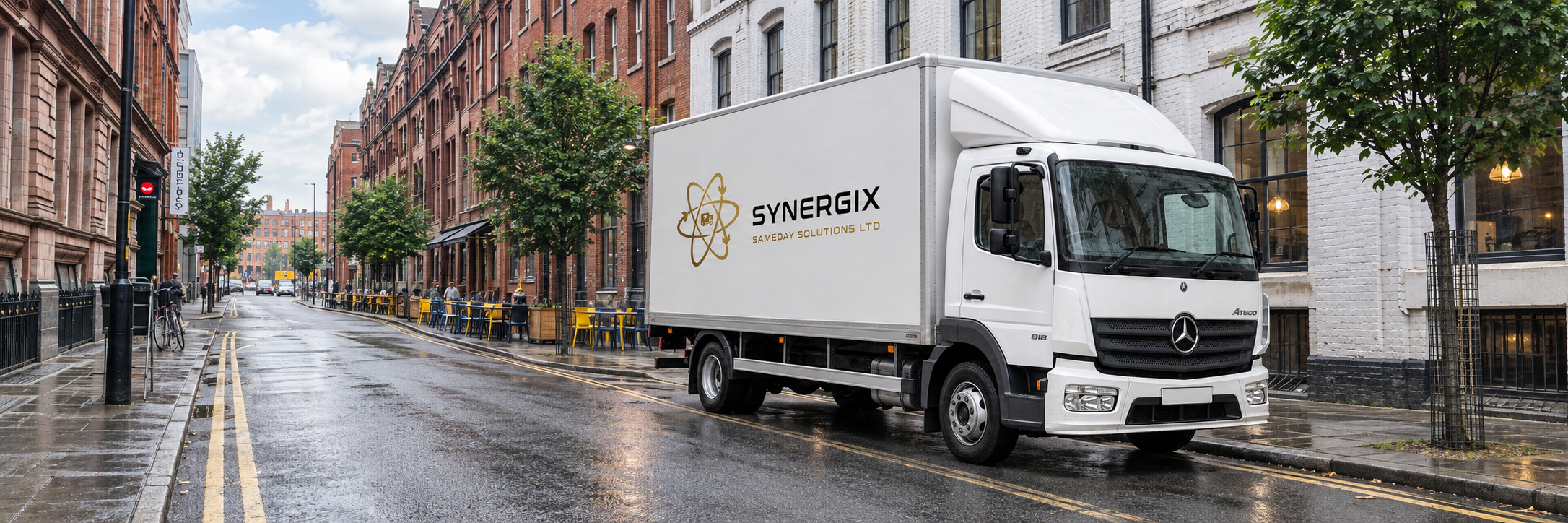
7.5-tonne truck
courier service
Available 7.5-tonne truck body types
Box and curtainside are the usual choices. Refrigerated work and tail-lift handling require the right completed vehicle, rather than a generic truck specification.
Box body: enclosed freight space.
A box truck has a fixed enclosed goods body. It suits packaged retail stock, furniture, appliances, cartons, exhibition equipment and compatible pallets where side forklift access is unnecessary. Rear loading is the usual starting point; side doors are specification-dependent.
Rigid walls give an enclosed working space, but they are not automatically rated to restrain every load. Check the door aperture, floor, securing points, water protection needed by the goods and the unloading method. A box body does not imply a tail lift.
Curtainsider: access along the side.
A curtainside body can allow a forklift to reach suitable goods through the side as well as use the rear. This can help with long pallets, awkward crates, machinery and a delivery sequence that would be difficult in a rear-loading box.
Posts, rails, roof height and the actual clear opening still matter. The curtain is weather protection, not a universal restraint system. Opening a side does not supply a forklift, create a crane or make a long pallet suitable for a rear tail lift.
Refrigerated or temperature-controlled bodies need their own check.
A purpose-built refrigerated truck has its insulation incorporated into the body construction. Its internal load space can be comparable with a similarly sized dry box, so refrigeration does not automatically mean a smaller cargo area. Refrigeration machinery, insulation, the tail lift and associated equipment add vehicle weight and can reduce the freight payload.
The refrigerated retail-delivery trucks we arrange are normally fitted with tail lifts. Confirm the actual platform and handling equipment for your load. Send the packaged dimensions, weight, temperature range, loading temperature and monitoring needs. Internal evaporators, bulkheads and required airflow still need checking, particularly for multi-temperature work. Cooling equipment does not replace correct preconditioning, packaging or door management.
The chassis badge does not define the cargo body.
A truck is often supplied as a chassis cab, then completed by a body builder. Wheelbase, chassis specification, body length, wall thickness, roof height, rear doors, floor and handling equipment can all differ between vehicles carrying the same 7.5-tonne description.
The body is part of the vehicle weight. A long, tall box may offer more volume while leaving less freight capacity. A light body may retain more payload, but only the actual completed vehicle and its permitted weights establish what can be accepted.
Tail lift and pallet truck need the right specification.
Ask for a tail lift when suitable freight must move between the truck floor and ground. Refrigerated retail vehicles normally have one; do not assume the same for every dry box or curtainsider. Specify whether a pallet truck is needed too. The installed platform size, rating, load-centre chart, access and safe operating surface must match the individual load.
Box and curtainside are the main body choices for this guide, with refrigerated work assessed separately. Do not select flatbed, tipper, crane or truck-mounted forklift work simply by ticking 7.5 tonnes. Describe the specialist task so an appropriate vehicle can be assessed.
Comparable space, different access.
Purpose-built refrigeration does not automatically shrink the cargo area. The illustration uses equal floor rectangles to explain access. Cooling, body and lift weight still affect freight capacity.
For the refrigerated retail vehicles we arrange, tail lifts are normal. Check the fitted lift and pallet truck, door aperture, evaporator, airflow and any compartment divider.
7.5-tonne truck dimensions and pallet capacity
Body, opening, freight weight and unloading equipment are separate checks. A pallet-space figure alone cannot decide the booking.
Use these figures to start the enquiry.
Use approximately 6.0 m internal length, 2.2–2.4 m internal width and 2.0–2.445 m internal height as body-dependent category references, with up to 2,400 kg total consignment weight. Our UK pallet guide is up to ten suitable 120 × 100 cm UK pallets. A suitable wider body may accommodate up to fourteen 120 × 80 cm Euro pallets; a narrower body can need a different arrangement and lower count. Count pallets, crates, wrapping and supports in the shipment weight.
These category figures are not guaranteed minimum clearances or the factory dimensions of every truck. Send the finished loaded sizes, including any overhang, and tell us which measurements are critical. A load filling every centimetre can leave no practical loading or restraint room.
Measure the opening as well as the body.
Door frames, shutter housings, roof bows, refrigeration evaporators, posts and fittings can obstruct a load that appears to fit the quoted interior. A 6 m floor does not guarantee that a 6 m rigid crate can be manoeuvred inside.
Internal height is not overall vehicle height. A truck carrying low pallets still has a tall body. For a canopy, bridge, gate or car-park entrance, request the assigned vehicle’s actual outside dimensions and plan the approach and exit.
| Planning item | Initial guide | What still needs checking |
|---|---|---|
| Load length | 600 cm / 6.0 m | Finished item length, loading path and securing clearance |
| Load width | 220–240 cm / 2.2–2.4 m | Actual internal width, posts and clear door aperture |
| Load height | 200–244.5 cm / 2.0–2.445 m | Actual opening and any roof or temperature equipment |
| Illustrative rectangular envelopes | 26.4–35.208 m³ | 6.0 × 2.2 × 2.0 and 6.0 × 2.4 × 2.445. Arithmetic examples, not guaranteed bodies or usable volume |
| Total freight weight | Up to 2,400 kg | Actual working payload, gross weight, individual axles and load position |
| UK pallet guide | Up to 10 suitable UK pallets, 120 × 100 cm | Loaded footprints, orientation, individual weight and handling |
| Euro pallet reference | Up to 14 Euro pallets, 120 × 80 cm, in a suitable wider body | A narrower 2.2 m example has a 12-base mixed layout. Actual space and handling decide the count |
| Body options | Box or curtainside; refrigerated by agreement | Conversion-specific measurements and availability |
| Tail lift | Request and specify | Platform, applicable load chart and every item on the platform |
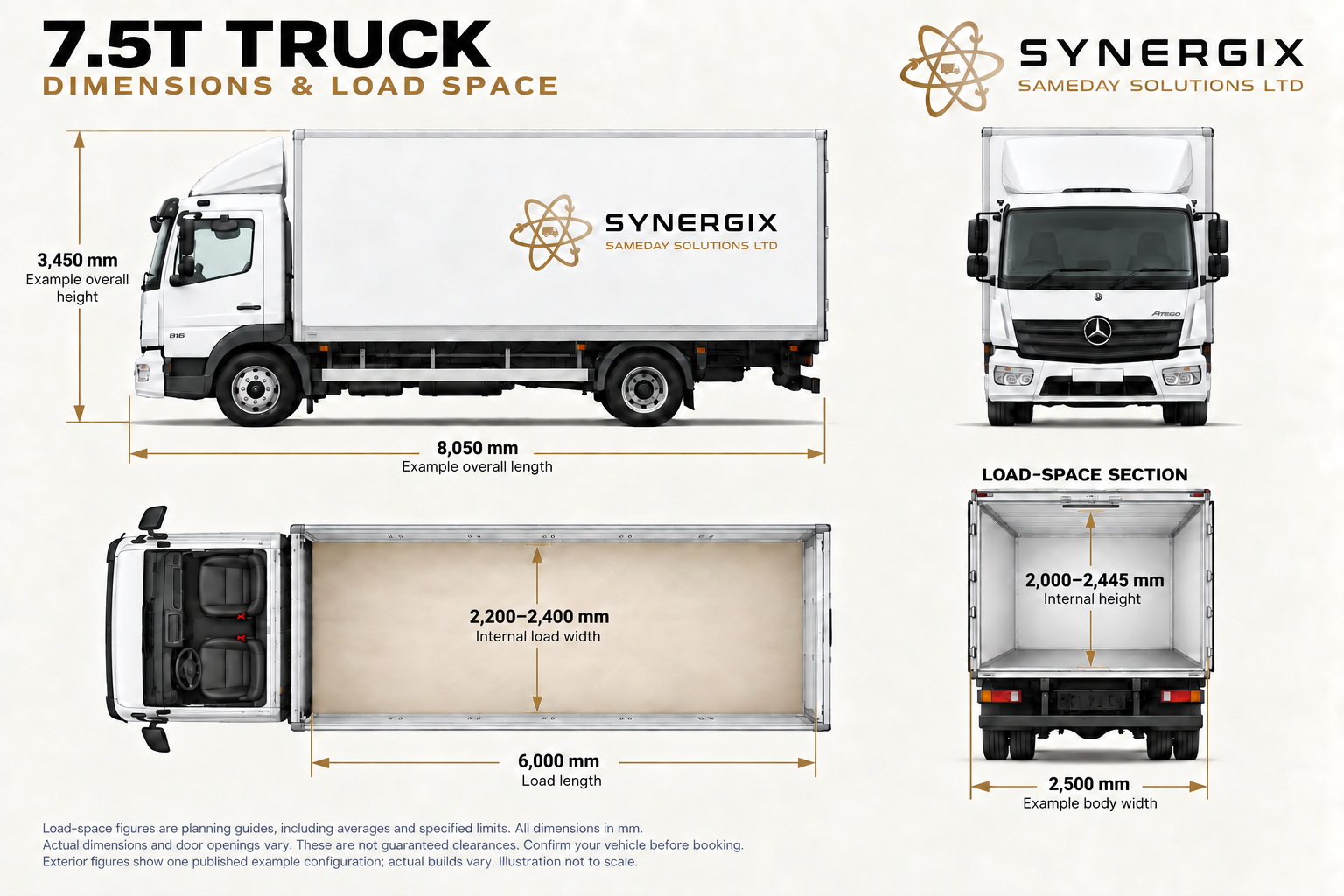
The illustration and booking guide have different purposes.
The diagram shows a 6,000 mm load length, with planning ranges of 2,200–2,400 mm internal width and 2,000–2,445 mm internal height. Its example outside dimensions are 8,050 mm long, 2,500 mm body width and 3,450 mm high. Width including mirrors can be greater.
The drawing repeats the body-dependent ranges above, rather than certifying one fixed interior. Two 1,200 mm pallet bases side by side require 2,400 mm before any loaded overhang or working clearance. That arrangement cannot fit a narrower body within the range. The internal height range does not confirm the clear rear-door height.
Use the category ranges for initial enquiries, then confirm the assigned truck. The upper width and height values do not establish that both occur on the same body. Do not treat a catalogue drawing or a body’s maximum advertised volume as guaranteed usable room. Exterior figures are one example, not a measurement of every 7.5-tonner.
Read the diagram measurements
| Measurement | Shown value |
|---|---|
| Load length | 6,000 mm |
| Internal width range | 2,200–2,400 mm |
| Internal height range | 2,000–2,445 mm |
| Example overall length | 8,050 mm |
| Example body width | 2,500 mm, excluding mirrors |
| Example overall height | 3,450 mm |
Up to ten UK pallets: 120 × 100 cm bases.
A UK base is commonly 120 × 100 cm. One illustrative ten-base layout is two across with 100 cm across the body and five rows with 120 cm along it. That uses 600 × 200 cm, leaving zero nominal length margin against the guide.
Rotating them to 120 cm across and 100 cm along gives 500 × 240 cm for five rows, but uses the entire nominal width. Neither layout proves fit through the opening or room to secure the goods. Actual loaded footprints can exceed the base.
Euro pallets: 120 × 80 cm bases.
In a suitable body with at least 240 cm clear width, two Euro bases at 120 cm across and seven rows at 80 cm along occupy 560 × 240 cm: fourteen floor positions. There is zero nominal width margin. This arrangement will not fit a 220 cm or 239 cm wide interior. Actual loaded sizes and working clearance can reduce the count.
A narrower 600 × 220 cm example can use a mixed layout: five bases at 120 cm along in one 80 cm-wide lane, and seven at 80 cm along in one 120 cm-wide lane. That gives twelve positions within 600 × 200 cm, with zero nominal length margin in the five-base lane. Rotation must still suit the loading equipment. The smaller base does not increase payload.
UK pallet loading: check the orientation.
The first example uses five rows, each with two UK bases. It occupies 600 × 200 cm and uses the full nominal floor length.
The rotated arrangement occupies 500 × 240 cm. It requires at least 240 cm clear width before any loaded overhang or working clearance. Neither arrangement is a guaranteed fit across the stated range.
Euro pallet loading: width changes the count.
The wider example has fourteen bases in seven rows. Its 560 × 240 cm occupied rectangle leaves zero nominal width margin.
The narrower example has twelve bases in two differently oriented lanes, occupying 600 × 200 cm. The five-base lane uses the full nominal length. Fork entry, transfer through the opening and working clearance must suit the actual loading method.
Pallet count is not a weight allowance.
Ten UK pallets averaging 240 kg each use the 2,400 kg freight guide. Ten at 300 kg total 3,000 kg and exceed it. Fourteen Euro pallets at 170 kg total 2,380 kg; at 180 kg they total 2,520 kg and exceed the guide. These are fully loaded pallet weights, including the bases and packaging.
A mathematical three-across, five-row arrangement contains fifteen Euro bases in exactly 600 × 240 cm. It has zero nominal margin in both directions and is not our booking guide. Overhang, handling, restraint, doors and airflow can make fewer positions necessary.
These diagrams explain floor geometry, not loading order or axle-approved positions. Confirm fork entry and pallet-truck compatibility for rotated bases, the loading method at both ends, the actual weight distribution, restraint and the delivery sequence.
A practical step up from a Luton
A 7.5-tonner can carry a heavier or larger business consignment without automatically needing the footprint of a larger rigid.
7.5 tonnes is the vehicle’s gross category.
The label describes the maximum authorised mass category, commonly 7,500 kg, rather than a 7,500 kg cargo allowance. The laden vehicle includes the chassis, cab, body, driver, fuel, equipment and goods. Check its actual plate and specification.
A rigid truck carries its body on the same chassis as the cab. It can offer more floor area, a squarer body and greater working freight capacity than a Luton, while often being easier to accommodate than a larger rigid or articulated vehicle.
Useful for more than an urgent pallet.
Engineering components, packaged machinery, building products, retail replenishment, store fixtures, furniture, appliances, printing and event equipment can all justify this size. A bulky load may need its body volume while remaining well below the freight allowance.
Dedicated collection and delivery can avoid unnecessary transfers for appropriate consignments. Regular haulage, planned distribution and return movements can be just as relevant as an urgent job. The goods and loading plan determine suitability.
Benefits
- More working freight capacity than the 900 kg tail-lift Luton guide.
- Room for a larger palletised or bulky consignment.
- Box protection or suitable forklift side access.
- An agreed tail lift can solve ground-level handling.
- A useful balance between access and capacity.
Limitations
- Bodies, doors and payloads vary substantially.
- Driver availability includes legal time remaining.
- Height, overhang, parking and turning need planning.
- A lift cannot handle every pallet that fits the body.
- More vehicle, fuel and labour commitment than a suitable van.
Match the whole task.
Choose a vehicle that can collect, carry, unload and leave the site. An oversized truck can add cost or lose access; an underspecified one can fail at collection or delivery.
Tell us what would make the job difficult: a heavy individual pallet, no forklift, a narrow street, a long crate, an exact temperature or a fixed appointment.
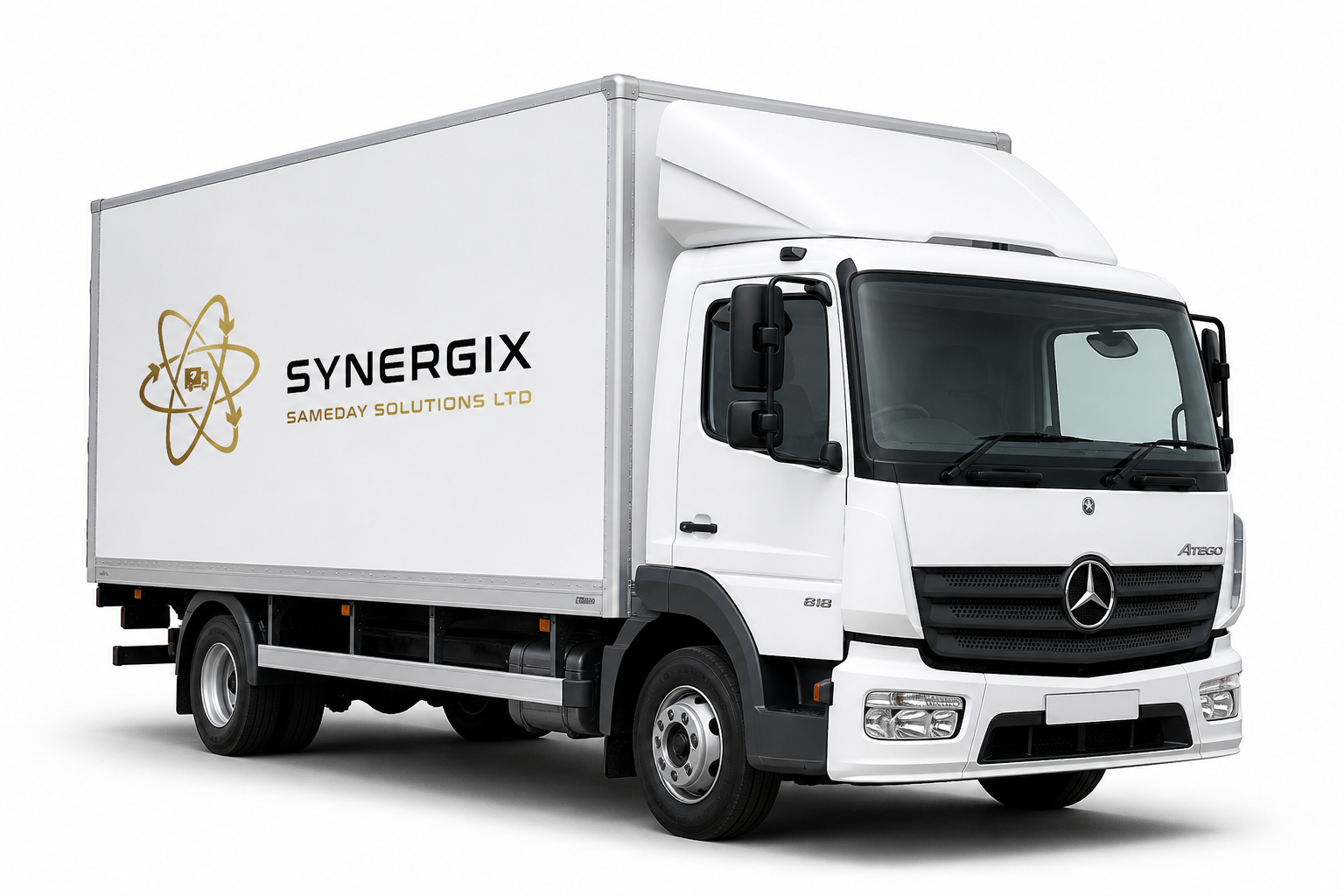
Check a completed truck, not a badge.
Mercedes-Benz Atego, DAF and other chassis families cover different configurations. The name on the cab is not enough to establish the rear opening, floor strength, tail lift, refrigeration specification or payload.
We assess the load and sites before confirming a suitable arrangement. The pictured truck is an illustration rather than a promise of a particular model or registration.
Luton vs 7.5-tonne vs 18-tonne
Compare useful body space, total weight, individual-item handling and access. Gross vehicle weight is not cargo payload.
| Vehicle | Load space L × W × H | Total freight guide | Pallet guide | Useful reason to choose it |
|---|---|---|---|---|
| Standard Luton | 400 × 200 × 200 cm / 16 m³ | Up to 1,100 kg | Up to 6 | Bulky, lighter goods that fit its body |
| Tail-lift Luton | Confirm fitted body | Up to 900 kg | Up to 6, subject to checks | Suitable ground-level unloading for a smaller load |
| 7.5-tonne truck | Approx. 6.0 × 2.2–2.4 × 2.0–2.445 m; body dependent | Up to 2,400 kg | Up to 10 UK; up to 14 Euro in a suitable wider body | More freight, floor area or handling capacity with workable access |
| 18-tonne rigid | 750 × 240 × 250 cm / 45 m³ | Up to 9,000 kg | Up to 14 | Substantially heavier freight or a larger body requirement |
Choose the Luton when it does the job.
One compatible 350 kg pallet needing a suitable tail lift may justify a Luton rather than a truck. Five light pallets can also need its wider body without needing 2.4 tonnes of freight capacity.
Using a larger truck adds no useful payload benefit if the goods already fit, the lift is suitable and the smaller vehicle offers better access. Confirm the real handling plan rather than buying extra space you cannot use.
Choose the 7.5-tonner for the middle ground.
A 1,600 kg shipment exceeds both Luton guides. A suitable 7.5-tonne body may provide the extra capacity needed without the footprint of an 18-tonner. Eight light pallets can justify its floor space even at a much lower total weight.
For a city shop or residential delivery, this size may be the largest practical rigid for the route or premises. That is a site-specific advantage, not a statement that every street accepts a 7.5-tonner.
Choose the 18-tonner when the load demands it.
A 4,000 kg consignment exceeds our 7.5-tonne guide. A suitable 18-tonne vehicle can offer materially more freight capacity. More than ten UK pallets, a Euro layout that cannot fit the selected body, or taller freight may also require a different body.
An 18-tonner is not automatically much wider than a 7.5-tonner, but its length, height, turning requirements and axle/loading arrangements may differ. Check the actual vehicle instead of judging only by gross-weight labels.
The unloading system may decide the size.
One exceptionally heavy pallet can need a different truck or unloading arrangement even when the total shipment is modest. A larger gross rating does not guarantee a higher-rated tail lift.
A 3 m pallet requiring forklift side loading can still fail in a larger rear-loading box. If the obstacle is the handling method, specify the right body and equipment before increasing vehicle size.
Use current company figures: tail-lift Luton 900 kg, 7.5t 2400 kg, 18t 9000 kg. Distinguish gross vehicle weight, freight, pallet positions and site access. Use this page comparison table as source. Do not reuse older artwork with 2500 kg truck payload unchanged.
Private artwork brief. Diagram not yet made.Heavy goods, tighter destinations
The extra payload can make this truck a useful option where a Luton is too limited and a larger rigid is impractical.
More payload for an awkward last mile.
A suitable 7.5-tonne truck can be particularly useful for large, bulky or heavy items going to city-centre premises or residential addresses. Furniture, appliances, packaged equipment and suitable pallets may exceed a tail-lift Luton’s 900 kg guide while still needing a relatively compact rigid.
Some streets, yards and delivery points cannot accommodate a larger truck because of their restrictions or physical layout. The 7.5-tonner can therefore be a practical upper size for a particular destination. Its actual length and height remain important: a long-bodied version can still be difficult.
Residential delivery needs more than a postcode.
Tell us about parked cars, one-way streets, turns, gates, trees, overhead cables, steep drives and the nearest usable unloading position. A postcode can identify the area without identifying the correct entrance or the safe truck route.
Explain whether the goods are to be left at an agreed kerbside point, moved across a threshold or delivered to a room. Tail-lift lowering and pallet-truck movement do not automatically include carrying furniture indoors, stairs, assembly, installation or two-person handling.
A 7.5-tonne restriction is not a blanket access guarantee.
A goods-vehicle restriction showing “over 7.5 tonnes” concerns the maximum gross weight shown, so a truck plated at 7,500 kg is not over that threshold. Other restrictions, supplementary plates, structural limits, timed closures and local traffic orders still need checking. “Except for access” is not permission to ignore every other sign.
Physical access is separate from legal access. A permitted truck may still lack room to turn or deploy its lift. Provide sign photographs and entrance details when restrictions are unclear. Route selection must follow the actual signs and current conditions.
| Issue | Why it matters |
|---|---|
| Street restriction | The wording, sign type, weight threshold, time and any exception decide the route |
| Unloading position | The truck must park safely with room for doors, platform and people |
| Destination surface | A pallet truck needs a suitable firm, smooth route; gravel and slopes can stop the delivery |
| Final delivery point | Kerbside, doorway and room-of-choice are different service requirements |
| Goods size and weight | A bulky item can need mechanical lifting or a separately agreed team |
| Neighbouring activity | School times, pedestrians, bus routes, parked cars and delivery windows affect the plan |
Where a suitable 7.5-tonner still cannot reach the premises, a different delivery plan may be necessary. Splitting goods, using a smaller final vehicle or agreeing another unloading point needs assessment and customer agreement. Do not assume a transhipment or second crew is included.
7.5-tonne truck payload explained
The badge, the catalogue and the loaded working vehicle can describe different things. The actual allocation must support the weight and its distribution.
Why our initial guide is 2.4 tonnes.
We use up to 2,400 kg as a practical category starting point across varying completed bodies. Some vehicles can legally carry more and others less. It is not a promise that every box, curtainsider or refrigerated truck has identical working capacity.
Advertised chassis payload may be the mass available for the body and freight together. After a third party fits the goods body, tail lift and other equipment, the amount available for the consignment is lower. Compare completed working specifications on the same basis.
Every kilogram needs the right place in the calculation.
Bodywork, refrigeration, fuel, driver and any crew, pallet truck, spare equipment and fixed fittings contribute to laden vehicle weight. Pallets, wrapping, crates and supports contribute to the shipment. Do not count the same allowance twice when reading an already completed payload specification.
For a purely hypothetical truck, a measured ready-to-load weight of 5,100 kg would leave 2,400 kg below a 7,500 kg gross limit. At 5,350 kg, only 2,150 kg would remain. Neither calculation establishes axle compliance or makes those example weights typical.
| Limit | What it controls |
|---|---|
| Company freight guide | The initial category allowance, including shipment packaging and pallets |
| Actual gross weight | The completed vehicle’s total legal laden mass |
| Individual axle limits | How the laden weight is distributed between the axles |
| Body floor and point loads | Concentrated pressure from feet, skids, wheels or dense goods |
| Handling equipment | The forklift, tail lift or pallet truck at the relevant position and load centre |
| Goods support and restraint | Whether the item can be held safely without damaging it or the vehicle |
Being below the gross limit does not prove both axles are legal.
Putting a dense item near the tail changes the axle reactions. A load behind the rear axle can add more than its own weight to that axle while reducing the front axle load. Check distribution rather than adding pallet weights alone.
Multiple deliveries can alter the balance as freight is removed. A layout suitable at collection may need reassessment after an earlier drop. Dense machinery, liquids and concentrated supports need a specific loading plan.
A tail lift’s own mass reduces what remains available within the gross weight, but there is no universal 100 kg or 150 kg deduction for every 7.5-tonne installation. Ratings, platform types and structures differ. Refrigeration and heavier bodies can make a further difference. Confirm the working freight allowance for the truck being supplied.
A conservative company guide does not change the legal plate. Keeping load within all applicable limits also supports braking, steering, tyre and suspension performance. Do not treat an assumed safety margin as permission to exceed either a company booking limit or a legal one.
Hypothetical 7500 kg gross minus 5100 kg ready-to-work = 2400 kg goods. At 5350 kg ready-to-work, only 2150 kg remains. Show axle, floor and individual handling checks separately. No fixed universal tail-lift deduction.
Private artwork brief. Diagram not yet made.Tail lifts, pump trucks and long pallets
Tell us how each item will leave the truck. “Tail lift required” starts the assessment; it does not finish it.
Ground-level unloading by agreement.
A compatible tail lift moves suitable freight between truck floor and ground. Its capacity is separate from the 2,400 kg freight guide. Platform depth, width, permissible load centre, support and the transfer route matter as much as the headline rating.
Count everything carried on the platform: the loaded pallet, the pallet truck and any operator permitted by the manufacturer’s instructions. A lift labelled 1,000 kg is not proof that every 1,000 kg pallet can use it at every position.
Check pallet-truck compatibility.
Pallet fork entry, bottom boards, fork length, under-clearance, stability and individual loaded weight all matter. Standard equipment may not engage an unusual stillage, long pallet, damaged base or low-clearance machine.
For an individual loaded pallet weighing 800 kg or more that requires pallet-truck handling, request an electric pump truck. This is Synergix’s booking rule, not a universal legal threshold or a guarantee that the lift and route are suitable. Lower weights can also require powered handling.
Freight capacity is not tail-lift capacity.
In a hypothetical example, a 900 kg pallet plus a 100 kg pallet truck totals 1,000 kg before any permitted operator mass is included. That leaves no capacity margin on a hypothetical 1,000 kg platform. The applicable load chart and working arrangement still need checking.
Ten UK pallet spaces or fourteen Euro positions do not mean pallets of any individual weight can be lowered. Give us both total shipment weight and the heaviest single item. The transport and handling checks must pass separately.
A long pallet can fit the body and still fail at the lift.
A 3 m pallet may sit inside a 6 m body but still be unsuitable for rear tail-lift transfer. It needs supported platform space, correct pallet-truck engagement, an acceptable load centre and a workable route through the opening.
Do not assume turning it diagonally solves the problem. Packaging rigidity, support positions and available manoeuvring room matter. Where rear transfer cannot be done safely, a different agreed method is needed.
Curtainside forklift loading can solve a different problem.
A suitable side-opening body may let a forklift place a long or awkward consignment through the side. The forklift must have capacity at the actual load centre, suitable forks or approved support, and clear working space.
Confirm that suitable unloading equipment also exists at delivery. A forklift at collection does not equip the destination. Side loading is not self-unloading, and a curtainsider does not automatically carry a truck-mounted forklift.
Explain any loading dock or dock leveller too. Truck floor height, lift stowage, dock approach, bridging and site procedures must be compatible. Do not assume a tuckaway, column or cantilever lift suits every dock because the truck has the right gross rating.
Ground-level unloading is normally limited to the agreed safe point. A standard pallet truck cannot cross every driveway or threshold. Grass, gravel, soft ground, broken surfaces, steep slopes and tight passages can require another plan. Keep lift operating space clear of people and traffic.
A 3 m pallet can fit a 6 m body yet fail platform support, load centre and manoeuvring. Show separate safe-method assessment through rear and side. Forklift needed at destination too. 800 kg individual pallet rule requires electric pump truck where pallet-truck handling needed. No prescription of safe lifting from drawn dimensions.
Private artwork brief. Diagram not yet made.Can the truck reach, unload and leave?
Useful payload is only valuable if the route and premises can accept the completed vehicle and its handling method.
Plan the route, the stop and the exit.
Check height barriers, low bridges, gates, tight corners, road restrictions, turning areas and the space needed to open the body or deploy a platform. Body width excluding mirrors is not the whole clearance requirement.
Rear overhang can swing towards nearby vehicles or structures as the front turns. Ramps and abrupt ground transitions can reduce underbody or tail clearance. Parked cars can make an otherwise usable street unsuitable on the day.
Load to unload safely.
The sequence should allow the driver and site team to release restraints and handle the next item without an unstable remaining load. Avoid trapping heavy goods behind fragile consignments or removing support needed by another item.
Share the freight description, centre-of-gravity concerns, packaging and handling instructions before allocation. Pallet wrap holds goods together; it does not automatically secure the pallet to the vehicle. A curtain should not be relied upon as generic load restraint.
Check the shopping-centre loading bay before choosing the truck.
City-centre shops, shopping centres and large buildings can have covered loading bays, height barriers, ramps and strict vehicle limits. Some sites accept suitable 7.5-tonne trucks; others require a Luton or another smaller vehicle. Synergix regularly encounters bookings where the goods fit but the requested vehicle cannot enter the bay.
Ask the receiving site for its maximum permitted vehicle height, length, width and gross weight, the delivery entrance, ramp and turning restrictions, and the permitted unloading method. We must check the completed truck’s actual outside dimensions, including roof equipment, against those limits. “7.5 tonnes allowed” does not guarantee that every 7.5-tonne box will fit.
Send the bay instructions, booking slot, contact and any clearance information before allocation. If a smaller vehicle is required but the load exceeds its safe payload, the plan may need multiple agreed trips or a suitable transfer arrangement. Do not rely on arrival-day improvisation.
Loading arrangements are part of the booking.
A safe area needs firm suitable ground, clear people and vehicle movements, and agreed responsibility for the task. Confirm who supplies and operates the equipment at collection and delivery.
Where reversing is unavoidable, follow the site’s assessed arrangements. A person waving the truck back without an agreed safe system does not remove the risk. Tell us about restricted visibility, public footways and busy shared yards.
Securing methods depend on the goods, vehicle and equipment. Suitable straps, blocking, anti-slip materials, load-rated structures and attachment points may be relevant, but a generic diagram cannot prescribe a complete securing specification. Goods must remain stable when individual restraints are removed at delivery.
Two-person handling, building entry, special packaging, fragile goods and high-value equipment need advance agreement. Insurance and claims arrangements should be discussed where the goods warrant it; do not assume a particular cover limit from the truck category.
Completed truck outside height including roof kit, length, width and mirrors, gross limit, ramp, turn and platform operating space. Compare a height-restricted bay allowing suitable 7.5t with one requiring smaller Luton. No made-up universal bay height. Use vehicle approach and load fit as separate checks.
Private artwork brief. Diagram not yet made.7.5-tonne truck drivers’ hours
The freight can fit and the route can be clear, yet the proposed timetable may still need a different arrangement.
A normal commercial 7.5-tonne goods delivery is generally subject to assimilated drivers’ hours rules and tachograph recording. Specific exemptions exist, but an urgent customer deadline is not itself an exemption. The journey to collection and relevant onward driving are part of the plan, including empty positioning for the job.
| Requirement | General starting rule |
|---|---|
| Daily driving | Up to 9 hours, extendable to 10 hours twice in a week. |
| Weekly driving | Up to 56 hours, with no more than 90 hours across any two consecutive weeks. |
| Driving break | At least 45 minutes by 4 hours 30 minutes of accumulated driving. A split can be at least 15 minutes followed by at least 30 minutes, in that order. |
| Daily rest | Normally at least 11 hours, with permitted reductions to 9 hours no more than three times between weekly rests. Daily rest must fit within the applicable 24-hour period measured from the end of the previous daily or weekly rest. |
| Weekly rest | Normally 45 hours. A permitted reduced weekly rest is at least 24 hours; compensation must be arranged by the end of the third following week. Weekly rest must start by the end of six 24-hour periods after the previous weekly rest. The required pattern and any international exceptions need assessment. |
A driving allowance is not a delivery window.
Four hours of driving does not imply arrival four hours after enquiry. Positioning, checks, loading, traffic, safe stopping, breaks and unloading need room in the schedule. A driver may already have used part of the available allowance before this job.
A delivery slot near the end of the day needs particular care. A long queue can remove the room needed to unload and reach suitable rest accommodation, even if the remaining road mileage appears short.
Stopping is not automatically a break.
Unloading, paperwork, checks and other duties are work. A driver supervising a transfer is not taking a driving break simply because the vehicle is parked.
Where a planned stop can legitimately serve as a break, the driver must be free of the relevant duties. Loading staff, a queue, a ferry or a charging stop should not be counted as a qualifying break without checking the actual arrangement.
Illustration: 4 hours 30 minutes of driving is not a 4-hour-30-minute working day.
A driver might start with checks and loading, then drive for two hours, unload, and drive for another two and a half hours. The intervening handling does not reset accumulated driving. A qualifying driving break is then required before further driving, and working-time breaks may already have become due.
This is an explanation of the separate clocks, not an approved duty roster. Previous work, rest, night work and the full onward plan still need assessment.
Illustrative checks/loading, driving, unloading, further driving, qualifying break and onward duties. 4h30 accumulated driving requires 45min break; work also has 6h/30min/45min conditions. Not an approved schedule; previous activity and rest matter.
Private artwork brief. Diagram not yet made.Check the current GOV.UK drivers’ hours summary and the detailed driving, break and rest guidance. These rules affect the service plan; they cannot be removed by paying for a faster delivery.
Working time and tachographs
Loading time, waiting and customer appointments can change the available day as much as the road distance does.
Working time covers more than driving.
For mobile workers within the road transport working-time rules, work includes driving, checks, loading, unloading, maintenance and relevant administration. Known, qualifying periods of availability are treated separately; an uncertain queue is not automatically availability or rest.
The tachograph records the activity.
It records driving, other work, breaks and rest, periods of availability, speed and distance. Drivers must use the appropriate mode and entries, and operators must monitor compliance. A tachograph is a working record, not simply a speed recorder.
| Measure | General rule |
|---|---|
| Average working week | 48 hours, normally over a 17-week reference period. A qualifying agreement can extend the reference period to 26 weeks. |
| Any single week | Up to 60 hours, provided the required average is respected. |
| Work without a break | No more than 6 consecutive hours. |
| Total working-time breaks | At least 30 minutes for 6 to 9 hours of work, or 45 minutes above 9 hours. Break portions must be at least 15 minutes. |
| Night work | For goods transport, work during 00:00 to 04:00 triggers a general 10-hour working limit in 24 hours. A valid collective or workforce agreement can vary the night-work limit. |
| Opt-out | There is no individual opt-out from the 48-hour average under these road transport rules. |
A qualifying break can satisfy more than one requirement, but the operator must assess the complete duty. A nine-hour driving allowance does not automatically authorise nine hours of driving plus unlimited loading. A reduced rest does not remove working-time controls.
For customers, the practical response is to share the real loading time and access slot. A “quick collection” that regularly takes two hours should be booked on that basis. Keeping the driver informed helps us assess changes before a deadline becomes unworkable.
Day cabs, overnight stops and delivery cost
A truck with enough payload may still need more time, accommodation and a different duty plan than a smaller van.
A day cab is not overnight accommodation.
Many of the 7.5-tonne trucks used for this kind of work have day cabs. Do not assume that the selected truck has a sleeper berth or that a driver can sleep on the seats.
Where an overnight stop is needed, suitable accommodation and parking may need arranging. A hotel can add room cost, travel between the truck and hotel, secure parking and a later start after the required rest. These details affect the quote.
Rest must be possible in the real arrangement.
Daily rest in a vehicle is permitted only under the applicable conditions, including suitable sleeping facilities and a stationary vehicle. Regular weekly rest cannot be taken in the vehicle. A sleeper does not make every overnight arrangement lawful.
Accommodation should let the driver obtain the required uninterrupted rest. A delivery site expecting the driver to move the truck repeatedly overnight can undermine that plan.
A long outward trip also needs an onward plan.
A truck does not disappear at the delivery point. Consider return travel, another collection, parking and rest. Even when an outward delivery can be completed in one day, the whole assignment may require an overnight stop.
Depending on the job, we can assess a different schedule, suitable driver arrangements or another transport plan. A second person in the cab is not automatically a qualified second driver, and two-person unloading is a different service from multi-manning.
Tell us if the load must arrive overnight, the site closes at a fixed time or collection cannot begin until late afternoon. Agree accommodation and overnight expectations before accepting a deadline. Do not build a timetable around maximum reductions and exceptional allowances as if they were routine capacity.
Outward journey, unload, safe parking, appropriate accommodation, required rest and later onward plan. Day cab not a sleeper. Hotel plus parking/transfer costs may apply. Do not imply regular weekly rest in a vehicle.
Private artwork brief. Diagram not yet made.Other operating and international considerations
The booking needs suitable people, equipment, records and route arrangements as well as enough cargo space.
Licence, professional qualification and operator arrangements.
Category C1 covers vehicles over 3.5 tonnes up to 7.5 tonnes, subject to the entitlement and trailer conditions. Category C also covers appropriate larger goods vehicles. A standard car licence is not proof that someone may drive this truck.
Professional Driver CPC requirements apply where relevant, with exemptions assessed separately. Business goods-vehicle operation over 3.5 tonnes normally requires the appropriate operator licensing arrangements. Licence entitlement alone does not establish that the whole commercial operation is compliant.
Road limits and the limiter are different.
For a normal rigid goods vehicle not exceeding 7.5 tonnes, national limits outside built-up areas are generally 50 mph on single carriageways, 60 mph on dual carriageways and 70 mph on motorways. Lower posted limits, road conditions, towing and other applicable restrictions still matter.
Many trucks are speed-limited below the motorway road limit. A limiter setting is not an average journey speed. Urban stops, traffic and breaks make a mileage divided by motorway speed estimate unsuitable for a delivery promise.
European work needs a route-specific check.
Discuss documents, customs arrangements, border and ferry time, local vehicle rules, emissions zones, drivers’ hours regime and suitable rest stops. Applicable assimilated or AETR rules depend on the operation and route.
Current international tachograph requirements must be checked for the actual truck. Do not assume rules stop applying because the vehicle is small compared with an artic. An international quote needs more than the collection and delivery postcodes.
Clean-air access depends on the actual vehicle.
Check the registration, applicable emissions standard and the destination’s current scheme. A diesel truck’s Euro standard relates to regulated pollutants; it does not establish its CO₂ output or guarantee free access everywhere.
London’s ULEZ and LEZ have different vehicle scopes. The Direct Vision Standard scheme covers goods vehicles over 12 tonnes, so it matters differently to an 18-tonne alternative. Being outside one scheme does not remove other road, loading or emissions restrictions.
Vans are also subject to applicable driving, working and fatigue rules. Moving up to a truck makes the tachograph and duty structure especially visible, but smaller vehicles should not be described as unrestricted.
Use the official licence categories, operator guidance and speed-limit table for current detail. Check destination schemes directly when planning the route.
7.5-tonne truck fuel economy and running costs
Include collection positioning, freight, stops, auxiliary equipment and the onward plan when assessing the real job.
There is no single 7.5-tonne MPG figure.
Body height, wheelbase, engine, gearbox, tyres, load and road conditions affect economy. A large box moving through air can use more fuel than a smaller body, while repeated urban acceleration differs from a steady road run.
Use consumption relevant to the actual completed truck and its work. Figures for an unbodied chassis, a different gross rating or an empty test run should not be treated as loaded delivery performance.
A fully loaded truck can use substantially more fuel.
Extra mass increases the work of acceleration and climbing. Stop-start deliveries, hills, headwinds, idling and refrigeration can add energy demand. There is no defensible universal “fully loaded percentage” for every truck.
Loading can change both diesel consumption and electric range. Measured whole-job consumption is more useful than assuming the same economy on the approach, loaded journey and onward run.
| Assumed economy | Diesel used | Illustrative fuel cost | Combustion + fuel-supply emissions |
|---|---|---|---|
| 15 imperial mpg | 30.31 L | £48.49 | 96.82 kg CO₂e |
| 20 imperial mpg | 22.73 L | £36.37 | 72.61 kg CO₂e |
| 25 imperial mpg | 18.18 L | £29.09 | 58.09 kg CO₂e |
| Assumed metered energy | At £0.30/kWh | At £0.70/kWh | UK electricity-supply emissions |
|---|---|---|---|
| 90 kWh | £27.00 | £63.00 | 16.59 kg CO₂e |
| 120 kWh | £36.00 | £84.00 | 22.12 kg CO₂e |
| 150 kWh | £45.00 | £105.00 | 27.65 kg CO₂e |
These scenarios show how energy use and tariff change the calculation. They do not assert that a particular electric truck carries the same load in the same body as a particular diesel. The actual vehicle, route, auxiliary consumption and charging plan must be established before comparison.
Fuel cost is one part of the courier price.
Suppose an illustrative job includes 25 miles to collection, 100 loaded miles and 25 onward miles. The truck travels 150 miles, rather than just the 100 shown between the two customer sites.
If the 50 approach/onward miles achieve an assumed 24 imperial mpg and the 100 loaded miles achieve 18 mpg, fuel use is about 34.73 litres. At the assumed £1.60/L that is £55.56 in diesel alone. The assumptions are examples, not a price or economy promise.
Driver time, loading and waiting, legal breaks, vehicle availability, tyres and maintenance, equipment, parking, accommodation, insurance, tolls and the rest of the operation also affect the quote. A truck’s cost is not its fuel receipt with a small mark-up.
25 miles approach +100 loaded +25 onward =150. Example 50 miles at24mpg and100 at18mpg =34.73 litres, approx£55.56 at£1.60/L. Recheck exact numbers in built page before artwork. Existing LWB whole-journey artwork may be reused if all labels agree; no new upload authorised.
Private artwork brief. Diagram not yet made.Diesel and electric 7.5-tonne trucks
The best operating choice depends on the load, route, timetable, charging access and the completed vehicle.
Diesel: established range and quick refuelling.
Diesel can be practical for urgent long distances, changing routes and work where dependable truck charging is unavailable. Refuelling is usually quicker and more flexible than arranging a substantial battery recharge.
That flexibility has costs: combustion emissions, fuel-supply emissions, noise, maintenance and possible local clean-air requirements. Diesel does not remove the driver’s break and rest obligations.
Electric: useful where the whole route can be supported.
Battery-electric trucks in the 7.49-tonne class exist, including FUSO eCanter configurations. Their battery, wheelbase and body options differ. This is evidence that the vehicle type exists, not a promise of Synergix availability or a payload claim for every conversion.
A suitable electric truck can work well for a predictable delivery round, depot charging and urban stops. It has no exhaust CO₂ while driving, but electricity generation, production of the vehicle and non-exhaust particles remain relevant.
Urgent long-distance work needs a credible charging plan.
Do not substitute an electric truck into a time-critical long-distance job using a headline range alone. Start-of-job charge, loaded route, weather, refrigeration, approach mileage, reserve and the onward requirement all matter.
A required charging stop can add detour, queue, connection and charging time. The charger must be accessible to the complete truck and compatible with it. Advertised peak power is not the average rate through a whole recharge. These uncertainties can make electric unsuitable for a particular urgent job.
Where the journey fits confirmed usable range, or dependable charging fits a realistic timetable, an electric truck may be appropriate. A charging stop only doubles as a driver break when the applicable conditions are actually met.
Petrol and plug-in hybrid choices seen in some van ranges should not be assumed to be equivalent mainstream 7.5-tonne truck options. We do not invent a petrol or hybrid truck comparison with unverified capacity. Alternative fuels also need evidence for the actual engine approval, supply chain and emissions boundary.
Compare a completed diesel and electric vehicle doing equivalent work. Extra battery mass, equipment and body construction can alter available freight capacity; a low energy figure is not useful if the vehicle cannot carry the booking. Manufacturer information is available on the 7.49-tonne eCanter range.
CO₂, fuel supply and truck lifecycle emissions
Explain what a number includes before using it to compare vehicles or claim an environmental benefit.
CO₂ and CO₂e are different measures.
CO₂ measures carbon dioxide. CO₂e expresses several greenhouse gases on a common basis. Tailpipe CO₂, fuel combustion CO₂e, upstream fuel production and whole-vehicle lifecycle emissions should not be labelled as the same result.
Euro VI pollutant compliance is not a CO₂ rating. An electric truck has zero exhaust CO₂, while its electricity and manufacture can still produce greenhouse gases.
The boundary changes the answer.
For diesel, include the litres consumed and the chosen combustion and fuel-supply factors. For electric, use metered energy or adjust battery-delivered energy for charging losses; do not add the same losses twice.
For a refrigerated truck, include the cooling system’s energy on the appropriate basis. Separately fuelled equipment needs its own consumption. Vehicle manufacture, replacement components and end-of-life are additional lifecycle terms.
The energy tables use the UK Government’s 2026 reporting factors: average-blend diesel combustion 2.58354 kg CO₂e/L plus fuel supply 0.61101, totalling 3.19455 kg CO₂e/L. For UK electricity, generation, transmission/distribution and their upstream terms total 0.18436 kg CO₂e/kWh. These are reporting factors, not live measurements of the particular fuel or charger.
Read the official 2026 conversion factors. The examples hold those factors constant; they do not forecast future grid changes or claim a company fleet average.
| Scenario assumption | Lifetime energy | Operating greenhouse gases |
|---|---|---|
| Diesel at 15 imperial mpg | 75,768 litres | 242.05 tonnes CO₂e |
| Diesel at 20 imperial mpg | 56,826 litres | 181.53 tonnes CO₂e |
| Diesel at 25 imperial mpg | 45,461 litres | 145.23 tonnes CO₂e |
| Electric at 90 metered kWh/100 miles | 225,000 kWh | 41.48 tonnes CO₂e |
| Electric at 120 metered kWh/100 miles | 300,000 kWh | 55.31 tonnes CO₂e |
| Electric at 150 metered kWh/100 miles | 375,000 kWh | 69.14 tonnes CO₂e |
Including manufacture needs real production data.
In the middle scenarios, diesel operation at 20 mpg produces about 181.53 tonnes CO₂e over 250,000 miles; electric operation at 120 metered kWh/100 miles produces about 55.31 tonnes CO₂e. That is an operating comparison under stated assumptions, not a complete lifetime verdict.
A fuller diesel total is its vehicle/body manufacturing emissions + 181.53 tonnes + applicable replacements and end-of-life. A fuller electric total is its vehicle/body/battery manufacturing emissions + 55.31 tonnes + applicable replacements and end-of-life. Reliable comparable production data are needed for those missing terms.
We do not assign an invented production footprint or battery-replacement count to a 7.5-tonne truck. Nor does a 250,000-mile illustration promise that a vehicle, battery or body will last that distance without repairs or replacement.
An electric vehicle with greater production emissions can offset that difference through lower operating emissions, depending on the real energy use and electricity supply. The indicative break-even distance is the extra production emissions divided by the operating-emissions saving per mile, with consistent units. If that saving is zero or negative, this simple calculation does not show a break-even.
Choosing a suitable smaller vehicle, avoiding unnecessary journeys and planning loading efficiently can reduce energy demand. Sending two under-capacity vehicles instead of one suitable truck may change the result in the other direction. Compare the complete job, not one unloaded vehicle-mile.
Estimate tailpipe CO₂ from a known rate.
Use a CO₂ rate for the actual vehicle or an explicitly assumed scenario. This calculator does not include upstream fuel, electricity, manufacture or refrigeration.
Tailpipe example over 100 miles.
100 miles equals 160.9344 km. At an assumed 800 g CO₂/km, the result is 128.75 kg CO₂. This cannot be compared directly with an electricity-supply CO₂e figure as if both covered the same emissions.
Report the job boundary.
State whether positioning, loaded mileage, onward travel and auxiliary energy are included. Use the same boundary and compatible measurement basis across the options. A precise-looking decimal does not remove uncertain assumptions.
Tailpipe CO2, fuel/electricity supply CO2e, manufacture, replacements and end-of-life separated. 250000mi examples operating only:20mpg diesel181.53t;120meteredkWh/100mi electric55.31t. Manufacture unknown; no claimed all-in total or automatic winner. Existing LWB boundary artwork may be reused if wording agrees.
Private artwork brief. Diagram not yet made.Courier work, haulage and specialist deliveries
Match the body, equipment and people to the job, from an urgent one-off delivery to a regular distribution plan.
Urgent dedicated transport.
A suitable truck can take an agreed consignment directly between sites without relying on a parcel sorting network. Dedicated allocation can help with bulky freight, urgent stock and production equipment.
The delivery commitment still depends on availability, loading, road access and a lawful duty plan. Call with the deadline when the consignment is time-sensitive; do not assume a particular truck can be at every postcode within a fixed time.
Regular haulage and retail distribution.
Planned supplier collections, replenishment, repeat business deliveries and agreed multi-stop work can suit this vehicle size. Confirm quantities, handling, delivery order, appointment windows and expected site time.
A ten-UK-pallet floor allowance is not proof that the truck can carry ten heavy pallets on a round. The combined weight, remaining stability and access to each drop must be checked.
Warehousing and two-person delivery.
Transport can form part of an agreed warehousing and distribution arrangement. Tell us about storage, stock movements, booking-in and the handling needed before allocation.
For home or business delivery, specify whether you need two-person handling, room-of-choice delivery, stairs, unpacking or assembly. These are additional requirements, not automatic benefits of ordering a 7.5-tonne truck.
Specialist and temperature-sensitive work.
Discuss fragile equipment, controlled temperatures, event schedules and other special requirements before booking. Vehicle availability, clean handling, securing, monitoring and product compatibility must be established.
Event refrigeration is a separate service requirement from merely sending a refrigerated delivery truck. Agree the cooling/storage arrangement, operating hours and power provision needed at the venue.
Explore our transport and logistics services for the wider business. Select the relevant service as well as the vehicle, so responsibility for equipment, access and handling is clear.
Clear details help us give a useful answer.
Tell us what the goods are, how they are packaged, the total weight and heaviest item, and what needs to happen at each site. If the first suggested truck cannot meet all those requirements, we can assess a suitable alternative.
A quote, an enquiry reference or a vehicle guide is not a confirmed booking. Agree the vehicle, service, handling and delivery arrangements before dispatch.
7.5-tonne truck prices and booking checklist
Give us the full job, including the loading bay, so we can assess a realistic price and workable delivery plan.
What changes the price?
Collection positioning and total mileage, vehicle availability, the selected body, individual item weight, handling equipment, staff, waiting, appointments, tolls, clean-air charges and parking all matter.
Overnight work can include accommodation and associated parking or transfers. Driver time includes duties outside the loaded road journey. A last-minute loading-bay change may require a different vehicle and a revised plan.
Choose enough vehicle, without ordering unnecessary size.
A Luton may be preferable for a smaller load and a restrictive bay. A suitable 7.5-tonne truck can add useful freight capacity without the size of an 18-tonne rigid. An 18-tonner can avoid multiple smaller movements where weight, volume and site access justify it.
Price comparisons need the same service assumptions. A cheaper vehicle without the required unloading method or bay clearance is not an equivalent option.
- Collection and delivery addresses, correct entrances, site contacts and requested dates.
- Packaged length, width and height of every differently sized item, including pallet, overhang and wrapping.
- Total consignment weight, individual pallet/item weights and whether the weight has been measured.
- Body requirement: box, curtainside or the agreed temperature-controlled specification.
- Loading and unloading method at both ends: forklift, dock, tail lift, pallet truck and any additional staff.
- Individual pallet at 800 kg or more requiring pallet-truck handling: request an electric pump truck.
- Bay and route limits: maximum vehicle height, length, width and gross weight, turning space, ramps and unloading area.
- Opening hours, booked slots, loading time, expected queues and the firm delivery deadline.
- Goods description, temperature requirements, fragile/high-value details and securing or handling instructions.
- Overnight expectations, European documents and any onward or return collection required.
Get the vehicle and delivery plan checked.
Use the online quote enquiry for the full job details. For an urgent deadline, call 01782 911 181. Written sales enquiries can go to sales@synergixsameday.com.
We will assess the consignment, suitable vehicle and handling before confirming the booking. Where site access or capacity is uncertain, send the receiving site’s instructions and actual measurements.
7.5-tonne truck courier FAQs
Find the practical detail on weight, fit, handling, costs and the journey.
Vehicle size, body and freight
What is a 7.5-tonne truck?
It is a goods vehicle in the 7,500 kg gross weight category. That gross figure includes the vehicle, body, people, fuel, equipment and freight. It does not mean the truck can carry 7,500 kg of goods.
How much can a Synergix 7.5-tonne truck carry?
Our initial planning guide is up to 2,400 kg total consignment weight. The actual completed truck, equipment, ready-to-work weight, axle limits and handling requirements must be checked before booking. A heavier body or conversion may leave less capacity.
Why do other 7.5-tonne trucks advertise different payloads?
Chassis specifications, body construction, length, roof height, tail lifts, refrigeration, fuel and equipment vary. The ready-to-work vehicle weight changes the remaining freight allowance. A different operator’s figure is not proof that our assigned truck can accept that load.
Does the 2,400 kg allowance include the pallets and packaging?
Yes. Give the total loaded consignment weight, including pallets, packaging, wrapping and anything else travelling as freight. Equipment carried on the vehicle also needs accounting for in the ready-to-work capacity check.
What are the planning dimensions?
Use approximately 6.0 m length, 2.2–2.4 m internal width and 2.0–2.445 m internal height as body-dependent category references. These are ranges, not guaranteed door or body clearances. Confirm the actual body for a tight or unusual consignment.
What is the planning load volume?
At the stated range endpoints, 6.0 × 2.2 × 2.0 gives 26.4 cubic metres and 6.0 × 2.4 × 2.445 gives 35.208 cubic metres. These are arithmetic envelopes, not confirmed body specifications or a guarantee of usable cargo volume. Individual dimensions, openings, obstructions and securing room can decide the result.
Why is the dimension diagram different from the booking figures?
The diagram gives planning ranges of 2,200–2,400 mm internal width and 2,000–2,445 mm internal height, with a 6,000 mm load length. The table, overview and drawing now use the same category ranges. Neither the upper values nor the internal height establish usable door clearance. Two 1,200 mm pallet bases side by side require at least 2,400 mm clear width before overhang or operating space, so that layout cannot fit a narrower body.
Does a 6 m body mean a 6 m item will fit?
No. The opening, packaging, load angle, internal obstructions, usable floor and room for handling and restraint need checking. An item filling all the nominal length may have no workable loading clearance.
Are all 7.5-tonne trucks the same outside size?
No. Wheelbase, chassis, body builder, roof, lift, mirrors and refrigeration equipment change the outside dimensions. Send access limits and ask for the completed vehicle’s actual height, length and width. The gross weight category cannot establish whether it fits a loading bay.
Which body types can I request?
Box and curtainside are the usual choices for this guide. Refrigerated or temperature-controlled transport requires an agreed specification. Refrigerated retail trucks normally have tail lifts, while dry box and curtainside equipment must be requested and confirmed. Tell us the goods and loading method.
When is a box truck suitable?
It suits compatible enclosed freight that can be loaded and unloaded using the agreed rear or fitted side access. Packaged retail stock, furniture, appliances, cartons and suitable pallets are examples. Confirm protection, securing, openings and the unloading method.
When is a curtainsider preferable?
It can help when a suitable forklift needs side access to long pallets, awkward goods or a planned unloading sequence. Posts and openings still matter. It does not supply a forklift at delivery or make a long pallet suitable for rear tail-lift unloading.
Can I book a refrigerated 7.5-tonne truck?
Discuss the required temperature, goods, packaged size, total weight, loading temperature and monitoring needs. Purpose-built insulation is incorporated into the body, so internal load space can be comparable with a similarly sized dry box. Added refrigeration, body and lift weight can reduce payload. Refrigerated retail vehicles normally have tail lifts. Confirm the actual body, cooling obstructions, airflow, platform and working freight allowance.
Do these trucks have sleeper cabs?
Some configurations can, but many trucks used for this work have day cabs. Do not assume a suitable sleeper is fitted. An overnight assignment may require accommodation, parking and a duty plan that allows the required rest.
Pallets, tail lifts and handling
How many pallets can a 7.5-tonne truck carry?
Our guide is up to ten suitable UK pallets at 120 × 100 cm. Up to fourteen Euro pallets at 120 × 80 cm may fit a suitable wider body; a narrower 6.0 × 2.2 m example has a twelve-base mixed layout. These counts depend on loaded dimensions, arrangement, weight and the actual body. Overhang, wrapping, handling and securing room must be included.
Can it take ten standard UK pallets?
That may be possible with an appropriate body and load. A nominal five-row layout uses the full 6 m length or full 2.4 m width depending on orientation, leaving no margin on that dimension. Do not treat the drawing as a guaranteed fit.
How many Euro pallets can it carry?
Up to fourteen nominal 120 × 80 cm Euro bases can fit a suitable body in two across and seven rows, occupying 560 × 240 cm. This needs at least 240 cm clear width before working clearance. A narrower 600 × 220 cm example has twelve positions using separate 80 cm and 120 cm-wide lanes. Confirm the actual loaded size, handling and weight.
Why do some layouts show fifteen Euro pallets?
Three across and five rows occupy exactly 600 × 240 cm. This is a zero-margin mathematical arrangement, not our booking guide. It leaves no nominal length or width allowance for loaded overhang, handling or securing. The actual body and job may require fewer positions.
Does a Euro pallet give me more payload?
No. A smaller pallet footprint may change the space arrangement, but the completed vehicle’s freight and axle limits remain. Confirm the count and loaded size separately instead of substituting a new pallet allowance without checks.
Can ten 300 kg pallets travel on this guide?
Ten loaded pallets at 300 kg each total 3,000 kg, above our 2,400 kg planning allowance. A suitable larger vehicle or another agreed transport plan is needed. Free floor space does not permit excess weight.
Can one item use nearly all the payload?
Only if the actual truck, floor, weight distribution, loading and unloading method can accept it. A single concentrated load can present different floor and axle issues from several lighter pallets. Send the item’s size, weight, support positions and centre-of-gravity concerns.
Is a tail lift included with every truck?
Not every dry box or curtainsider does. Refrigerated retail trucks normally have a tail lift. Confirm it explicitly and provide the heaviest item and handling method. The selected lift’s capacity, platform dimensions, load centre and operating conditions must be suitable. The truck’s freight payload is not its tail-lift rating.
How much weight does a tail lift remove from payload?
Its installed mass and associated equipment contribute to vehicle weight. The reduction depends on the actual lift and completed body, so a fixed deduction should not be applied to every truck. Confirm ready-to-work freight capacity for the assigned vehicle.
Does the lift rating include the pallet truck?
The total load on the platform must comply with the applicable lift specification, including handling equipment and any permitted operator mass. A pallet matching the nominal lift rating can exceed it once those other loads are added.
When do I need an electric pump truck?
For an individual loaded pallet at 800 kg or more requiring pallet-truck handling, request an electric pump truck under Synergix’s booking rule. Lighter loads may also require powered handling. This does not guarantee that the lift, ground or delivery route is suitable.
Can a 3 m pallet be unloaded using a rear tail lift?
Do not assume so because it fits inside the truck. Platform support, pallet-truck engagement, load centre, rear opening and manoeuvring space all need assessment. A suitable curtainsider with forklift handling at both ends may be a different solution.
Can the driver take a pallet across gravel or grass?
A standard pallet truck is intended for a suitable firm surface and cannot be assumed to cross soft ground, gravel, steep slopes or rough thresholds. Describe the full path and unloading point so a workable method can be assessed.
Does a tail lift mean the truck can unload itself anywhere?
It provides an agreed way to transfer compatible goods between truck and ground. It still needs suitable freight, equipment, ground and safe operating space. Building entry, stairs and long or unusually heavy items require separate arrangements.
Is a forklift at collection enough?
No. Confirm a compatible unloading method at delivery too. A side-loaded pallet may not be transferable using the destination’s rear lift arrangement. Equipment capacity must be assessed at the actual load centre, not just by a headline forklift rating.
Can I use a loading dock instead of a lift?
Possibly, if the truck floor height, approach, doors, lift stowage and dock or leveller are compatible. Give the site’s vehicle and loading requirements. A dock designed for another body or vehicle size is not automatically suitable.
Can I stack pallets?
Only where the goods, packaging, pallet supports, available height, stability and handling method allow it. Stacking does not increase the payload. Do not load one pallet on another merely to reach an advertised position count.
Are curtains enough to secure the goods?
Do not assume so. The load needs a suitable securing arrangement for the actual body, freight and equipment. Some rated structures have specific conditions, but a standard curtain is not a generic restraint system. Packaging wrap also does not secure the pallet to the truck.
City centres, homes and loading bays
Why use a 7.5-tonne truck for residential deliveries?
A suitable truck can provide more freight capacity than a tail-lift Luton while reaching some streets and premises that cannot accept a larger rigid. It can suit bulky furniture, appliances and compatible heavy goods. Route, parking and unloading access still need checking.
Is it always the biggest HGV allowed in a city centre?
No. It can be a practical upper size at particular streets or premises, but there is no universal city-centre limit. The actual truck, traffic restrictions, loading rules and site acceptance decide the result.
Will it fit a shopping-centre loading bay?
Only after checking. Covered bays, height barriers, ramps and turning areas vary, and some sites require a Luton or smaller vehicle. Ask the receiving site for its maximum vehicle dimensions, gross limit, correct entrance and handling instructions before allocation.
Why can a booked truck fit the goods but fail at the building?
Freight size and outside vehicle size are separate checks. A taller body or roof-mounted equipment can exceed the loading-bay height even when the consignment is small. Mirrors, ramps, turns, tail overhang and lift operating space can cause other problems.
Does a bay allowing 7.5 tonnes accept every 7.5-tonne truck?
No. A gross-weight allowance does not establish height, length or width clearance. Confirm all the completed vehicle dimensions and the site’s operating rules. A particular 7.5-tonne box may be too tall or long even when its gross category is accepted.
What if the site only permits a Luton?
Tell us before booking. Check that the consignment fits the chosen Luton and its actual capacity; our tail-lift Luton planning allowance is up to 900 kg. A heavier load may require separate trips or another agreed arrangement, rather than overloading a smaller vehicle.
Does travelling empty remove a weight restriction?
Not necessarily. Restrictions can be defined by permitted gross weight, actual weight, vehicle type or the relevant order and signs. Do not assume an empty truck is exempt. The route must be assessed against the restriction that actually applies.
What information do you need for restricted access?
Send the correct delivery entrance, maximum permitted height, length, width and gross weight, bay instructions, ramp and turning restrictions, booked slot, site contact and unloading method. Photos or site documents can help, but actual clearance must be confirmed.
Is room-of-choice home delivery included?
No. State whether you need building entry, stairs, two-person handling, unpacking or assembly. A standard tail-lift delivery should not be understood as taking every item into a home. Service and access must be agreed.
Should I choose a Luton, 7.5-tonne or 18-tonne truck?
Choose the smallest suitable completed vehicle that can carry and handle the freight and reach the site. A Luton can suit restricted access; a 7.5-tonne truck adds useful capacity; an 18-tonner can suit heavier or larger loads where site access permits.
Driver time, waiting and overnight work
Does a commercial 7.5-tonne delivery normally need a tachograph?
Yes, normal in-scope commercial goods work generally does. Specific exemptions must be assessed against the operation. A time-sensitive booking is not itself an exemption, and empty positioning for an in-scope job is not automatically outside the rules.
How many hours can the driver drive?
The general daily driving limit is nine hours, extendable to ten twice a week, with separate weekly and two-week limits. Previous activity, rest and breaks also matter. The full allowance cannot be assumed available when a new enquiry arrives.
When is a driving break needed?
A qualifying break totalling at least 45 minutes is needed by four hours 30 minutes of accumulated driving, unless an appropriate rest begins. The permitted split is at least 15 minutes followed by at least 30 minutes. Loading and unloading do not reset that clock.
Does loading count towards working time?
Relevant loading, unloading, checks, administration and maintenance count as work for in-scope mobile workers. Driving limits and working-time limits operate together. A long loading delay can therefore affect the schedule even though the truck has not covered much distance.
Can a site queue count as rest?
Not automatically. The duties and whether a waiting period qualifies as availability, a break or rest must be assessed. A driver required to supervise goods or move the truck repeatedly is not simply free to rest.
Can the driver unload while taking a break?
Unloading is work. A parked vehicle does not turn a handling task into a qualifying break. A real break needs the applicable freedom from duties, and working-time and driving-break requirements must both be considered.
Why does a delay at collection change the delivery plan?
It can use working time, move arrival beyond a booked slot and reduce the room for onward travel and rest. Tell us when the load will actually be ready and update the expected delay. The solution may need a revised schedule or transport arrangement.
Can you run a truck overnight?
Discuss the route and deadline. A suitable vehicle, available qualified driver and lawful duty plan are needed. Night-work rules, previous activity, site hours, accommodation and onward travel can affect feasibility and price.
Why might a hotel be included in the quote?
The truck may have a day cab and the assignment may require an overnight rest away from base. Suitable accommodation, parking and transfers can add cost. A driver should not be expected to sleep on seats or keep moving the truck during required rest.
Does a sleeper cab remove the hotel requirement?
It can change some daily-rest arrangements, subject to suitable facilities and the applicable rules. It does not permit regular weekly rest in the vehicle or remove accommodation needs in every case. Confirm the actual truck and duty plan.
Does two-person delivery mean two drivers?
No. A second person may be supplied for handling rather than qualified multi-manning. Both are distinct requirements. Additional personnel and driver arrangements must be agreed for the actual job.
Are vans free of driving and working rules?
No. Applicable domestic or international rules and fatigue responsibilities still matter. A truck guide makes the tachograph and driving/rest structure especially prominent, but smaller vehicles should not be presented as unrestricted.
Fuel, electric trucks and emissions
What fuel economy does a 7.5-tonne truck achieve?
It depends on the completed body, drivetrain, load, route and conditions. This page uses clearly labelled arithmetic scenarios, not a claimed Synergix average. Use relevant measured consumption or verified model information for the actual work.
Will a fully loaded truck use more fuel?
It can use substantially more, particularly in stop-start traffic and on hills. Body aerodynamics, speed, weather, tyres, idling and refrigeration also matter. There is no single percentage penalty that can safely be applied to every completed truck.
Why include miles before collection?
The truck needs to reach the goods. Relevant positioning and onward travel use energy and driver time even when the customer’s site-to-site distance is shorter. A useful whole-job assessment includes that plan rather than counting only loaded miles.
Do electric trucks in this size exist?
Yes, battery-electric configurations in the 7.49-tonne class exist. Body, battery and wheelbase choices affect capacity and range. Their existence does not guarantee Synergix availability or make every electric conversion equivalent to a diesel truck.
Are electric trucks suitable for urgent long distances?
Only where the load, usable range and charging arrangements fit a credible timetable. Required charging can add detours, queues and uncertain duration, making some urgent jobs unsuitable. A headline range or peak charging rate is not enough to confirm the job.
Can charging happen during the driver’s break?
Sometimes, if the stop and duties meet the relevant break conditions. Connecting, moving, monitoring or dealing with a charger may involve work. Do not automatically subtract the whole charging time from the delivery schedule as if it were already a required rest.
Is diesel always better than electric for courier work?
No single answer covers every job. Diesel can offer useful refuelling and route flexibility for urgent long distances. Electric can suit predictable routes with suitable capacity and dependable charging. Compare the completed vehicles doing the required work.
Why is there no equivalent petrol-truck scenario?
Petrol and plug-in hybrid choices in some van ranges do not establish comparable mainstream 7.5-tonne truck options. We do not assign an invented petrol truck payload or consumption figure. A meaningful comparison needs real equivalent specifications.
How much CO₂ does the truck produce per 100 miles?
A result needs an actual emissions rate or fuel consumption and a stated boundary. At an illustrative 800 g tailpipe CO₂/km, 100 miles produces 128.75 kg CO₂. That assumption is not a fleet average or a fuel-supply CO₂e result.
Does zero tailpipe CO₂ mean zero lifecycle emissions?
No. Electricity supply, vehicle and battery production, replacement components and end-of-life can produce emissions. Non-exhaust particles also remain. Keep exhaust CO₂, operating CO₂e and full lifecycle emissions separate.
Can you calculate all emissions over 250,000 miles?
We can show operating scenarios using stated consumption and reporting factors. A complete lifecycle total also needs comparable manufacture, replacements and end-of-life data. This page leaves those unknown terms explicit instead of inventing production footprints or battery replacement counts.
Does refrigeration change the emissions result?
Yes. Include the cooling energy and any separately fuelled equipment on the appropriate basis. Insulation and machinery can also affect freight capacity and vehicle energy use. A standard dry-body scenario should not be applied unchanged to every refrigerated job.
Enquiries, prices and service details
Can I book urgent or same-day 7.5-tonne transport?
Call with the load, route, handling and deadline. Availability and a realistic lawful delivery plan must be checked. An urgent enquiry is not a guaranteed dispatch time, and a quote is not a confirmed booking.
Can I arrange regular haulage or retail deliveries?
Discuss quantities, repeat dates, delivery order, booked slots and handling at every site. The vehicle can form part of an agreed distribution plan, with the body and freight limits checked against the actual work.
What should I send for a quote?
Send packaged dimensions, total and individual weights, goods description, addresses, dates, deadline, body requirements, loading/unloading methods and site restrictions. Include loading-bay instructions, waiting expectations and any overnight or European requirements.
Can I get a fixed price from mileage alone?
Mileage is only one input. Vehicle availability, body, freight and handling, personnel, waiting, legal duty time, charges and possible accommodation affect cost. Two quotes are only comparable when the service and access assumptions agree.
Can warehousing or specialist handling be included?
Discuss the full requirement before booking, including storage, stock movements, two-person handling, controlled temperature or fragile equipment. These are service arrangements, not automatic features of a truck category.
Where should I enquire?
Use the online quote enquiry or call 01782 911 181 for a time-sensitive job. Written sales enquiries can go to sales@synergixsameday.com. The vehicle, handling and delivery plan need confirmation before dispatch.
Truck terms explained
Plain definitions for the capacity, handling and operating language used in this guide.
- 7.5 tonnes / 7,500 kg
- The vehicle’s gross weight category, not the weight of goods it can carry.
- Payload
- Freight capacity available in the actual ready-to-work vehicle, subject to all applicable limits.
- Chassis cab
- The base truck before the completed goods body and associated equipment are fitted.
- Body builder
- The business that constructs or fits the cargo body; specification can vary independently of the chassis brand.
- Clear opening
- The usable loading aperture after frames, posts, mechanisms and equipment are accounted for.
- Load centre
- The position of a load’s centre of gravity relative to the handling equipment’s reference point. Rated lifting capacity can depend on it.
- Tail lift
- A powered goods platform attached to the vehicle. Its rating and geometry are separate from truck payload.
- Day cab
- A cab without an assumed suitable sleeper berth. Overnight rest may require other accommodation.
- Tachograph
- The device recording vehicle movement and the driver’s activity for compliance purposes.
- Period of availability
- A qualifying known period treated separately from working time. It is not automatically a break or rest.
- CO₂e
- Carbon dioxide equivalent: a common greenhouse-gas measure that can include gases other than CO₂.
- Well-to-tank
- Emissions associated with supplying the fuel or energy before its use in the vehicle.