
Synergix / Specialist vehicle guides
MOFFETT
vehicles.
The forklift travels with the load. Explore rigid, articulated and wagon-and-drag options for suitable goods delivered where there is no receiving forklift, with unloading planned around the load and the full site route.
A carried forklift and operator for the handling agreed in your booking.
Compare open and enclosed bodies, rigid, artic and drawbar arrangements.
Check individual weights, fork access and the path to the receiving position.
The MOFFETT range
Choose your vehicle.
Select a vehicle for its detailed guide further down the page. On phones, swipe through the picture cards or open the stationary list.
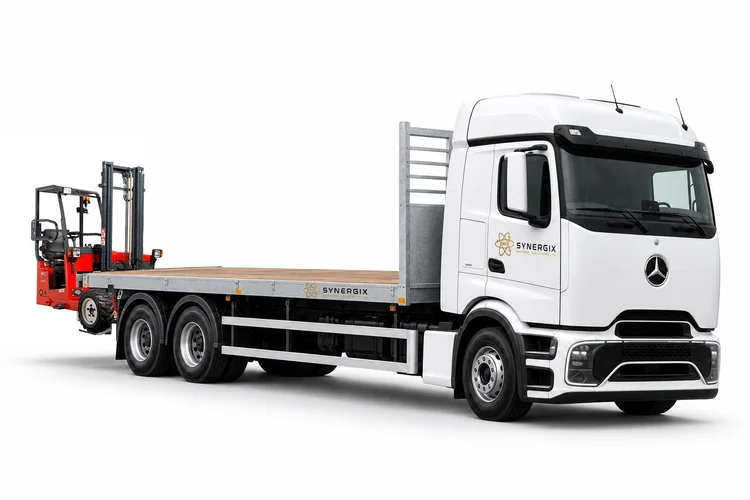 26t flatbed MOFFETTOpen deck, one rigid body and a rear-carried forklift.Read this vehicle guide ↓
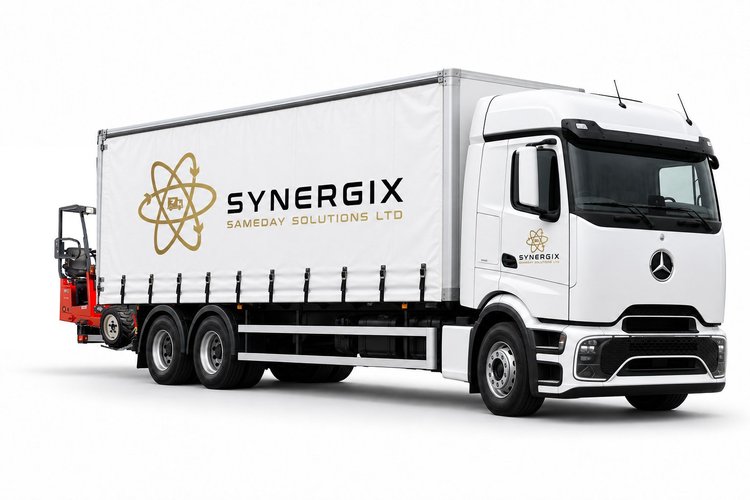 26t curtainsider MOFFETTRoofed body with side access and carried forklift unloading.Read this vehicle guide ↓
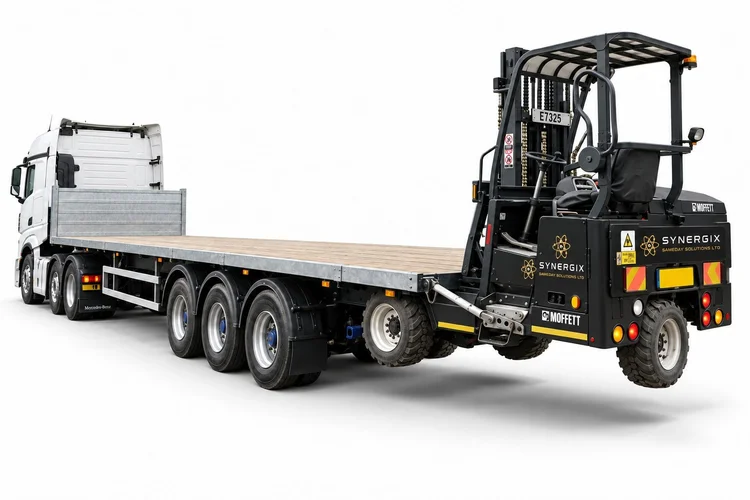 Artic flatbed MOFFETTA continuous open trailer deck with the forklift at its rear.Read this vehicle guide ↓
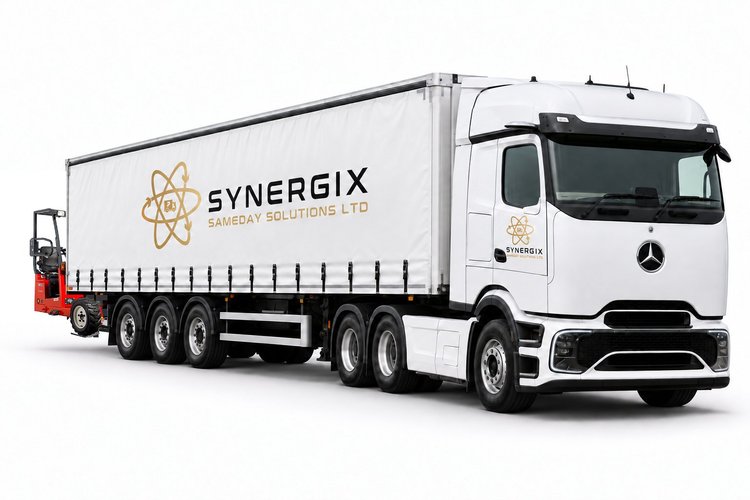 Artic curtainsider MOFFETTA long enclosed trailer body with independent unloading.Read this vehicle guide ↓
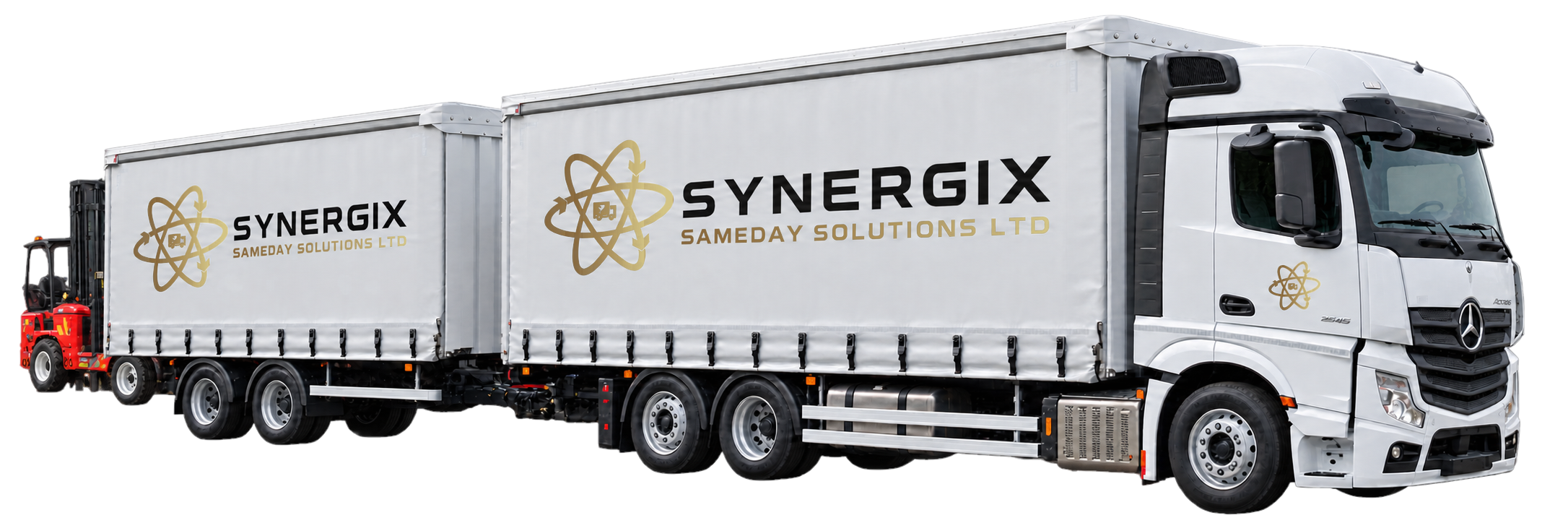 Wagon and drag MOFFETTTwo separate curtainsider bodies and a forklift on the trailer.Read this vehicle guide ↓
Stationary list of all five MOFFETT vehicles
The pictures illustrate arrangements. Actual body dimensions, forklift equipment, working capacity and availability are confirmed for your job.
Dimensions and weight
Three checks before choosing.
Measure the goods, establish the road carrying allowance and check the forklift duty separately. Passing one does not settle the others. The assigned body and forklift specification govern the booking.
Physical fit
Give each item’s packed length, width, height and gross weight, including its pallet or stillage. Identify the sides that allow fork entry, any projections, the centre of gravity and whether it can be turned. For a curtainsider, check the clear bay or rear opening as well as internal space. For a flatbed, include support, restraint and weather protection. For wagon and drag, allocate the load to the two separate bodies. These details are more useful than a pallet count without sizes.
Road freight allowance
The completed vehicle carries its cab, body, forklift, mounting, fuel, driver and normal equipment before the freight is added. Use a ready-to-work mass that actually includes the carried forklift. For illustration, an assumed 26,000kg gross limit minus an assumed 15,500kg ready-to-work mass leaves 10,500kg before any lower axle, body or other limit is applied. This is arithmetic, not a Synergix payload. Do not subtract the forklift again if it is already included in that ready-to-work figure.
Forklift handling
Check each item against the assigned machine’s capacity plate or chart for the relevant load centre, lift height, reach and attachment. Include the pallet or stillage in the handled load. Fork length, spacing, load support and stability matter alongside mass. The forklift also needs enough room to approach, lift and withdraw. A sender’s larger warehouse truck loading the goods does not prove the carried machine can unload them.
Useful dimensions to ask for
Ask for the usable body length and width, clear opening heights, deck height, maximum relevant point loading, actual freight allowance and road envelope with the forklift carried. For the machine, ask for width, collapsed and working mast heights, fork dimensions, chart and required clearance. These are different measurements. Quoting a forklift’s lifting height does not say how tall it is when travelling through a doorway.
| Vehicle | Dimensions | Weight and handling |
|---|---|---|
| 26t rigid flatbed | Usable deck length/width, deck height, headboard, supports and restraint space. | Ready-to-work payload, rigid axle distribution and each fork duty. |
| 26t rigid curtainsider | Clear internal dimensions, side bay/rear openings, roof/posts and loading height. | As above, plus practical forklift/mast access to each bay. |
| Articulated flatbed | Actual continuous deck and loaded envelope, supports and concentrated loads. | Completed outfit mass, trailer axles, kingpin/tractor loads and individual lifts. |
| Articulated curtainsider | Actual floor and bay openings; pallet footprint, height and working clearances. | Completed outfit limits, loading sequence and access to each pallet. |
| Wagon and drag | Each body’s separate dimensions, openings and loading height. | Rigid/trailer/coupling limits, forklift location and body allocation. |
Start with the configuration
One family. Different jobs.
First compare the carrying body and access pattern. Then match the actual forklift to the goods and route. A larger body does not automatically bring a higher forklift capacity.
| Configuration | What it offers | What can decide the choice |
|---|---|---|
| 26t flatbed MOFFETT | Open deck on one rigid chassis. | Weather plan, fork support, rigid access and freight allowance. |
| 26t curtainsider MOFFETT | Enclosed single body with side access. | Clear openings, product protection and loading-bay access. |
| Artic flatbed MOFFETT | Long continuous open semitrailer deck. | Articulated approach, kingpin/axle loads and rear clearance. |
| Artic curtainsider MOFFETT | Long enclosed body with side-loading bays. | Openings, pallet sequence, enclosure and articulated access. |
| Wagon and drag MOFFETT | Rigid body plus a separate drawbar trailer. | Two body limits, coupling, allocation and forklift staying with the trailer. |
Configuration guide
26t flatbed MOFFETT.
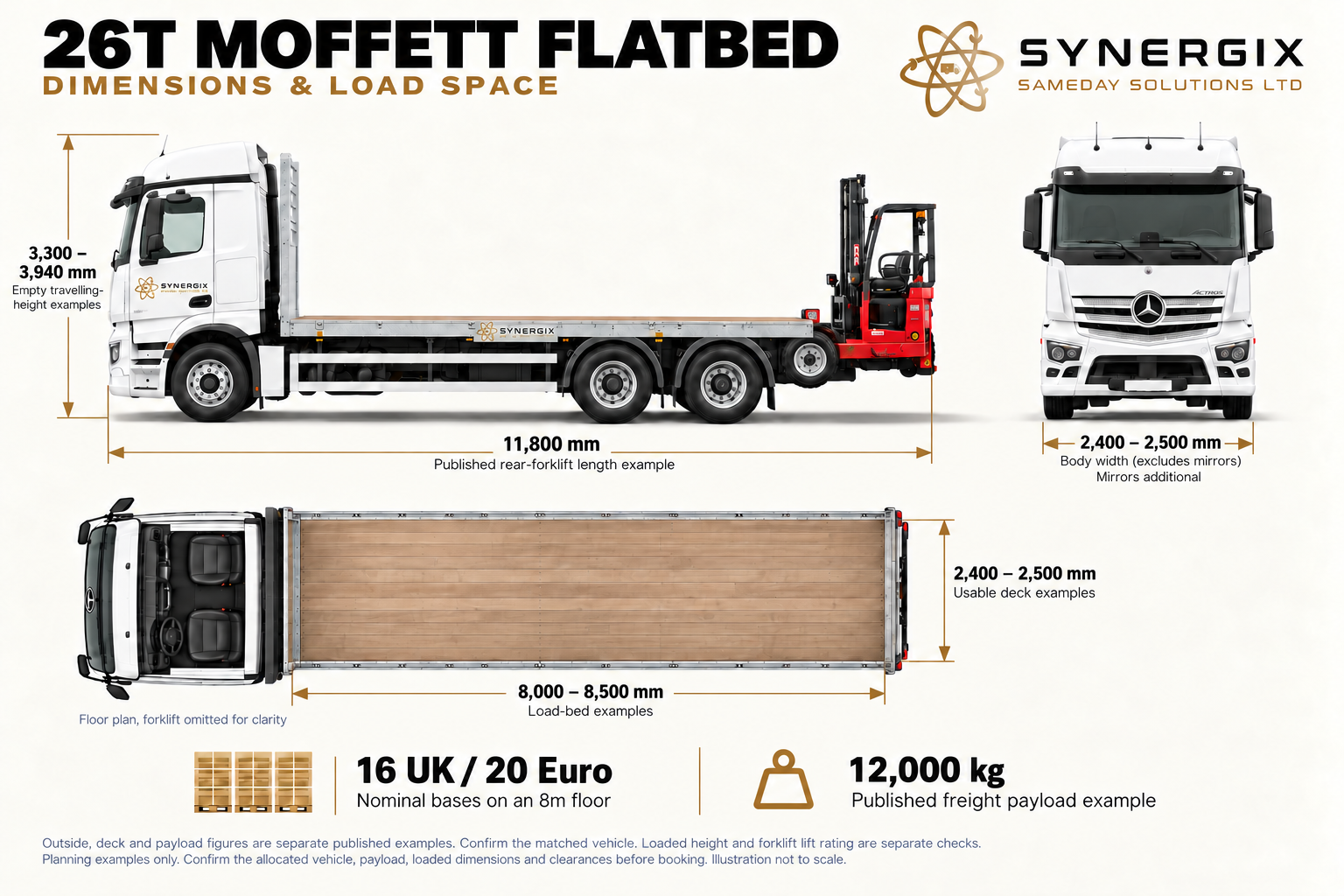
A three-axle rigid with an open freight deck and a forklift carried at the rear. The body and cab stay on one chassis, while the MOFFETT comes down to the ground to unload suitable goods. This combines an accessible flatbed with a separate machine that can travel between the vehicle and an agreed receiving position.
26 t MOFFETT flatbed
Published planning examples. The actual vehicle, equipment, load distribution and access must be checked for your booking.
Open the full-size diagramDimensions and planning figures in text
Rear-forklift complete-length example 11,800 mm; empty height 3,300–3,940 mm; body/deck width 2,400–2,500 mm. Deck 8,000–8,500 mm. 16 UK /20 Euro nominal on 8 m deck. Freight example 12,000 kg.
Overall-length evidence is a published rear-forklift carrier, not the exact illustrated Mercedes/MOFFETT build. Dimensions/payload are separate examples.
Published example sources:
What the flatbed changes
The open deck gives access to suitable loads from the sides and, where the loading plan allows, above. It suits weather-tolerant or properly protected packs, palletised materials and awkward shapes that do not need an enclosed body. There is no curtain opening or roof rail to pass through, but the headboard, posts, restraint equipment and forklift mounting still define usable space. The load must sit on adequate support and allow access for the forks. Open access is particularly useful when the collecting warehouse loads one way and the receiver needs unloading another way.
Why choose the rigid
A rigid avoids the articulation and additional platform of an artic or wagon and drag. That can simplify positioning at some entrances and yards, especially when the goods fit on one body. It still needs enough road width, turning room and a suitable parking area. Its three axles and the rear-carried forklift affect swept path and loading distribution. Choosing a rigid because the address looks tight should follow a check of the actual approach rather than a guess from the vehicle picture.
Carrying weight and individual pack weight
26t identifies a gross vehicle class, including vehicle and equipment. It is not the freight allowance. The forklift, mounting, body, fuel and carried equipment leave a smaller allowance for the goods. Separately, one dense pack may exceed the forklift chart even when the total consignment is light enough for the rigid. Give individual weights, the side from which each pack can be approached and how far its centre of gravity is from the fork face. A pack that can be loaded by the sender’s large yard forklift still needs checking against the carried machine.
How the delivery is planned
The receiving site needs room behind the rigid to demount and remount the forklift, plus working space alongside the deck and a ground route to the delivery point. Loading order should keep the right goods accessible without destabilising the remaining load or creating an axle problem after the first stop. The operator transfers goods using the agreed handling arrangement; assembly, installation and pushing loads through unsuitable routes are separate requirements. Tell us if sheets must be removed, packs split or return packaging collected.
Compare the neighbouring options
Choose the rigid curtainsider when enclosure matters and the load fits through its openings. Compare an articulated flatbed when a longer continuous deck or a different freight allowance is needed and access permits. Consider a HIAB when the goods require a suspended lift, suitable lifting points or placement across a barrier. A MOFFETT is valuable when forks can support the goods and the machine can physically travel the route to them.
Configuration guide
26t curtainsider MOFFETT.
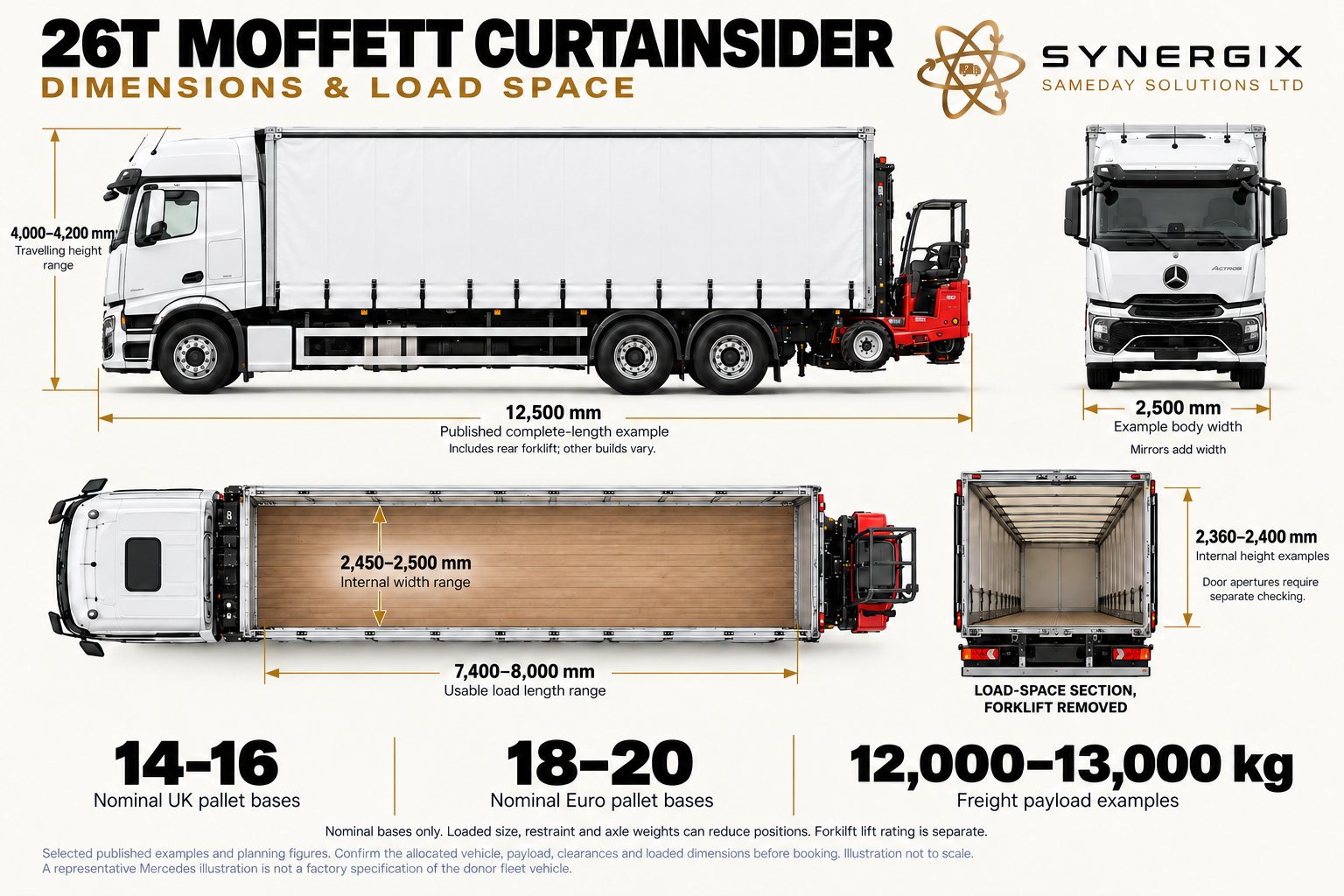
A 26t curtainsider MOFFETT keeps the goods inside a roofed, curtained body during travel and carries its own forklift at the rear. It is a useful combination for suitable retail, industrial and building-product loads delivered to places without a receiving forklift.
26 t MOFFETT curtainsider: dimensions
Published planning examples. The actual vehicle, equipment, load distribution and access must be checked for your booking.
Open the full-size diagramDimensions and planning figures in text
Complete-length example 12,500 mm including forklift; height 4,000–4,200 mm; body width 2,500 mm. Load 7,400–8,000 × 2,450–2,500 mm, internal height 2,360–2,400 mm. 14–16 UK /18–20 Euro; freight 12,000–13,000 kg.
Selected different builds. Rear apertures and forklift lift rating are separate.
Published example sources:
26 t MOFFETT curtainsider: pallet layout
Published planning examples. The actual vehicle, equipment, load distribution and access must be checked for your booking.
Open the full-size diagramDimensions and planning figures in text
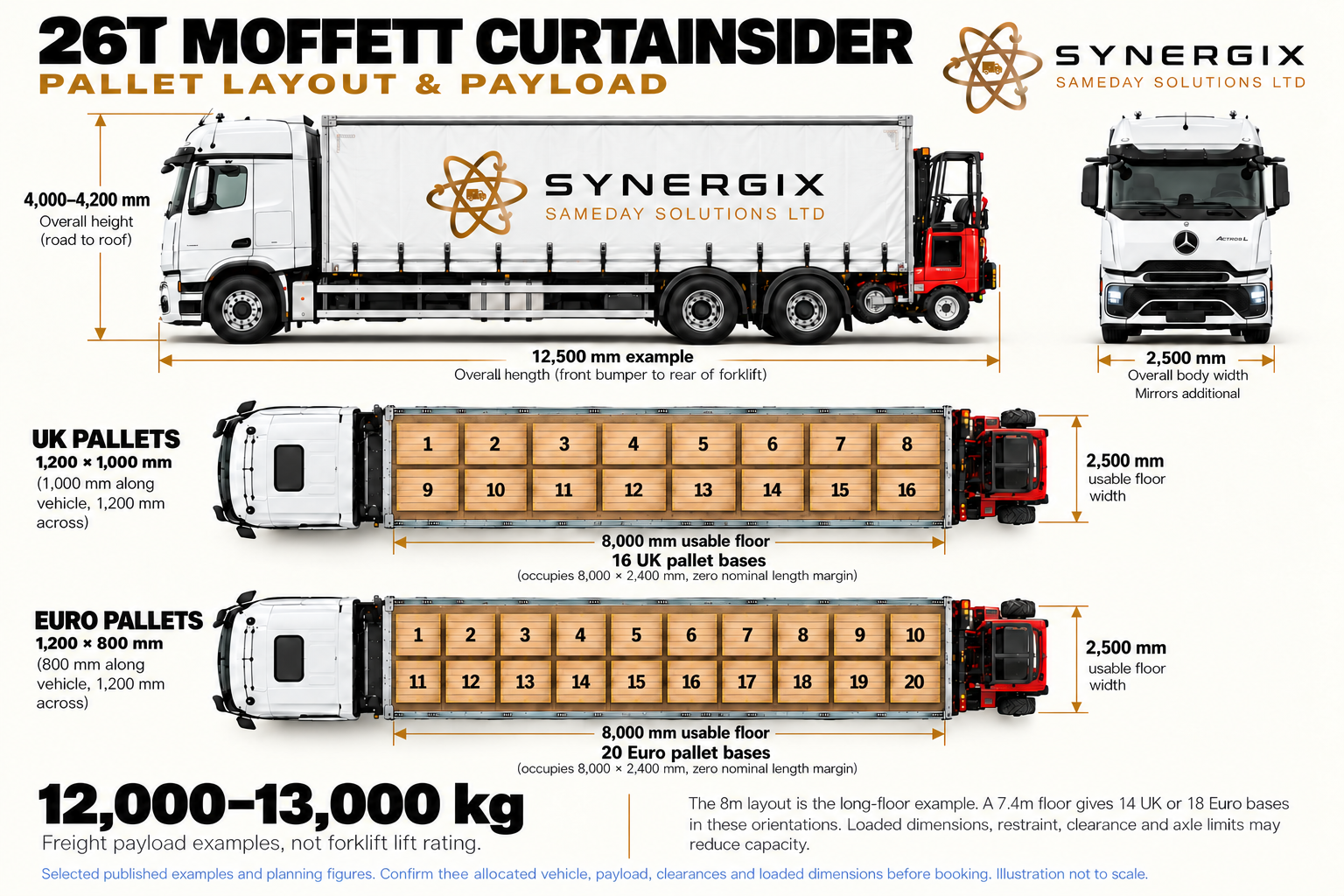
External-length example 12,500 mm; height 4,000–4,200 mm; width 2,500 mm. Worked 8,000 × 2,500 mm floor: 16 UK or 20 Euro bases, zero nominal length margin. Freight 12,000–13,000 kg.
Shorter 7.4 m floor gives 14 UK /18 Euro in these orientations.
Published example sources:
Enclosure with side-loading access
The curtains open to expose loading bays along the body. Depending on the body, posts and roof structure can remain in the way of a tall or long pack, so the clear opening is as important as nominal internal size. A curtainsider offers weather protection during the journey, but opening the side exposes goods during unloading. It is not refrigerated or a guaranteed controlled-humidity environment. Explain any product sensitivity, clean handling needs and weather limitations when booking.
A practical single-body arrangement
The rigid combines one freight body, one vehicle and a carried forklift. That makes it a useful starting point when one body accommodates the load and a longer combination would complicate access. It can support multi-stop deliveries where individual pallets are accessed from the sides in a planned order. The route, stop sequence and changing axle loads still need to work together. Do not choose by pallet count alone: a small number of heavy pallets can govern the job before floor space is filled.
Curtains, roof and load restraint
A curtain is not automatically the restraint holding the goods in place. The load securing method depends on the goods, body construction, any applicable body certification and how the actual load meets its conditions. Straps, blocking, suitable anchorages and packaging may be needed. The pallet must keep the product stable when it is lifted as well as during road travel. Tell us about top-heavy displays, liquids, fragile cartons, straps that must avoid finished surfaces and products that cannot be stacked.
Unloading both sides or only one
Normal planning should identify which loading bays the forklift must approach. If a fence, parked vehicle or live traffic prevents access to one side, explain that at quotation stage. Some machines have equipment for reaching a far-side pallet from one side of a vehicle, but ordinary fork length or a general reach function does not prove this capability. The assigned machine’s approved reach system, support arrangement and chart must match the position. There must also be enough clear height to work inside the body opening.
When another configuration earns its place
Use a flatbed when a roof or side opening would obstruct the goods and their weather protection can be managed. Consider an articulated curtainsider for a longer single loading floor, or wagon and drag when two separate bodies suit the distribution plan. A tail lift can be appropriate for suitable pallets lowered to a prepared surface; it does not provide the same independent forklift movement across a site. Share the final set-down location so we can compare the complete job.
Configuration guide
Artic flatbed MOFFETT.
An articulated flatbed MOFFETT couples a tractor unit to an open-deck semitrailer, with the forklift mounted at the trailer’s rear. It combines a long continuous freight platform with an unloading machine that can leave the carrier and move suitable goods along an assessed site route.
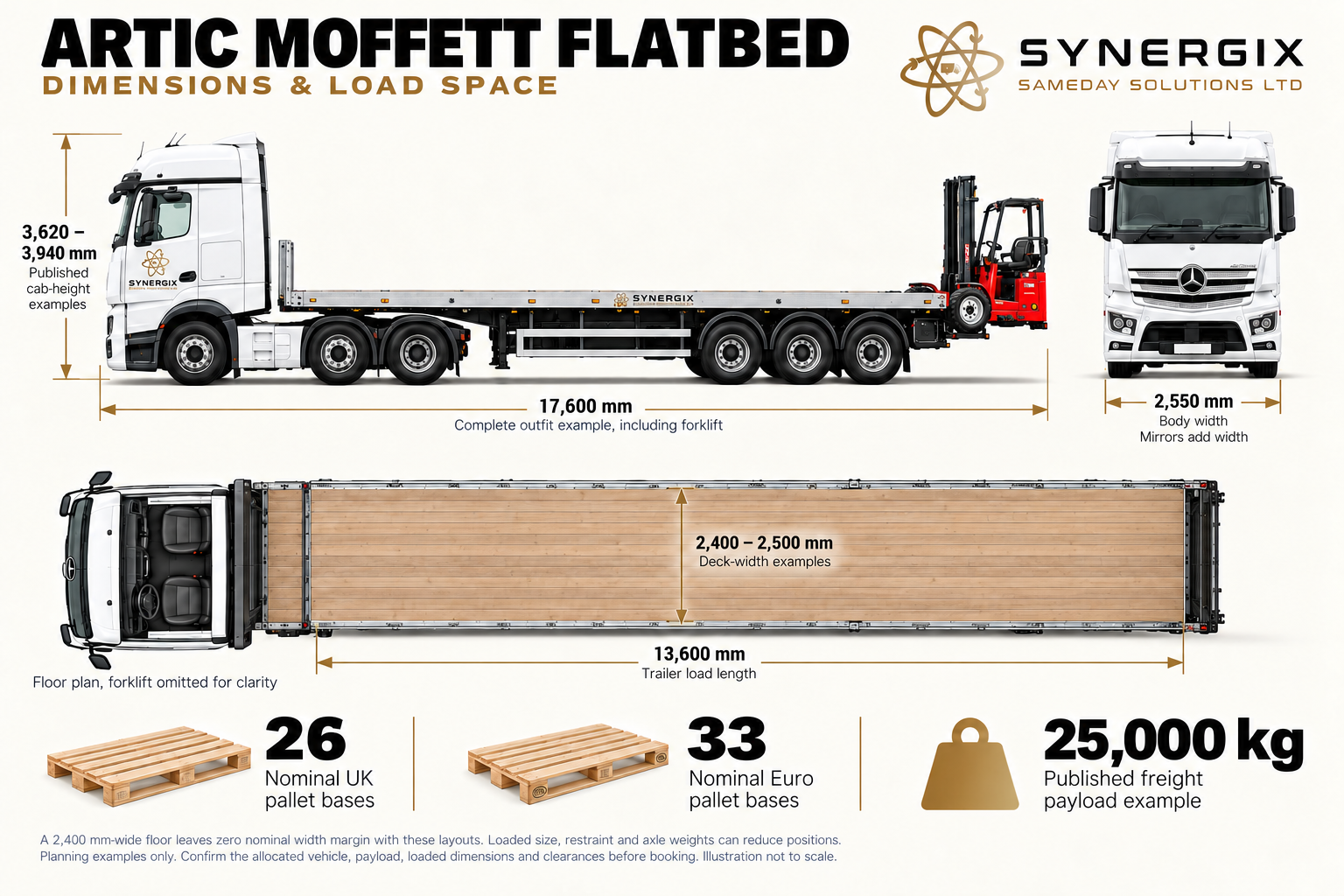
Artic MOFFETT flatbed
Published planning examples. The actual vehicle, equipment, load distribution and access must be checked for your booking.
Open the full-size diagramDimensions and planning figures in text
Complete-length example 17,600 mm including forklift; empty cab-height examples 3,620–3,940 mm; body width 2,550 mm. Deck 13,600 × 2,400–2,500 mm. 26 UK /33 Euro references. Freight example 25,000 kg.
Forklift omitted only from overhead floor view. Loaded road height and equipment mass need separate checks.
Published example sources:
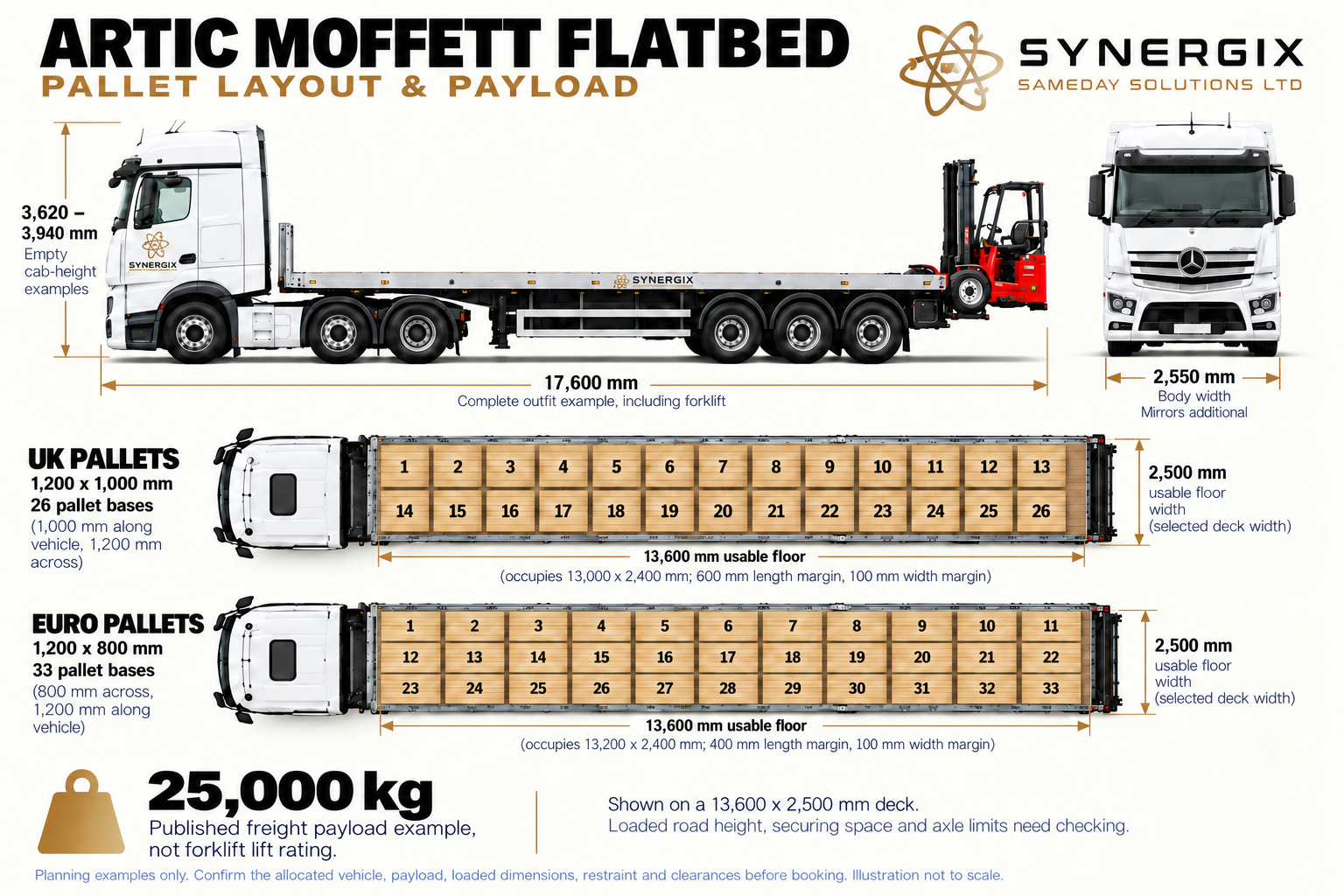
Artic Moffett Flatbed: pallet layout
Published planning examples. The actual vehicle, equipment, load distribution and access must be checked for your booking.
Open the full-size diagramDimensions and planning figures in text
26 nominal UK / 33 nominal Euro bases. 13,600 × 2,500 mm worked deck. 25,000 kg published freight example.
Forklift omitted only from floor plans. Selected 2,500 mm width leaves 100 mm total nominal width margin; 2,400 mm examples have zero nominal width margin.
Published example sources:
One continuous freight platform
The semitrailer provides one principal deck rather than two separate wagon-and-drag bodies. This can suit longer supported packs, larger consignments and a sequence of pallet positions. The actual usable length, width, deck height and point-load capability depend on the trailer and equipment. A standard 13.6m trailer category is a useful starting description, not a promise of exactly that much unobstructed space on every specialist installation. Support timbers, restraint clearances and any projections count.
Open access and weather protection
An open platform can make suitable loads accessible to the sender’s crane or forklift without passing them through a curtain opening. On delivery, the MOFFETT still needs compatible fork entry and the rated duty to lift each piece. Being accessible from above does not give the carried forklift crane capabilities. Weather-sensitive goods need suitable packaging or an agreed protection plan; sheets can add handling time and do not replace load restraint. Tell us if a pack must stay level or has surfaces that cannot take a strap.
The forklift changes the combination
Equipment carried behind the semitrailer axle group affects trailer axle load, kingpin load and the complete ready-to-work mass. Its position and transport overhang also matter at tight corners and ramps. The vehicle cannot be assessed only by total gross weight or a standard flatbed payload. A load layout that is acceptable at collection must remain acceptable as deliveries are made. The same principle applies if pallets or return packaging are added later in the journey.
Plan the articulated approach
The tractor and trailer need room to turn, align and leave. Check junctions, parked cars, gate posts, approach gradients, overhead clearances and the surface that supports the parked outfit. At the rear, space is needed to release and recover the forklift safely. Alongside, the machine needs access to the goods; beyond the lorry, the loaded route must lead to a usable landing area. A photograph of a clear gate does not show whether the complete operation can fit.
A useful choice for larger open-deck movements
Consider this arrangement when the freight needs a longer platform and unloading independence is valuable. A smaller rigid may be more economical and easier to accommodate when the load fits it. Wagon and drag provides two distinct decks and a different access pattern. A HIAB artic addresses planned lifting requirements, while a low loader serves different deck-height and machinery-loading needs. Start with the goods and receiving method rather than selecting the largest pictured vehicle.
Configuration guide
Artic curtainsider MOFFETT.
An articulated curtainsider MOFFETT brings a long enclosed freight body and a carried forklift together. It is suited to suitable palletised stock and packs where the receiver needs unloading support but the journey calls for a roofed, curtained body.
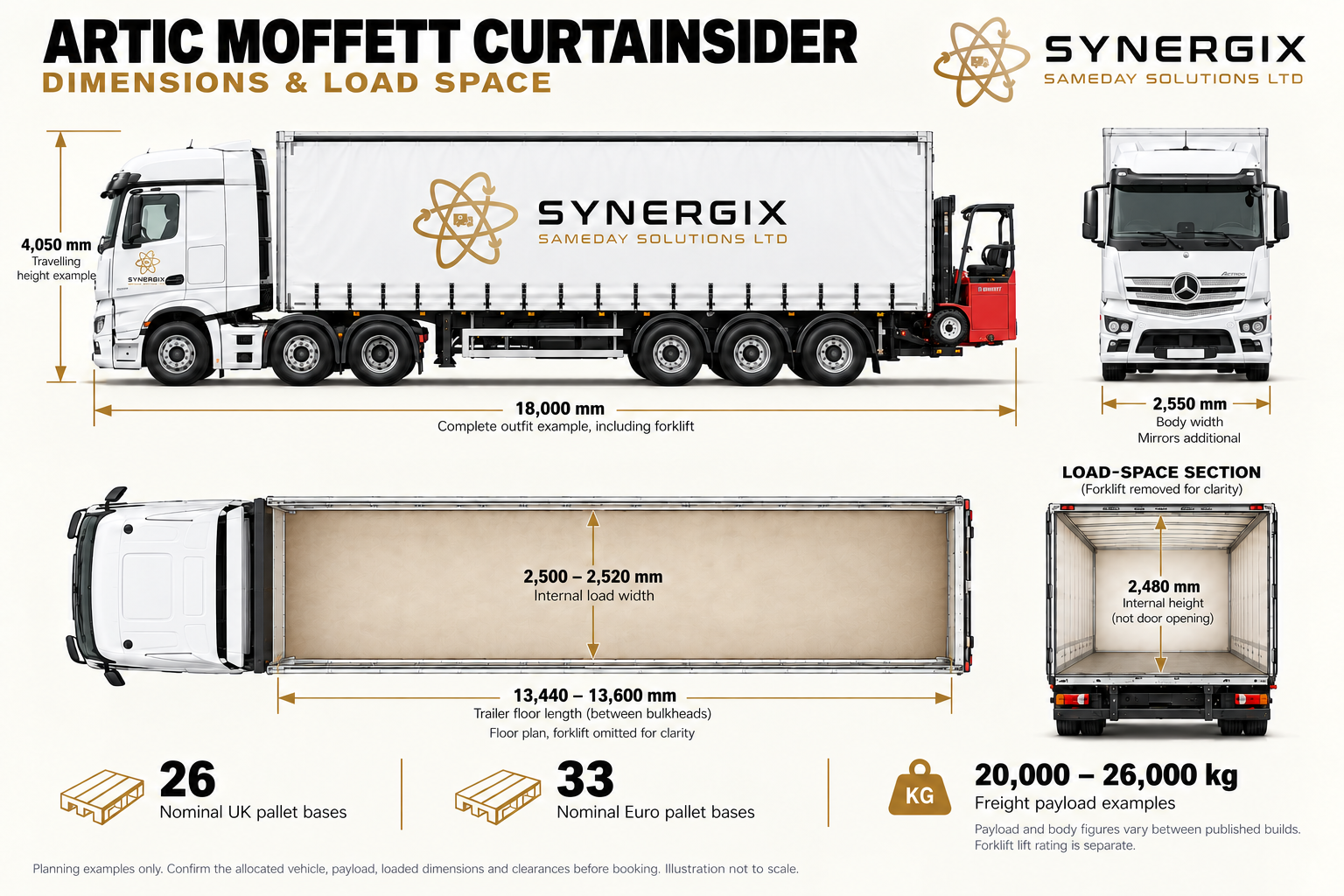
Artic MOFFETT curtainsider
Published planning examples. The actual vehicle, equipment, load distribution and access must be checked for your booking.
Open the full-size diagramDimensions and planning figures in text
Complete-length example 18,000 mm; height 4,050 mm; body width 2,550 mm. Floor 13,440–13,600 × 2,500–2,520 mm; internal height 2,480 mm. 26 UK /33 Euro; freight 20,000–26,000 kg.
Published builds differ. Forklift is carried outside cargo floor, omitted from overhead view only.
Published example sources:
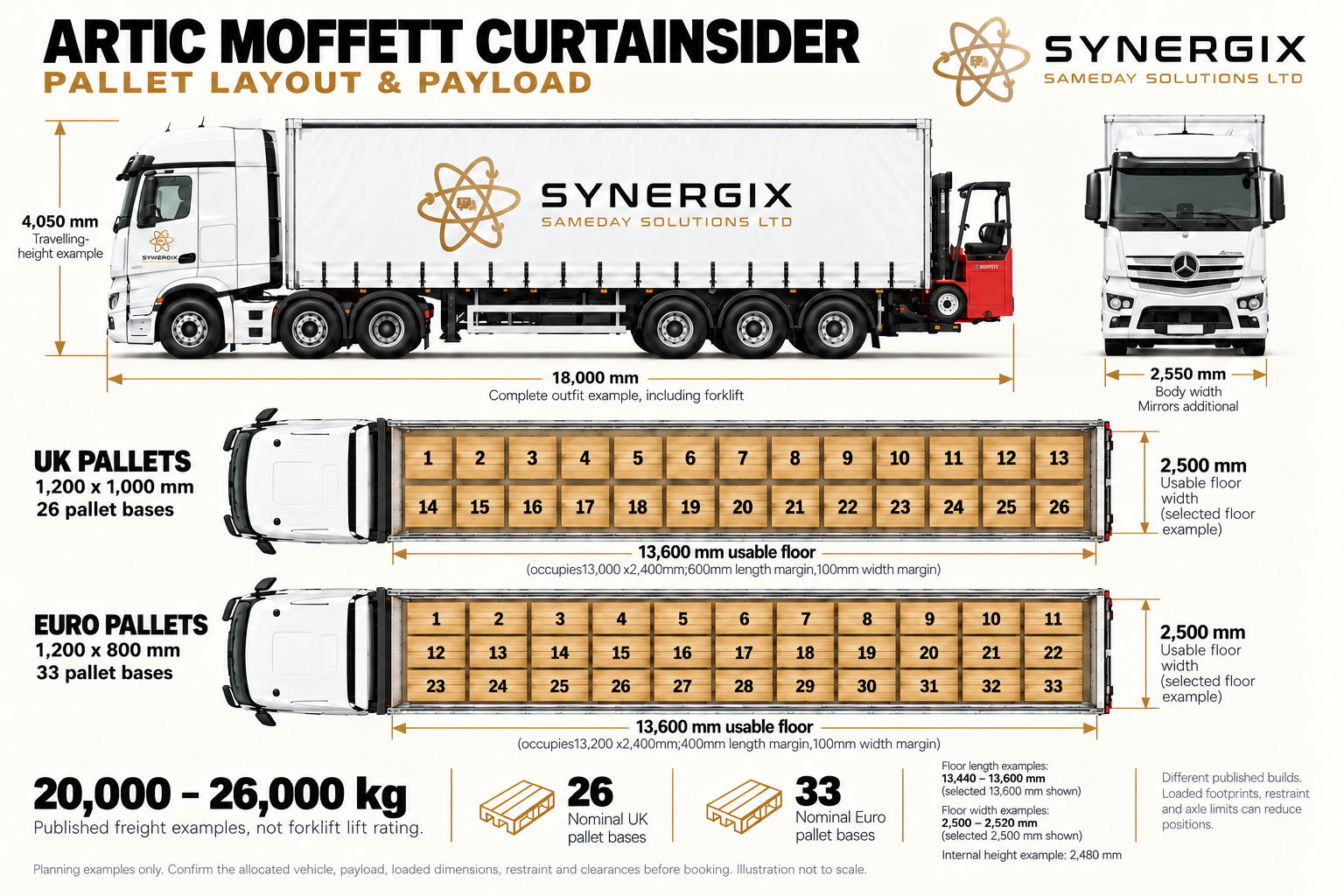
Artic Moffett Curtainsider: pallet layout
Published planning examples. The actual vehicle, equipment, load distribution and access must be checked for your booking.
Open the full-size diagramDimensions and planning figures in text
26 nominal UK / 33 nominal Euro bases. 13,600 × 2,500 mm worked floor. 20,000–26,000 kg published freight examples.
Floor ranges remain 13,440–13,600 × 2,500–2,520 mm. The layouts use the 13,600 × 2,500 mm example. Freight is separate from forklift lift rating.
Published example sources:
Long body, accessible loading bays
Side access allows suitable pallets to be loaded into planned bays and unloaded without every earlier pallet leaving through a rear doorway. Body posts, roof rails, rear openings and load position affect that access. Confirm actual clear dimensions for tall stock, wide packs or items that need to be rotated. The forklift mast and raised load need enough working clearance as well as a path for the pallet itself. Curtains and doors must be able to open in the available parking position.
Pallet capacity needs a defined footprint
UK pallets commonly have a 1,200 × 1,000mm footprint; Euro pallets commonly use 1,200 × 800mm. A nominal body layout is only useful after the footprint, orientation, overhang and loading method are defined. Heavy pallets, mixed sizes, fragile goods and required access can reduce a floor-layout count. The MOFFETT’s chart applies to each handling operation. A trailer that can accommodate many pallet bases does not establish the mass of each pallet or the available freight payload.
Build a delivery sequence into the load plan
For multi-stop work, identify every pallet’s destination and handling restrictions. The plan should make the right bays accessible while keeping the remaining freight secure and the outfit within its axle and coupling limits. Return pallets, cages and rejected goods also need an agreed place and method. If the delivery requires the forklift to carry stock a long distance from the lorry, that travel is part of the booked handling time rather than an invisible extra after arrival.
Protection is different from controlled temperature
The body gives useful shelter in travel, but an ordinary curtainsider does not provide refrigerated transport. Goods can still be exposed while curtains are open, and suitable packaging remains important. Tell us about hygiene, odour transfer, moisture, food products or sensitive electrical goods. Indoor delivery requires a separate check of the forklift’s power source, ventilation, floor loading, mast height and venue rules. An enclosed trailer does not make a diesel forklift suitable for every building.
Choose by the complete delivery
This configuration can remove dependence on a receiving forklift while retaining a larger enclosed body. It needs articulated access, rear demounting space, accessible unloading bays and a suitable ground route. A 26t rigid curtainsider may be the better fit for a smaller consignment or tighter approach. A standard artic without carried equipment may be sufficient where suitable receiving machinery and a competent operator are already guaranteed. Agree both collection and delivery arrangements before comparing prices.
Configuration guide
Wagon and drag MOFFETT.
The wagon-and-drag MOFFETT arrangement has a rigid truck with its own curtainsider body, a separate drawbar trailer and a carried forklift at the rear of the trailer. Two distinct load spaces and one mobile unloading machine create a different distribution option from an artic.
Two bodies, two loading plans
There is a gap and coupling between the truck and trailer. Their decks do not form one continuous floor, so a long item cannot simply bridge the two bodies. Each body needs its own usable length, width, height, floor and mass limits. The loading plan identifies which goods go on the rigid, which go on the trailer and how each is accessed. The combined theoretical floor area should never be quoted as one uninterrupted loading length.
One forklift can serve both platforms
After the machine is safely demounted onto suitable ground, it can travel to accessible loading bays of either body. This differs from a fixed crane whose ability to reach a deck depends strongly on crane position. The MOFFETT still needs physical access, suitable loading height and the rated duty for each pallet. Parking the trailer behind the rigid does not by itself provide a clear route alongside both bodies. Fences, queues and other traffic can make apparently useful bays inaccessible.
Where a drawbar arrangement can help
Separating stock across two bodies may suit a distribution plan, consignments with different receiving orders or a larger load that benefits from independent body allocation. Any plan to leave the trailer, uncouple at an access point or serve a restricted site with the rigid needs to be agreed specifically. In the illustrated arrangement the forklift is on the trailer: taking the rigid away alone also leaves that forklift behind. A smaller vehicle reaching the address is not enough if the unloading machine cannot accompany it.
Coupling, support and working space
The complete outfit has its own swept path and reversing behaviour. Coupling forces, trailer nose load, rigid axle loads and rear-carried equipment affect the permissible layout. Uncoupling and supporting a trailer require a suitable location, approved procedure and agreed responsibility. The public guide is not an uncoupling instruction. Tell us about trailer parking permissions, ground condition, security, access to the mounting area and where the driver can safely work clear of people and moving traffic.
Compare it with an artic or rigid
An artic gives a different coupling arrangement and one principal trailer deck. A rigid alone avoids a second body but offers less loading floor than a suitable complete combination. Choose wagon and drag when its two-body operation helps the actual job, not because a sum of deck lengths sounds larger. Send a stop-by-stop allocation if you already have one. We can assess the bodies, forklift location, route and receiving sequence together before the arrangement is agreed.
Understanding the load
Depth can change the lift.
Load centre describes the horizontal distance from the fork face to the load’s centre of gravity. It helps explain why two equally heavy loads can make different demands on the forklift.
Measure in the direction of the forks
For a uniform load sitting against the fork face, a 1,200mm depth gives an approximate 600mm centre; 1,800mm depth gives about 900mm. Packaging gaps, uneven contents and attachments can move it farther away. A long timber pack carried across the forks may have a different forward load centre from the same pack approached from its end. State both its length and depth and show the intended entry side.
Use the plate, not a homemade rating
A simple mass-times-distance comparison explains increased overturning demand, but it is not a substitute capacity chart. Lift height, mast or reach position, machine stability and the attachment have their own limits. Do not calculate a reduced rating and assume the job is approved. Send a drawing or photograph of an unusual load so the actual arrangement can be assessed. Dense machinery with an off-centre motor is a different problem from evenly distributed boxed stock.
Fork entry and support
A sound pallet, suitable stillage or engineered fork pockets must allow the load to be properly supported. Closed entry, broken bearers, protruding screws, flexible packs and loose contents can defeat an otherwise suitable weight. Fork extensions and other attachments need approval and an appropriate rated configuration. Two forklifts lifting one unsupported item are not an ordinary workaround. If the goods need a crane lift or purpose-made handling frame, describe that from the outset.
A sourced manufacturer example
Hiab’s published UK M4 NX V range lists 2,000kg and 2,500kg lifting-capacity variants. Its M4 NX 25.3 entry lists 2,210kg machine weight and 1,200mm transport overhang. Those figures show why model and installation matter; they are a manufacturer’s example, not the specification of the vehicle booked through this page. The allocated machine’s plate, options and actual mounting remain decisive.

Different forklift equipment
Reach, steering and attachments.
MOFFETT is a brand of truck-mounted forklift, not one universal machine specification. The body type tells you how the freight travels. The actual forklift equipment tells you how it can be handled.
Static mast and moving mast
In a static-mast design the mast has its own fixed structural arrangement, with available reach equipment depending on model. A moving-mast machine can move the mast assembly relative to the chassis. These mechanisms affect how the operator brings the load toward the machine and approaches a deck. Neither description alone establishes the far-side capacity. Quote the model and required pick position rather than requesting an unspecified “long reach”.
Single-side unloading
Some approved configurations combine reach equipment and a support system to lift loads on the far side of a truck from one working side. This can help when the opposite side is unavailable. In the manufacturer’s Lift Assist example, arms react against the side of the carrier bed, while the forklift’s stabilisers and their contact with the ground contribute to the supporting system. This is a defined equipment arrangement, not simply a set of longer forks. The load position, chart, compatible bed and ground must match the task. The mechanism is explained here to help specify a job; its operating procedure belongs to the trained operator and the actual manual. Avoid planning a public-road position around a capability that has not been confirmed.
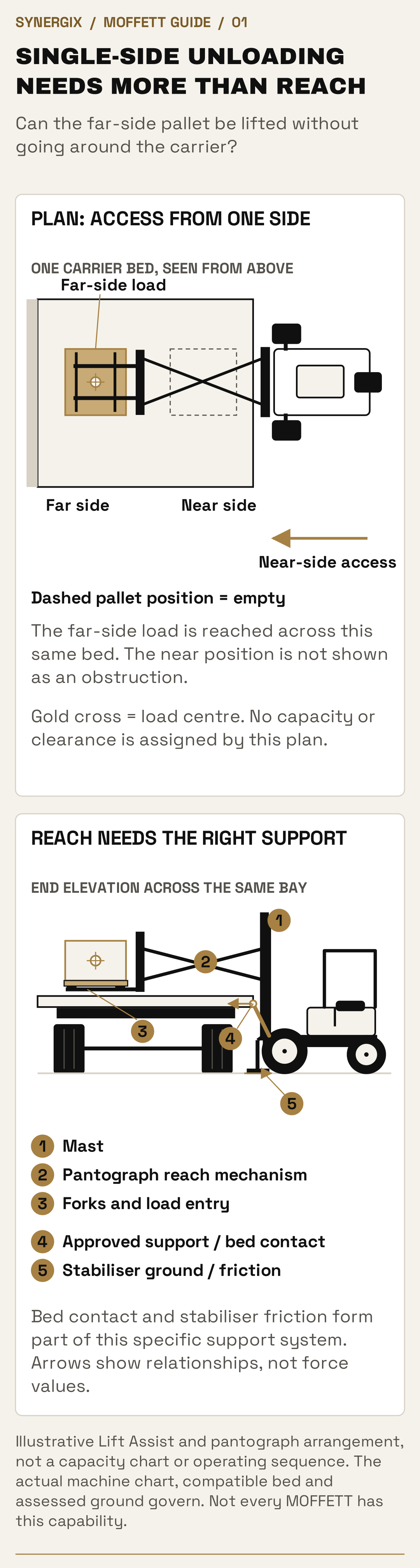
Illustrative Lift Assist and pantograph arrangement, not a capacity chart or operating sequence. The actual machine chart, compatible bed and assessed ground govern. Not every MOFFETT has this capability.
Open full-size desktop diagram · Open full-size mobile diagramFour-way travel
Selected machines can steer for lateral travel, letting a long supported pack move lengthways along a suitable aisle. That can reduce the space needed to turn the complete load. It does not shorten the pack, remove its swept path at corners or make a narrow doorway wider. Check the combined machine-and-load envelope in the chosen travel direction and the space needed for approach and placement. Four-way capability is a model option to request, not a feature to assume from the MOFFETT name.
Sideshift and special attachments
Sideshift helps position the carriage laterally; fork positioning adjusts fork spacing. Neither is the same as four-way travel. Clamps, extended forks and other attachments change the supported load and rated duty and must match the product. Tell us about paper reels, awkward stillages, finished surfaces or packs that cannot tolerate squeezing. Availability and suitability are agreed for the job. Do not assume a general pallet-fork booking includes a special attachment.

Conceptual comparisons, not manoeuvring steps. The pack keeps the same proportions. No aisle width, turning clearance or load rating is assigned. Abstract machine footprints do not depict steering geometry.
Open full-size desktop diagram · Open full-size mobile diagramGround mounting is an equipment feature
Manufacturer options can let an operator mount or demount from a ground position. That is separate from driving or handling the goods. Ask about the actual arrangement when site documents or examination intervals depend on whether a person rises with the machine. A marketing feature name or a forklift photograph is not enough to establish the complete mounting procedure or its legal assessment.
Carrying the forklift
Rear mounting changes the vehicle.
The forklift travels on a compatible mounting arrangement at the rear of the carrier. Keeping it off the freight deck preserves useful loading space, but its mass and position still count in the road transport plan.
Mounting is structural equipment
The carrier and mounting system must be compatible with the forklift and intended use. The installation has load paths, retaining components, clearances and inspection requirements. The rear structure must support equipment during road travel, not merely hold a parked machine for a photograph. Body length, rear protection, lights, number plate visibility and departure clearance all need considering in the completed arrangement. This guide’s illustrations show layouts and do not certify hidden hardware.
Rear axle and front axle effects
Equipment behind a rear axle group creates a lever effect. As an engineering illustration, a 2,000kg mass centred 1m behind an idealised rear support on a vehicle with 5m between front and rear supports adds 2,400kg at the rear and removes 400kg from the front. Real multi-axle vehicles require their actual geometry, suspension and weight data. The example explains why the rear axle effect can exceed the forklift’s own mass and why total gross weight alone is insufficient.
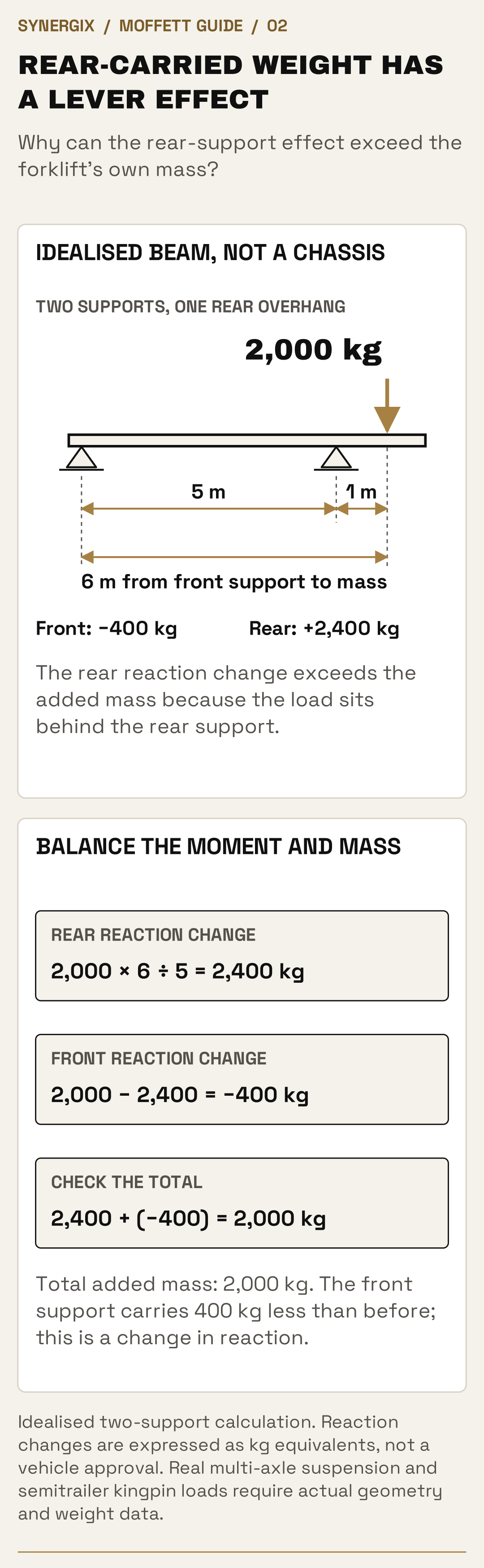
Idealised two-support calculation. Reaction changes are expressed as kg equivalents, not a vehicle approval. Real multi-axle suspension and semitrailer kingpin loads require actual geometry and weight data.
Open full-size desktop diagram · Open full-size mobile diagramA semitrailer has a coupling load too
On an artic, the carried machine affects the trailer axle group and kingpin loading. The tractor has its own axle and fifth-wheel limits. On wagon and drag, load allocation must also respect the rigid, trailer and coupling arrangement. Goods removed at an early stop change those distributions. Do not treat an empty-looking floor position as permission to move a heavy pallet anywhere or assume the remaining load becomes acceptable simply because it weighs less overall.
Demounting and remounting space
The full operation needs a suitable clear area behind the mounting, safe access for the operator and separation from other traffic. The forklift must be able to come down, move clear and return after unloading. Sloping entries, traffic queues, narrow lay-bys, overhead structures and soft verges can make that impossible even when the lorry has parked. A public highway or pavement cannot simply be treated as an available work area. Arrange permissions and traffic control where required.
Access and ground
Plan the whole ground route.
A MOFFETT can take suitable goods beyond the lorry, but only along a route the loaded machine can safely use. Assess the carrier’s approach, the unloading area and every part of the path to the receiving position.
Rough terrain is a capability with limits
Tyres, traction, ground clearance, machine stability and the load influence suitability. Firm gravel may be different from loose deep stone; dry grass can become soft after rain. Crossfall, ruts, excavations, edges, buried voids and unverified covers introduce separate risks. There is no single safe slope or ground-bearing figure for every MOFFETT. Manufacturer limits and the assessed operation govern the plan, and a changed surface can require the work to stop and be reassessed.
Ground must carry machine plus load
The surface supports the complete loaded forklift and concentrated wheel reactions, not just the goods or the machine’s brochure weight. A paved area may conceal a cellar, weak cover or unsupported edge. Indoors, floor capacity and point loading can govern the route. Temporary trackway and bridging need to be suitable for the actual machine and load. Do not improvise a crossing with loose boards or assume a load-spreading sheet is an engineered solution.
Width, height and turning
Measure the narrowest point, opening height, threshold, corner and space at the final position. Include the load’s projections and the machine’s working mast height. A gate wide enough for the forklift alone may still be too narrow for a sideways pack. A roofed passage can restrict the lift needed to withdraw goods from a vehicle. Show steps, kerbs, cambers, ramps and surface transitions in photographs rather than describing the route only as “flat”.
People and other vehicles
Agree a controlled working area, a receiving contact and any required site induction. Pedestrians, venue staff, customers and other deliveries need separation from the forklift’s operating route. Good lighting and a usable line of sight matter, especially at night or around blind corners. The route should remain available for the full delivery, including recovery of the machine. An escort or banksman requirement is a role to agree, not a reason for unbriefed people to stand beside moving equipment.
Indoor, residential and roadside work
Indoor delivery requires checking power source, exhaust, ventilation, floor loading and fire or venue restrictions. Electric equipment can help some requirements but still needs a suitable route and an agreed specification. Residential deliveries need space, permission and surface protection assessed; a domestic driveway is not automatically an industrial handling area. Where a road crossing or public-road movement is involved, road-use requirements, insurance and permissions must be established before the job. A short distance does not remove them.

Loads and applications
What is MOFFETT transport useful for?
It is particularly useful when suitable goods can be supported on forks and the receiver has no dependable unloading equipment. The following are applications to discuss, with the packaging, weights and site assessed for each enquiry.
Bricks, blocks and landscaping materials
Dense packs can reach a handling or axle limit well before filling the body. Give gross pack weights, pallet or bearer arrangement and the exact place where the materials must finish. Stone, paving and bagged aggregates need stable packaging and proper support. A delivery beside a building is different from moving every pack through a garden or up a prepared access route. Explain surface sensitivity and any restrictions on where materials may be placed.
Timber, boards and long packs
Long goods introduce bending, support, load-centre and access questions. Identify the fork-entry direction, banding and support points. A four-way machine may help a suitable long pack travel through a constrained route, but the combined load envelope still needs checking. Sheets, glazing and finished panels can need purpose-designed stillages or alternative handling. The fact that a pack is banded together does not prove it can safely span the forks.
Retail stock and industrial pallets
For cartons, displays, consumables and suitable equipment on pallets, identify overhang, stacking limits, fragility and any uneven mass distribution. Sound pallets and a stable load help goods survive the lift as well as the journey. Delivery into a shop, warehouse or production building is a separate route and handling scope. Security seals, item counts, returns and an authorised receiver should be agreed in advance where they matter.
Festivals, events and temporary sites
Synergix frequently uses MOFFETTs for festival work. They can help with suitable stock where receiving facilities are temporary or unavailable. Share accreditation, gates, delivery slots, the route to the stock area and a contact with authority to receive it. Wet-weather changes, temporary trackway, crowds and vehicles can alter the plan. HIABs have a different role for loads requiring a crane lift; the two are not interchangeable simply because both bring unloading equipment.
Rural locations, farms and projects
A carried forklift can reduce reliance on machinery waiting at a remote destination. The last part of the approach may still determine which carrier can reach it and whether the machine can complete unloading. Show tracks, bridges, overhead branches, gradients, waterlogged areas and turning points. Livestock, moving plant and members of the public need managing. Equipment, containers and machinery without suitable fork support may need a different method rather than a bigger forklift.
Goods requiring a separate acceptance check
Dangerous goods, leaking products, waste, fragile high-value items, unstable loads and products needing controlled temperature require their own acceptance and handling assessment. A MOFFETT is unloading equipment, not an automatic authorisation for every commodity. Describe contents honestly, including batteries or liquids inside equipment. Any additional packaging, documentation, insurance or specialist vehicle requirement must be settled before allocation.
Condition and servicing
Look beyond a service sticker.
Reliable unloading depends on the forklift, its mounting and the carrier being suitable and maintained. Four different activities contribute to that assurance: pre-use checks, planned servicing, risk-based inspection and thorough examination.
Pre-use checks and reporting faults
The operator checks the equipment under the relevant instructions and defect system before use. Important areas include forks and retainers, mast and chains, hoses, controls, brakes, steering, tyres, restraints and mounting security. Visible leakage, damaged forks, missing guards or an illegible capacity plate need reporting and an appropriate response. Customers should send known load or site concerns in advance rather than expecting the operator to improvise around a defect on arrival.
Planned maintenance follows the actual machine
Service work addresses wear, lubrication, filters, fluids, adjustments and time-expired components. Both operating hours and calendar time matter, along with dust, salt, repeated outdoor work and storage conditions. As one model-specific reference example, Hiab’s published US M5/M8 NX manual includes a 50-hour check, quarterly servicing, a 300-hour filter item and a 500-hour or 12-month service milestone, whichever comes first. This illustrates the different triggers; it is not the service instruction for an allocated UK machine. Its serial-specific instructions and actual maintenance plan must be followed.
Inspection between examinations
Deterioration can arise between formal examinations. Risk-based inspections under the Provision and Use of Work Equipment Regulations (PUWER) help identify it. Scope and frequency depend on the equipment and conditions. Non-lifting safety items such as steering, brakes and tyres need attention as well as the mast and lifting system. The mounting and carrier interface also need an appropriate inspection and maintenance regime; a forklift service alone does not prove the supporting installation is sound.
Thorough examination is a separate duty
The Lifting Operations and Lifting Equipment Regulations (LOLER) require applicable lifting equipment to be thoroughly examined by a competent person, with a written report. A routine service, pre-use check or roadworthiness test does not replace that examination. Conversely, an examination does not perform all maintenance work. Reports should identify the equipment and relevant defects, remedial requirements and next examination, so a sticker on its own is not the complete evidence.
What the customer can request
If site access depends on documentation, identify the required examination, maintenance, operator-competence and roadworthiness evidence when booking. The scope should match the actual vehicle, forklift, attachments and job. Agree document delivery and site approval in time for the slot. This guide does not claim a particular accreditation, inspection provider or maintenance programme for every vehicle that might be allocated. Those facts belong to the confirmed equipment record.
Regulations and competence
The right evidence for the machine.
For work in Great Britain, LOLER and PUWER have different but complementary purposes. Operator competence, site management, road use and load security add their own requirements. Northern Ireland and international work need the applicable jurisdiction checked separately.
Six months or twelve months?
Do not apply a blanket annual rule to every truck-mounted forklift. The general LOLER framework distinguishes equipment lifting people, lifting accessories and other lifting equipment, and also allows a competent-person examination scheme. For truck-mounted forklifts specifically, SAFed’s published guidance distinguishes mounting or demounting with a person seated on the machine (at least six-monthly) from operation by a person situated remotely (at least twelve-monthly), subject to the actual risks and any valid examination scheme. Establish the assigned arrangement with the competent person; do not infer it from a brand name.
Changes, attachments and exceptional events
A significant incident, damage, alteration or other exceptional circumstance can call for further examination before use. Attachments need the right approval, markings, chart and examination scope. A report for the base machine is not proof that an unlisted attachment is covered. The existence of a six-monthly report does not authorise lifting people on ordinary pallet forks. Passenger lifting is outside an ordinary freight-unloading booking.
A forklift licence and training
There is no single state-issued forklift licence equivalent to an HGV driving entitlement. Employers must ensure appropriate training, competence and authorisation for the equipment and work. Basic training, job-specific training and familiarisation have distinct roles. A card for another machine is not automatically enough for a truck-mounted forklift, its mounting system or a specialist attachment. A site may set an additional card or accreditation requirement, which needs agreeing before the job.
Roadworthiness and transport duties
The truck or trailer has its own roadworthiness, inspection, testing, licence, insurance and driver requirements. The forklift has separate road-use questions if it is to move on a public road. A lorry’s annual test does not certify the forklift duty, and an examination report does not approve a delivery location. Load security and correct axle distribution remain necessary for every part of the route. Conditions on the day still need checking even after documents have been approved.
Responsibilities at both ends
The sender provides reliable weights, packaging and handling information and makes the goods available as agreed. The site controller provides accurate access information and coordinates the work area, people and receiving arrangements. The transport operator and forklift operator have their own equipment, competence and operating duties. Agree who supplies any traffic management, special handling support or permits. A quote needs a defined scope; a customer’s preferred unloading spot is a request to assess rather than an instruction overriding safe operation.
The journey and load plan
Secure the goods at every stop.
A carried forklift gives unloading independence, while the road journey still requires a suitable, secure and correctly distributed load. Plan collection, each delivery and any returns as one job.
Pallet layout and real loading space
Start with the exact footprint and orientation of every pallet. Overhang, damaged packaging, unusual heights and mixed bases change a nominal layout. Allow room for restraint and practical access rather than filling every theoretical square of floor. A standard vehicle guide or LoadCheck result can help describe a consignment, but it does not approve the specialist payload, fork duty or loading plan. For wagon and drag, describe the allocation to each body separately.
Curtains and securing equipment
An ordinary curtain is primarily weather protection. Whether a certified body contributes to restraint depends on its actual certification, condition, load and operating conditions. Otherwise suitable restraints and blocking remain necessary. Flatbed loads need a securing and weather-protection arrangement matched to the goods. Packaging that holds a pallet together is not automatically restraint securing it to the vehicle. A forklift unloading a pallet does not remove the need to secure the remaining freight.
Loaded height, overhang and route
The finished envelope includes the carrier, goods, forklift in its transport position and any other projections. Check the actual route against heights, widths, weight limits, access restrictions and site rules. Rear-carried equipment affects clearance over ramps and the tail’s path at turns. A delivery-address exemption from one restriction does not override another restriction, bridge limit or physical obstruction. If the load becomes abnormal, its specific assessment and permissions are additional work.
Collection matters as much as delivery
Explain how the sender will load and what equipment is available. A suitable forklift and operator at collection may speed the job, but loading method, pallet position and load centre must still suit the receiving operation. Tell us if the carried machine must also load at origin. Every additional handling cycle, gate delay and route to the stock affects the programme. For returns, state sizes, weights and condition rather than assuming an empty return journey has unlimited usable capacity.
Timing and driver hours
Book the handling time as well.
Driving, waiting, checking the site, opening the body, mounting or demounting and moving the goods all take time. Forklift operation is work, so it cannot simply be counted as a driving break.
Driving limits and breaks
For drivers within the assimilated/AETR goods-vehicle rules, normal daily driving is nine hours, extendable to ten twice in a week, with a 45-minute break after 4½ hours of driving, subject to the permitted split and applicable exceptions. Weekly and fortnightly limits also apply. These figures describe a rules framework, not the bookable length of every working day. Loading and unloading use time even when the road distance is short.
Working time and waiting
Mobile-worker working-time rules have their own limits, breaks and night-work provisions. A wait may be work or, in appropriate circumstances, a period of availability; it is not automatically rest. Site induction, queues, booking slots and long forklift routes can govern the programme. Give realistic dates, receiving windows and handling distances so the team can plan the vehicle and driver rather than build a schedule on map driving time alone.
Day cab, sleeper and multi-day work
The booked vehicle’s cab and the driver’s legal rest arrangements affect longer jobs. A sleeper does not extend driving limits, and a day-cab job may need suitable accommodation or a different operating plan. Ask about overnight parking permissions, load security and access to the receiving site on the following day. Urgent or overnight work is assessed against the complete duty, equipment availability and safe receiving arrangements, not a guaranteed specialist mobilisation time.
Quotation and value
What changes a MOFFETT price?
A useful quote covers the transport and the agreed unloading work. There is no reliable universal per-pallet or per-mile price for every body, forklift, route and site.
Vehicle, equipment and distance
The body and capacity needed, forklift duty, collection and delivery locations, positioning mileage, onward movement and road restrictions influence the cost. A nearby collection can still require a specialist vehicle to travel to it. A rigid may be more appropriate than an artic when the freight and access allow; a longer platform may avoid separate movements for a larger suitable load. Equipment that cannot complete the unload is not a saving.
Time spent completing the delivery
Include site induction, demounting, opening the body, every lift, travel to the receiving point, remounting and any return handling. A short drive from the gate to the final position can become significant when repeated for many pallets. Additional stops, restricted slots, long waits, traffic management and special attachments alter the scope. Charges and conditions should be agreed in the quote; this guide does not create an automatic waiting tariff.
Compare equivalent service
When comparing offers, identify what unloading and placement are included, which equipment is assumed and what the receiver must supply. A price for transport to a warehouse forklift bay is different from a job involving independent offload and repeated travel across a site. Provide the same item weights, dimensions, access photographs and final positions to get a meaningful comparison. The cheapest vehicle category on paper may leave the most expensive problem at delivery.
Fuel and emissions
Count the whole job.
Road transport and forklift operation are separate energy uses. Include positioning and onward mileage as well as the loaded leg when estimating an operating footprint.
An illustrative calculation
Assume 100 loaded miles plus 50 positioning/onward miles, road fuel use of 0.40 litres/km and six litres of separately measured diesel for the forklift work. The assumed road leg uses 96.56 litres; the total is 102.56 litres. Applying the UK 2026 average diesel factors gives about 264.97kg CO₂e for direct fuel combustion and 62.67kg CO₂e for upstream fuel supply, about 327.64kg CO₂e combined. These are illustrative inputs, not measured Synergix economy or a carbon quote. The boundary excludes vehicle manufacture and other lifecycle stages.
Avoid counting one use twice
A separately fuelled forklift can be counted separately from the road vehicle. If an energy record already includes the relevant equipment use, do not add it again. Actual road fuel depends on the route, traffic, speed, mass, weather and body. Forklift consumption depends on handling time and duty. Using only the delivery miles understates a job with substantial positioning, while adding speculative empty return miles can overstate it.
Electric MOFFETTs and electric trucks
Battery-electric truck-mounted forklifts exist and can reduce local exhaust emissions and noise during handling. They still require adequate charge, the correct duty capability and an agreed charging arrangement. An electric forklift carried by a diesel lorry does not make the road journey electric. Conversely, a battery-electric carrier has its own range, payload and charging constraints. Neither system’s availability is promised by this guide; request the requirement specifically.
State the environmental boundary
Zero local exhaust emissions is not a claim of zero lifecycle impact. Electricity generation, charging losses, battery production and vehicle manufacture need defined treatment if included. Noise restrictions and indoor air requirements are practical reasons to discuss electric equipment, but they do not remove ground, load-chart or pedestrian checks. For a comparison, use the same service boundary and actual duty data for each option rather than a universal diesel-versus-electric winner.
Compare unloading methods
Choose the method the load needs.
The right equipment depends on how the goods leave the vehicle and reach their final position. These options solve different parts of that problem.
MOFFETT or HIAB
A MOFFETT supports suitable goods on forks and can travel with them along an assessed ground route. A HIAB uses a loader crane for an assessed lift, with suitable lifting points or gear and a rated load at the required radius. A crane may place goods across an obstruction where a forklift cannot travel. The forklift may be useful for several ground-level placements away from the lorry. Describe the actual movement rather than asking for either name interchangeably.
MOFFETT or tail lift
A tail lift lowers suitable goods from the vehicle on a platform. Platform dimensions, rated capacity, load centre, all weight on the lift and subsequent pallet-truck movement need checking. A MOFFETT provides a different unloading and travel capability. Where pallet-truck handling is needed, Synergix requires an electric pump truck to be requested for an individual loaded pallet of 800kg or more; lower weights can also need powered handling. This booking rule is not a forklift rating or a guarantee of tail-lift suitability.
Site forklift or telehandler
If the receiver can guarantee suitable equipment, a competent authorised operator and timely access, a standard vehicle may be sufficient. A telehandler has its own reach and attachment duties and is not automatically available with a transport booking. Confirm that the site machine can handle the load rather than relying on its presence. Its operator and the visiting driver still need an agreed loading or unloading plan.
Machinery, containers and difficult support
A low loader, crane vehicle or another arrangement may be more appropriate for wheeled plant, containers, cabins or equipment with no suitable fork support. An ordinary MOFFETT booking does not include lifting a laden shipping container or improvised suspended lifting. Reliable weights and drawings help establish an alternative early. Choosing another method can be the practical answer to an inaccessible route rather than increasing forklift size.
Illustrative jobs
How the choices change the plan.
These are planning examples, not claims about named customers or completed deliveries.
Building supplies to a prepared site
Several dense packs fit a rigid deck, but their individual gross weights and entry faces determine whether the carried forklift can handle them. The enquiry includes the level offload area, site route, ground condition and final positions. An exposed flatbed may suit protected materials; a curtainsider may suit goods needing enclosure. Total pack count alone would miss the handling issue.
Long stock through a narrow route
A timber pack needs a suitable support arrangement and a measured path. A confirmed four-way machine may allow lateral travel, but the load’s length still affects corners and placement. The team needs both the forward load-centre information and the complete travel envelope. If the site cannot support that movement, a different receiving point or unloading method is needed.
Festival stock behind a delivery gate
The carrier parks in an authorised receiving area while the forklift takes suitable stock to an agreed point. The plan includes repeated travel time, segregation and wet-weather reassessment. A forklift on the trailer of a wagon-and-drag outfit stays with that trailer if the rigid departs alone. That fact can decide whether the proposed restricted-access plan actually works.
Indoor stock delivery
A roofed body protects goods in transit, while the indoor part needs a separate decision about forklift power, ventilation, floor loading and mast clearance. A suitably specified electric machine may help with exhaust and noise requirements. Product handling and venue approval still need agreeing. “Curtainsider with MOFFETT” on its own would not define the full job.
Why Synergix
Confidence in the whole delivery.
Synergix brings the transport and receiving arrangements together, so your enquiry starts with what the goods and site actually need.
Practical transport experience
Three generations of family transport experience support a practical conversation about access, equipment and the delivery plan. We help turn the load description into the information needed for an appropriate vehicle.
Direct delivery and wider reach
Dedicated direct movements and UK and European capability help connect the collection with the receiving operation. Specialist equipment, route and cross-border requirements are agreed for the particular job.
Tracking and delivery evidence
Live tracking and proof of delivery help you follow the movement and confirm receipt. Established customer-portal facilities support registered customers; the actual access and information available are agreed with the team.
Insured transport and active support
Insured transport and active operations support help manage the movement. Tell us about the goods, value and any unusual handling so applicable cover and conditions can be confirmed before acceptance.
Experience with demanding sectors
Synergix is trusted by major companies in the sectors it serves and frequently uses MOFFETTs for festival work. The benefit is practical coordination around real receiving constraints, without assuming one site’s arrangements apply to another.
A useful equipment comparison
We can compare carried-forklift delivery with standard haulage, crane unloading and other appropriate methods. The aim is equipment that completes the agreed job, with clear responsibilities at collection and delivery.
Specialist vehicle availability and mobilisation are confirmed for the job. The separate same-day courier collection proposition is not a 60-minute MOFFETT guarantee.
Technical words explained
MOFFETT glossary.
- Truck-mounted forklift
- A forklift carried by a road vehicle and demounted for work.
- Load centre
- Distance from the fork face to the load’s centre of gravity in the direction of the forks.
- Rated capacity
- The permitted duty for the specified machine configuration and conditions.
- Moving mast
- A design in which the mast assembly can move relative to the forklift chassis.
- Pantograph
- A linkage used in certain reach systems; its approved duty depends on the machine.
- Four-way travel
- Travel in selected lateral directions as well as forward and back on suitably equipped machines.
- Sideshift
- Lateral movement of the carriage for positioning, distinct from four-way travel.
- Ready-to-work mass
- Vehicle mass with the equipment and operating items included in the stated measurement.
- Kingpin load
- The load transferred from a semitrailer through its coupling to the tractor.
- Swept path
- The area occupied by the vehicle or load as it turns and manoeuvres.
- LOLER
- The Lifting Operations and Lifting Equipment Regulations, covering applicable lifting equipment and operations.
- PUWER
- The Provision and Use of Work Equipment Regulations, covering suitability, maintenance and safe use of work equipment.
Your questions answered
MOFFETT vehicle FAQs.
What is a MOFFETT delivery?
A delivery using a lorry or trailer that carries a detachable forklift. The operator uses the forklift to unload suitable goods and take them to an agreed accessible position. Vehicle carrying capacity, each lift and the site route are checked separately.
What is a MOFFETT on a lorry?
It is a truck-mounted forklift carried at the rear for transport. It comes down onto suitable ground to work. It is different from a fixed loader crane and does not turn every lorry into a crane vehicle.
Is Mounty the same as MOFFETT?
Mounty and Moffett Mounty are familiar descriptions customers use for truck-mounted forklift deliveries. Specify the body, goods and required handling rather than relying on the name to define one exact machine.
Can you deliver where we have no forklift?
Yes, that is a principal reason to arrange a MOFFETT delivery. The load must be suitable for the carried machine and there must be a safe demounting area, unloading access and route to the receiving point.
Which MOFFETT vehicles are covered here?
26t flatbed and curtainsider rigids, articulated flatbed and curtainsider combinations, and wagon and drag with a carried forklift. The illustrations describe arrangements; the actual body, machine and availability are confirmed for the enquiry.
How much can a MOFFETT lift?
The assigned machine’s plate or chart gives the permitted duty for the actual load centre, lift height, reach and attachment. Some manufacturer ranges include 2,000kg and 2,500kg variants, but that does not establish a universal capacity for every load or the vehicle allocated to you.
What measurements do you need for a pallet?
Packed length, width and height, total mass including the pallet, quantity, entry faces, projections and any uneven weight distribution. Also describe the final position and route, not only the truck unloading point.
Can a long pallet be unloaded?
Possibly, if fork entry, support, load centre and the rated duty are suitable. Length alone does not decide it. Send the full dimensions, entry direction, weight and packaging photographs for assessment.
Can it unload everything from one side?
Only where the allocated machine and load arrangement have the required approved capability. Some reach and support systems can handle far-side loads. Request single-side unloading explicitly and explain why the other side is unavailable.
Do all MOFFETTs have four-way steering?
No. It is a capability of selected machines. If lateral travel is needed for a long pack or access route, request it and provide the route dimensions. Sideshift is a different function.
Can it go on grass or gravel?
Some suitable machines can operate on assessed firm off-road surfaces. Soft ground, loose material, crossfall, hidden voids and wet-weather changes can make a route unsuitable. Rough-terrain capability is not permission to use any surface.
Can it deliver inside a building?
Only after checking the machine, power source, ventilation, floor loading, clearances and site rules. Specify indoor delivery when booking. An electric machine may help certain exhaust or noise requirements but is not automatically included.
How much room is needed behind the lorry?
Enough for the actual mounting system, safe operator access and the complete demounting and remounting operation, separated from traffic. The required distance is equipment-specific, so send a measured plan or photographs of the proposed position.
Can wagon and drag leave the trailer outside?
That needs a specific plan for parking, coupling, support, security and receiving. In the illustrated arrangement the forklift is on the trailer, so taking only the rigid into a site also leaves the unloading machine behind.
Does a 26t MOFFETT carry 26 tonnes of goods?
No. Gross weight includes the vehicle and all carried equipment. The remaining freight allowance and axle distribution are confirmed for the completed vehicle. The weight of each handled item also needs to suit the forklift.
Are curtains enough to secure the load?
Not automatically. Load restraint depends on the body, certification where relevant, goods and loading conditions. Appropriate restraints or blocking can still be required. The remaining freight must stay secure after each delivery.
Is a service the same as a LOLER examination?
No. Maintenance keeps equipment in working condition; thorough examination is a separate competent-person assessment with a written report. Pre-use checks, risk-based inspections and carrier roadworthiness are separate activities too.
Does every truck-mounted forklift need examination every twelve months?
No. Whether a person rides on it while it mounts or demounts is a specific consideration, alongside the equipment, risks and any valid examination scheme. Agree the correct interval and scope with the competent person rather than assuming an annual rule.
Does the driver need a MOFFETT licence?
Appropriate training, competence, familiarisation and authorisation are required. There is no single state-issued forklift licence equivalent to a driving licence. Any site-specific operator card or accreditation requirement should be stated before allocation.
How much does MOFFETT transport cost?
The quote depends on the body and machine needed, road and positioning distance, handling scope, access, stops, timing and any additional requirements. Send the complete job so the price covers the intended unloading and placement.
Can I book a MOFFETT for a day?
Ask for the actual transport and operating scope, locations, loads and time windows. Availability, permitted duty and commercial terms need agreeing. A day booking does not create unlimited driving or handling time.
Can you arrange urgent or overnight delivery?
Send the date, time windows, collection details and full load and site information. Availability depends on suitable equipment, an operator and the complete operating plan. Specialist mobilisation is confirmed for the job.
Will the driver install or assemble the goods?
Unloading to an agreed position does not automatically include assembly, fixing, commissioning or moving goods through every part of a building. Describe any extra handling or installation requirement so it can be assessed and agreed.
Can LoadCheck approve a MOFFETT job?
No. It helps describe the load and possible vehicle category. It does not approve a specialist payload, axle distribution, forklift chart, ground route or booking. Send the equipment and site information for the actual movement.
Are electric MOFFETTs available?
Battery-electric truck-mounted forklifts exist. If electric handling is essential, request it so availability, rated duty, charge and site requirements can be checked. This guide does not promise an electric machine for every job.
Before you book
Send the load.
Show us the route.
You do not need to know the forklift model before contacting us. Send the goods, the locations and where the load needs to finish. Photographs of the pallets and complete route help us identify the next checks.
Describe each load
Item type, contents, packed dimensions, gross weight, quantity, fork-entry sides, centre of gravity and support or handling restrictions. Include photographs or drawings for unusual pieces.
Show both locations
Collection/delivery postcodes, approach restrictions, parking and demounting area, unloading-side access, ground and gradients, narrow points, overhead clearance and final receiving position.
Define the handling
Does the carried forklift load at origin, unload at destination or both? Include every stop, placement distance, returns, indoor work, required attachments, site documents and any traffic-management needs.
Agree the booking
Share the date, time windows, contacts and receiving authority. The team confirms the arrangement, handling scope, price and conditions. A guide illustration or calculator result does not reserve equipment.