
Synergix / Specialist vehicle guides
Skeletal container trailers and chassis.
A container chassis supports and secures compatible containers through their designed fittings. Understand container positions, locks, road weight, port handovers and the separate question of lifting the container off the trailer.
Body, equipment and receiving method considered together.
Understand carrying limits, loading and the complete working area.
Clear handling scope, timing and specialist availability.
The practical guide
Choose your layout.
Start with the layout and the job it needs to do.
Jump to the layout that interests you, then compare its useful capability, loading method and trade-offs. The actual vehicle and equipment are agreed for your job.
Stationary list of the layouts explained
Before choosing a vehicle
Dimensions, weight and handling.
Use these measurements to describe the requirement. They are separate limits, not interchangeable ways of approving a load. A standard body’s dimensions or payload must not be copied to a conversion without its own specification.
| Check | What to establish | Why it matters |
|---|---|---|
| Container | Identity, size/type, tare, cargo mass and gross mass | A container’s contents and its own shell both use road allowance. |
| Chassis | Approved positions, lock spacing and support arrangement | 20ft, 40ft, 45ft and paired positions are not universal. |
| Road loading | Complete outfit mass, axle/kingpin loads and loaded height | A container gross plate or sea VGM does not establish road legality. |
| Handling | Grounding/lifting method and site access | An ordinary skeletal transports containers but does not lift itself. |
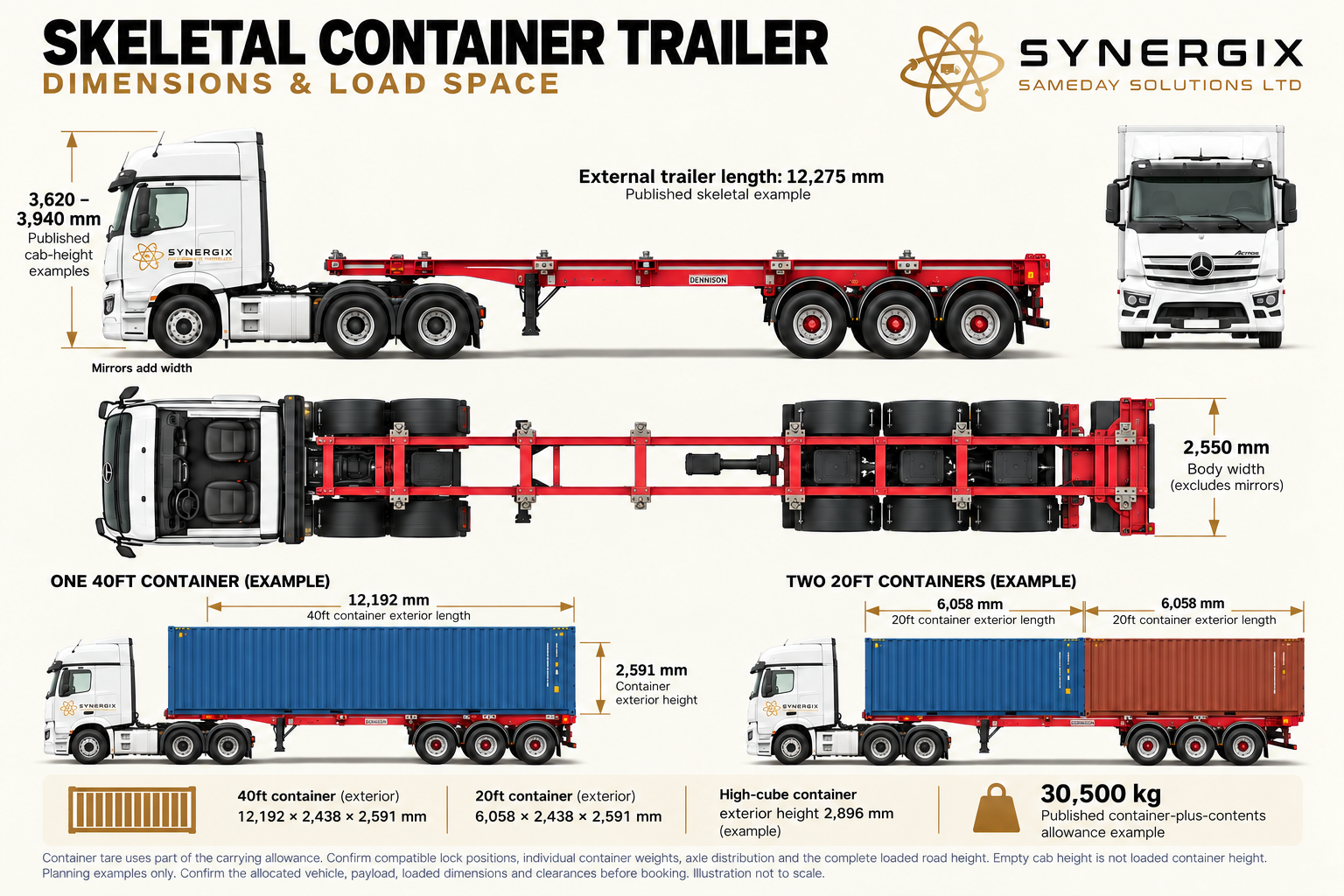
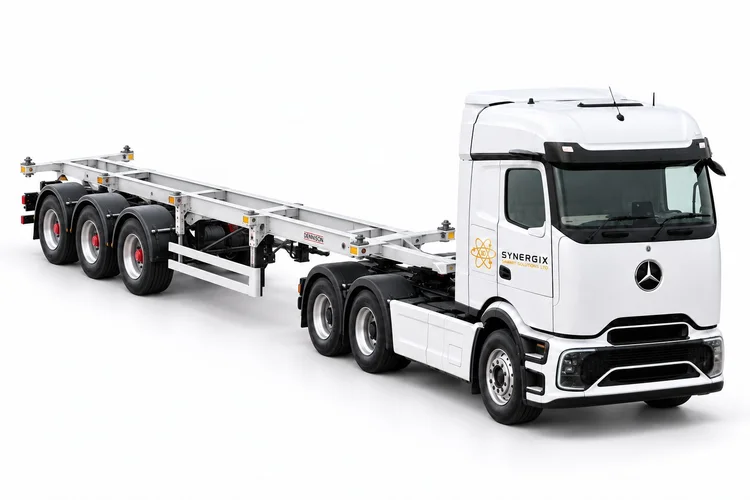
Skeletal container trailer
Published planning examples. The actual vehicle, equipment, load distribution and access must be checked for your booking.
Open the full-size diagramDimensions and planning figures in text
External trailer example 12,275 mm; width 2,550 mm; empty cab height 3,620–3,940 mm. One 40 ft OR two 20 ft containers on compatible locks. 40 ft exterior 12,192 × 2,438 × 2,591 mm; 20 ft exterior 6,058 × 2,438 × 2,591 mm; high-cube height 2,896 mm. Container-plus-contents allowance example 30,500 kg.
Container tare uses carrying allowance. No pallet count or universal loaded height. Selected frame length and payload are separate specifications.
Published example sources:
Configuration explained
Fixed container chassis.
A defined frame and approved container positions.
Construction and useful capability
The open chassis uses longitudinal structure and transverse support points rather than a normal continuous freight deck. Compatible container corner fittings and correctly engaged twistlocks connect the container to it. A fixed chassis can have more than one approved arrangement, but those positions are defined by its design, not by placing a box wherever it balances visually.
Loading, limitations and booking implications
Give the container size, type, gross mass and any weight-distribution information. A 20ft box can be particularly dense, so its approved carrying position matters for axle and kingpin loading. The carrier must know whether the container is empty, loaded or a specialist type. A chassis suitable for one ISO box arrangement is not automatically approved for every tank or swap body.
Configuration explained
Sliding and extending chassis.
Different approved running and loading arrangements.
Construction and useful capability
Some chassis alter length, support position or bogie relationship to accommodate different containers and weight distributions. The configuration suitable for loading may differ from the legal travelling position. Extensions, pins and locks need to reach their approved positions and remain secure. Adjustment is an equipment operation for competent staff, not a way to ignore axle limits.
Loading, limitations and booking implications
A container presented at the rear for dock access can impose a different load distribution from a central travel arrangement. Agree the handover, configuration and handling method with the sites. The actual model drawing and restrictions are more useful than a broad claim that every sliding skeletal handles all 20ft, 40ft and 45ft boxes.
Configuration explained
Two 20ft boxes and longer containers.
Multiple fitting patterns with additional loading questions.
Construction and useful capability
Two compatible 20ft containers need an approved paired arrangement and a mass/distribution plan for both. They do not become one freely positioned 40ft container. If one is removed or collected along the route, the remaining container’s position and axle loading still need to be valid. A heavy front box and light rear box can produce a different result from the reverse arrangement.
Loading, limitations and booking implications
Longer and specialist containers can use different corner fittings, tunnels, clearances or support needs. Confirm actual dimensions and the chassis manufacturer’s approved configurations. High-cube height affects the road envelope. A gooseneck chassis can help overall height for a compatible tunnel-equipped container, but does not establish clearance on every route.
The practical guide
How the equipment works.
20 ft, 40 ft and 45 ft containers
Specify the container’s actual length, width, height, corner fittings and gross mass. Common road-container arrangements include one 40 ft, two 20 ft containers or a suitable 45 ft container on a compatible chassis. A 45 ft pallet-wide unit may require particular extensions and geometry. “44 ft” is not a standard substitute for these labels; non-standard units need their actual drawing and mounting positions.
Two 20 ft containers need the correct chassis
The frame needs approved locks and support positions for both containers, with acceptable kingpin and axle loading. Gross weights do not simply split equally because the containers are the same length. A heavy front container and a light rear container can place different loads on the tractor and trailer group. Handling order, terminal access and whether either box remains after a delivery also matter.
A single 20 ft container may need a different position
A rear-flush 20 ft box can be convenient at a dock but may create an unsuitable load distribution on some chassis. Central, front, rear or sliding arrangements are manufacturer-specific. Use the chassis’s authorised position and load chart, not an improvised placement on spare twistlocks. A lift axle or slide does not automatically cure an overloaded axle.
Container tare reduces product payload
The road freight allowance includes the container, packaging and all goods inside it. If a complete combination can accept 26,000 kg of container-and-contents and the container weighs 4,000 kg, only 22,000 kg remains for goods and their packing before any other limiting check. This is an illustrative subtraction, not a promise of a particular chassis or container allowance.
Container plate and condition
Check the container’s identity, maximum gross rating, tare and relevant safety approval/examination status. Doors, corner castings, structure and floors must be suitable for the load and handling method. International container movements may depend on the CSC safety-approval plate and inspection regime. A container’s permitted gross mass does not override the truck’s lower road or axle allowance.
Twistlocks and approved supports
Container locks must correspond to the actual corner fittings and be correctly engaged and checked through the approved system. A skeleton supports a container through designed load paths; freight cannot be balanced on bare chassis crossmembers as though they formed a load deck. Extensions and locking pins require their own checks. A compatible footprint alone does not prove suitable structural support.
Flat racks and approved platform modules
A compatible flat rack or engineered demountable platform can provide an open cargo deck on a suitable skeletal. The module, fittings, chassis and loading conditions must be approved together. This is not permission to put an arbitrary 40 ft or 44 ft flatbed structure on top and strap it down. Include the module’s mass, usable dimensions, point-load ratings and rated cargo anchors.
Box bodies, swap bodies and specialised units
Certain skeletal or swap-body chassis accept approved demountable boxes, tanks or other bodies with the correct fittings and support. Not every container chassis accepts every swap body or filled tank container. Tank loads have different structural and dynamic effects. Specify the actual body and manufacturer approval; a standard skeletal booking does not automatically include a box, platform or container.
High cube and loaded road height
A high-cube container is taller than a standard-height box and must be matched to suitable chassis/coupling height and the route. Measure the overall loaded height, including the carrier. Tunnels, bridges and dock entrances can rule out a combination even when the container is a standard size. International route height limits and port rules also need checking.
The goods inside still need securing
Locking the container to the chassis secures the container, not every item inside it. The packed load needs an appropriate system against movement, including correct distribution and safe access when doors open. A seal is tamper evidence, not proof of load restraint or weight. The packing party must provide enough information for the road movement and acceptance checks.
Ports, VGM and documentation
Where a packed container is shipped by sea under the relevant SOLAS rules, the shipper needs verified gross mass before loading on the vessel. That is separate from checking road weight and axles. Give container number, seal, terminal reference, release status, booking slot, customs requirements and who provides the lifting equipment. A missing release or weight can prevent collection despite a truck being present.
Lift-on, lift-off and ground delivery
A plain skeletal normally needs external container-handling equipment at the relevant handover points. A Megalift/side-loader or an assessed crane arrangement provides different handling options at greater tare and cost. If the container needs to be left on the ground, say so explicitly. Door orientation, final level and access for later collection must be agreed.
The practical guide
Container mass and container handling.
Work from gross mass, not payload alone
For illustration, a 4,000 kg container carrying 18,000 kg of goods imposes 22,000 kg before considering the chassis and tractor. The road outfit must stay within its own complete and axle limits. The container’s permitted gross mass is another limit, not permission to carry that full amount on any road combination. Use actual tare and verified load data.
VGM is a sea-loading requirement
A packed container for a SOLAS sea movement needs the appropriate verified gross mass process. That helps identify total container mass, but road checks still need the actual tractor/chassis, permitted positions and axle distribution. Sea documentation and a secure seal also do not prove that cargo inside the container has been restrained correctly for road transport.
The locks secure the box, not the contents
A sound container and engaged compatible locks prevent the container separating from its carrier through the intended system. Inside, the freight still needs appropriate packing, blocking and restraint. A sealed load may limit driver inspection, so the consignor needs to supply relevant mass, distribution, contents and securing information. Dangerous goods and residues must be declared.
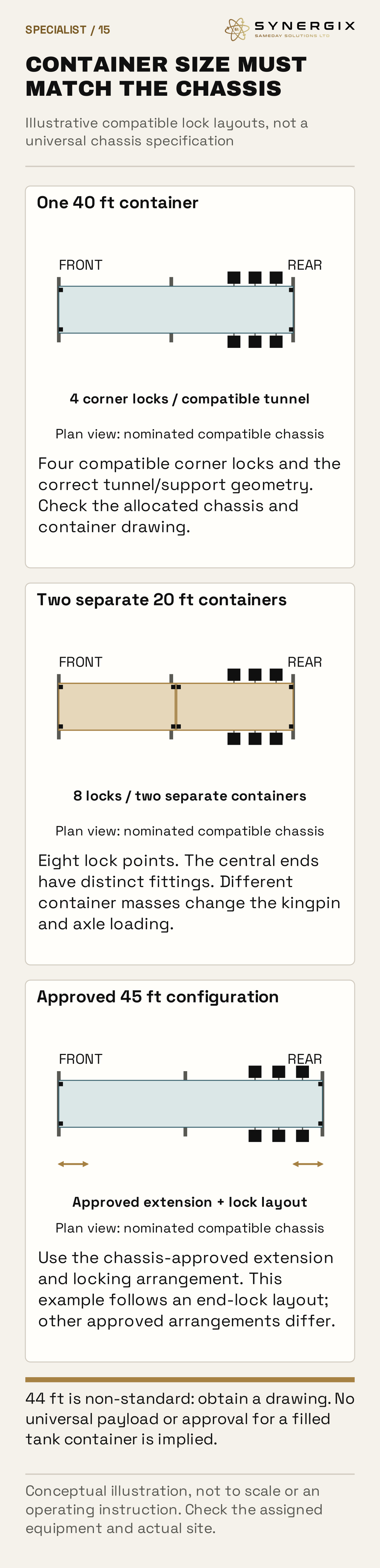
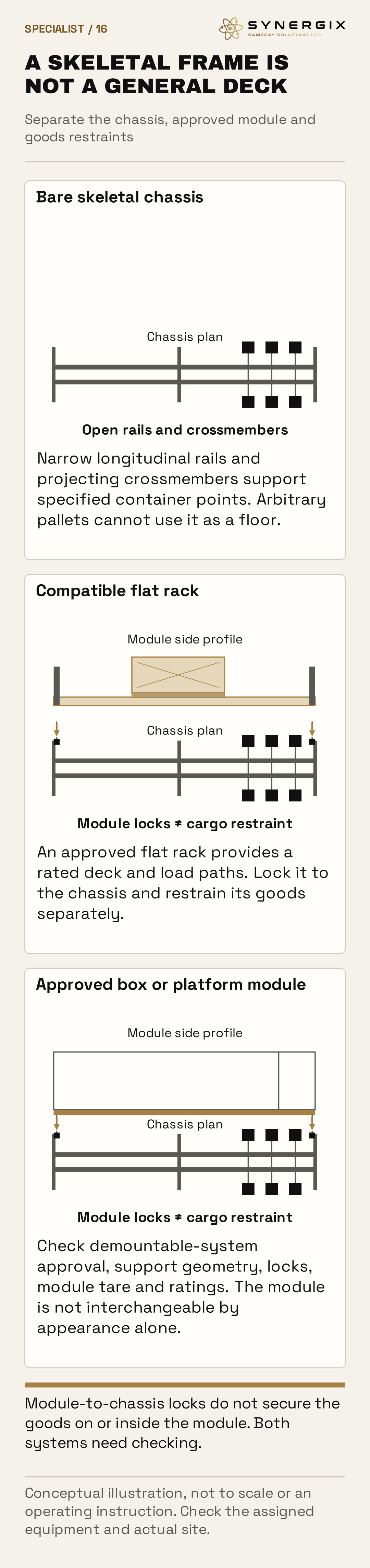
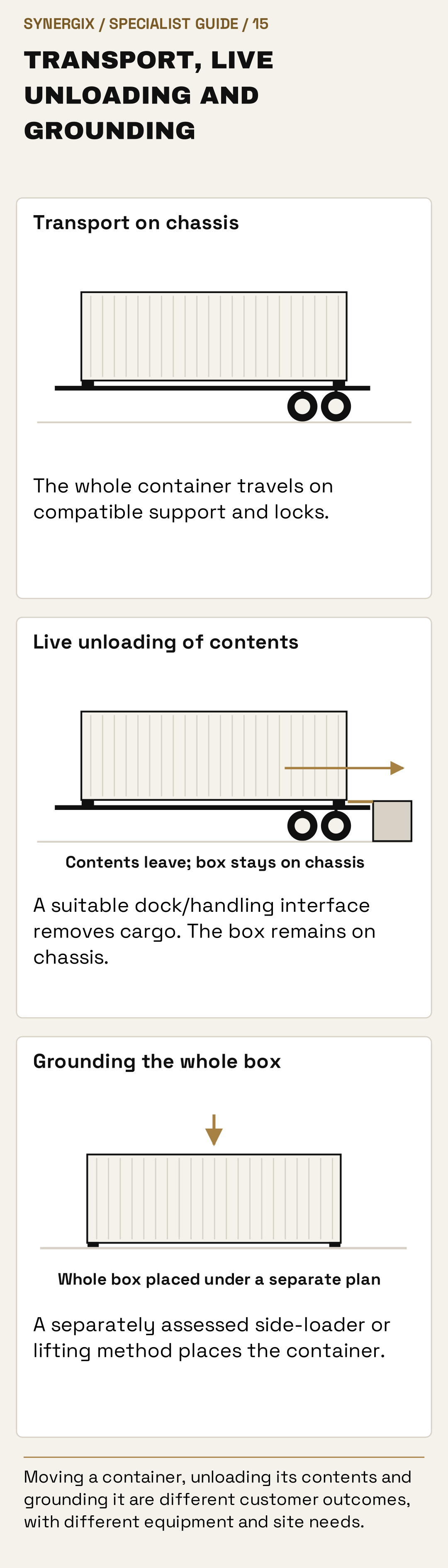
Moving a container, unloading its contents and grounding it are different customer outcomes, with different equipment and site needs.
Open full-size desktop diagram · Open full-size mobile diagramThe practical guide
Port, yard and receiver.
A container move has several handovers
Provide container number, size/type, collection and release references, terminal/depot, booking slot, customs/release status where relevant and receiving contact. Identify detention, waiting and empty return instructions in the commercial agreement. A truck arriving at the port cannot resolve an unreleased box simply because a road journey was booked.
Loaded on the chassis or placed on the ground
A warehouse can unload cargo from a box that stays on a compatible chassis through an appropriate dock arrangement. Grounding the whole container needs external lifting or a suitable side-loader/crane arrangement. Ask which outcome is required. An ordinary skeletal has no independent mechanism to place a container on a yard floor.
Doors, support and access
A container at trailer-floor height needs a suitable loading interface and approved support/restraint if uncoupled. Grounded containers need an appropriate prepared support arrangement, including the structural corner support specified for the unit and loading duty. Allow door swing and future collection access. A door opening against a wall can make a correctly placed box unusable.
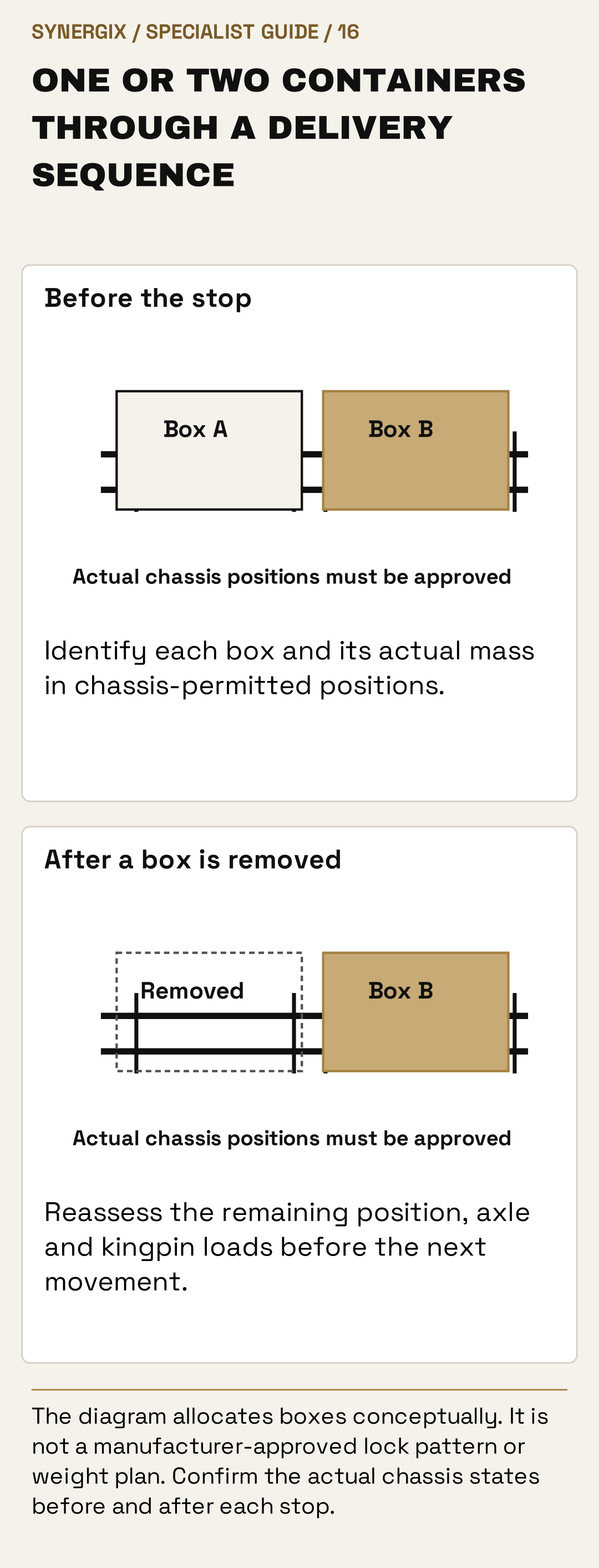
The diagram allocates boxes conceptually. It is not a manufacturer-approved lock pattern or weight plan. Confirm the actual chassis states before and after each stop.
Open full-size desktop diagram · Open full-size mobile diagramThe practical guide
Condition and servicing.
Container support and locks
Inspect lock condition and engagement, supports, chassis pins and extension locks through the operator’s system. Distorted corner fittings, damaged lower structure or seized mechanisms need assessment. The frame must carry the intended container in the approved position. Do not substitute casual straps for an unsuitable or defective container connection.
Two assets with different records
The road trailer needs its roadworthiness and equipment maintenance. The container has its own structural and, where applicable, CSC examination/approval evidence. These are separate from product cleanliness, seal identity and dangerous-goods requirements. An in-date container plate does not excuse a damaged floor or establish compatibility with any chassis.
Special boxes need special acceptance
Tank containers, reefers, open tops, flat racks and unusual intermodal units need their own compatibility and cargo checks. A reefer may need a suitable power arrangement for the journey; an ordinary skeletal does not guarantee a generator. A loaded tank has mass and stability considerations beyond external size. Supply the actual container type and documentation.
The practical guide
The complete approach and working area.
The gate is only one part of access
Use the actual loaded vehicle dimensions and assess the approach, bends, mirrors, rear swing, gradients and departure. A route that admits the cab may still be unsuitable for the trailer or its load. Height includes the body, supports and cargo, not just the nominal vehicle category. Where required, the in-cab height indication must represent the actual overall height.
Space to complete the operation
The site must accommodate terminal slots, container positioning, handovers, release checks and cargo receiving time. Add working space to the parked outline, with suitable ground and separation from people and traffic. Overhead lines, canopies, drains, buried services and weak edges may be relevant. Photographs help identify obstacles, but cannot certify hidden ground strength or approve a machine’s duty.
Permissions and receiving authority
Give timed-access rules, parking/road occupation constraints, site inductions, authorised contacts and the actual receiving point. An except-for-access exemption does not suspend a weak-bridge or physical height restriction. For unusual mass, width, length or projections, the operator establishes the appropriate road framework and any surveys, notices or other arrangements. GB, Northern Ireland and international movements can have different requirements.
The practical guide
Condition, records and responsibility.
Condition on the day
For this family, focus on locks/supports, extension pins, container fittings/structure and road records. Pre-use checks and defect reporting remain essential alongside scheduled maintenance. A current annual test or an equipment sticker cannot approve a newly damaged component. Stop using defective equipment and have it assessed through the appropriate competent process.
Servicing, tests and examinations are different
The road vehicle/trailer needs its roadworthiness programme. Specialist mechanisms need manufacturer-based maintenance suited to age, duty, environment and condition. Where lifting or pressure equipment falls within a statutory inspection or examination regime, its reports and defect actions have their own purpose. Do not replace all of these with one claim that the vehicle is serviced annually.
Agree the roles
The consignor supplies accurate goods, weights, dimensions and handling information. The carrier and driver retain their own road and equipment responsibilities. The receiver provides the agreed access, receiving arrangement and authority. Identify who loads, operates machinery, provides documents and receives the goods. Ownership or hire of equipment does not remove the duties of those using or controlling it.
The practical guide
Driver hours and a realistic schedule.
Driving is only part of the job
Allow for terminal slots, container positioning, handovers, release checks and cargo receiving time, as well as travel, queues and departure. Loading, equipment operation and checks are normally work, not a driving break simply because the vehicle is stationary. Waiting has to be classified under the applicable conditions; unknown waiting with continuing duties is not automatically rest.
The usual in-scope HGV limits
For a normal in-scope operation, the assimilated rules generally allow nine hours of daily driving, extendable to ten twice a week, with 56 hours in a week and 90 across two consecutive weeks. After 4½ hours of driving, a qualifying 45-minute break is required, which can normally split as 15 then 30 minutes. Rest, working time, the actual regime and any valid exceptions also need consideration. These limits are not an arrival-time calculator.
Working time, rest and overnight work
Mobile-worker rules generally limit working time to a 48-hour weekly average and 60 hours in an individual week, with separate break and night-work provisions. Previous duties can reduce what the assigned driver can do on your job. A long movement can require suitable overnight parking, sleeper/hotel arrangements, relief or a multi-day plan. A specialist day cab does not automatically provide sleeper accommodation.
Routes and vehicle scope matter
The actual vehicle, activity and route determine the applicable rules. Since 1 July 2026, relevant UK/EU international light-goods movements over 2.5t can fall within expanded hours/tachograph scope; that is not a blanket statement about every domestic van. International requirements, borders, site hours and ferry timings belong in the schedule.
The practical guide
What the quotation needs to cover.
Quote the whole movement
The useful starting specification is container identity/type/gross mass, chassis positions, lifting and port release. The price covers the suitable vehicle/equipment, competent people, full route, agreed handling, availability and time. It is not simply a loaded-mile fuel calculation. Tell us about urgency, exact slots, extra stops, waiting, returns and work beyond the vehicle.
Positioning and onward mileage
The vehicle may need to travel to collection, reposition, return equipment, use a wash or move to another agreed handover. Empty mileage still uses time and energy. Uncoupled hire, delayed release or a second visit can create additional work. Agree these elements in the quotation, including what happens if the site or goods are not ready.
Good preparation helps value
Accurate dimensions and weights, clear access, prepared receiving equipment and a ready contact reduce the risk of a failed visit. Appropriate specialist equipment can cost more per mile while completing the actual job more effectively. The cheapest vehicle description is not a useful comparison if it excludes the handling you need.
The practical guide
Fuel, auxiliary power and emissions.
Count the actual energy sources
The energy plan includes road travel, any agreed reefer power and positioning or empty-return mileage. Load, equipment mass, road speed, gradients, traffic, stops and weather all affect consumption. Published economy for another body or a lightly loaded vehicle is not a reliable specialist-job MPG. Use measured data or clearly declared assumptions for an estimate.
Avoid double counting
If fuel is measured for the complete movement, do not add the same engine-driven PTO consumption again. A separate refrigeration engine, compressor, generator or metered supply may need its own entry. Include positioning and the agreed return scope. Distinguish an energy estimate from an actual vehicle record and avoid claiming a single consumption figure for the whole equipment family.
Electric feasibility is a duty decision
Electric road vehicles or auxiliaries can suit appropriate known routes with compatible power, range, charging and reserve. Their suitability depends on the load, deadline, auxiliary demand and reliable supply; availability is confirmed separately. Electric standby on a trailer is different from an electric tractor and does not make the entire movement electric.
Use a consistent reporting boundary
CO₂ measures carbon dioxide; CO₂e includes other greenhouse gases on an equivalent basis. Compare like-for-like combustion and upstream fuel, or electricity generation/supply, as applicable. A whole-life comparison also needs manufacture, batteries/equipment, maintenance and end of life. No exhaust at the vehicle is not the same as no lifecycle impact. A calculated footprint needs its date, factors and assumptions.
Choose the equipment for the outcome
Compare the adjacent choices.
| Alternative | Reason to assess it |
|---|---|
| Side-loader | Where the whole container needs assessed ground placement without site lifting. |
| Flatbed with approved fittings | Only where the actual container support/securing and load plan are suitable. |
| Unpack cargo at a dock | Where unloading contents with the container remaining on chassis meets the requirement. |
Put the information to work
Three practical booking examples.
One heavy 20ft container
Check actual gross mass, approved chassis position and axle/kingpin loads. Its short length does not make it a light or easy road load.
Two 20ft boxes with different stops
Plan each container’s mass and position through the sequence, including the outfit after the first box is removed. Confirm lifting at both handovers.
A container for a site without lifting equipment
Compare a side-loader or an appropriate crane method with arranging site lifting. State the final position, orientation, ground and access.
Terminology in plain English
Useful equipment terms.
- Twistlock
- A compatible locking connection engaging the container’s designed corner fitting.
- Kingpin load
- The trailer load transferred to the tractor through the fifth wheel.
- VGM
- Verified gross mass for a packed container in the relevant SOLAS sea-loading process.
- High cube
- A taller container type that changes the complete road height.
- CSC
- The container safety approval/examination framework, separate from road trailer condition.
- Grounding
- Placing the whole container off the carrier onto suitable prepared support.
Why Synergix
Confidence in the whole delivery.
Practical transport experience
Three generations of family transport experience support useful decisions about the load, site and receiving operation. We bring those details together before agreeing the movement.
Direct delivery and wider capability
Dedicated direct delivery and UK/European capability help connect collection with the required handover. Specialist equipment, route, timing and availability are confirmed for the actual job.
Tracking and proof of delivery
Live tracking and delivery evidence help you follow progress and establish receipt. Any specialist temperature, cleaning or equipment record needs to be requested in the required format before booking.
Insured transport and active support
Insured transport and active operational support provide reassurance through the movement. Declare goods, value and unusual handling so applicable cover and terms can be confirmed. No unlimited cover or automatic acceptance is implied.
Specialist equipment availability and mobilisation are confirmed for the job. Synergix’s separate 60-minute UK courier collection proposition is not a universal guarantee for these specialist vehicles.
Skeletal container trailers and chassis FAQs
Your questions answered.
Does a skeletal unload the container?
A standard chassis carries it. Grounding or transfer needs suitable external equipment or a separately specified self-loading arrangement.
Can every chassis carry every container size?
No. Use the model’s approved positions, fitting pattern, support, weight and dimensional limits.
Can two 20ft containers travel together?
On a compatible approved arrangement with suitable individual masses and distribution, subject to the complete road checks.
Is the sea VGM enough for road transport?
No. The actual road outfit, axle loads, positions, route and internal cargo security remain separate checks.
Can you move an empty container?
Provide its size/type, actual tare, condition, collection and delivery handling and authority to release it.
What is a gooseneck chassis?
A shaped front frame designed to fit the tunnel of a compatible container, which can help reduce overall height. Compatibility and the loaded route still matter.
Are tank containers ordinary container loads?
No. Declare the product, gross mass, approvals and actual tank/chassis compatibility. External size alone is insufficient.
What affects container transport cost?
Complete mileage, container type/mass, chassis, port/depot slots, waiting, lifting, release status, returns and timing.
Before you book
Tell us what needs moving.
You do not need to identify every equipment model before contacting us. Start with container identity/type/gross mass, chassis positions, lifting and port release.
Describe the goods
Product/type, quantity, packed dimensions, verified gross unit weights or density/volume as relevant, support/handling points, condition, value and any hazards, hygiene or temperature instructions.
Show both sites
Postcodes, approach, restrictions, measured openings, ground, working space, loading/discharge equipment, receiving position, contacts and useful photographs or drawings.
Define the work
Date/time windows, stops, loading/unloading roles, equipment operation, placement or transfer, parked periods, returns, cleaning and required documents. Include any installation or indoor handling as a separate requested scope.
Agree the arrangement
The team confirms the appropriate equipment, availability, scope, price and conditions. A vehicle illustration or LoadCheck calculation is planning help, not a reservation or approval for specialist handling.