
XLWB van
courier service
Available XLWB van body types
An enclosed panel van is the standard starting point. Refrigerated or temperature-controlled work needs its own specification and availability check.
Standard enclosed panel van
An XLWB panel van carries the goods inside a fixed enclosed body, separated from the cab. It is useful for long packaged materials, larger equipment, cartons and suitable palletised freight. The additional body length gives more floor room than our LWB guide without assuming truck handling or a wider box body.
Rear doors are the usual route for pallet loading. A sliding side door may help with smaller items or the collection sequence, but its aperture is not an open curtain side. Confirm the actual openings and the equipment at both sites. A forklift must not be assumed able to place a long crate through any door.
Use 420 × 120 × 180 cm and up to 1,100 kg to start the enquiry. These are Synergix category planning guides. They are not the maximum specifications of every vehicle with an XLWB badge.
Refrigerated or temperature controlled
Specify chilled, frozen or controlled ambient conditions, the required temperature range, product, starting condition and journey. A larger van alone does not establish temperature control, recording or any product-specific transport standard. Agree the arrangement before booking.
Insulation, cooling equipment, partitions and the energy supply can reduce useful space and payload. The temperature-controlled version must be assessed on its actual converted measurements and working weight. Do not transfer the standard panel-van figures to a refrigerated body.
Allow for airflow, how goods are packaged, exposure while loading and unloading, and the order of multiple deliveries. Preconditioning, monitoring, cleaning or segregated compartments are included only where expressly agreed.
Check the usable space after conversion.
Insulation and cooling equipment can reduce an XLWB van’s usable space and payload.
Send the packaged dimensions, total weight and required temperature so we can check a suitable vehicle.
A panel body has practical boundaries.
A panel van shields packed freight from direct weather exposure. It is not automatically insulated, humidity controlled, suitable for loose liquids or equipped to secure any load without preparation. Cargo walls and a closed door are not a complete restraint plan.
Need side forklift access or a tail lift?
An ordinary XLWB panel van does not include a tail lift, curtainside or crane. If ground-level unloading, a wide side opening or a particular body is essential, describe the task. A suitable Luton or larger specialist vehicle may solve the handling requirement even when the goods fit inside an XLWB.
XLWB van dimensions and pallet capacity
Start with the guide, then confirm the actual van, finished goods and loading method. Weight, floor positions and access are separate checks.
- Planning load length
- 420 cm / 4.2 m
- Planning load width
- 120 cm / 1.2 m
- Planning load height
- 180 cm / 1.8 m
- Calculated rectangular volume
- 9.072 m³, approximately 9.07 m³
- Total shipment weight
- Up to 1,100 kg
- Pallet allowance
- Up to four, subject to checks
- Loading access
- Rear doors; side opening varies
- Tail lift
- Not a standard panel-van feature
Booking space is different from brochure space.
XLWB means extra long wheelbase in everyday courier language. Manufacturers may call a configuration extra long, extended or L4, but length and roof codes are not consistent across brands. Mercedes-Benz Sprinter, Ford Transit, Renault Master and Volkswagen Crafter versions have different dimensions and gross ratings.
Our rectangular 9.072 m³ guide comes from 4.2 × 1.2 × 1.8 metres. A quoted total interior volume can include curved areas or wider space above wheel arches that your crate cannot use. A published maximum for a model range may also belong to a different roof, drivetrain or gross-weight version.
The illustrated body is wider than our booking rectangle in some places. That does not turn its maximum width into a guaranteed continuous clear width from floor to roof. Doors, arches, lining, supports and securing space must all be checked.
Outside length, mirror width and overall height are separate site-access measurements. A generic size label cannot certify that the assigned vehicle clears a gate, canopy or tight turning area.
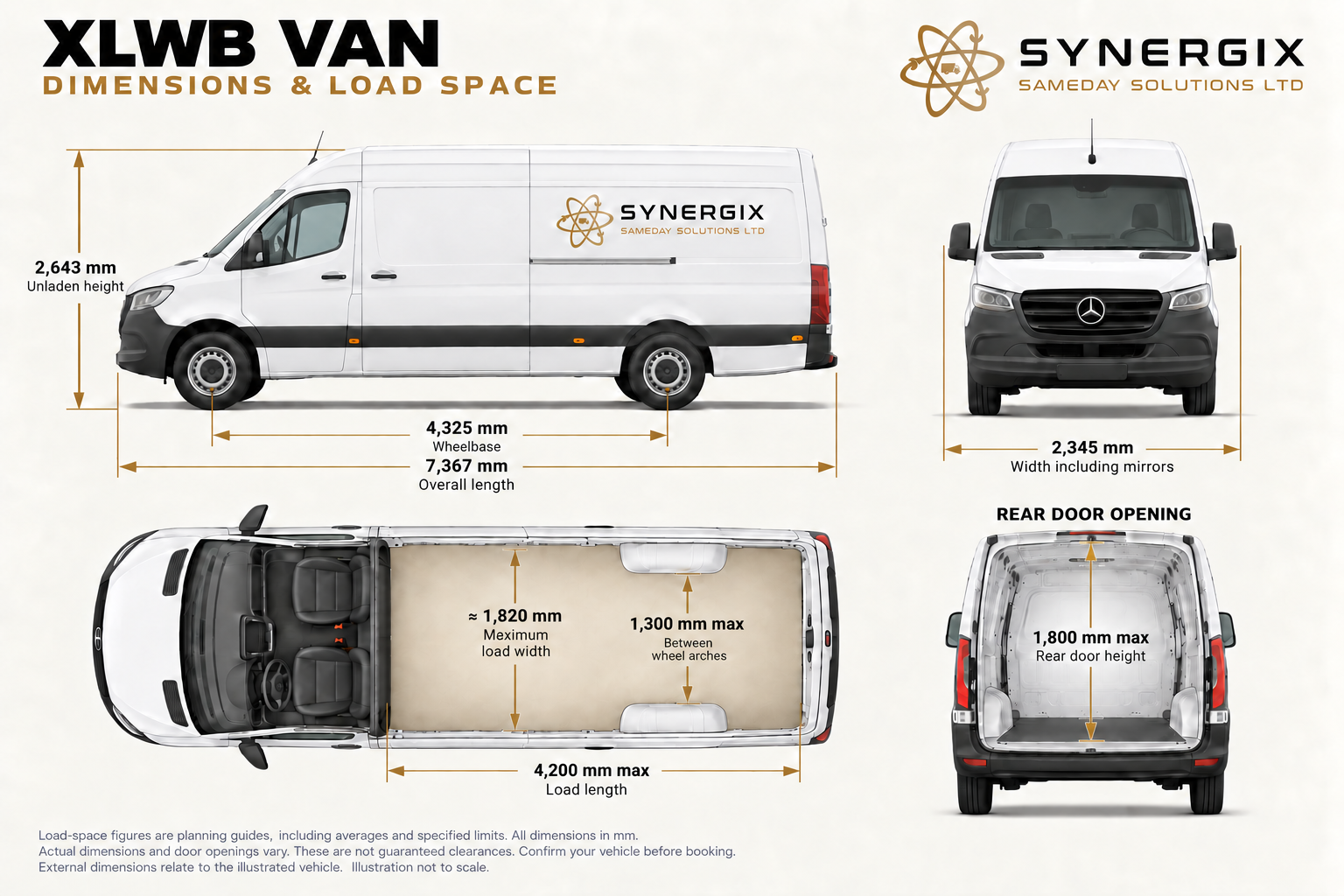
Use 420 × 120 × 180 cm and up to 1,100 kg to begin your enquiry. The illustration’s wider maximum sections do not replace that booking rectangle. The 1,800 mm rear-door figure describes an opening, not a universal interior height. Confirm the finished load, entry path and restraint in the actual van.
Read the diagram measurements
- Illustrated overall length: 7,367 mm.
- Illustrated wheelbase: 4,325 mm.
- Illustrated unladen height: 2,643 mm.
- Illustrated width including mirrors: 2,345 mm.
- Shown maximum load length: 4,200 mm.
- Illustrative maximum load width: approximately 1,820 mm.
- Shown maximum between wheel arches: 1,300 mm.
- Shown maximum rear-door opening height: 1,800 mm.
All dimensions are in millimetres. Exterior figures relate to the illustrated vehicle; the drawing is not to scale. Actual doors, lining, equipment and required clearances still need checking.
A 4.2 m floor does not guarantee a 4.2 m long crate.
A finished rigid crate needs to pass through the rear opening, clear the bulkhead and sit where it can be supported and restrained. Handles, skids, wrapping, protective end pieces and tolerance count. A crate exactly matching the nominal bay length can leave no room to load or secure it.
Give the largest item’s finished dimensions separately from total volume. Say whether it may tilt, turn or lie down and identify support or lifting points. A diagonal line in an empty rectangle does not prove a real three-dimensional loading manoeuvre.
Measure the loaded pallet, including the base.
A common UK pallet base is 120 × 100 cm; a Euro base is 120 × 80 cm. Cartons, drums or wrapping may overhang the base. Measure maximum length, width and height after packing, and give the gross weight including the pallet.
For an EPAL Euro pallet, the nominal base height is 14.4 cm and approximate empty weight 25 kg. Even before clearance, that base uses part of the height allowance. Another pallet design can have different mass and dimensions.
| Empty base arrangement | Footprint used in one row | Practical meaning |
|---|---|---|
| Four UK bases: 100 cm along the bay, 120 cm across | 400 × 120 cm | Within a 420 × 120 cm rectangle on paper; exact width, arches, loaded overhang and restraint need checking. |
| Four UK bases: 120 cm along the bay, 100 cm across | 480 × 100 cm | Exceeds the 420 cm length guide. Four pallets cannot be promised in this orientation. |
| Four Euro bases: 80 cm along the bay, 120 cm across | 320 × 120 cm | Leaves theoretical length, but door/arch clearance, loading direction and distribution still matter. |
| Four Euro bases: 120 cm along the bay, 80 cm across | 480 × 80 cm | Exceeds the planning length despite the narrower footprint. |
| Five Euro bases: 80 cm along the bay, 120 cm across | 400 × 120 cm | A theoretical empty-base layout, not our booking allowance. Synergix’s XLWB guide remains up to four suitable pallets. |
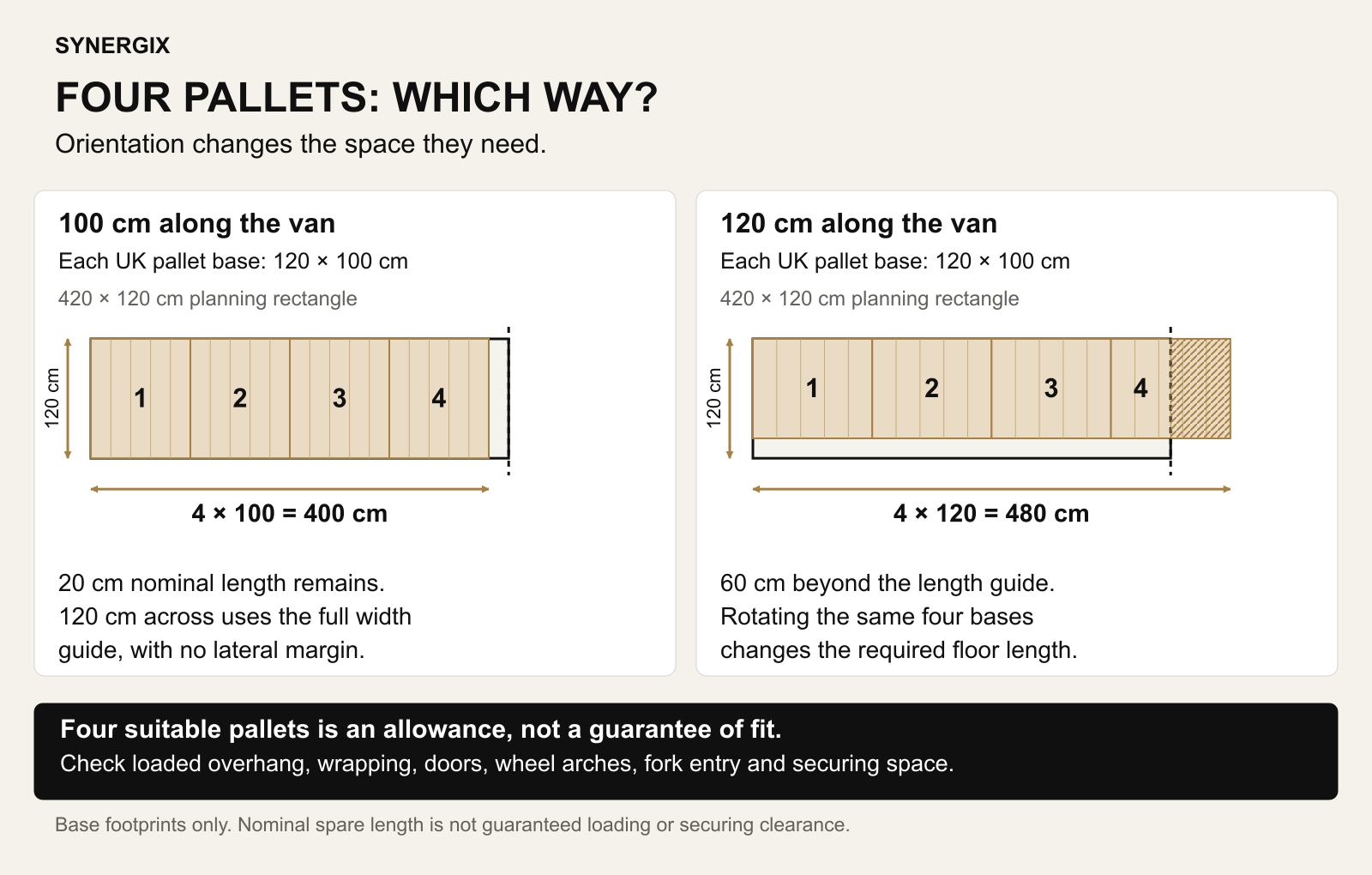
Four pallets: orientation changes the fit.
Four 120 × 100 cm pallet bases use 400 cm when their 100 cm side runs along the van. Against the 420 × 120 cm planning rectangle, that leaves 20 cm nominal length and no nominal width margin.
Rotating the same bases uses 480 cm of length, exceeding the guide by 60 cm. Loaded overhang, wrapping, access and securing space still need checking.
Four pallet spaces do not mean four heavy pallets.
Four gross pallet weights of 275 kg total 1,100 kg, exactly the category limit. Four at 300 kg total 1,200 kg and exceed it. Count bases and wrapping before deciding, and provide individual weights for load distribution.
At an individual loaded pallet weight of 800 kg or more, request an electric pallet truck under Synergix’s booking rule. This does not guarantee that the truck, pallet or lift operation is suitable. A powered truck’s own weight and the actual loading arrangement matter; lighter pallets may also need powered assistance.
What is an XLWB van courier?
An XLWB adds usable cargo length and floor positions. It remains a panel van with its own door, weight and site-access limits.
More useful length for goods that need it.
An XLWB courier is a dedicated extra long van and driver for an agreed collection, journey and delivery. It is particularly useful when a long rigid item or additional floor positions exceed our LWB guide, but the freight does not require a wider box, a tail lift or a heavier truck.
The label describes a category rather than one exact model. Wheelbase is axle-centre spacing. Overall length includes front and rear overhangs; load length is the usable space behind the cab. A manufacturer can extend a body without increasing wheelbase, so an extended L4 is not necessarily a different axle spacing from every shorter variant.
More room is useful only if the item enters, the load stays within the working payload and both addresses can handle it. An XLWB can run out of weight allowance while appearing half empty, or be full of light bulky goods long before reaching its kilogram limit.
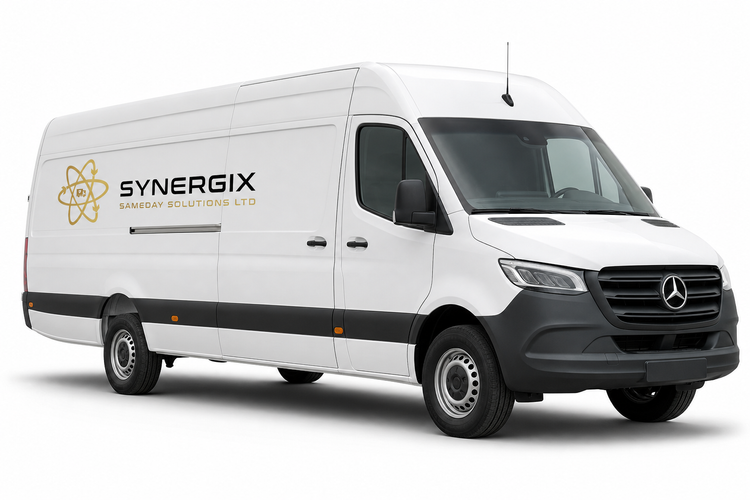
Dedicated transport with a workable plan.
A direct booking gives your consignment an agreed journey instead of assuming it will move through a shared pallet network. It can help with appointment-sensitive equipment, long goods and urgent production requirements that need the load and handover organised together.
Dedicated does not establish instant availability, a guaranteed drive time or unlimited driver handling. Loading, receiving arrangements, safe driving and communication remain part of delivering the service properly.
Our broader transport service still matters.
Synergix arranges urgent courier work alongside planned deliveries, regular haulage, retail distribution, warehousing, two-person delivery, specialist transport and event refrigeration. An XLWB may be one suitable leg of a larger requirement.
Tell us the goods, route and outcome needed. A smaller van can be better for compact work; a Luton or truck can be better for width, heavier freight or agreed unloading equipment. The vehicle should serve the job.
Why use a 1,100 kg XLWB payload guide?
Published maximum payload, remaining working capacity and the accepted shipment guide are different figures. The lowest applicable limit controls.
Why the longer van can carry less.
Synergix’s XLWB consignment guide is up to 1,100 kg, compared with up to 1,250 kg for LWB. Extra bodywork and equipment can make a longer vehicle heavier while the permitted gross weight stays the same. More cubic space therefore need not mean more remaining freight capacity.
These are category operating guides, not a measured fleet average or a legal maximum applying to every model. A manufacturer’s highest payload can belong to a shorter, lower-roof or heavier-plated version. Check the actual vehicle rather than reading the largest number on a range overview.
A 3.5 tonne vehicle rating is total permitted laden mass, not 3.5 tonnes of goods. Battery-electric vans can have different gross ratings and payloads; diesel figures cannot automatically be transferred to them.
Fuel, driver and equipment already occupy capacity.
A ready-to-work van includes people, fuel, lining, straps, tools and any fitted or carried equipment. Remaining capacity is what is available inside the gross and axle limits after that running weight is established.
Published unladen, kerb and mass-in-running-order figures use different conventions. Some already include a nominal driver or fuel quantity. Check the definition before deducting those items a second time. There is no reliable universal subtraction that converts every brochure payload into our 1,100 kg guide.
The freight figure must include pallets, cases, stillages, protective packing and equipment travelling with the goods. A product-only weight is insufficient, especially for multiple pallets close to the limit.
| Component | Illustrative amount | What it establishes |
|---|---|---|
| Permitted gross weight | 3,500 kg | Total ceiling for this hypothetical vehicle; axle limits apply separately. |
| Measured ready-to-work weight | 2,350 kg | Assumed to include the actual driver, fuel and equipment for the job. |
| Remaining gross-weight capacity | 1,150 kg | 3,500 minus 2,350. Not automatically a freight acceptance or axle approval. |
| Synergix XLWB category guide | Up to 1,100 kg | The lower operating guide still applies. A real vehicle with less remaining capacity requires a lower load. |
Rear axle and load position matter.
A heavy pallet near the rear doors can impose a very different axle load from the same pallet correctly positioned further forward. A load behind the rear axle can increase rear-axle load by more than its own mass while reducing the front reaction. Total weight alone cannot establish legality or handling.
Wheelbase, ready-to-work axle weights and the load’s centre of gravity are needed for a defensible assessment. Suspension appearance or the number of unused floor spaces is not evidence of remaining axle capacity. Dense machinery and liquids also need support and movement checks.
Wear and tear is a planning concern, not a new legal formula.
Repeated heavy loading can increase demands on tyres, suspension, brakes and driveline. Poor positioning and inadequate restraint can worsen the task. A sensible operating guide supports consistent planning and equipment care.
It does not authorise overload or prove an exact reduction in wear. The individual vehicle’s gross, axle, tyre and floor limits remain decisive, and a lower verified limit takes precedence over a category headline.
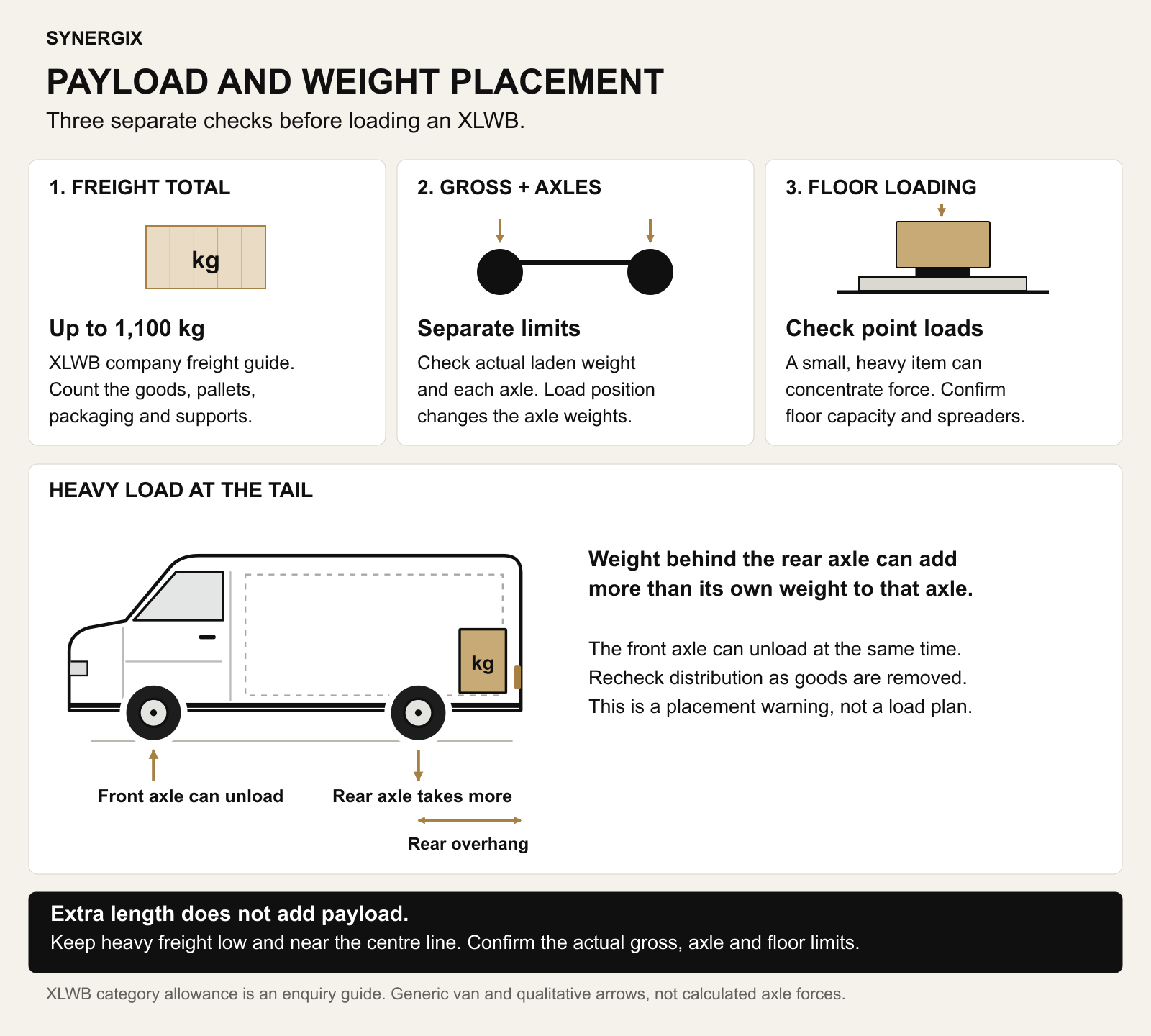
Extra length does not add payload.
The up to 1,100 kg freight guide includes the goods, pallets, packaging and supports. Actual gross weight, individual axle limits and concentrated floor loads are separate checks.
A heavy item behind the rear axle can increase that axle’s load by more than the item’s own weight while reducing the front axle load. Confirm the actual distribution and recheck it as goods are removed.
Over 1,100 kg? Extra length is not the solution.
If the gross shipment exceeds our XLWB guide, disclose it before booking. A suitably sized LWB may be worth assessing within its 1,250 kg guide, or a truck or agreed split movement may be required. A standard Luton also has a 1,100 kg guide, and our tail-lift Luton guide is lower at 900 kg.
Never omit packaging or divide the weight by pallet count to disguise the total. Provide the full consignment and individual heavy-item weights so the correct category and loading arrangement can be assessed.
What is an XLWB van used for?
Extra length helps when the finished consignment needs it. Goods, packaging, handling and the receiving site decide the final arrangement.
Long engineering parts
Packaged shafts, extrusions, pipework, machine components and long assemblies may need the additional bay length. Tell us the full finished length, weight, supports, fragile sections and approved lifting points.
A slender item can still be heavy or flexible. The load must be supported without damaging it and restrained against forward and sideways movement. Loose ends cannot be left free simply because the doors close.
Building and fit-out materials
Long boxed joinery, trim, conduit, panels and packaged fixtures can suit an XLWB when length is the constraint. Give individual item dimensions, whether stacking is permitted and the delivery access.
A nominal material length is not the packaged length. Heavy tiles, masonry or dense stock may exhaust the weight guide quickly. Loose material and dirty or incompatible loads need separate assessment.
Retail stock and display units
Larger cartons, light retail fixtures, shelving components and promotional displays can use the floor length. An agreed store schedule, contact, handover reference and receiving equipment are important.
A shop entrance is different from a goods-in bay. Indoor positioning, stairs, unpacking and a second person need agreeing, even if the consignment fits inside the van.
Printing, signage and exhibitions
Long printed panels, exhibition components and protective flight cases benefit from a direct movement with an agreed unloading point. Keep corners, surfaces and upright requirements clear in the booking.
Venue access windows, inductions, vehicle height limits, build schedules and return collections can affect the plan. An exhibition deadline does not remove the need for safe handling or legal breaks.
Equipment and bulky light freight
Packed furniture, insulation, lightweight assemblies and equipment can fill space before reaching 1,100 kg. Measure the largest indivisible item rather than adding carton volume alone.
A high-roof shape is not a square box. Tall wide units may favour a Luton even if their length is within 4.2 m. Protective packaging and restraint still take space.
Suitable palletised consignments
Up to four suitable loaded pallets can be assessed within the combined guide. Give each footprint, height, gross weight and loading equipment at both ends.
This is a planning allowance, not a promise of four UK pallets in every orientation or four heavy pallets. The actual vehicle and manoeuvre decide acceptance.
Good uses for regular transport.
An XLWB can support repeated collections, replenishment, warehouse-to-store movements and supplier routes where the load pattern justifies the extra length. Reliable dimensions and receiving arrangements make a repeat allocation easier to assess.
Do not size a regular route only around the first delivery. A changing load mix, several stops or returns may alter capacity and access. Agree how exceptional items and peaks will be handled.
When the XLWB is a poor match.
A few small cartons do not justify the longer body by themselves. Very heavy compact freight, goods needing a broad unobstructed side opening, oversized tall crates or unsupported long pallets can need a different vehicle or handling plan.
Vehicle size is only one part of suitability. Dangerous goods, controlled temperature, high value and fragile contents have additional requirements. Declare them early rather than treating extra cargo room as universal acceptance.
XLWB van benefits and disadvantages
The useful advantage is additional load length in an enclosed van. The trade-offs include payload, manoeuvring room and ordinary panel-van handling.
Why choose the extra long body?
A single suitable XLWB can keep a long item or additional compatible cartons together, avoiding an unnecessary second vehicle or an awkward split. An enclosed direct movement can suit commercial freight whose main constraint is length rather than width or weight.
The van format can be useful for sites that accept light commercial vehicles, but the actual 7 m-plus example still needs space. It is not reasonable to assume the same parking or turning behaviour as an SWB.
Additional capacity can also help retain room for an agreed loading sequence or supports. That room is useful working clearance, not permission to exceed the dimensions or leave a load unsecured.
What are the drawbacks?
Our XLWB guide is 150 kg lower than our LWB guide. The extra length can be unnecessary for a compact load and can make confined sites, street bays and reversing more difficult. Door and wheel-arch limits remain.
A high or long body can experience different aerodynamic and weather demands from a smaller van. Consumption depends on actual specification, loading and route. There is no justified fixed percentage fuel penalty for every XLWB.
A panel van normally depends on prepared loading and unloading arrangements. Extra space does not supply a forklift, tail lift, second person or a wider loading aperture.
Choose enough van, without booking needless size.
Send the actual finished consignment and both site requirements. We can assess the smallest suitable arrangement that performs the job, while allowing for loading and restraint. A van that is too small can cause a failed collection; an unnecessarily large one can add access difficulty and resource use.
LWB vs XLWB vs Luton vans
Compare usable length, width, payload and handling separately. An extra long van is not automatically the next best choice for every larger consignment.
| Category | Planning length × width × height | Freight guide / pallets | Useful difference |
|---|---|---|---|
| LWB | 360 × 120 × 180 cm; 7.776 m³ | Up to 1,250 kg / three suitable pallets | Shorter enquiry length, higher category payload. |
| XLWB | 420 × 120 × 180 cm; 9.072 m³ | Up to 1,100 kg / four suitable pallets | 60 cm more length than LWB, 150 kg less payload. |
| Standard Luton | 400 × 200 × 200 cm; 16 m³ | Up to 1,100 kg / six suitable pallets | Wider, box-like space; body and door openings vary. |
| Luton with agreed tail lift | Converted body and platform checked | Up to 900 kg freight; platform limit separate | Agreed ground-level handling can be the reason to choose it. |
LWB vs XLWB: when the length is worth it.
A 390 cm packaged item at 700 kg is a reason to assess an XLWB: it exceeds our LWB length guide but is inside the XLWB starting figures. Its actual door path, support and securing arrangement still need confirming.
A 1,200 kg consignment that fits the LWB dimensions is a reason to assess an LWB, not our XLWB. Four 300 kg gross pallets cannot use the XLWB simply because four bases fit on paper.
The XLWB adds approximately 1.296 m³ of rectangular planning volume, around 16.7% over the LWB rectangle. That percentage describes the guides only; it is not a measured difference between every paired model. Read the LWB guide.
XLWB vs Luton: length and width are different.
Our XLWB guide is 20 cm longer than the standard Luton guide, but the Luton rectangle is 80 cm wider and 20 cm higher. A 390 × 150 × 190 cm crate exceeds the XLWB width and height guides and gives a reason to assess a suitable Luton.
A 410 cm narrow item may be a reason to assess an XLWB. The standard 400 cm Luton guide does not automatically solve it, even though the Luton has more total volume. Roof, door and body dimensions must still be confirmed.
If a site has no unloading equipment, an agreed tail-lift Luton and suitable pallet truck can be relevant. That version’s 900 kg freight guide and the separate platform limits must be respected. Read the Luton guide.
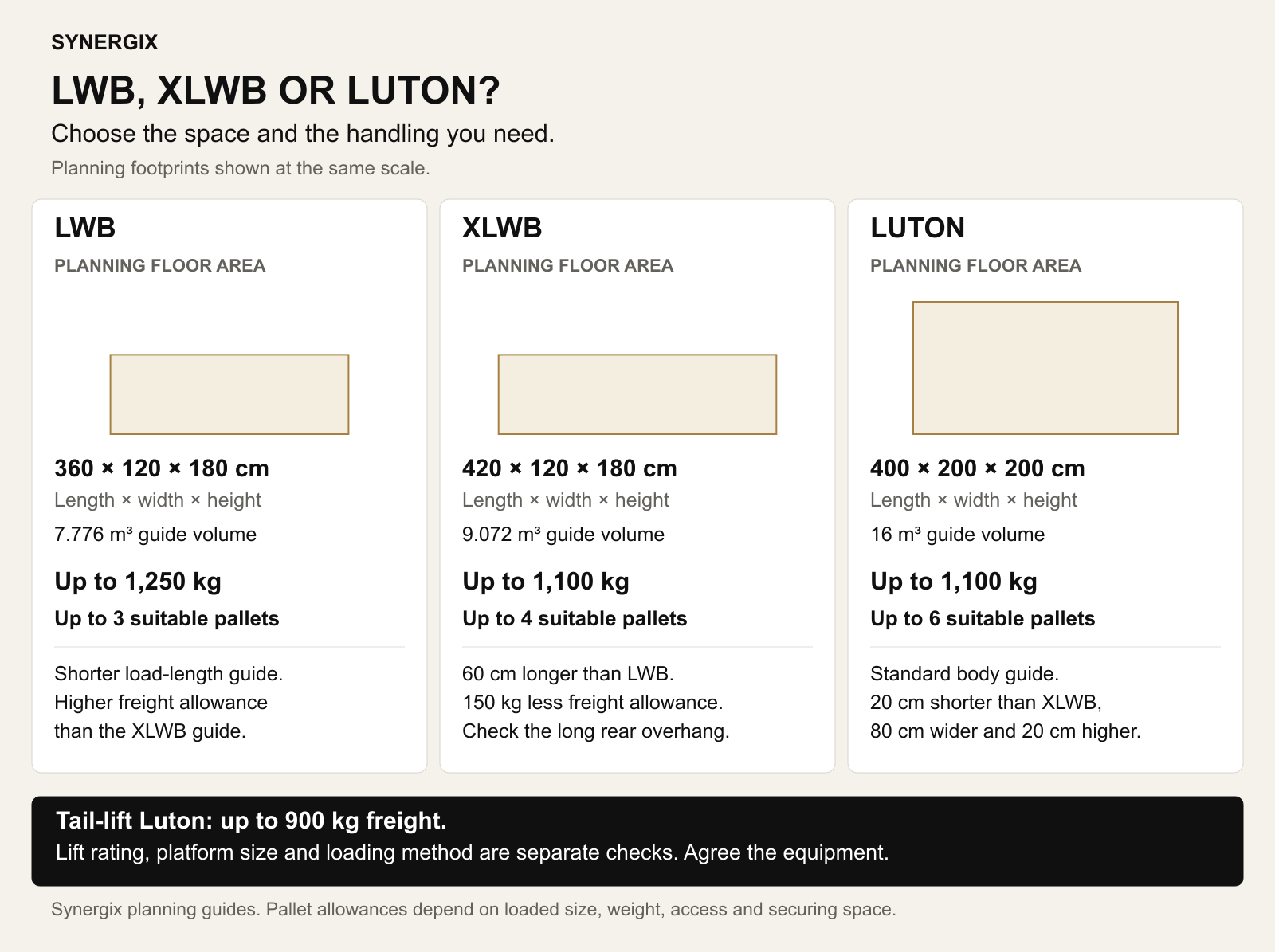
LWB, XLWB or Luton?
The XLWB planning guide offers 60 cm more load length than the LWB, but 150 kg less freight allowance. A standard Luton offers a wider, taller body, while its planning length is 20 cm shorter than the XLWB.
Choose the useful space and handling method rather than assuming a larger body carries more weight. A tail-lift Luton has a separate up to 900 kg freight guide; platform capacity, access and equipment must also be checked.
| Finished load or task | Starting assessment | Why |
|---|---|---|
| Two compact pallets, 650 kg total, within 240 × 120 × 120 cm | SWB | An XLWB adds length the shipment does not need. |
| Three suitable pallets, 1,200 kg combined, fitting LWB guide | LWB | XLWB weight guide is exceeded. |
| 390 cm long packaged item, 700 kg, narrow enough | XLWB | Additional length may be needed; fit and support checked. |
| Four UK pallet bases, rotated to 100 cm along, 1,000 kg combined | XLWB assessment | 400 cm nominal row, but actual width/arches/clearance/loading still determine fit. |
| 390 × 150 × 190 cm crate, 600 kg | Luton assessment | Width and height exceed our XLWB rectangle. |
| One 500 kg gross pallet with no forklift at delivery | Agreed tail-lift body and pallet-truck assessment | Handling requirement may decide the vehicle despite modest freight size. |
| Long item plus consignment over 1,250 kg | Truck or separately agreed alternative | Neither extra-long label nor Luton space creates the required payload. |
There is no single vehicle-size ladder.
Longer, wider, taller, heavier-rated and self-unloading describe different capabilities. Choose the combination required for the goods and handover. Check SWB, LWB, Luton or the 7.5-tonne guide where the job needs them.
XLWB courier services with Synergix
Tell us the whole movement so the vehicle, driver, loading and handover can be organised around it.
Same-day commercial delivery
For production parts, urgent stock, long equipment or materials needed at an agreed time, provide the goods-ready time and latest acceptable arrival. Availability, fit, loading and the route need assessing together.
A dedicated XLWB enquiry is not an instant collection guarantee. If the deadline is too tight for the proposed movement, a workable alternative must be discussed.
Scheduled routes and regular work
Book agreed collection windows, repeat supplier routes and store deliveries around the real load pattern. Share quantities, packaging, recurring peaks, receiving hours and any returns.
Regular work still needs a process for changes. An extra pallet, heavier order or different site can alter vehicle suitability and the price.
Multi-stop and return movements
Provide stops in the intended order, appointment windows, contacts and goods for each address. Loading sequence and changing weight distribution are part of the plan.
Goods must be restrained after partial unloading. Do not assume the van’s balance or access stays the same once the first delivery is removed.
Warehouse and retail support
Consolidated freight, cross-docking, warehouse-to-store work and stock movements can be assessed alongside the wider Synergix service. State what is ready now and any storage or consolidation needs.
Storage, checking, repacking and additional handling are separate agreed tasks. A courier booking does not automatically include them.
Two-person or specialist delivery
Tell us about long carries, stairs, awkward packaged furniture, on-site positioning and the intended handover point. The task can need a second person or different equipment.
Unpacking, assembly, installation and packaging removal are not automatic parts of a driver-and-van service. Agree the scope and access beforehand.
European enquiries
Supply countries, timing, goods description, values, origin and customs arrangements. Border travel, documentation, legal rest and operator requirements affect the plan.
An XLWB size name does not exempt the trip from cross-border requirements. A passenger-car arrival estimate is not a delivery commitment.
Clear information allows a useful answer.
Send the finished dimensions and gross weight, addresses, goods-ready time, deadline and equipment at both ends. We can assess the vehicle and explain the agreed scope. Request an XLWB quote or call 01782 911 181.
Loading long goods into an XLWB van
The longest compartment is useful only when the load can enter, be supported, secured and removed at the destination.
Plan the entry path, not just the final position.
For a long crate, the approach outside the rear doors can be as important as the bay. The receiving site needs room for the van, loading equipment and the item while it enters. The opening must clear every projecting fitting without damaging either freight or vehicle.
A side door rarely provides an unrestricted 4.2 m-long loading face. If an item must be placed sideways by a forklift, a curtainsider or flatbed may be the better starting point. Confirm both ends can handle it; a side-loading collection does not solve a rear-only delivery.
Do not plan transport with doors open, goods projecting outside or material entering the cab unless a specifically suitable alternative arrangement has been assessed. Those are not part of a standard enclosed XLWB booking.
Long pieces need suitable supports.
Thin bars, panels or fabrications can bow, shift or suffer local damage when supported at the wrong points. Ask the consignor for the approved support and lifting arrangement. Length alone does not establish where the centre of gravity sits.
Describe stillages, skids and dunnage with the load. They add dimensions and weight and can concentrate pressure on small floor areas. Spreading a heavy point load is different from merely covering it with a blanket.
Keep fragile ends, finishes and attachment points protected. Transport restraints should secure the load without crushing or bending it. The packaging and manufacturer’s handling instructions remain relevant.
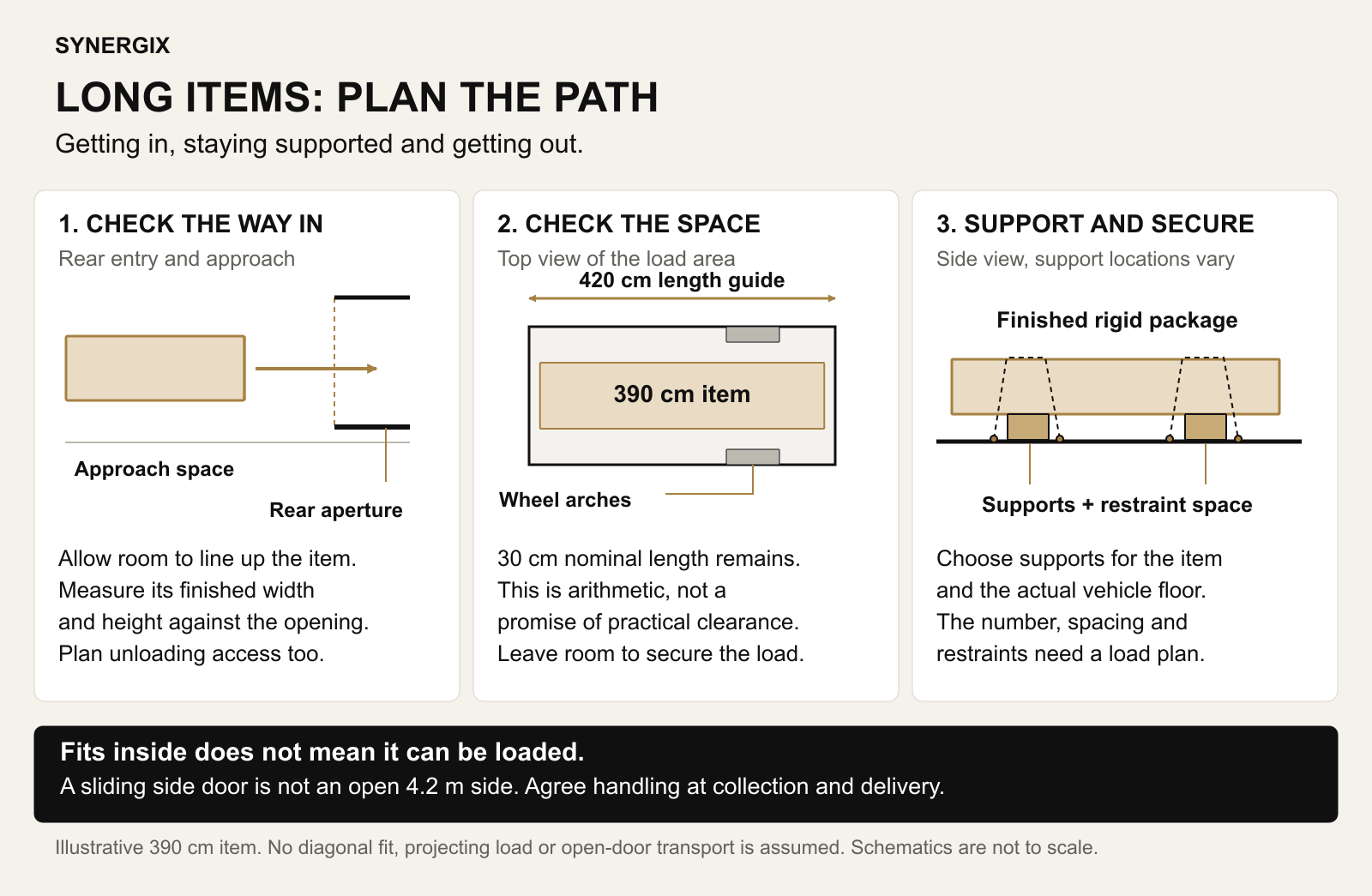
Plan the loading path as well as the floor length.
A 390 cm finished rigid item leaves 30 cm nominal length against the 420 cm guide. This arithmetic does not guarantee a workable loading or unloading clearance.
Check the rear opening, approach space, wheel arches, supports and restraints. A sliding side door does not provide an open 4.2 m side. Agree suitable handling at both ends.
Forklift and pallet-truck loading are different.
Give forklift access, capacity and the usable opening at each address. A forklift loading through the rear needs a controlled approach and a plan that avoids striking the roof, bulkhead or doors. Never assume forklift entry onto a van floor is acceptable.
A pallet truck moves a compatible pallet at the floor level available to it. It does not lift a pallet from ground level into an ordinary van. The fork-entry direction after rotating a pallet also matters; a theoretical footprint that prevents unloading is not a useful plan.
Match powered handling to the site.
At an individual loaded pallet of 800 kg or more, request an electric pallet truck under Synergix’s rule. Lower weights can also need powered help because of gradients, surfaces, distance or operator conditions. The threshold is not proof that manual handling below it is safe.
Confirm whether any carried handling equipment travels with the van and count its weight. Ground, approach, floor transitions and available space matter. No pallet-truck type or lift rating is automatically included in an XLWB booking.
Packing and labelling
Provide protective packaging suitable for the item and journey, with a clear count and any upright, fragile or non-stackable requirements. Wrapping can hold cartons together without making the whole pallet adequately restrained in the vehicle.
Stacking and mixed goods
Stack only where the goods and packaging support it. Heavy material above fragile cartons or an unstable tall stack can create a new problem despite saving floor space. Describe any segregation or contamination risks.
Restraint and accessible unloading
The securing plan needs suitable anchor points, rated equipment and a layout that resists movement. After a part delivery the remaining goods need checking and re-securing as necessary. Closed doors are not the restraint plan.
| Check | Information needed |
|---|---|
| Goods prepared | Finished package dimensions, count, gross weights and the actual collection-ready time. |
| Entry and loading | Rear/side route, equipment, staff, safe approach and whether rotation is permitted. |
| Supports and security | Approved lifting/support points, dunnage, fragile finishes and a workable restraint plan. |
| Unloading | Receiving staff, equipment, ground, booking slot and final handover point. |
| Sequence | Stop order, access to each item and how remaining load security is maintained. |
| Unexpected change | Contact the team before loading if extra freight, a different weight or missing equipment changes the agreed plan. |
XLWB overhang, turning and access limits
More load length needs more attention to entrances, reversing, parking, ground transitions and unloading space.
Overall length is not wheelbase.
The diagram’s 7,367 mm outside length includes the cab and overhangs; its 4,325 mm axle spacing describes wheelbase. Neither figure alone specifies the turning circle or every clearance during a manoeuvre. An extended variant may add rear body length to an existing wheelbase.
At a narrow entrance, check the actual van, mirrors, gate alignment, approach and available area after the gate. A gap just wider than the body does not necessarily leave room to turn into it. Give a site plan or clear measurements where necessary.
Rear overhang changes the space required.
As the van turns, the rear body sweeps a different path from the front wheels. A longer tail needs clearance around posts, parked vehicles, walls and people. Sensors and cameras assist the driver but do not create manoeuvring space.
The rear underside also needs checking on abrupt ramps, steep entrances and uneven transitions. A long overhang can meet the ground before the axle does. A generic illustration is not a measured departure-angle or ramp clearance certificate.
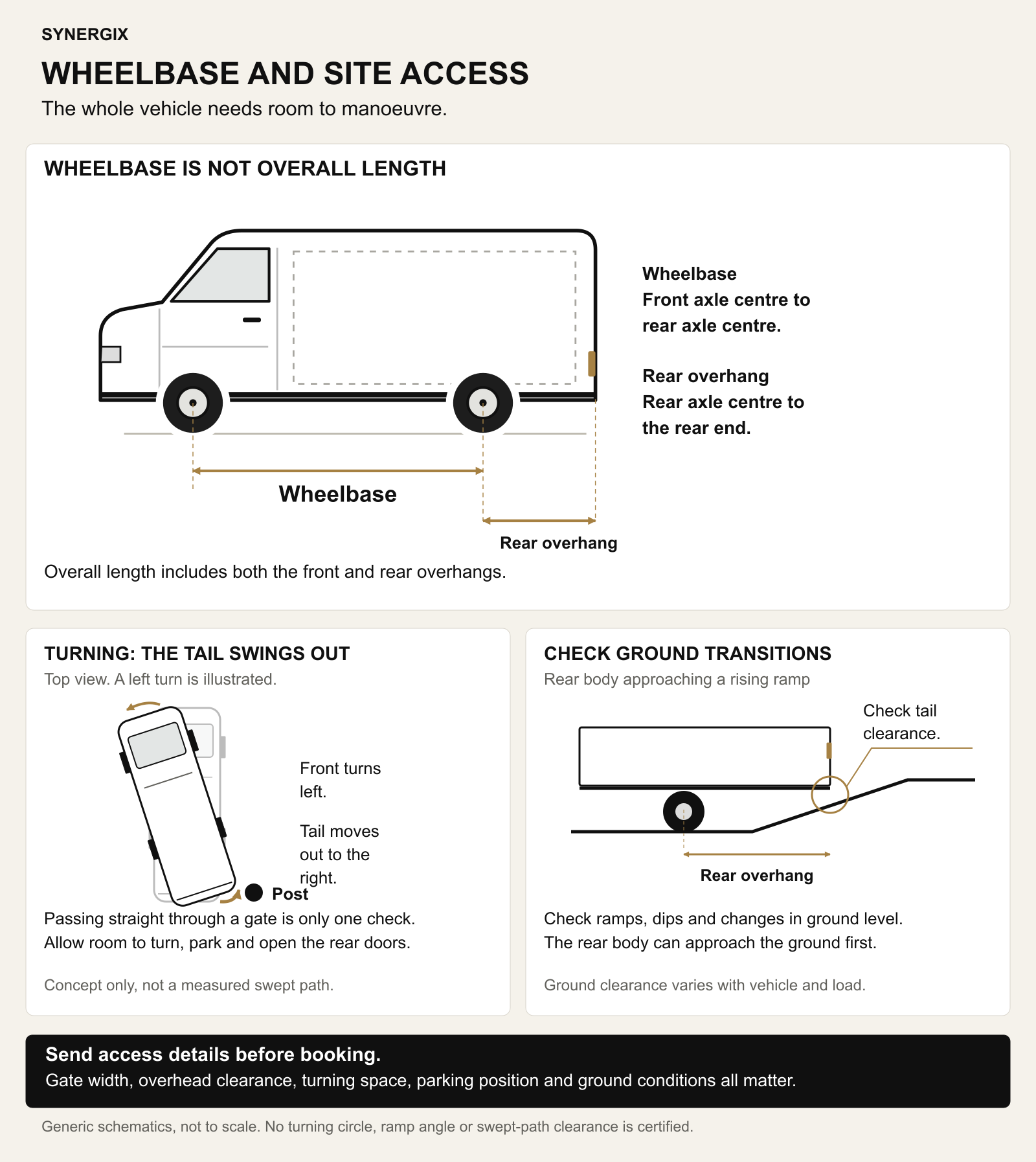
Check the whole vehicle’s room to manoeuvre.
Wheelbase is the distance between the axle centres. Overall length includes the overhangs, and rear bodywork can swing out as the front turns.
Check gate width, overhead clearance, turning room, parking, open-door space and changes in ground level. These schematics explain the checks; they do not supply a measured turning circle or approve a site.
Parking and unloading space.
A long commercial van may extend beyond an ordinary car bay. Loading restrictions, door swing, forklift approach and room for staff must be considered, rather than choosing a stopping point solely because the cab fits.
Agree a permitted unloading position and receiving contact. The last few metres can decide the job even when the national road route is straightforward.
Height, mirrors and unsuitable ground.
Use the assigned vehicle’s height, including equipment, and its width including mirrors for clearance. The illustrated unladen dimensions are not measurements of every loaded or converted XLWB.
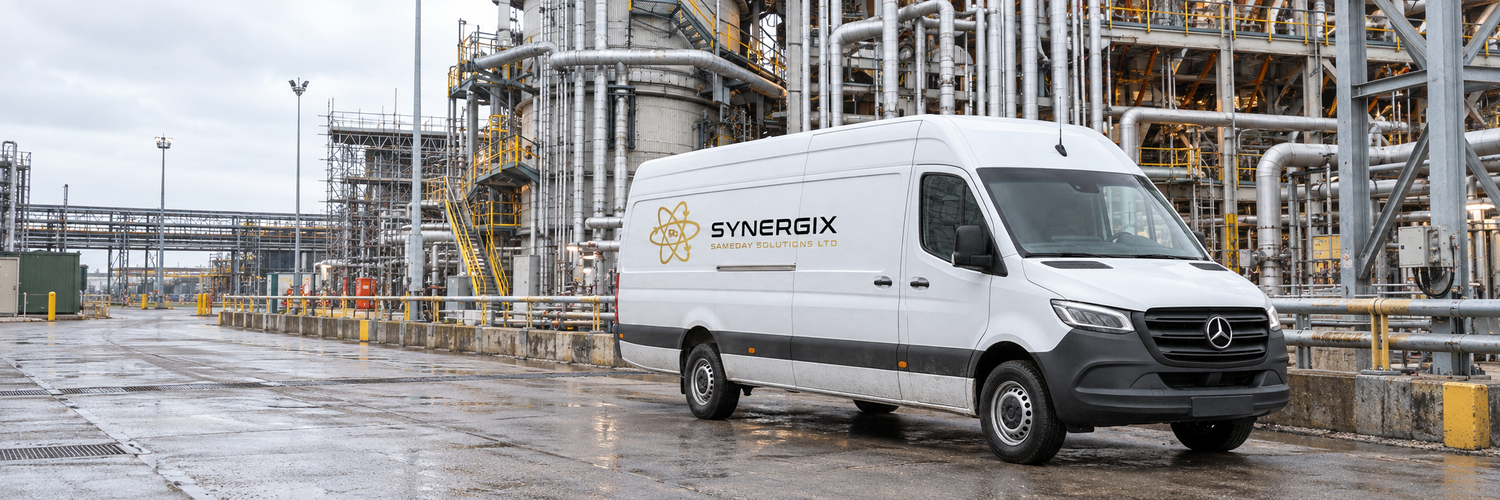
Soft verges, wet grass, deep ruts and sharp slopes may be unsuitable for a standard panel van. The industrial hero is an illustration, not a promise of off-road capability or a record of a customer delivery. Agree a firm accessible handover point.
XLWB van fuel economy and running costs
Use model figures as a reference, then account for load, route, collection mileage, charging and the rest of the delivery plan.
Fuel economy is not one XLWB number.
Body length and height, engine, gearbox, drivetrain, gross rating, tyres and the route affect fuel use. A manufacturer’s combined test figure is useful for a defined model comparison, but it is not a promise for a fully loaded courier journey.
As a broad manufacturer reference, Mercedes-Benz UK publishes Sprinter combined consumption of 8.3 to 12.7 litres per 100 km, approximately 34.0 to 22.2 imperial mpg across its stated range. That range includes different specifications and gross ratings. It is not a measured Synergix average or a claim that every 3.5 tonne XLWB achieves those figures.
For planning, use fuel consumption appropriate to the assigned vehicle and work. The scenarios below show how the maths changes at different imperial MPG values, without assigning an unverified figure to a particular van.
Fully loaded work can use substantially more fuel.
A laden van has more mass to accelerate and climb hills with. Stop-start traffic, short urban stops, high-speed travel, headwinds, roof equipment, tyre condition and idling can change the result further. An empty motorway test is not representative of every loaded business delivery.
There is no reliable universal percentage reduction for every fully loaded XLWB. Keep empty, part-loaded and heavily loaded work separate when comparing results. A return with freight, a refrigerated conversion and a different route can all change the fuel used.
A published combined figure should not be used as a fixed fuel allowance for a time-critical job. The vehicle still needs enough fuel or charge to reach collection, complete the loaded journey and follow the onward plan.
| Assumed economy | Fuel used | Fuel-only cost at an assumed £1.60/L |
|---|---|---|
| 20 mpg | 22.73 litres | £36.37 |
| 25 mpg | 18.18 litres | £29.09 |
| 30 mpg | 15.15 litres | £24.25 |
| 35 mpg | 12.99 litres | £20.78 |
| 40 mpg | 11.37 litres | £18.18 |
Imperial MPG means miles travelled per 4.54609-litre gallon. For a stated distance: litres = miles ÷ imperial MPG × 4.54609. Litres per 100 km is another way of expressing consumption; lower is better. Do not compare a US MPG number directly with an imperial MPG number.
Electric consumption uses a different unit.
Battery-electric vans are normally compared in kWh per 100 km, kWh per mile or miles per kWh. Mercedes-Benz UK publishes eSprinter combined electricity consumption of 28.0 to 34.5 kWh per 100 km for its stated configurations. Converted to 100 miles, that is about 45.06 to 55.52 kWh.
These are model test figures, not a guaranteed loaded result. Distinguish energy delivered by the battery from energy metered at the charging point, and establish whether a quoted test figure already includes charging losses. Adding a guessed loss percentage on top can double-count it.
Petrol and plug-in hybrid need their own figures.
Petrol, hybrid and electric options depend on the actual model range. The full-size Ford Transit’s current UK range includes diesel and E-Transit battery-electric models. The Transit Custom plug-in hybrid is a different van range, so its specifications must not be presented as a full-size XLWB Transit option.
A plug-in hybrid uses both fuel and charging. Its official weighted fuel result assumes a test charging pattern and cannot be read as sustained MPG for a long motorway trip with a depleted battery. Compare the full route, including electric energy, fuel and where recharging is possible.
| Assumed tariff | Energy cost | What is excluded |
|---|---|---|
| £0.25/kWh | £12.50 | Driver time, vehicle, maintenance, charging time and the rest of the courier service. |
| £0.50/kWh | £25.00 | The same service costs. This is not a current public charging tariff. |
| £0.80/kWh | £40.00 | The same service costs. Actual tariffs and charging losses must be checked. |
Fuel cost is one part of the courier price.
Suppose a hypothetical job involves 25 miles to collection, 100 miles loaded and 25 miles onward. At 35 mpg for the two positioning legs and 25 mpg when loaded, the van uses about 24.68 litres. At an assumed £1.60 per litre, that is about £39.49 of fuel. Counting only the loaded 100 miles would miss the approach and onward mileage.
This is an example, not a quoted rate or a claim that these MPG values describe a Synergix van. The transport price also covers the driver, vehicle availability, maintenance, insurance, administration, loading and waiting time where applicable. A loaded van’s fuel consumption and the cost of getting to site belong in the plan.
Reduce avoidable use through planning.
Correct load information can prevent the wrong vehicle attending or an unnecessary second journey. A workable delivery slot, ready unloading team and agreed collection time reduce avoidable waiting. Choosing one suitable vehicle can be more useful than choosing the lowest consumption badge for each separate trip.
Smooth driving, an appropriate route, correct tyres and maintained equipment matter. The driver must still work within safe speed, rest and loading requirements. Fuel saving is not a reason to miss those checks.
Compare transport cost on the same basis.
Compare the complete service: vehicle size, covered mileage, loading method, waiting, stop count and any special handling. A cheap mileage headline may exclude work required to complete the job.
If you are comparing an urgent XLWB with a planned shared-pallet movement, compare the timing, handling and flexibility as well as the price. They can solve different business needs.
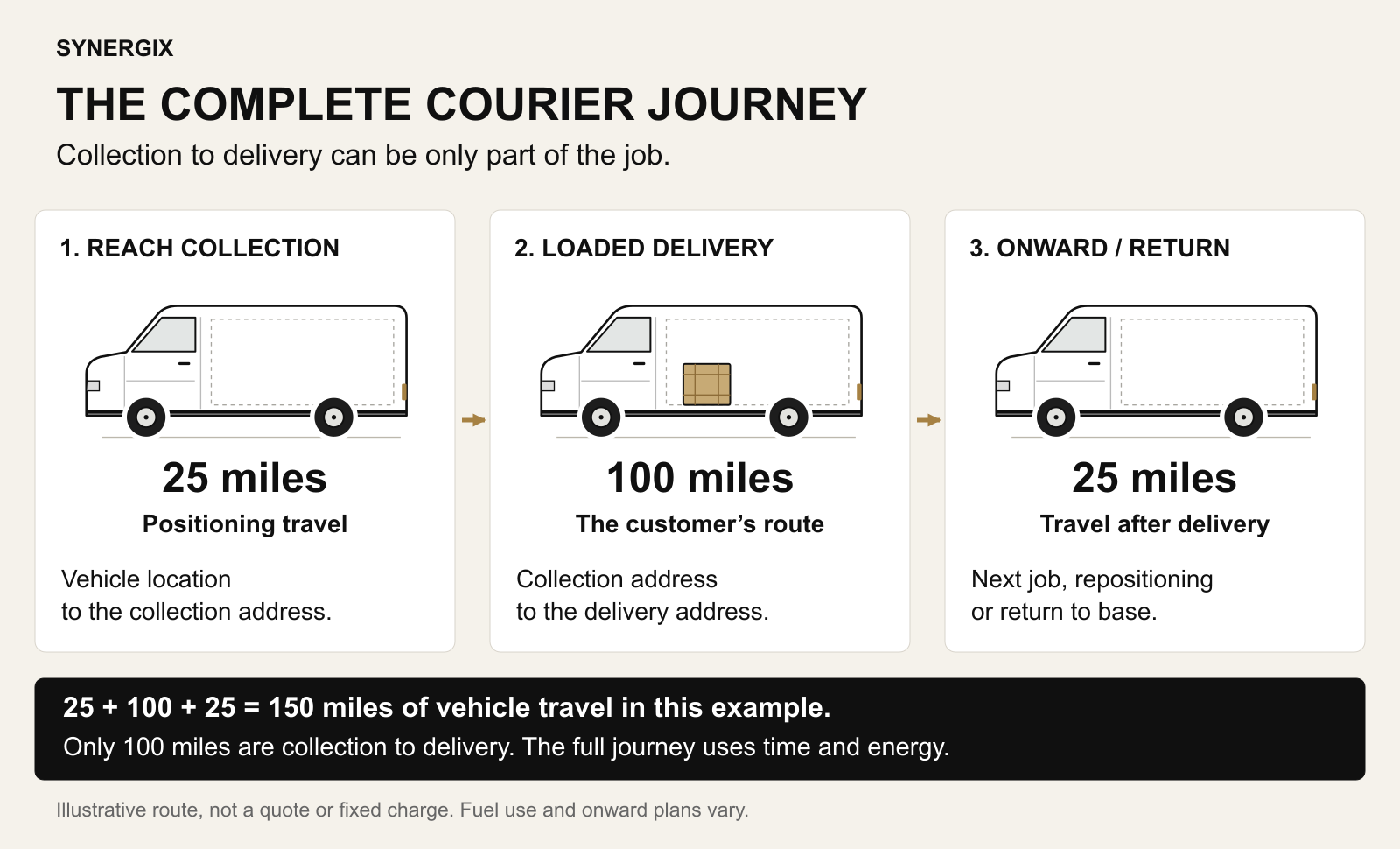
Count the whole courier journey.
This illustration uses the same journey as the XLWB worked example: 25 miles to collect, 100 miles loaded and 25 miles onward, totalling 150 miles.
The fuel example assumes 35 UK mpg on the approach and onward legs and 25 mpg while loaded. These are illustrative inputs, not guaranteed economy. Actual positioning, load and driving conditions vary.
XLWB van CO₂ per 100 miles
A useful emissions figure states the vehicle, distance, energy assumptions and what is included. Zero tailpipe emissions and zero lifecycle emissions are different claims.
Calculate tailpipe CO₂ from a stated rate.
For a diesel or petrol vehicle with a known CO₂ rate in grams per kilometre: kilograms of tailpipe CO₂ = miles × 1.609344 × g/km ÷ 1,000. At 250 g/km, a 100-mile journey produces about 40.23 kg of tailpipe CO₂.
The rate must describe the basis being used. A manufacturer’s combined test value, a measured journey and an assumed scenario are different inputs. The tool below performs the arithmetic; it does not know the assigned van’s real loaded consumption.
Count the relevant miles.
A customer’s collection-to-delivery route is not necessarily all the vehicle travel caused by the job. Getting to collection, returning, repositioning and extra stops may add miles. For a comparison, apply the same mileage boundary to both transport options.
Do not describe a calculation for the loaded leg as a complete shipment footprint if other relevant travel is excluded. If one suitable XLWB avoids two smaller vans, include both vans’ journeys in the alternative.
| Assumed rate | CO₂ over 100 miles | CO₂ over 250,000 miles at the same rate |
|---|---|---|
| 180 g/km | 28.97 kg | 72.42 tonnes |
| 220 g/km | 35.41 kg | 88.51 tonnes |
| 250 g/km | 40.23 kg | 100.58 tonnes |
| 300 g/km | 48.28 kg | 120.70 tonnes |
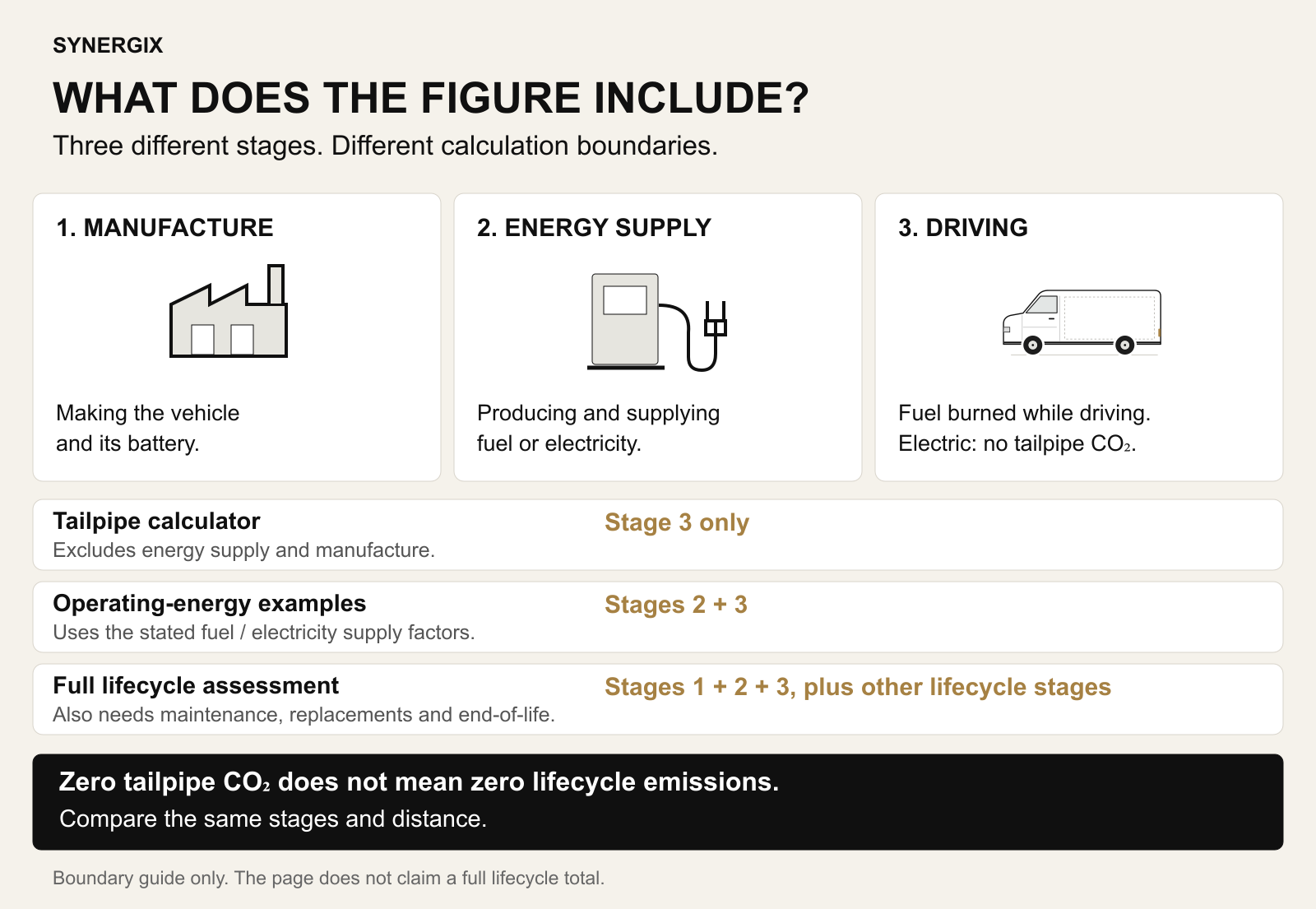
Compare carbon figures on the same basis.
This boundary diagram applies to the XLWB calculations too. Tailpipe figures cover driving emissions, while operating-energy figures also include the stated fuel or electricity supply components.
A full lifecycle comparison additionally needs vehicle and battery manufacture, maintenance, replacements and end-of-life. The diagram explains those boundaries; it does not supply a manufacturing total.
Tailpipe CO₂ calculator
Use a known rate or a clearly labelled assumption. This calculation excludes fuel supply, manufacturing and all other lifecycle stages.
CO₂ and CO₂e are different.
CO₂ means carbon dioxide. CO₂e expresses different greenhouse gases as a common carbon-dioxide-equivalent quantity. A tailpipe g/km CO₂ figure cannot be treated as directly equivalent to a lifecycle CO₂e figure with additional stages included.
A battery-electric van has no tailpipe CO₂ from driving. It still has emissions associated with electricity, vehicle production and other lifecycle stages. Calling it zero tailpipe emissions does not establish a zero-carbon delivery.
Fuel and electricity need a consistent boundary.
The 2026 UK government factors for average-blend diesel are 2.58354 kg CO₂e/L for direct use and 0.61101 kg CO₂e/L for upstream fuel supply. The UK grid factors used here total 0.18436 kg CO₂e/kWh across generation, transmission/distribution and their upstream energy components.
These reporting factors are applied to stated fuel or metered charging quantities. They do not include manufacturing the van, replacing a battery, maintenance or end-of-life. Biofuel accounting and the method’s treatment of biogenic carbon also matter for a formal report.
| Scenario | Per 100 miles | Over 250,000 miles |
|---|---|---|
| Diesel at an assumed 30 imperial mpg: 15.15 L/100 miles; 37,884.08 L over 250,000 miles | 48.41 kg CO₂e | 121.02 tonnes CO₂e |
| Electric at an assumed 40 metered kWh/100 miles: 100,000 kWh over 250,000 miles | 7.37 kg CO₂e | 18.44 tonnes CO₂e |
The two rows use invented consumption assumptions and constant 2026 UK factors for every mile. They are calculations, not a matched XLWB road test, a fleet footprint or a forecast of future electricity. They are intended to show why operating energy and vehicle production must be calculated separately. A formal comparison needs the actual vehicles, measured or justified consumption, all relevant journeys and a consistent accounting method.
What would a full 250,000-mile comparison require?
Add a model-specific manufacturing inventory for the diesel or petrol van and for the electric van, including its battery. Then add the energy used across the same distance, fuel/electricity supply, maintenance, any replacement battery and an agreed end-of-life method. State the place and period of charging because the electricity mix can change.
There is no defensible single production figure for “an electric XLWB van”. Battery size, manufacturing energy, vehicle specification and study boundaries differ. A study of passenger cars cannot be relabelled as an XLWB van study. Without matched evidence, a precise manufacturing total or carbon break-even mileage would give false certainty.
Does diesel or petrol become greener because it is practical?
A fuel-powered van can be the more workable choice for an urgent long-distance job where charging delays cannot fit the deadline. That operational advantage does not by itself prove lower lifecycle greenhouse-gas emissions.
The right assessment keeps service suitability and environmental accounting clear. One can favour diesel for a particular urgent route while recognising that a suitable electric van can have lower operating emissions under an explicitly stated electricity mix.
What can improve the shipment outcome?
Avoid an unnecessarily large van, repeated failed collection attempts and extra journeys caused by missing load information. Combine compatible goods into one workable movement where timing and handling allow it.
Assess the full job rather than asserting that XLWB, electric, diesel or a particular badge is always the lowest-carbon answer. Reliable dimensions, weights and receiving details are useful inputs to that decision.
Which XLWB powertrain suits the journey?
Choose a vehicle that can carry the goods and meet the real route and deadline. A low test consumption figure cannot replace a workable operating plan.
Diesel XLWB vans
Diesel is a practical option for sustained mileage, variable routes and loads needing a workable refuelling plan. Refuelling is generally quicker to fit into a time-critical route than a substantial traction-battery charging stop.
The engine’s fuel consumption and emissions still depend on its specification and loaded duty. Emissions-control equipment, maintenance and any access restrictions must be considered. A diesel badge does not guarantee exemption from an urban charging scheme.
Petrol and plug-in hybrid
Petrol and hybrid availability is model-specific. A petrol option in one smaller van range does not prove that the same powertrain is available in the full-size XLWB configuration required for the job.
A plug-in hybrid can use both electricity and fuel, but its result depends on charging and the route. Its weighted test MPG should not be used as an uncharged long-distance fuel promise. Confirm the actual model, cargo capacity and operating pattern.
Battery-electric XLWB vans
Electric can suit predictable routes with suitable range, load capacity and reliable charging before the job. Quiet operation and no driving tailpipe emissions can be useful for some urban and planned deliveries.
Battery weight, temperature, load, sustained speed, heating and auxiliary equipment affect the working plan. A brochure’s best range and highest payload can belong to different versions. The assigned electric van must meet the load and deadline together.
Urgent long-distance work needs a charging plan that fits the deadline.
An electric XLWB is unsuitable for an urgent long-distance job when the loaded journey and onward requirements exceed the available usable charge and charging cannot be accommodated in time. A charger detour, queue, failed unit or slower-than-expected session can create a serious delivery problem.
Diesel is often the more practical option for unpredictable, time-critical long-distance work because refuelling can be fitted into the route more readily. This is a service-planning point, not a claim that electric vans cannot make any long journey. A job within the van’s usable range, or with reliable time allowed to charge, needs its own assessment.
Use charging figures with their conditions.
Ford’s UK E-Transit reference gives approximately 37 minutes for a standard-range 10–80% DC charge at 115 kW and approximately 28 minutes for the enhanced-range version at 180 kW. These are manufacturer examples under the stated conditions, not a guaranteed stop time for an assigned van.
A 10–80% session is not a full recharge, and the charger’s advertised maximum does not prove the van will receive that power throughout. Arrival charge, battery temperature, charger availability, power sharing, detour and connection time all affect the real stop.
Plan beyond collection-to-delivery mileage.
Check the charge available now, the drive to collection, the loaded route, weather, auxiliary demands, reserve and what happens after delivery. An electric van already nearby with sufficient charge can present a different plan from one that must travel a long way to collect.
Do not schedule an urgent arrival using an unloaded best-case range figure. A conservative usable-range assessment and a fallback are more valuable than an attractive headline. A depot-charged regular route is a different use case from a last-minute cross-country emergency.
| Requirement | What to assess |
|---|---|
| Predictable local or regional route | Actual loaded range, depot charging, reserve and available payload. Electric may be suitable. |
| Urgent long-distance movement with little time margin | Fuelled range and quick refuelling, or a verified electric plan with enough usable charge and charging time. |
| Heavy shipment near the category guide | Actual permitted weights and working capacity. Do not transfer diesel payload to electric. |
| Refrigerated or auxiliary equipment | Energy/power supply, usable load space, weight and the temperature requirement. |
| Urban access requirement | The actual vehicle’s compliance with the current scheme, rather than assumptions from its size name. |
| Customer asks for lower-carbon transport | A consistent emissions boundary and a suitable vehicle, route and deadline. |
Tell us if a powertrain or environmental requirement is part of the booking. An XLWB enquiry does not guarantee a particular make, engine, battery size or electric allocation. Suitability and availability must be confirmed before the transport is accepted.
Specialist XLWB transport requirements
Identify sensitive, regulated or awkward freight early so the body, people and handling plan can be assessed.
Fragile and high-value goods
Describe the item, declared value, packaging and any handling conditions. An enclosed body does not prevent vibration or movement by itself. Goods needing an upright position, shock protection or a specified handover need those requirements agreed.
Do not assume unlimited insurance or cover for every type of freight. Confirm the relevant terms and any declared-value arrangement before booking. Packing and condition records can be important at collection and delivery.
Dangerous or regulated goods
Disclose batteries, chemicals, cylinders, aerosols, fuels and other goods that may require a dangerous-goods assessment. Give the product identification, quantity, packaging and available safety information.
A load being small enough for an XLWB does not establish acceptance. The goods, applicable rules, driver/vehicle requirements and any exemptions must be checked for the specific movement. Do not conceal the description to obtain a standard quote.
Temperature-sensitive freight
Agree the range, starting condition, journey length, door-open exposure and any monitoring requirement. Chilled, frozen and controlled ambient are different specifications.
The converted vehicle’s usable space and payload must be established separately. Standard XLWB figures do not guarantee refrigeration capability, pharmaceutical compliance or suitable airflow around a full load.
Food and event stock
Packed stock can need hygiene, segregation and protection from incompatible goods. Tell us whether the consignment needs controlled temperature and who is responsible for preparing it at the required condition.
Event refrigeration can also involve delivered on-site storage or larger vehicles. A refrigerated courier van is not the same service as fridge-trailer hire. Describe the whole event requirement.
Two-person and indoor delivery
Bulky goods, a long carry, stairs or an agreed indoor point can need a second person or other equipment. Specify the intended handover point, access route and any installation requirement.
A standard driver-and-van movement does not automatically include unpacking, assembly, positioning or removal of packaging. Agree the required service so the team and price match the work.
Unusual supports or handling
Items with feet, wheels, liquids or moving parts need an appropriate transport arrangement. Give point loads, centre of gravity, lifting points and whether the load may be rotated.
An extra long wheelbase body does not solve every specialist requirement. A crane, forklift, flatbed, curtain access or different floor construction may require another vehicle and an agreed loading plan.
Declare the requirement before collection.
Dimensions and kilograms describe only part of a specialist job. Tell us about the contents, value, condition, packaging and handling rules as well. We can assess a suitable service without treating a standard XLWB as a universal answer.
Where can an XLWB van deliver?
The route can be straightforward while the last few metres are difficult. Plan the actual collection and delivery points.
UK routes and receiving sites.
An XLWB can serve eligible business deliveries between towns, cities, industrial estates, warehouses and event sites. The destination needs to be accessible to the actual van and ready to receive the goods. A postcode alone does not describe the unloading point.
Provide the correct entrance, site contact, reference and booking slot. Mention height barriers, restricted gates, narrow lanes, loading bays, security checks and rules about where vehicles may wait. A van arriving on time can still miss a handover if goods-in is closed or the required equipment is absent.
For urban deliveries, state whether unloading is in a permitted bay or other agreed location. Parking restrictions, pedestrian areas and timed access can affect the plan. A vehicle’s smaller size than a truck does not give it unrestricted access.
European movements.
Give the countries, actual goods, value, origin/destination, timing and customs arrangements. Ferry or tunnel travel, border processes, documents, operator requirements and driver rules can all affect the arrival plan.
Vehicle and combination weight thresholds for international regulation are based on the permitted weight, not just the freight aboard. Relevant goods movements over 2.5 tonnes entered additional tachograph and driver-hours scope from July 2026, subject to applicable rules and exemptions.
Do not use a car journey estimate as a cross-border van delivery commitment. Availability, documents, loading, legal rest and onward travel need a realistic assessment. Discuss European transport.
Height and width restrictions
Measure the actual access and compare it with the assigned van, including mirrors, roof equipment and refrigeration where relevant. A generic drawing is not a clearance certificate.
A stated unladen height may also differ from the vehicle’s exact operating configuration. Do not rely on retracting mirrors or squeezing under a barrier as an unplanned workaround.
Turning, overhang and reversing
A longer van can need more manoeuvring space than an SWB. Overall length, wheelbase, rear overhang and the actual turning area all matter at confined sites.
Provide a site plan or clear access description where needed. Cameras and sensors do not create space or guarantee a safe reversing route around people and equipment.
Ground and weather
Soft ground, deep ruts, slopes and wet grass can make access unsuitable for a standard panel van. Tell us if collection or delivery is away from a firm surfaced unloading point.
An ordinary panel van is not an off-road delivery solution. Agree a firm, accessible unloading location and suitable equipment for the goods.
A useful access description saves a failed visit.
Tell us which gate to use, the unloading position, any minimum or maximum vehicle specification and who will be present. Share restrictions before booking rather than leaving the driver to discover them with a loaded van at the entrance.
XLWB van weights, access and road rules
The size name is not a legal classification. The assigned vehicle, load and route determine the requirements.
Gross weight, entitlement and vehicle class.
Maximum authorised mass is the permitted total laden weight shown for the vehicle, including people, fuel, equipment and freight. It is not the payload. A 3.5 tonne van does not carry 3.5 tonnes of goods.
Driver entitlement depends on the actual vehicle and applicable licensing rules. Electric vans can have different permitted gross ratings, so do not assume that an electric and diesel version share the same licence or operating requirements.
Vehicle checks, tyres, brakes, lighting, mirrors, floor, bulkhead and restraint equipment remain important whether the journey is urgent or planned. The actual vehicle must be suitable and maintained for the work.
Speed and a realistic delivery deadline.
For applicable goods vehicles up to 7.5 tonnes, national limits are generally 50 mph on single carriageways, 60 mph on dual carriageways and 70 mph on motorways when not towing, subject to lower posted limits and conditions. An XLWB van must not be scheduled using passenger-car limits on every road.
Traffic, loading time, site delays, weather and required breaks also affect the journey. Dedicated transport is not a promise that a driver will exceed limits or drive without rest. Give the latest acceptable delivery time so a workable plan can be assessed.
Towing changes the job and can introduce different weight, licence and operating requirements. It is not part of a standard XLWB booking simply because the vehicle has a towbar.
International requirements changed in July 2026.
In-scope international goods movements using vehicles or combinations over 2,500 kg and up to 3,500 kg require the applicable smart tachograph and driver-hours arrangements from 1 July 2026, subject to exemptions. Other operator and cross-border requirements can also apply.
This is planning guidance, not a complete compliance checklist. The operator must check the actual vehicle, route, work and rules. A small payload on an otherwise in-scope van does not remove the requirement.
Emission zones and local restrictions.
Urban charging schemes and restricted areas depend on the vehicle and location. Check the actual registration and current route requirements rather than assuming all diesel vans are charged or all electric vehicles have unrestricted access.
Provide any customer-mandated vehicle standard, site specification or permit requirement at enquiry. It can affect the allocation and cost even if the goods fit the XLWB guide.
Reliability includes time for the necessary checks.
Clear load information, a suitable vehicle and prepared receiving staff make the movement easier to deliver. Cutting out checks to gain a few minutes can create a larger delay when the load will not fit or cannot be unloaded.
If the deadline changes, contact the team early. The route, vehicle and service can be reassessed without pretending every new timing is automatically achievable.
What does an XLWB courier cost?
A useful quote covers the complete movement. Accurate load, route and handling details help us match the service and vehicle.
What affects the XLWB courier price?
Collection and delivery locations, total route, timing, vehicle availability, loading method, stop count and waiting can all matter. Weight, packaging and dimensions decide whether an XLWB is suitable or another category is required.
The plan may include positioning mileage to reach collection, a loaded leg that uses more fuel than an empty van, and onward or return travel. An urgent deadline, restricted appointment or specialist requirement can change how the work is arranged.
Share the whole job when requesting a quote. An extra stop, indoor carry, return load, second person, powered handling or controlled temperature should be included before confirmation.
Why a simple price per mile can mislead.
Mileage is only one part of delivering a consignment. The driver’s time, vehicle, maintenance, insurance, loading, waiting and administration are part of the service. A short trip with lengthy handling can require more resource than the distance suggests.
Fuel and electricity examples on this page are arithmetic assumptions, not Synergix courier rates. A quoted transport price should be compared on the same scope, including any applicable tax and agreed extras.
A request is not a confirmed booking until suitability, availability, timing and the accepted terms have been agreed. Wait for the agreed transport arrangements to be confirmed before treating the enquiry as a booking.
| Tell us | Include |
|---|---|
| Goods and quantity | A clear description, number of items and any sensitive or regulated contents. |
| Packaged dimensions | Length, width and height of every distinct item or loaded pallet, including overhang. |
| Gross weight | Finished total including pallets, packaging, cases and travelling equipment. Individual heavy item weights too. |
| Stacking and orientation | Whether goods may be stacked, rotated or laid down, and any required support points. |
| Collection | Full address, postcode, goods-ready time, contact and the correct entrance. |
| Delivery | Full address, contact, receiving hours and latest acceptable arrival or appointment. |
| Loading and unloading | Equipment, staff, dock/ground arrangements and who provides them at each end. |
| Body or powertrain | Temperature range, special body, electric requirement or other specification that affects allocation. |
| Site access | Height, width, parking, turning, permits, security and any vehicle standard. |
| Extra work | Returns, multiple stops, carry distance, stairs, second person or agreed indoor delivery. |
| Documentation and value | References, delivery notes, declared value and customs requirements where relevant. |
Send the finished load details, even if you are unsure of the category.
If you do not know whether the job needs an LWB, XLWB or Luton, send the facts. We can assess the suitable option. Understating a load to fit a cheaper category can create a failed collection, delay and extra cost.
For an urgent enquiry, call 01782 911 181. For the written job details, request a quote or email sales@synergixsameday.com.
At collection and during the journey.
Have the goods ready in the agreed packaging with the right staff and equipment available. Provide references, labels and paperwork, and raise any change in quantity, weight or condition before loading.
Agree the required communication and any specific delivery instructions. A realistic transport plan includes the site process, rather than counting only driving minutes. If circumstances change, a timely conversation helps the team assess the next step.
At delivery and for repeat work.
The receiver should be available at the agreed point with suitable unloading arrangements. Identify who may accept the freight and any required count, signature, condition note or proof-of-delivery detail.
For repeated routes, review typical loads, peaks, access and receiving times. A stable planned arrangement can be more suitable than repeatedly guessing the vehicle for each urgent request. Tell us if warehousing, retail distribution or general haulage is part of the wider requirement.
XLWB van transport glossary
Common terms in vehicle specifications, quotations and emissions comparisons.
XLWB
Extra long wheelbase. A category name associated with greater space than a shorter van, not an exact cargo-box specification.
Wheelbase
Distance between front and rear axle centres. Different from overall length or usable load length.
SWB / LWB
Short wheelbase / long wheelbase. Compare the actual guide and vehicle rather than assuming the initials determine payload.
L2, L3, L4, H2 and H3
Manufacturer body-length and roof-height labels. They are not universal dimensions across different makes.
Payload
Weight of goods and other load carried within the vehicle’s permitted limits. A headline specification must be interpreted with its weighing convention.
Gross consignment weight
All goods, pallet bases, packaging, cases and accompanying equipment in the shipment.
Maximum authorised mass / GVW
Permitted total laden vehicle weight. It includes the van itself, people, fuel, equipment and freight.
Axle limit
Permitted weight on an individual axle. It can be reached before the overall gross limit.
Point load
Weight concentrated through a small contact area, such as machinery feet. Floor suitability needs separate assessment.
Door aperture
The clear opening goods must pass through. It may be smaller than the interior load space.
Planning rectangle
Length × width × height used as an enquiry guide. It does not represent every curved part of the cargo bay or guarantee fit.
Pallet overhang
Goods or packaging projecting outside the base footprint. Measure the complete loaded size.
Dedicated courier
An agreed vehicle-and-driver movement organised for the consignment, rather than a standard shared parcel-network service.
POD
Proof of delivery. The required handover record should be agreed for the service.
WLTP
A standard vehicle test method. A combined result is not a guaranteed figure for each loaded route.
Imperial MPG
Miles per imperial gallon of 4.54609 litres. It differs from US MPG.
kWh
Kilowatt-hour, a quantity of energy. It is different from kW, which describes power.
CO₂ / CO₂e
Carbon dioxide / carbon-dioxide-equivalent greenhouse gases. Compare figures only with consistent boundaries.
Tailpipe emissions
Emissions at the vehicle while driving. They exclude vehicle manufacturing and energy supply.
Lifecycle emissions
An assessment spanning defined production, use and end-of-life stages. It needs a stated method and vehicle-specific evidence.
Controlled ambient
An agreed temperature range that is distinct from ordinary uncontrolled panel-van transport.
Positioning mileage
Travel to reach collection or reposition after the delivery, beyond the customer’s collection-to-delivery leg.
XLWB van courier FAQs
Find the practical detail on weight, fit, handling, costs and the journey.
Choosing XLWB, LWB or Luton
What does XLWB mean?
XLWB is the courier category for extra long wheelbase vans. It describes a useful size class rather than a universal model specification. Body length, wheelbase and cargo length are different measurements, and manufacturers do not use every L/H code consistently. Ask for the actual load compartment, working payload and openings required for your goods.
What are Synergix’s XLWB booking figures?
Start with 420 × 120 × 180 cm of rectangular planning space, up to 1,100 kg total consignment weight and up to four suitable pallets. These guides do not guarantee every van, door or load arrangement. Finished dimensions, gross weights, loading, restraint, conversion equipment and the assigned vehicle must be checked before booking.
When should I choose XLWB instead of LWB?
Choose an XLWB assessment when the finished goods need more than our 360 cm LWB length guide or additional suitable floor positions, while remaining within the XLWB weight guide. A 390 cm long packaged item at 700 kg is an example. The longer van does not automatically suit a heavier load, because the LWB guide is 1,250 kg and the XLWB guide is 1,100 kg.
When is an LWB better than XLWB?
If the freight fits our LWB space, the extra length may add no benefit. A 1,200 kg consignment within the LWB dimensions is above our XLWB weight guide but can be assessed against the LWB’s 1,250 kg guide. Site access and actual axle capacity still matter. Do not book a longer body just because the load is heavier.
When is a Luton better than XLWB?
Assess a Luton for goods needing the wider box-like body or separately agreed handling equipment. Our standard Luton guide is 400 × 200 × 200 cm, up to 1,100 kg and six suitable pallets. A tail-lift Luton has a 900 kg freight guide, with independent platform limits. Its guide is shorter than XLWB’s, so check long items rather than assuming a Luton solves every larger load.
Is an XLWB always the biggest van?
No. Manufacturers sell different body lengths and gross-weight versions, and a Luton offers a different body shape. Our XLWB guide is longer than our standard Luton guide but narrower and lower. Some manufacturer cargo bays extend beyond our 4.2 m planning figure. Size names are not a universal ranking of usable space, payload or unloading capability.
Can an SWB or small van be more suitable?
Yes, for a compact shipment whose finished dimensions, weight and handling fit the smaller category. An XLWB’s spare floor space does not necessarily help a few cartons. Accurate details allow a suitable vehicle to be assessed without unnecessary length or a failed collection caused by undersizing.
Is this self-drive van hire?
This guide concerns transport arranged with a driver for an agreed collection and delivery. It does not offer a self-drive rental tariff or imply that vehicle purchase, camper conversion or every form of removals handling is part of the courier service. Describe the movement and required handover so the scope can be confirmed.
Dimensions, pallets and long goods
How much space is 420 × 120 × 180 cm?
The rectangular calculation is 4.2 × 1.2 × 1.8 = 9.072 m³, approximately 9.07 m³. It is an enquiry guide, not a measured manufacturer total volume or a guarantee that any object of that volume fits. Curved sides, arches, doors, supports and securing space affect usable capacity.
Why is the diagram wider than the booking guide?
The illustration includes a maximum load width of about 1,820 mm and a maximum of 1,300 mm between arches, while our planning width is 1,200 mm. Maximum width at one section does not establish continuous clear width for a rigid item at every height and position. Keep using the planning rectangle and check the actual finished load in the allocated van.
Does the 1,800 mm rear-door height equal internal height?
No. It describes the illustrated rear opening, which is distinct from interior roof height and from the clearance available while loading. A tall packaged unit must pass the actual opening and remain in its permitted orientation. Do not relabel a door measurement as a guaranteed height for every vehicle.
Can I send a crate exactly 4.2 metres long?
It needs an actual-vehicle fit and loading check. A crate at the full nominal length may have no room for end protection, manoeuvring, supports or restraint. Measure after packing, including skids, handles and projecting fittings. Tell us if it cannot be tilted or rotated, and provide the intended loading method before confirming the vehicle.
How do four UK pallets fit a 4.2 m guide?
For empty 120 × 100 cm UK bases in one row, orient 100 cm along the bay and 120 cm across. Four bases then use 400 × 120 cm on paper. With 120 cm along the bay they use 480 cm, outside the guide. This is footprint arithmetic only: arches, opening width, overhang, fork access, loading clearance and restraint can prevent the theoretical layout.
How do Euro pallets fit?
A Euro base is 120 × 80 cm. Four with 80 cm along the bay use 320 cm and are 120 cm across. Four with 120 cm along use 480 cm, which exceeds the length guide. The actual loaded dimensions and fork-entry direction still need checking, and a theoretical empty-base layout does not establish a safe loading sequence.
Can an XLWB carry five Euro pallets?
Five empty Euro bases at 80 cm along and 120 cm across use 400 × 120 cm theoretically. Some individual vehicle layouts may offer that possibility, but our XLWB guide remains up to four suitable pallets. Do not treat the old page’s five-Euro-pallet wording as an accepted booking or guaranteed clearance. Send the full load for a separately assessed arrangement.
Can I carry four 300 kg pallets?
Four gross pallet weights of 300 kg total 1,200 kg, exceeding our 1,100 kg XLWB guide. Floor positions do not create weight allowance. A different category or agreed alternative needs assessing, including its actual floor layout and axle limits. Make sure the quoted weights already include bases, wrapping and other packaging.
Are four pallets allowed to weigh 275 kg each?
Four at 275 kg gross total exactly 1,100 kg, with no spare allowance in the category guide. This does not prove the van’s actual axle distribution, floor loading or usable space. If 275 kg is product weight only, the packed pallets will be heavier. Supply finished individual weights and dimensions for the assessment.
Can long goods be carried diagonally?
Only if the actual item, opening, permitted orientation, support and securing arrangement have been assessed. A diagonal calculation for an empty floor does not prove three-dimensional fit through a rear door or permission to tilt fragile freight. A specifically suitable longer or different body can be needed instead.
Does an open side door make it a curtainsider?
No. A sliding aperture has door frames and limited dimensions. It does not expose the full side of the cargo floor to a forklift. If a long pallet or rigid assembly must be placed sideways, ask for a suitable curtainside or other agreed alternative and confirm compatible equipment at delivery too.
Can the rear doors stay open for a longer item?
An open-door or externally projecting load is not part of our standard enclosed XLWB booking. Give the actual length so a suitable vehicle or separately assessed movement can be considered. Extra projection introduces support, restraint, access and operating questions that are not solved by closing only one door.
Can goods use space beside the driver?
A load-through or cab arrangement is not included in our standard planning rectangle. Freight must not be assumed able to project into occupied space or compromise the driver, controls or separation. Provide the actual goods and permitted handling so the suitable body can be assessed.
What should I measure on a loaded pallet?
Record maximum finished length, width, floor-to-top height and gross weight, including the base, wrap, straps and projections. State the fork-entry directions, whether it is stackable and any upright restriction. Empty-base dimensions and product-only weight can give a misleading fit result.
Payload, axles and equipment
Why use a 1,100 kg limit if a brochure shows more?
A brochure maximum is tied to a particular version and weighing convention. Synergix’s 1,100 kg is an XLWB category consignment guide, not a universal manufacturer or legal maximum. The actual van must also stay within its remaining gross capacity, individual axle limits and other relevant limits once ready for the job.
Why can XLWB have less payload than LWB?
Extra bodywork or a different specification can increase the van’s own mass without increasing permitted total laden mass. Our guides are 1,250 kg for LWB and 1,100 kg for XLWB. Their 150 kg difference is a category planning distinction, not proof that every individual XLWB body weighs exactly 150 kg more.
Should driver and fuel be subtracted from published payload?
Check the published definition first. Some mass-in-running-order figures already include specified allowances, so subtracting the driver or fuel again can double count them. A measured ready-to-work weight with the actual people and equipment is more useful. No single fixed subtraction works for all models.
Does packaging count towards 1,100 kg?
Yes. Count pallets, wrapping, cases, skids, stillages and equipment travelling with the consignment. Product-only weights can hide a substantial part of the total. Individual heavy-item weights are also needed to assess support and distribution; dividing a total equally by pallet count can hide a concentrated load.
Can I place the heaviest pallet at the back?
It needs a load-distribution assessment. A load near or behind the rear axle can impose a high rear reaction and reduce the front reaction. Being under the total weight ceiling does not guarantee that an individual axle, tyre or floor point load is acceptable. Do not choose the position merely because it is easiest to unload.
Do you deduct a wear-and-tear allowance?
The category guide supports sensible working plans, but there is no universal legal wear-and-tear subtraction or quantified tyre-life benefit stated here. Actual gross and axle limits, working weight, floor support, restraint and maintenance remain the checks that matter. A lower verified vehicle capacity controls.
Can I book heavier freight if the van looks empty?
No. Unused volume does not create weight allowance. Dense machinery or liquid can exceed the category or axle limits in a small area. Declare the total and individual weights so another suitable category or an agreed alternative can be assessed before the vehicle attends.
Does a fridge conversion keep the same payload?
Not automatically. Insulation, refrigeration equipment, partitions, fuel or electrical supply add mass and take space. The converted working capacity and cargo clearances need confirming separately, including airflow. Do not use the standard panel guide as a promise for chilled or frozen transport.
Does a powered pallet truck count as load?
If it is carried in the van, its actual mass contributes to the vehicle’s running weight. On a tail-lift platform the applicable total includes the load, truck and any operator where permitted by the lift instructions. A freight allowance is separate from equipment and platform capacity.
Loading, access and delivery
Does an XLWB have a tail lift?
An ordinary XLWB panel van does not include one. If there is no compatible unloading equipment at a site, describe the pallet, ground and task. An agreed tail-lift Luton or other suitable vehicle can be relevant. Check freight weight, platform geometry, load centre and all mass on the platform independently.
Can a pallet truck unload from van floor to ground?
A conventional pallet truck moves suitable pallets at the floor level available to it; it does not bridge the vehicle’s height to the ground. A suitable lift, dock, forklift or separately assessed handling arrangement is needed. Equipment at collection and delivery must be confirmed rather than assumed.
When must I request an electric pallet truck?
Under Synergix’s booking rule, request one for an individual loaded pallet weighing 800 kg or more. Lower weights may also need powered assistance depending on surface, gradient, distance and the task. This is not a universal legal threshold or evidence that manual movement below 800 kg is safe or suitable.
Can a forklift drive into the XLWB?
Do not assume this is permissible. Its mass and local wheel loads can exceed what the vehicle floor, loading arrangement or access was designed for. Give the equipment and load so a controlled loading method can be assessed. A forklift able to lift the pallet does not automatically have clearance or access to place it.
Can I stack the goods to fit four pallets?
Only where goods and packaging are suitable and the resulting dimensions, stability, floor loading and restraint work. Stacking can create height, crushing and access problems. Tell us whether each item is stackable; do not rely on total cubic volume or assume heavy goods may be placed on fragile cartons.
How much room is needed behind the van?
It depends on the actual doors, item and loading equipment. A long rigid crate needs space to align and enter, not just room to open the doors. Provide gate, bay and approach measurements or a site plan for a restricted location. The page does not supply a universal minimum distance.
What is rear overhang and why does it matter?
It is the body length behind the rear axle. It affects the path swept by the tail in a turn and clearance at sharp ground transitions. It is different from wheelbase. A longer vehicle needs an actual site assessment rather than assuming that its rear follows the front wheels through a narrow entrance.
Can the XLWB use normal car parks?
Check the actual permitted vehicle size, height barrier, bay length, turning space and local access rules. The illustrated vehicle is over 7 m long and around 2.64 m unladen height, but those are one illustration’s values. A generic category label is not permission to enter a car park.
Can it deliver across grass or onto a construction site?
A standard panel van is not automatically suitable for soft ground, deep ruts or steep and uneven routes. Give the actual entrance and unloading point, ground condition and restrictions. Agree a firm accessible handover location. The industrial hero image is illustrative and does not prove off-road capability.
Does dedicated delivery include indoor carry or two people?
Only where agreed. Describe the final handover point, stairs, distance, awkward size and any positioning or installation work. A standard van-and-driver movement does not automatically include assembly, unpacking, furniture installation or packaging removal. The people and price must match the scope.
Can it make multiple deliveries?
Multiple stops can be assessed with their order, time windows, item allocation and receiving arrangements. The load needs arranging so goods can be removed safely and remaining freight re-secured. Partial unloading can alter axle distribution, so the first delivery’s removal should not be treated as automatically harmless.
Fuel, electricity and carbon
What fuel economy does an XLWB achieve?
There is no one defensible category MPG. Body, roof, engine, gross rating, speed, payload, weather, maintenance and route all affect it. The diesel scenarios on this page use assumed imperial MPG for comparison, not measured Synergix averages or guaranteed loaded figures. Use the exact model data and real duty pattern for a working estimate.
How much worse is fuel use fully loaded?
It can be substantially worse than an unloaded or favourable test result, particularly with repeated acceleration, gradients and demanding routes. This guide gives a sensitivity calculation rather than a fixed percentage penalty. Actual loaded consumption is needed for a dependable estimate; an attractive brochure rate is not a courier quote.
Is electric cheaper to run?
It depends on metered energy use, charging losses, tariff and the job. Low-cost depot charging and public rapid charging can produce very different energy costs. Include positioning, loaded and onward miles, driver time and charging delays when assessing transport, rather than equating electricity cost with the full courier price.
Are petrol or plug-in hybrid XLWB vans available?
Availability depends on the exact model and body required. A petrol or plug-in option sold in Transit Custom or another smaller range does not establish a full-size extended Transit equivalent. A plug-in hybrid’s weighted MPG also cannot be used as an uncharged motorway fuel promise. Any specified allocation needs confirming.
Why can diesel suit urgent long-distance courier work better?
Refuelling can generally be fitted into a changing time-critical route more readily than a substantial traction-battery charge. If the loaded distance and onward requirement exceed available usable charge and charging cannot fit the deadline, that electric arrangement is unsuitable. This practical advantage does not prove diesel has lower lifecycle greenhouse-gas emissions.
Can an electric XLWB complete a long journey?
Yes where actual loaded range, initial charge, reserve, route and dependable charging time support the plan. An in-range movement differs from a last-minute route requiring unplanned charging. Queues, failed units, detours, shared power and temperature can affect a stop, so a headline range or 10–80% charge time is not a delivery guarantee.
How is CO2 per 100 miles calculated?
For a stated tailpipe rate in g/km, multiply 100 miles by 1.609344 km per mile and the rate, then divide by 1,000 for kilograms. At an assumed 250 g/km this is 40.23 kg CO2. That boundary excludes fuel supply, electricity supply, manufacture, maintenance and end-of-life. Count other vehicle travel separately where relevant.
Does an electric van produce zero carbon?
It has no driving tailpipe CO2, but electricity supply, manufacture, battery production, maintenance and end-of-life have their own emissions. Zero tailpipe is a specific claim, not a complete shipment or lifetime footprint. Keep CO2 and greenhouse-gas-equivalent CO2e calculations clear and compare the same boundaries.
What does the 250,000-mile comparison include?
The operating-energy illustration holds the stated consumption and 2026 UK factors constant for that distance. It includes the specified fuel or electricity supply components, but no manufacturing, replacement battery, maintenance or end-of-life total. It is not a forecast of future grid mix or a matched road test of particular XLWB models.
Can we state the carbon needed to manufacture an electric XLWB?
A precise figure needs a model-specific inventory including battery size, production energy, location and consistent study boundaries, together with equivalent evidence for the fuel-powered vehicle. The page does not invent a production total or relabel a passenger-car study as a van study. Operating calculations alone cannot establish a full lifecycle break-even mileage.
Do collection positioning and return miles count?
For a complete job assessment include the relevant travel needed to reach collection, carry the load and return or reposition afterwards, plus any extra stops. Use the same mileage boundary for each alternative. Loaded-leg emissions alone should not be described as the complete shipment footprint.
Quotes, routes and specialist needs
How much does an XLWB courier cost?
The quote depends on the whole movement: load, route, timing, availability, positioning travel, loading, waiting, stops and any specialist scope. There is no fixed page tariff. Fuel or electricity arithmetic is only one operating cost and does not include driver time, vehicle, maintenance and the rest of delivering the service.
What details should I send for a quote?
Send a goods description and count, finished dimensions and gross weights, individual heavy-item weights, whether rotation or stacking is allowed, addresses, ready time, deadline, contacts and loading equipment at both ends. Add restricted access, temperature, value, regulated contents and any indoor carry or return work before confirmation.
Can I book a guaranteed make or electric vehicle?
State the required model, powertrain or equipment when enquiring. An XLWB category request does not by itself confirm a Mercedes, Ford, particular battery or electric allocation. Suitability, availability and any contractual requirement must be expressly agreed before treating it as part of the booking.
Can an XLWB transport dangerous goods or valuable equipment?
Disclose batteries, chemicals, cylinders, liquids or other regulated contents, as well as high-value or fragile goods. Size alone does not establish acceptance, driver qualifications, insurance or packing suitability. The specific contents, quantity, value and handling conditions need a separate assessment and agreed terms.
Can it deliver to Europe?
European enquiries need the countries, goods, value, origin, dates, customs arrangements and receiving details. Border travel, operator requirements, driver hours and tachograph scope can affect the plan. Relevant international hire-and-reward vehicles over 2.5 tonnes entered additional scope from July 2026, subject to applicable rules and exemptions. Do not plan only from the freight weight aboard.
Do XLWB vans have the same road limits as cars?
Do not assume so. Applicable goods-vehicle national limits and lower posted restrictions can differ from passenger-car limits. The actual vehicle classification and towing arrangement matter. The transport deadline must allow for legal speeds, loading, traffic and necessary rest rather than relying on the size name.
What happens if the consignment changes?
Contact the team before the vehicle attends or loads. A longer crate, extra pallet, heavier product or different handover point can alter capacity, loading and cost. The accepted plan needs reassessing; an earlier enquiry does not automatically cover every addition.
Is an enquiry a confirmed booking?
No. Suitability, availability, timing, price and accepted terms need agreement before the transport is confirmed. A submitted form or generated reference is not evidence that a vehicle has been allocated or a booking accepted. Wait for the agreed arrangements to be confirmed.